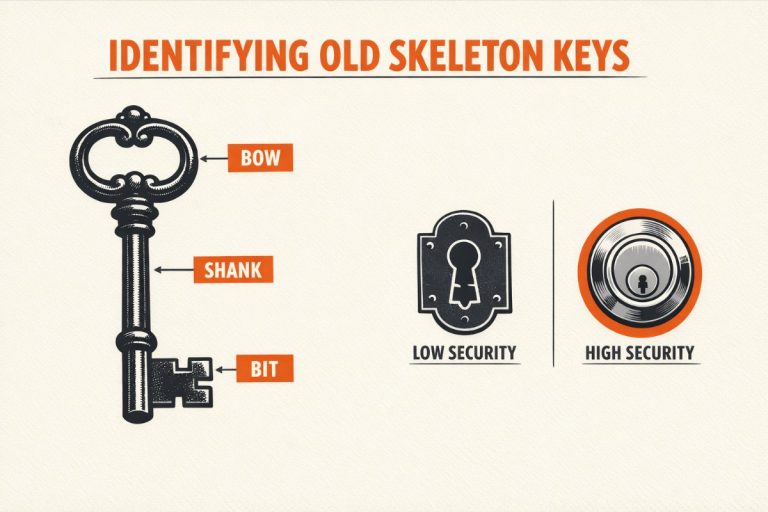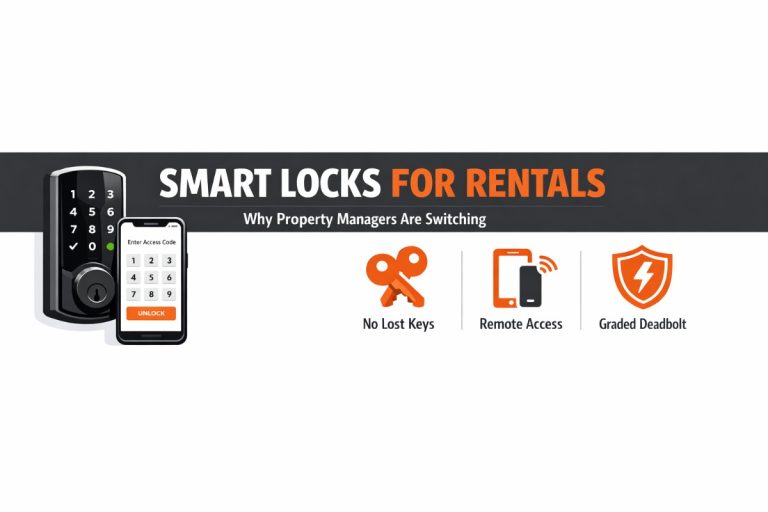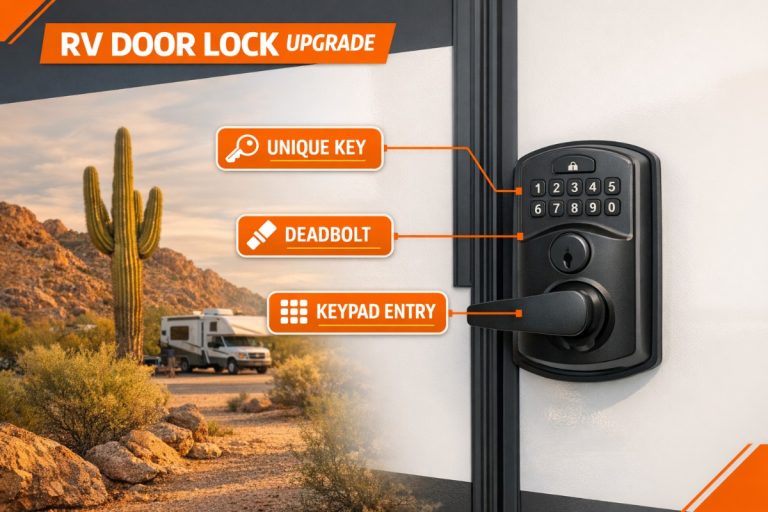
Electronic keyless entry system smart lock on residential door in Tempe AZ — CallOrange Locksmith

Go Keyless: Why Your Next Home Lock Should Be an Electronic Keyless Entry System

Go Keyless: Why Your Next Home Lock Should Be an Electronic Keyless Entry System

Most homeowners don’t think about their front door lock until a key goes missing — and by then, the question isn’t just “where is it?” but “who might have it?” A lost or unaccounted-for key is enough to compromise your entire home’s security, since standard locks offer no way to track duplicates or revoke access. Electronic keyless entry systems close that gap entirely. In this guide, you’ll learn how these systems work, which type fits your home, and why the installation process matters just as much as the product you choose.

What Are Keyless Entry Systems?

A keyless entry system is an electronic lock that authenticates the person — not a physical key. Access is granted through a PIN code, fingerprint scan, smartphone app, or RFID fob, depending on the model. Most residential units are designed to fit a standard deadbolt backset, so they integrate with existing doors without structural modifications.

Unlike a traditional lock-and-key setup, these systems let you create and revoke credentials without calling a residential locksmith for a rekey. Change a code in seconds. Add a temporary PIN for a contractor. Delete access when someone moves out. The control stays with you.


Why Standard Deadbolts Leave Gaps in Your Home Safety

A traditional deadbolt provides solid resistance to brute-force entry — but it has vulnerabilities that go unnoticed until they’re exploited:

  • Untracked duplication: Any hardware store can copy a house key in minutes. You have no way of knowing how many copies exist or who has them.
  • Lock bumping: A specially cut “bump key” can manipulate the standard pin-tumbler mechanism in most residential deadbolts, a technique documented extensively by security researchers at organizations like the American National Standards Institute (ANSI).
  • Thumbturn lock exposure: Interior-facing thumbturn locks can be turned from outside if an intruder breaks a glass panel adjacent to the door — a risk that keyless systems with no thumbturn exposure eliminate.
  • Zero access history: Standard locks offer no log. You have no record of who entered or when.

Electronic keyless entry systems address every one of these points at the hardware level.


4 Types of Keyless Entry Systems for Homes

1. Keypad Deadbolts

The most accessible entry into keyless security. A numeric keypad replaces the traditional cylinder. Set a personal code for your household, a separate temporary code for guests or service workers, and delete it when it’s no longer needed. These work entirely offline — no Wi-Fi, no app, no dependency on a phone.

2. Smart Locks with App Control

These connect via Bluetooth or Wi-Fi and pair with a smartphone app. Lock or unlock your door from anywhere, receive entry alerts, and manage access codes remotely. Popular brands like Schlage, Yale, and August integrate with Google Home and Amazon Alexa for voice control.

3. Biometric Fingerprint Locks

Fingerprint scanners store individual prints and grant access in under a second. There’s no code to share, no fob to lose — access is literally on your hand. High-end models store up to 100 fingerprints, making them practical for households with multiple family members.

4. RFID / Key Fob Proximity Locks

A programmed card or fob held near the reader unlocks the door. Common in commercial applications, these are gaining traction in residential settings, especially as part of a broader high-security lock setup that combines multiple access layers.


Keyless Entry Systems Comparison

Use this overview to identify which system aligns with your household’s needs before consulting your locksmith:

Feature Keypad Deadbolt Smart Lock Biometric Lock RFID / Fob Lock
Physical key required No Optional backup No No
Remote access No Yes (app) No No
Temporary access codes Yes Yes No Yes (fobs)
Access log Basic Full history Some models Yes
Works offline Yes Yes (offline mode) Yes Yes
Thumbturn bypass risk Low Low Low Low
Best for Budget upgrade Tech-savvy owners High security Multi-user homes

Deadbolt Security Grades: What the ANSI Rating Actually Means

ANSI classifies residential locks into three grades. Grade 1 is the highest — engineered to withstand over 250,000 open/close cycles and kick-in forces exceeding 250 lbs. Most quality smart locks are built on a Grade 1 or Grade 2 deadbolt frame, meaning the electronic component rides on a mechanically sound foundation.

That said, a Grade 1 lock installed on a weak door frame still fails. When a professional locksmith from CallOrange installs your system in Tempe, Mesa, or Chandler, the assessment always includes the door frame and strike plate — not just the lock itself.


Pro Tip: The Strike Plate Is the Most Overlooked Part of Any Lock Installation

After installing keyless systems across Tempe and the East Valley, the most consistent finding is this: most builder-grade homes ship with a 2-inch strike plate held by half-inch screws that bite into the door jamb alone. A well-placed kick bypasses even the strongest deadbolt in that scenario.

The fix is simple: replace it with a 6-inch reinforced strike plate using 3-inch screws that anchor into the structural stud behind the jamb. This single upgrade dramatically increases door-kick resistance — no new lock required. When you pair it with a quality keyless deadbolt, you’ve addressed two of the most common residential entry points at once.


Before You Buy: 5 Home Safety Checks for Keyless Lock Installation

  1. Door frame integrity — Inspect for rot, previous damage, or gaps around the latch area before installing any lock.
  2. Door thickness — Most smart locks fit doors 1-3/8″ to 1-3/4″ thick. Confirm your door’s measurement before ordering.
  3. Wi-Fi signal strength at the door — App-controlled locks require a stable signal. A weak connection causes intermittent failures.
  4. Existing lock condition — If your current deadbolt is worn or misaligned, start with a lock change before adding electronics on top of a failing mechanism.
  5. Backup access plan — Every keyless lock should have a secondary entry method: a physical key override slot, a backup code, or a mechanical bypass kept in a secure location.

Do You Still Need a Traditional Deadbolt Alongside a Keyless Lock?

In most cases, no — because keyless entry systems are deadbolts. The locking bolt mechanism is identical; only the access method changes. Some retrofit smart locks slide over your existing deadbolt cylinder, preserving the mechanical bolt while adding electronic control. Others fully replace the cylinder.

If your existing lock is still structurally sound, a lock rekey followed by a smart retrofit may be the most cost-effective path. If the hardware is worn or outdated, a full lock replacement sets a cleaner foundation.


Schedule a Keyless Lock Installation or Home Security Audit in Tempe

Switching to a keyless entry system is one of the most practical home safety upgrades available — but the product is only as good as the installation behind it. Misaligned bolts, incorrect backset sizing, and skipped strike plate reinforcement are all common errors in DIY setups that compromise the security you paid for.

The team at CallOrange Locksmith Tempe has been installing and servicing residential locks across Tempe, Mesa, Chandler, Scottsdale, and Phoenix since 2008. We’ll assess your door, recommend the right system, and complete the installation correctly the first time.

Call (480) 847-2635 or visit our contact page to schedule a consultation. You can also find us on Google Maps for directions to our Tempe location.

Frequently Asked Questions

Are keyless entry systems safe against hacking or code theft?
Quality keyless entry systems use AES-128 or AES-256 encryption for wireless communication, making remote interception impractical for standard residential attacks. Rolling code technology changes the authentication signal with every use, so a captured signal can’t be replayed. The greater vulnerability is usually a weak or reused PIN code — not the hardware itself. A residential locksmith can advise on best practices for code management and layered security.
What happens if the battery dies on a keyless lock?
Nearly all residential keyless locks include a low-battery warning — typically an audible alert or flashing indicator — well before power fails completely. Most models also have a physical key override cylinder as a backup. A select few higher-end units include an emergency terminal on the exterior that accepts a 9V battery for one more code entry. Replacing the batteries once or twice a year prevents the situation entirely.
Can a keyless entry lock be installed on any residential door?
Most standard keyless locks fit doors between 1-3/8″ and 1-3/4″ thick with a standard 2-1/8″ bore hole — covering the vast majority of residential exterior doors. Doors outside those dimensions may require adapters or a different product line. A professional locksmith will verify these specs during a site visit to avoid compatibility issues at installation.
Do keyless entry systems require Wi-Fi to function?
No — only smart locks with app control require a Wi-Fi or Bluetooth connection. Keypad deadbolts, biometric locks, and RFID systems operate entirely offline with no network dependency. Smart locks also function locally when the internet is down; you simply lose the remote-access feature until connectivity is restored.
Is it better to install a keyless lock myself or hire a professional locksmith?
Simple keypad deadbolts are designed for DIY installation on a properly prepared door. However, professional installation ensures correct bolt alignment, door frame integrity assessment, and proper programming. For biometric, RFID, or smart locks with wiring components, professional installation is the recommended path. See our lock change service for what a professional installation includes.
Can I keep my existing deadbolt and just add a keyless entry system?
Yes — retrofit smart locks attach to the interior side of your existing deadbolt and motorize the thumbturn, so your exterior hardware stays the same while you gain electronic control. If the existing deadbolt is worn or low-grade, a full lock replacement first is recommended for the strongest foundation.
Have a question not listed here? Call (480) 847-2635 or visit our contact page — our team in Tempe is available to help.
Lock bumping protection guide — CallOrange Locksmith Tempe

Stop Lock Bumping: How to Upgrade Your Home’s Vulnerable Entryways

Stop Lock Bumping: How to Upgrade Your Home’s Vulnerable Entryways for Real Lock Bumping Protection

Lock bumping is a low-tech break-in method that opens standard pin tumbler deadbolts in seconds using only a modified key and a blunt object — no drilling, no forced entry, and no visible damage left behind.
Most homeowners assume a deadbolt means safety. The reality: a technique called lock bumping renders the majority of standard residential locks open in a single strike, and most people never know it happened until valuables are already gone. The fix isn’t complicated — but it requires knowing which hardware actually holds up and when to bring in a professional locksmith for a full residential security review. In this guide, you’ll find exactly what to look for, which upgrades deliver genuine protection, and how to build real lock bumping protection at every entryway in your home.

What Is Lock Bumping and Why Does It Threaten Home Safety?

Lock bumping exploits a fundamental flaw in the pin tumbler mechanism — the internal design found in virtually every standard residential deadbolt on the market. A bump key is a specially cut key modified so each cut reaches the maximum depth allowed by the keyway. The key is inserted into the target lock, and when struck sharply with a mallet or blunt object, the kinetic energy causes all driver pins to jump simultaneously. For a fraction of a second, the pins clear the shear line and the cylinder turns freely.

The entire process takes under thirty seconds. It leaves no scratches on the keyway, no damaged frame, and no evidence of forced entry. On insurance claims and police reports, it often registers as an unexplained entry. According to ALOA (Associated Locksmiths of America), bump keys can be manufactured from standard key blanks and have been extensively documented in security research since the early 2000s.

Is Your Current Deadbolt at Risk?

If your deadbolt carries a standard ANSI/BHMA Grade 2 or Grade 3 rating and uses a conventional pin tumbler cylinder, it’s likely vulnerable. This covers the majority of builder-grade locks installed in rental properties and tract homes across Tempe, Mesa, Chandler, Scottsdale, and the broader East Valley.

Signs your current hardware may not be delivering adequate home safety:

  • The lock was installed by the original builder or left behind by a previous occupant
  • No “bump-resistant” or “high-security” designation appears on the packaging
  • The cylinder uses a standard 5- or 6-pin configuration without secondary anti-bump features

If you’re unsure what’s installed at your entries, a residential security assessment from our team can identify every vulnerability before it becomes an entry point for an intruder.

Lock Bumping Protection: The Deadbolts and Hardware That Actually Hold Up

Bump-Resistant vs. Bump-Proof — Know the Difference

There’s a meaningful distinction between these two terms. Bump-resistant locks use modified pin chambers or secondary locking elements that raise the difficulty of a successful bump attempt — but they are not impervious with enough persistence. Bump-proof locks eliminate the pin tumbler mechanism entirely:

  • Disc detainer locks — use rotating discs instead of driver pins. No bump key geometry can exploit this mechanism.
  • Sidebar locks (e.g., Medeco Maxum, Mul-T-Lock MT5+) — require both a rotational and a lateral movement to turn the cylinder, making them mechanically resistant to both bumping and picking.
  • Dimple locks — use a different keyway orientation that standard bump keys cannot target.

For whole-home deadbolt security, look for locks carrying an ANSI/BHMA Grade 1 rating with documented anti-bump, anti-pick, and anti-drill certifications. Our licensed technicians handle deadbolt upgrades and full lock changes for residential clients throughout Tempe and the East Valley.

The Thumbturn Lock: How It Fits Into Your Defense

A thumbturn lock — the interior rotating knob on a single-cylinder deadbolt — doesn’t directly resist a bump entry from outside. However, its configuration matters in composite attack scenarios. Doors with decorative glass panels are especially vulnerable: a bump entry is followed by a hand reaching through shattered glass to turn the interior thumbturn. For those specific openings, a double-cylinder deadbolt requiring a key on both sides is worth serious consideration. For standard solid wood or fiberglass doors, a quality single-cylinder thumbturn paired with a certified Grade 1 deadbolt delivers solid protection.

🔐 Pro Tip — From the Field

In servicing locks throughout Tempe and the East Valley, the single most overlooked upgrade is the strike plate. A standard builder-grade strike plate uses 3/4-inch screws driven into soft wood framing — it offers almost no resistance to a coordinated kick. Replacing it with a reinforced steel strike plate secured with 3-inch screws into the door stud — at the same time as the deadbolt upgrade — closes both the bump vulnerability and the kick-in vulnerability in one visit. Address them together or you’ve only solved half the problem.

Home Safety Goes Beyond the Cylinder

Upgrading the cylinder is step one. A layered home safety strategy closes the remaining gaps that a new deadbolt alone cannot address:

  • Door reinforcement kits — door jamb armor and hinge reinforcers protect against kick-in attacks that can defeat even a bump-proof lock if the frame gives way first
  • Smart locks with tamper alerts — models with app-based tamper notifications add a detection layer, even when the underlying cylinder remains a pin tumbler design
  • Entry-point cameras — visible surveillance deters opportunistic bump attempts before they start
  • Rekeying after every occupancy change — a professional lock rekey ensures no copied keys from former tenants or contractors remain in circulation

For commercial and multi-tenant properties, the same principles scale up. Commercial locksmith services address high-security cylinder replacements for mortise lock bodies, cylindrical commercial hardware, and access control integration at high-traffic entries.

Get a Professional Locksmith Security Audit — Don’t Wait for a Break-In

Real lock bumping protection isn’t a product you pick up from a hardware store shelf — it’s the right hardware, installed correctly, at every vulnerable entry point in your home. A licensed locksmith can walk every exterior door, assess the cylinder grade, inspect strike plate depth, flag glass-panel risks, and recommend targeted upgrades without replacing hardware that’s already performing at the level your home needs.

CallOrange Locksmith Tempe provides residential security assessments and deadbolt upgrades throughout Tempe, Mesa, Chandler, Scottsdale, Phoenix, and Gilbert. Find us on Google Maps, or reach our team directly at (480) 847-2635 to schedule a home security review.

Don’t let an intruder reveal the gap in your deadbolt security. Contact CallOrange Locksmith Tempe today and have every entry point assessed by a licensed professional who knows the East Valley.

Lock Type Comparison: Bump Resistance & Security Grade
Lock Type Mechanism Bump Resistant? ANSI Grade Best Application
Standard Pin Tumbler Deadbolt 5–6 pin tumbler ✗ No Grade 2–3 Builder-grade residential
Kwikset SmartKey Re-keyable side-locking bar ~ Partial Grade 2 Budget residential upgrade
Schlage B60N Deadbolt Pin tumbler + alarm alert ~ Partial Grade 1 Mid-range residential
Smart Lock (e.g., Schlage Encode) Pin tumbler + electronics ~ Partial Grade 1 Modern smart home
Double-Cylinder Deadbolt Pin tumbler — keyed both sides ~ Partial Grade 1–2 Doors with glass panels
Medeco Maxum Deadbolt Sidebar + rotating pins ✓ Yes Grade 1 High-security residential
Mul-T-Lock MT5+ Telescopic pin tumbler ✓ Yes Grade 1 High-security residential / commercial
Abloy Protec2 Disc detainer (no pins) ✓ Yes Grade 1 Premium residential / commercial
High-Security Mortise Lock Mortise cylinder + deadbolt ✓ Yes* Grade 1 Commercial & multi-unit residential

* Bump resistance depends on the cylinder installed. ANSI/BHMA Grade 1 = highest residential/commercial standard.

Frequently Asked Questions — Lock Bumping Protection

Common questions from homeowners in Tempe, Mesa, Chandler, and the East Valley.

?

What exactly is lock bumping and how does it work?

Lock bumping is a non-destructive entry technique that exploits the pin tumbler mechanism inside most standard deadbolts. An attacker inserts a specially cut bump key into the keyway and strikes it sharply. The impact causes all the driver pins to jump simultaneously, momentarily clearing the shear line and allowing the cylinder to turn. The process leaves no visible damage, making it difficult to detect on a police report or insurance claim.

?

How do I know if my current deadbolt is vulnerable to bumping?

If your deadbolt is a standard pin tumbler model rated ANSI/BHMA Grade 2 or Grade 3 — which covers the vast majority of builder-grade hardware — it’s likely vulnerable. Look at the lock packaging or the lock body itself. If you don’t see designations like “bump-resistant,” “high-security,” or an ANSI Grade 1 rating with additional certifications, assume the lock can be bumped. A licensed locksmith can assess every entry in your home and give you a clear picture of where you stand.

?

What are the best locks for lock bumping protection?

Locks that eliminate the pin tumbler mechanism entirely provide the strongest protection. Disc detainer locks (like the Abloy Protec2) and sidebar locks (like the Medeco Maxum or Mul-T-Lock MT5+) are considered bump-proof by design. For homeowners looking for a strong upgrade without going to the highest tier, ANSI Grade 1 deadbolts with documented anti-bump certifications offer a meaningful improvement over standard builder hardware. Have a professional locksmith assess your specific doors before selecting a model.

?

What is a thumbturn lock and does it affect bump resistance?

A thumbturn lock is the interior rotating knob on a single-cylinder deadbolt — the part you turn from the inside without a key. It doesn’t directly affect how resistant the lock is to bumping from outside. However, its design becomes relevant for doors with glass panels. On those doors, a break-in may combine a bump entry with a reach-through to turn the interior thumbturn. For glass-panel doors, a double-cylinder deadbolt — requiring a key on both sides — removes that secondary vulnerability entirely.

?

Can a smart lock be bumped the same way?

It depends on the model. Many smart locks still use a traditional pin tumbler cylinder as a physical backup, which means they remain vulnerable to bumping despite the electronic access component. Smart locks that rely exclusively on electronic or motorized mechanisms — with no physical keyway at all — are immune to bump attacks. If you use a smart lock with a physical key backup, check the cylinder grade and verify it carries anti-bump certification.

?

Do I need a professional locksmith to upgrade my locks, or can I do it myself?

High-security locks — particularly sidebar and disc detainer models — require precise installation to function correctly. An improperly installed bump-proof lock can fail to engage fully, defeating its purpose entirely. Beyond the cylinder itself, a professional locksmith inspects the strike plate, checks door alignment, and assesses the entire entry. For standard Grade 1 deadbolt upgrades, a competent DIYer can manage installation, but a security audit from a licensed locksmith identifies vulnerabilities a product swap alone won’t solve.

Sticky door lock fix

How to Fix a Sticky Door Lock in Minutes Without Calling a Pro

You walk up to your front door after a long day, slide your key in, and… nothing. The key won’t turn, the deadbolt feels gritty, and the thumbturn fights back like it’s personal. A sticky door lock is one of the most common household frustrations homeowners in Tempe and across the East Valley deal with every single year. The good news? Most cases of a stiff or stuck lock can be solved in under ten minutes with tools you already own — no service call required. Keep reading and I’ll walk you through exactly how I diagnose and fix sticky locks in the field, what products to use (and which ones to avoid), and when the problem points to something bigger.
Why Door Locks Get Sticky in the First Place

Before we jump into the sticky door lock fix, it helps to understand what’s happening inside the cylinder. A standard pin tumbler lock has five or six tiny spring-loaded pins that rise to a precise height when the correct key is inserted. Over time, three things go wrong:

  1. Dust, lint, and grit build up around the pins
  2. Old lubricant turns into sticky residue
  3. The key itself wears down and stops aligning the pins cleanly

Add Arizona’s dry heat and fine desert dust to the equation, and even a brand-new deadbolt can start dragging within a year or two. The result is a lock that catches halfway, requires jiggling, or refuses to turn at all. If your lock has reached the point where no amount of cleaning helps, our residential locksmith team can diagnose it on-site.

The 3-Step Sticky Door Lock Fix Anyone Can Do

Here is the exact sequence I use when a customer calls me about a stiff lock. Try this before anything else.

Step 1 — Clean the Keyway

Grab a can of compressed air (the same kind you use for keyboards) and give the keyway three short bursts. You’ll be surprised how much pocket lint, dust, and old grease comes flying out. If you don’t have compressed air, a thin plastic coffee stirrer works to scrape debris loose.

Step 2 — Apply the Right Lubricant

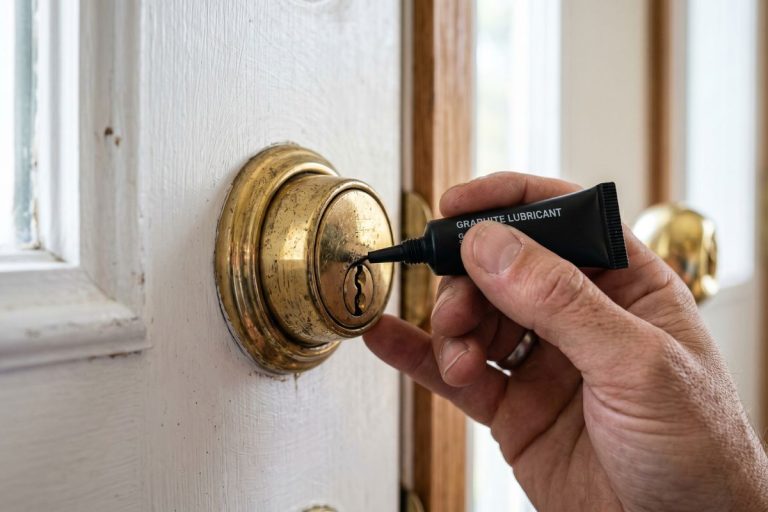
This is where most homeowners go wrong. Do not use WD-40, 3-in-1 oil, or any wet spray lubricant on a pin tumbler lock. Oil-based products attract dust and turn into sludge inside the cylinder within weeks, making the problem worse. Use one of these instead:

  • Powdered graphite (best for older locks)
  • Dry Teflon (PTFE) spray (best for modern deadbolts and smart locks)
  • Silicone spray (good for the latch and strike plate)

Insert the applicator straw into the keyway and give it one short squeeze. Less is more.

Step 3 — Cycle the Key

Insert your key, turn it gently left and right ten to fifteen times. This works the lubricant down into the pins. Wipe any excess off the key with a clean cloth so it doesn’t stain your door.

That’s it. In most cases, a sticky lock turns smooth again at this point. If yours doesn’t, it may be time for a lock change rather than another round of lubricant.

Sticky Lock Lubricant Comparison

Lubricant Type Recommended Use Lasts Risk to Lock
Powdered Graphite Older pin tumbler locks, traditional deadbolts 12–18 months None
Dry Teflon (PTFE) Spray Modern deadbolts, smart locks, electronic locks 8–12 months None
Silicone Spray Latch, hinges, strike plate (NOT keyway) 6 months Low
WD-40 ❌ Not recommended Days High — gums up pins
3-in-1 Household Oil ❌ Not recommended Weeks High — attracts dust

When the Problem Isn’t the Lock

Sometimes the lock cylinder is fine — the issue is the door itself. Arizona homes shift with temperature swings, and a door that’s gone slightly out of square will bind against the strike plate. Signs that point to a misaligned door rather than a sticky cylinder:

  • The deadbolt extends fine when the door is open but binds when closed
  • You see scrape marks on the strike plate
  • The thumbturn moves freely from the inside but the key fights from outside

In these cases, loosening the strike plate screws and shifting it 1/16 of an inch in the direction the bolt needs to travel usually solves it. Homeowners across Mesa, Chandler, Scottsdale, and Phoenix deal with this every season as the desert heat expands and contracts wood frames.

Pro Tip From the Field

After 10+ years of pulling apart locks across Tempe, Mesa, and Chandler, I can tell you the single biggest cause of premature lock failure isn’t wear — it’s using a copy of a copy of a copy of the original key. Each duplication loses a tiny amount of precision. By the third generation, the key is cutting the pins at slightly wrong heights and grinding them down every time you use it. If your lock got sticky after you started using a duplicate, throw the duplicate away and cut a fresh one from the original or have a lock rekey done so you start fresh.

When to Stop and Call a Locksmith

The DIY fix above handles roughly 80% of sticky lock cases. Stop and bring in a professional if:

  • The key broke off inside the cylinder
  • The lock turns but the deadbolt won’t extend or retract
  • You hear grinding metal sounds
  • The cylinder spins freely without engaging the bolt
  • The lock is on a high-security or smart deadbolt under warranty
  • You’re locked out and can’t access the lock at all — see our home lockout service

Forcing a damaged lock can crack the cylinder housing, snap pins, or shear the cam — turning a $0 fix into a full lock replacement. Browse all of our locksmith services to see what we cover across the Tempe metro.

Frequently Asked Questions

Why is my door lock suddenly hard to turn?

The most common cause is dust and old lubricant buildup inside the cylinder. Arizona’s dry climate pulls fine particles into the keyway, where they mix with any leftover oil and form a sticky residue around the pins. A quick cleaning with compressed air and a dry graphite or Teflon lubricant usually restores smooth operation.

Can I use WD-40 to fix a sticky door lock?

No. WD-40 is a petroleum-based solvent that attracts dust and turns into sludge inside a pin tumbler lock within days. It will give you temporary relief but make the problem significantly worse over the following weeks. Always use powdered graphite or a dry Teflon (PTFE) spray on lock cylinders.

What’s the difference between a sticky lock and a misaligned door?

If the deadbolt extends and retracts smoothly when the door is open but binds when the door is closed, the issue is door alignment, not the lock. You’ll often see scrape marks on the strike plate. Loosening the strike plate screws and shifting it slightly usually corrects it.

How often should I lubricate my deadbolt?

Once a year is usually enough for most homes. If you live near a construction zone, on a dirt road, or in a high-traffic household, every six months is a better schedule. Use a dry lubricant only — never wet oil.

When should I replace a sticky lock instead of fixing it?

Replace the lock if the cylinder spins without engaging the bolt, the key has broken inside, you hear grinding metal sounds, or the lock has been forced repeatedly over months. At that point the internal components are likely worn beyond repair. A professional lock change will install a new deadbolt and rekey it to match your existing keys.

Does fixing a sticky lock improve my home security?

Yes. A lock that’s been fought with for months develops worn pins and weaker springs, which reduces pick resistance and can leave the deadbolt sitting in an incomplete locked position. Restoring smooth operation — or upgrading to a higher-grade deadbolt — directly improves your home safety.

Keep Your Home Security Strong

A smooth-turning lock isn’t just about convenience — it’s a core piece of your deadbolt security and overall home safety. A lock that’s been forced or fought with for months has worn pins, weakened springs, and reduced pick resistance. If your thumbturn lock has been giving you trouble for more than a few weeks, or you’ve never had a security audit on your front and back doors, it’s worth having a professional locksmith take a look.

Contact CallOrange Locksmith Tempe at (480) 847-2635 to schedule a home security assessment or a same-visit deadbolt installation. Get help now.

Commercial door hardware

Choosing the Right Commercial Door Hardware for High-Traffic Offices

Office managers across Tempe and Mesa face a recurring headache: door hardware that fails months after installation. Handles loosen, latches misalign, and locks jam during peak business hours, leaving employees locked out and clients waiting in lobbies. The solution is straightforward — match the right grade of commercial door hardware to your actual traffic volume and security needs from day one. Keep reading to learn how to specify the correct hardware for your office, avoid the most common mistakes, and protect your building without overpaying for features you’ll never use.
Why Standard Hardware Fails in Commercial Settings

Residential-grade locks and handles are engineered for a household — perhaps 20 to 30 cycles per day. A busy office door, by contrast, can see 1,000 or more cycles in a single workday. That mismatch is the single biggest reason commercial properties end up calling a professional locksmith for emergency repairs within the first year of occupancy.

[IMAGE: Insert Image Described Here]

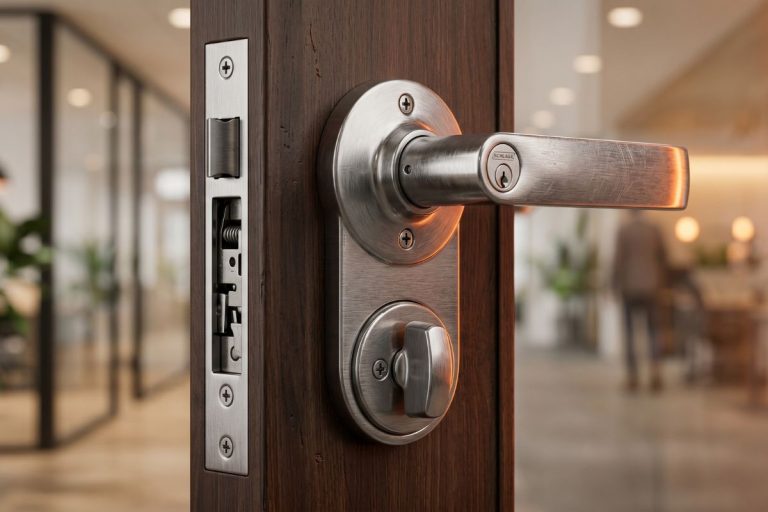
Image prompt: A photorealistic close-up of a polished stainless steel commercial lever handle installed on a glass office door, with a blurred background showing employees walking through a modern Tempe office lobby. Natural daylight from large windows highlights the brushed metal finish and the heavy-duty mortise lock body visible at the door edge.

The American National Standards Institute (ANSI) and the Builders Hardware Manufacturers Association (BHMA) classify commercial hardware into three grades. Understanding these grades is the foundation of every smart purchasing decision.

ANSI/BHMA Grades Explained

The grading system measures cycles, force resistance, and finish durability. Most office buildings only need to remember one rule: pick the grade that matches your door’s daily volume.

Hardware Grade Cycle Rating Best For Lifespan in Office Use
Grade 1 (Heavy Duty) 800,000+ cycles Main entrances, conference rooms, server rooms 10–15 years
Grade 2 (Medium Duty) 400,000 cycles Interior offices, break rooms, supply closets 5–8 years
Grade 3 (Light Duty) 200,000 cycles Residential only — not recommended for offices 2–3 years in commercial use
Mortise Lock (Grade 1) 1,000,000+ cycles High-security entries, executive suites 15+ years


A Grade 3 lock on a main lobby door will fail. Period. We’ve replaced hundreds of them across Tempe office buildings where contractors cut corners during the build-out.

The Four Hardware Components Every Office Needs

A complete commercial door system is more than just a lock. Each component plays a role in security, code compliance, and daily usability.

1. The Lockset

For high-traffic openings, a mortise lockset is the gold standard. The lock body sits inside a pocket cut into the door edge, distributing force across a large internal mechanism rather than relying on a small bored hole. Cylindrical locksets are acceptable for medium-traffic interior doors but are not built for main entrances.

2. The Deadbolt

Strong deadbolt security is non-negotiable for any door that locks the building down at end of day. Look for a 1-inch throw bolt with a hardened steel insert and a reinforced strike plate secured with 3-inch screws into the door frame stud. A standard half-inch latch is not a deadbolt — it’s a courtesy lock that any motivated intruder can defeat in seconds.

3. The Handle Trim

Lever handles are required by the Americans with Disabilities Act (ADA) on most commercial doors. Avoid round knobs unless you have a specific exemption. Stainless steel and solid brass levers outlast plated zinc-alloy handles by a factor of three or more.

4. The Closer and Exit Device

Doors with panic bars and automatic closers are governed by local fire codes. Grade 1 closers maintain consistent door speed and latching pressure across temperature swings — critical in Arizona, where summer heat warps cheaper hardware fast.

Thumbturn vs. Double-Cylinder: Which Is Safer?

A common debate in commercial security is whether to install a thumbturn lock on the interior or a double-cylinder deadbolt requiring a key on both sides. The answer depends on the door.

A thumbturn allows anyone inside to exit immediately without a key — a major advantage during fire emergencies and a requirement under most building codes for primary egress doors. Double-cylinder locks add a layer of security on glass doors where an intruder could break a pane and reach the interior knob, but they create a serious life-safety risk and are prohibited on egress paths in many jurisdictions.

For most office front doors in the East Valley, a Grade 1 deadbolt with a thumbturn interior is both code-compliant and secure when paired with a reinforced strike plate.

Pro Tip from the Field

After 15+ years of commercial installs across Mesa, Chandler, and Scottsdale, here’s the single upgrade that saves clients the most money long-term: replace the factory strike plate. Almost every commercial door ships with a strike plate held by half-inch screws into the door frame casing — not the structural stud. Swap those for 3-inch screws that bite into the framing lumber behind the casing. This one $5 fix increases kick-in resistance by roughly 400% and takes 10 minutes per door. Most break-ins through commercial doors fail at the frame, not the lock itself.

Common Specification Mistakes to Avoid

When reviewing your office’s hardware schedule, watch for these red flags:

  • Mixing grades on a single door. A Grade 1 lockset paired with a Grade 3 closer will still fail at the closer.
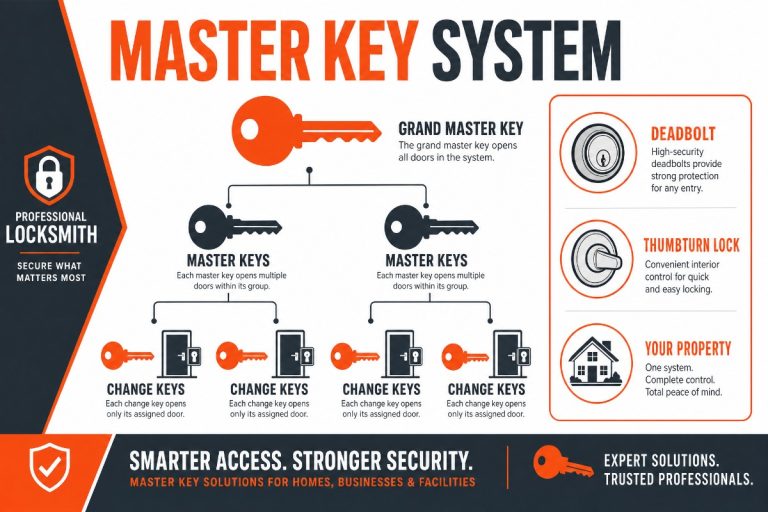
  • Ignoring keying alignment. Master key systems must be planned before purchase, not retrofitted afterward.
  • Skipping the strike plate upgrade. As noted above — this is where most security plans collapse.
  • Choosing finish over function. Polished brass looks elegant but pits and tarnishes within months in Arizona’s dry, dusty climate. Satin chrome and oil-rubbed bronze hold up far better.

Home safety principles apply at the office too: layered security beats a single expensive lock every time. A Grade 1 lockset, a reinforced strike, a working closer, and a documented key control policy together cost less than one emergency board-up after a break-in.

Frequently Asked Questions

What grade of commercial door hardware should I install on my office’s main entrance?

Grade 1 hardware is the standard for any main entrance with high foot traffic. It’s tested for over 800,000 cycles and built with reinforced internal components that handle the daily wear of a busy commercial property. Grade 2 is acceptable for interior offices, but Grade 3 should never be used on a primary commercial door.

Is a thumbturn lock secure enough for a commercial office door?

A thumbturn lock is secure and code-compliant for most office front doors when paired with a Grade 1 deadbolt and a reinforced strike plate. It also satisfies fire egress requirements by allowing immediate exit without a key. The exception is glass doors, where a double-cylinder option may be considered if local code permits.

How long does professionally installed commercial door hardware last?

Grade 1 commercial hardware typically lasts 10 to 15 years in heavy office use, and mortise locks can exceed 15 years with proper maintenance. Lower-grade hardware installed in commercial settings often fails within 2 to 3 years, which is why grade selection is the most important specification decision.

Can I upgrade my existing office hardware without replacing the doors?

In most cases, yes. A professional locksmith can replace locksets, deadbolts, strike plates, and closers on existing doors without removing the door itself. Mortise lock retrofits are more involved and may require door modification, but standard cylindrical and deadbolt upgrades are straightforward same-day work.

What’s the most cost-effective security upgrade for a commercial door?

Replacing the factory strike plate with a reinforced strike using 3-inch screws into the framing stud. This single upgrade dramatically increases kick-in resistance and pairs with any existing Grade 1 or Grade 2 deadbolt. It’s the highest-impact, lowest-investment improvement available for home safety and commercial security alike.

Does CallOrange Locksmith Tempe service commercial properties outside of Tempe?

Yes. We provide commercial door hardware installation and security audits across Tempe, Mesa, Chandler, Scottsdale, Phoenix, and Gilbert. Call (480) 847-2635 to schedule a walkthrough of your property.

Getting It Right the First Time

Specifying commercial door hardware is a one-time decision with a 10-year impact. The wrong choice means recurring service calls, frustrated tenants, and avoidable security gaps. The right choice means doors that simply work — every cycle, every day, for the life of the building.

If you’re planning a new office build-out, a tenant improvement, or a security upgrade across an existing portfolio, schedule a walkthrough with a commercial locksmith who works on your specific door types. Call CallOrange Locksmith Tempe at (480) 847-2635 for a no-obligation security audit of your office hardware. We’ll evaluate every opening, flag the weak points, and give you a written specification you can hand directly to your contractor or facilities team.

Contact us today to schedule your commercial security audit.

High security deadbolts

Standard vs. High-Security Deadbolts: Is the Extra Cost Worth It?

You came home from a weekend trip, slid your key into the front door, and noticed something that made your stomach drop — fresh scratches around the lock cylinder. Maybe nothing happened this time, but the message is clear: your standard deadbolt is the only thing standing between your family and a determined intruder, and most standard deadbolts can be defeated in under 60 seconds by someone who knows what they’re doing.

The solution is straightforward. High security deadbolts are engineered to resist the exact attack methods burglars use most often: picking, bumping, drilling, and kick-ins. They cost more upfront, but they’re the difference between a locked door and a secured door.

Keep reading to learn exactly what separates a high-security deadbolt from the hardware store special, what you should expect to pay, and whether the extra investment actually makes sense for your home. If you’d rather skip ahead and talk to a technician, CallOrange Locksmith Tempe handles residential locksmith installations across the East Valley.

What Makes a Deadbolt “High-Security”?

A standard deadbolt from a big-box store is built to meet a minimum ANSI Grade 2 or Grade 3 rating. It keeps honest people honest. A high-security deadbolt is a different product category entirely — built to ANSI Grade 1 commercial standards with hardened steel internals, anti-drill pins, anti-pick sidebars, and patented keyways that prevent unauthorized key duplication.

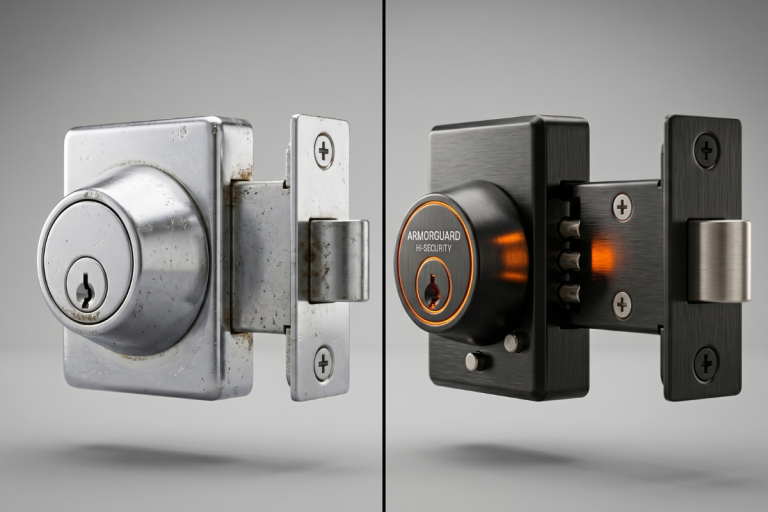
[IMAGE: Insert Image Described Here] Photorealistic close-up side-by-side comparison of two deadbolt cylinders cut in half to show their internal mechanisms. The left cylinder shows a basic pin-tumbler standard deadbolt with brass pins, while the right cylinder shows a high-security deadbolt with hardened steel anti-drill pins, a sidebar mechanism, and a reinforced strike plate, lit with clean studio lighting on a neutral gray background.

The brands professional locksmiths actually install in their own homes — Medeco, Mul-T-Lock, Schlage Primus, and Abloy — share four core features that cheap deadbolts don’t have:

1. Hardened Steel Inserts

Anti-drill pins made of hardened steel or carbide shatter drill bits before the bit can reach the cylinder pins.

2. Patented Keyways

You can’t walk into a hardware store and copy the key. Duplication requires a registered dealer and proof of ownership.

3. Pick and Bump Resistance

Lock bumping — a technique where a specially cut key is tapped to force pins into position — defeats most standard deadbolts. High-security cylinders use sidebars and rotating pins that don’t respond to bumping at all.

4. Reinforced Strike Plates

The lock is only as strong as the frame it’s attached to. High-security kits include heavy-duty strike plates with 3-inch screws that anchor into the wall stud, not just the doorjamb. If your existing hardware is older or you’re not sure it’s anchored properly, a lock change service is the cleanest way to bring the whole door up to standard.

Standard vs. High-Security Deadbolts: Side-by-Side Comparison

Feature Standard Deadbolt High-Security Deadbolt
ANSI Grade Grade 2 or 3 Grade 1 (Commercial)
Pick Resistance Low — 30 seconds to 2 minutes High — 10+ minutes or unpickable
Bump Resistance Vulnerable Fully resistant
Drill Resistance Minimal Hardened steel + carbide pins
Key Duplication Any hardware store Patented — authorized dealer only
Kick-In Resistance Depends on strike plate Reinforced 3-inch anchor screws
Average Lifespan 5–7 years 15–25 years
Installation Cost (per door) $45 – $120 $180 – $450
Warranty 1–5 years limited Lifetime mechanical (most brands)

The Real Cost Difference — And What You Get For It

A standard Kwikset or basic Schlage deadbolt runs $25 to $60 at a home improvement store, plus $50 to $100 for professional installation. Total: around $75 to $160 per door.

A high-security deadbolt from Medeco or Mul-T-Lock typically costs $150 to $280 for the hardware, plus $80 to $180 for professional installation by a licensed locksmith. Total: around $230 to $460 per door.

The gap is real — roughly $150 to $300 more per door. But spread that over a 20-year service life and the math changes. You’re paying about $15 to $25 extra per year for hardware that actually resists the attack methods used in real-world break-ins.

If you’re not ready to replace the full cylinder, a professional lock rekey is a lower-cost alternative that invalidates any existing keys — useful after moving in or losing a copy, though it won’t increase the lock’s security grade.

The Thumbturn Lock Consideration

One upgrade worth discussing with your locksmith is the interior thumbturn lock style. Standard interior thumbturns can be defeated through a technique called “lock flipping” if there’s a nearby window or mail slot — a burglar uses a tool to reach in and rotate the thumbturn. High-security deadbolts offer double-cylinder options (key on both sides) or captive thumbturn designs that prevent this exact attack.

Commercial properties face similar challenges on a larger scale, which is why business owners typically opt for high security locks designed for commercial use with restricted keyways and master key systems.

Pro Tip From 10+ Years in the Field

Here’s what most homeowners get wrong: they spend $400 on a premium deadbolt and screw it into a factory doorframe using the original 3/4-inch screws that came with the builder’s hardware. I’ve responded to dozens of break-in calls where the lock held perfectly — but the frame split in half on the first kick.

If you’re upgrading to a high security deadbolt, insist on three things during installation:

  1. Three-inch screws through the strike plate into the wall stud. Not the doorjamb. The stud.
  2. A reinforced box strike, not a flat plate. The box protects the bolt on all four sides.
  3. Solid-core or metal door. A hollow-core door defeats any lock you put on it.

Any professional locksmith worth hiring will do all three by default. If they don’t bring up the strike plate upgrade, find a different locksmith.

Is the Extra Cost Worth It?

For deadbolt security on a primary residence, the answer is almost always yes — especially if you meet any of these conditions: you live in a ground-floor home, your door is visible from the street, you’ve recently moved in and don’t know who has copies of the old keys, or you have valuables, firearms, or family members you’re responsible for protecting.

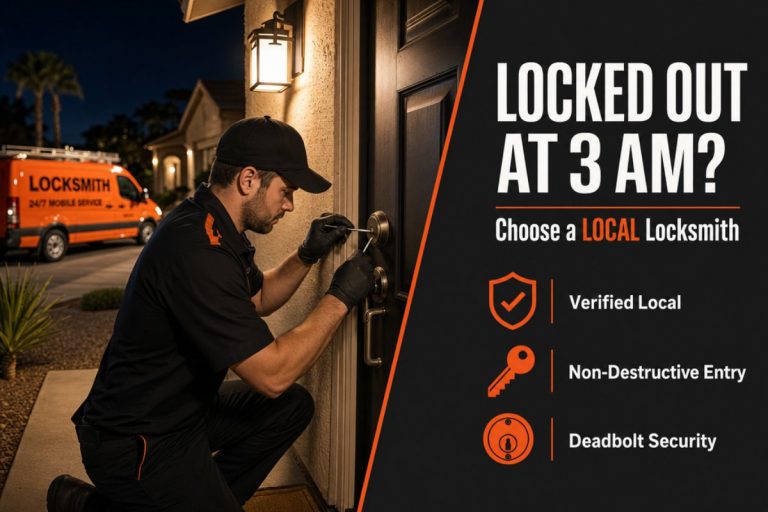
If you’re ever locked out mid-upgrade or need emergency access before the new hardware arrives, residential home lockout service gets you back inside without damaging the door. For a rental property or a secondary interior door, a mid-grade Schlage Grade 1 residential deadbolt may be enough. Talk to a licensed locksmith who can evaluate your specific situation rather than guessing.

Are high security deadbolts really pick-proof?

No lock is 100% pick-proof, but high-security deadbolts from brands like Medeco and Mul-T-Lock are rated to resist picking for 10+ minutes — far beyond the time most burglars will spend at a front door. Their sidebars, rotating pins, and tight tolerances also make them fully resistant to lock bumping, which defeats most standard deadbolts in seconds.

Can I install a high-security deadbolt myself?

Technically yes, but we don’t recommend it. High-security deadbolts require precise alignment, reinforced strike plate installation with 3-inch screws into the wall stud, and sometimes door frame reinforcement. A professional residential locksmith ensures the hardware performs to its rated security level — a poorly installed premium lock is no better than a cheap one.

How much does a high-security deadbolt cost installed?

Expect to pay between $230 and $460 per door installed, which includes the hardware ($150–$280) and professional installation ($80–$180). Final pricing depends on the brand you choose, door condition, and whether frame reinforcement is needed. Contact CallOrange Locksmith Tempe or call (480) 847-2635 for a specific quote on your home.

What’s the difference between a thumbturn lock and a double-cylinder deadbolt?

A thumbturn lock has a key cylinder on the exterior and a rotating knob on the interior. A double-cylinder deadbolt requires a key on both sides — more secure if there’s a window near the door, but a safety concern during emergencies since you need the key to exit. Your locksmith can help you choose based on your door’s location and local fire code requirements.

Will a high-security deadbolt work with my existing door?

Most high-security deadbolts fit standard 2-1/8 inch door prep, which is the size used on the majority of American residential doors built since the 1970s. If your door is solid-core wood, fiberglass, or metal, you’re a good candidate. Hollow-core interior doors should not receive high-security hardware — the door itself becomes the weak point. A lock change specialist can evaluate your door during a site visit.

How long does installation take?

A single high-security deadbolt installation typically takes 45 minutes to 90 minutes, including strike plate reinforcement and function testing. If you’re upgrading multiple doors or need frame repair, plan for 2 to 4 hours on-site. Most CallOrange locksmith jobs are completed in a single visit.

Ready to Upgrade Your Home Safety?

Every home has different entry points, frame conditions, and security needs. A 15-minute in-person security audit from a licensed professional will tell you exactly which doors need high-security hardware and which ones are already well-protected.

CallOrange Locksmith Tempe has been installing high-security deadbolts across Tempe, Mesa, Chandler, Scottsdale, and Phoenix since 2008. Our technicians carry Medeco, Mul-T-Lock, and Schlage Primus hardware on every truck and can complete most installations in a single visit. See the full list of locksmith services we offer, or contact us to schedule directly.

Call (480) 847-2635 to schedule your home security audit or high-security deadbolt installation today.