
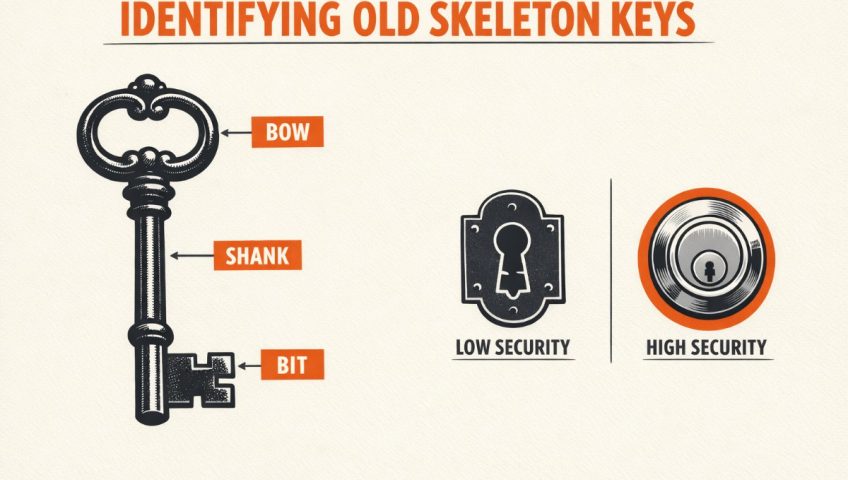
Identifying old skeleton keys comes down to reading three parts: the looped bow you hold, the long shank in the middle, and the flat bit at the end that turns the lock. Most antique keys found around the house once opened warded locks — a simple style standard in American homes before the 1940s. The shape of that bit is the clearest clue to what the key originally opened.
You clean out a drawer, an attic box, or a relative’s old desk, and there it sits — a heavy metal key with a fancy looped top that matches nothing in the house. It won’t slide into a single modern door, and you have no idea what it was meant to open. That puzzle is common, and it usually has a simple answer. Most of these mystery keys are antique skeleton keys built for lock styles no longer used on American doors. The good news is that you can learn to read one. In this guide, a professional locksmith walks through how to name the key in your hand, what it likely opened, and what it means for the safety of your home today. Keep reading to put a name to that old key.
What Is a Skeleton Key, Anyway?
A skeleton key is a key that has been filed down — or purpose-built — so the central shaft and a single thin bit can slip past the wards inside a warded lock. “Wards” are the small obstructions cast into a lock that block the wrong key from turning. A true skeleton key strips away everything except the part that actually moves the bolt, which lets one key open many similar warded locks. That same simplicity is why these locks faded out for exterior doors: the design that makes them charming also makes them easy to bypass.
For a deeper look at how the mechanism works, the overview of the warded lock on Wikipedia is a solid starting point.
How to Start Identifying Old Skeleton Keys
Identifying old skeleton keys comes down to four features. Examine each part of the key in good light before you guess.
The Bow, Shank, and Bit
The bow is the decorative loop you grip. Ornate, scrolled bows often point to furniture or cabinet keys, while plain rounded bows lean toward door locks. The shank is the long stem between the bow and the bit. A solid shank usually means a bit key made for a door; a hollow shank — one that would slide over a pin inside the lock — marks a barrel key, common on clocks and older cabinets. The bit is the flat blade at the end that does the work. The notches and grooves cut into that bit are the fingerprint of the lock it once matched.
Size and Material
Large iron or steel keys, roughly three to six inches long, were typically made for the interior and exterior doors of older houses. Smaller brass keys usually belonged to cabinets, desks, chests, or trunks. Hand-filed edges, uneven casting, and natural tarnish are signs of real age rather than a modern reproduction sold for decoration.
Markings and Maker Stamps
Turn the key over and check the bow and shank for stamped numbers, letters, or a maker’s name. Brand and pattern details documented in collector references for antique keys can help you trace an origin. A number stamped on the bow is usually a lock-pairing code, not a year.
Key Types Compared
Use this table to match the key in your hand to its most likely purpose and the level of protection it offered.
| Key Type | Typical Era | What It Opened | Protection Level | Common Today? |
|---|---|---|---|---|
| Bit key (skeleton) | Pre-1940s | Interior & exterior warded door locks | Low | Rare |
| Barrel key | 1800s–1900s | Clocks, cabinets, older furniture | Low | Rare |
| Furniture / cabinet key | 1800s–early 1900s | Desks, chests, trunks | Low | Occasional |
| Lever-lock key | 1800s–today | Lever-tumbler locks & some safes | Medium | Some |
| Tubular key | 1930s–today | Bike locks, vending, some cabinets | Medium | Some |
| Pin-tumbler key (modern) | 1900s–today | Modern deadbolts & knob locks | High | Standard |
| Dimple key | 1970s–today | High-security cylinders | High | Growing |
| Smart / electronic credential | 2000s–today | Keypad & smart deadbolts | High | Growing |
On a phone, swipe the table sideways to see every column.
Antique Keys and Your Home Safety Today
Here is the part many homeowners miss. If a warded lock and its skeleton key are still installed on an interior or exterior door, that opening is not protected against anyone holding a generic passkey. Antique skeleton keys are wonderful to collect and display — but they were never built to meet modern home safety standards.
A current exterior door should rely on a deadbolt with a pin-tumbler cylinder. Real deadbolt security comes from a one-inch throw bolt seated in a reinforced strike plate, paired on the inside with a thumbturn lock you can operate by hand without a key. If you’ve inherited or bought an older property that still runs on warded hardware, upgrading those locks is one of the more meaningful steps you can take for the household. A professional locksmith can rekey or swap the cylinders so every door answers to one modern key instead of a passkey almost anyone could own. Homeowners across Tempe and the wider East Valley ask us about exactly this when they move into an older home.
For hands-on help, our team handles lock change and lock rekey for houses throughout the area. If a door has been standing open to you and now sticks or jams, a home lockout visit can get you back in, and you can review every residential locksmith option on one page.
Pro Tip From the Field
After years of opening older homes around Tempe, here is the test I use right on the doorstep: insert the key and try to wiggle it gently side to side. If a key rocks loosely in the keyway yet still turns the bolt, you are almost certainly looking at a warded lock — and a skeleton key will likely operate it. On a modern pin-tumbler deadbolt, the key seats snugly with no play at all. That simple wiggle tells you, before you remove a single screw, if the door is protected by current hardware or by a mechanism from another era. When it is the latter, treat the lock as decorative history on the door — not as security.
Turn That Old Key Into a Smarter Lock
That antique key is a great find — frame it, hang it, or add it to a collection. Just don’t let an old warded lock stand guard over a door your family uses every day. If you’ve discovered original hardware in a Tempe-area home and want to know what is actually protecting the household, our professional locksmith team can assess your doors and recommend an upgrade that fits the house. Call CallOrange Locksmith Tempe at (480) 847-2635 to schedule a lock change or a full security audit. Learn more about us or contact our team to get started.
Frequently Asked Questions
How can I tell if my old key is a real skeleton key?
Look at the bit — the flat blade at the end. A genuine skeleton key has had most of its bit filed away, leaving a thin profile that slips past the wards inside the lock. Pair that with a looped bow, a long shank, and hand-filed edges, and you are almost certainly holding an antique skeleton key.
What kind of lock does a skeleton key open?
Skeleton keys are made for warded locks, a design built around fixed obstructions called wards. They were standard on American interior and exterior doors before the 1940s and still appear on antique furniture, cabinets, and older homes that were never upgraded.
Are antique skeleton keys worth anything?
Many are collectible, especially keys with ornate bows, maker stamps, or ties to a specific brand or era. Condition, rarity, and original hardware matter most to collectors. A decorative reproduction, by contrast, will usually show machine-cut edges and little tarnish.
Can one skeleton key open every door in my house?
If your doors still use warded locks, a single generic passkey can often operate several of them — which is exactly why warded hardware is no longer suitable for an entry door. Modern deadbolt security uses pin-tumbler cylinders that respond only to one cut key.
Should I keep using an antique lock on my front door?
For home safety, an antique warded lock is better treated as a display piece than as front-door security. A pin-tumbler deadbolt with a one-inch throw bolt and an interior thumbturn lock offers far stronger protection. A professional locksmith can upgrade the hardware while keeping the look of the door intact.
Can a locksmith make a key for an old lock?
Often, yes. A locksmith can cut a working key for many vintage warded and lever locks, or rekey the mechanism so a fresh key operates it. If the goal is real security on an active door, replacing the cylinder is usually the better route. Call CallOrange Locksmith Tempe at (480) 847-2635 to talk through the options.