High security deadbolts wich is better

Standard vs. High-Security Deadbolts: Is the Extra Cost Worth It?

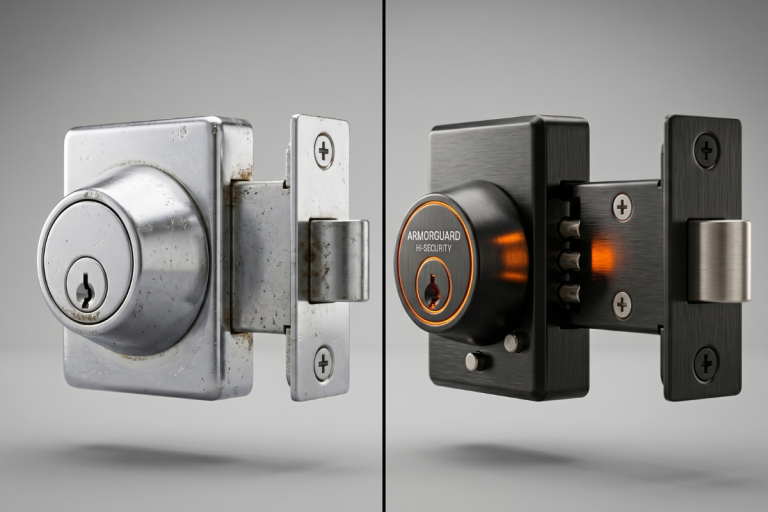
High-security deadbolts stop the three attacks that defeat standard locks — picking, bumping, and drilling — by combining hardened steel inserts, patented restricted keyways, and sidebar-driven pin stacks. A standard Grade 3 deadbolt from a big-box store resists casual attempts but opens in under 90 seconds with a bump key. A high-security Grade 1 deadbolt with ANSI/BHMA certification and UL 437 drill-resistance is engineered for a different threat level entirely — and for most Tempe homeowners and business owners, the price gap is smaller than the repair bill after a forced-entry break-in.

If you’ve been standing in the hardware aisle staring at a $35 deadbolt next to one priced at $180, that gap is real — and so is the confusion about whether the upgrade actually protects your door. Most residential burglaries in the East Valley involve either an unlocked door, a kicked-in frame, or a lock that was manipulated in seconds by someone who knew what they were doing. The deadbolt’s rating is only part of the story; the cylinder engineering, the strike plate, and the door frame reinforcement all share responsibility.

The right answer depends on your door, your threat profile, and how long you plan to stay in the property. A standard deadbolt installed correctly on a reinforced frame can keep out an opportunist. A high-security deadbolt on a weak jamb still fails under a determined kick. Our residential lock change service in Tempe handles both scenarios — and we’ll tell you honestly which one fits your situation.

With more than 15 years of field experience across Tempe, Mesa, Chandler, Scottsdale, and the broader Phoenix metro, our technicians at CallOrange Locksmith Tempe install and service both categories every week. This guide breaks down the real engineering differences, the true cost over time, and when each one is the right call.

How Standard Deadbolts Work — and Where They Fail

A standard residential deadbolt uses a pin tumbler cylinder with five or six brass driver pins stacked over key pins. When the correct key is inserted, the cuts lift the pins to a uniform shear line, allowing the plug to rotate and retract the bolt. This design is over 150 years old, and while it’s adequate for casual security, it has three well-documented weaknesses that anyone with a YouTube connection can learn to exploit.

Picking is the manipulation of each pin to the shear line using tension and a pick. Standard pin stacks with simple brass drivers are vulnerable to single-pin picking or raking in under two minutes by a modestly skilled attacker. Bumping uses a specially cut “bump key” and a sharp tap to jolt all pins to the shear line simultaneously — a standard deadbolt can be bumped open in under 30 seconds with no visible damage. Drilling destroys the shear line with a cordless drill and a standard bit; once the pins are punched through, the plug turns freely.

Grade 3 deadbolts — the category most homeowners buy — are tested to resist 5 strikes with 75 lbs of force and 2 cycles of 300 lbs. They pass minimum residential standards, not attack resistance. That’s a code threshold, not a security threshold. For a full walkthrough of hardware grades and what they actually mean, our residential locksmith team publishes specifications tied to each lock we install.

What Makes a Deadbolt “High-Security”?

The term “high-security” isn’t marketing — it’s a specific combination of engineering features documented under ANSI/BHMA Grade 1 certification and, for the best models, UL 437 listing. A genuine high-security deadbolt checks four boxes at once.

Pick-resistance through sidebar technology, spool drivers, or rotating disc detainers. Medeco’s angled key cuts rotate each pin to a specific position, requiring two separate manipulations at once. Mul-T-Lock’s telescoping pin-in-pin design forces the picker to align inner and outer pins simultaneously. Abloy Protec2 replaces pins entirely with rotating discs — there’s no shear line to find.

Bump-resistance is achieved when the pin design makes a bump key physically unable to transfer energy correctly. Sidebar-dependent locks (Medeco, Mul-T-Lock MT5+) are essentially bump-proof because lifting pins alone doesn’t disengage the secondary locking element.

Drill-resistance comes from hardened steel inserts around the cylinder, anti-drill pins in the pin stack, and ball-bearing reinforcement in the plug face. A Schlage Primus or a Medeco Maxum can resist 10+ minutes of concentrated drilling — long enough that most attackers move on or get noticed.

Key control is the quiet feature that matters most long-term. Standard keys can be copied at any hardware store for $3. High-security systems use patented restricted keyways — the blanks themselves are legally protected and only issued to authorized dealers with ID verification. A disgruntled ex-employee or former tenant cannot walk into Home Depot and duplicate your key. If key control is the reason you’re upgrading, a rekey from a restricted keyway locksmith solves the problem without replacing the lock.

The Real Cost Difference: Upfront Price vs. Lifetime Value

A quality standard deadbolt (Kwikset SmartKey, Schlage B60N) runs $30–$70 at retail, plus $75–$120 for professional installation. A high-security deadbolt (Medeco Maxum, Mul-T-Lock Hercular, Schlage Primus) runs $150–$350 for the hardware, plus $120–$180 for installation because the technician is aligning hardened strike plates and verifying door reinforcement.

On paper, the high-security option costs roughly $180 more per door. Spread across a 15–20 year service life, that’s about $1 per month. Compare that to the average cost of a forced-entry break-in in the Phoenix metro — $2,500 to $7,000 in property loss and door frame repair — and the math shifts quickly. Insurance deductibles on homeowner policies in Arizona average $1,000 to $2,500; the deadbolt upgrade pays for itself the first time it prevents a break-in attempt.

Commercial properties see the cost case even more clearly. Business owners in Tempe and Mesa who store inventory, customer data, or cash face both property loss and liability exposure after a break-in. For commercial doors, our high-security lock installation service pairs the deadbolt with a reinforced strike, a restricted key system, and — where the insurance carrier requires it — documented key-control records.

Quick Diagnosis Table

Symptom / Scenario Likely Cause What a Pro Checks
Deadbolt turns but bolt barely extends Worn tailpiece or shallow strike pocket Bolt throw length, strike box depth, cam engagement
Key works on second or third try Pin tumbler wear or warped key blade Pin height variance, keyway wear, key profile against master cut
Door pushes open when shouldered Short strike screws or splintered jamb Strike screw length (should be 3″+), jamb reinforcement, latch alignment
Lock feels loose in the door Loose mounting screws or worn cross-bore Thumbturn torque, cross-bore diameter, spindle wear
Previous tenant may still have a key Non-restricted keyway, no key control Rekey vs. cylinder swap to restricted keyway
Deadbolt sticks during AZ summer Door frame expansion from heat Latch-to-strike alignment, weatherstrip compression, bolt drag

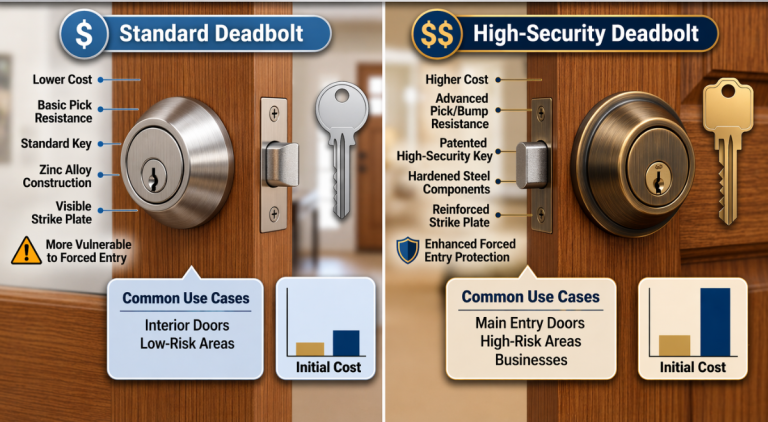
Standard vs. High-Security Deadbolts — Side by Side

Comparison of hardware tier, attack resistance, and real-world cost.

Feature Standard Deadbolt High-Security Deadbolt
ANSI/BHMA Grade Grade 3 (Grade 2 on premium) Grade 1 + UL 437 listed
Pick Resistance Low Opens in under 2 min High Sidebar + spool pins
Bump Resistance Vulnerable Under 30 sec Bump-proof Requires dual manipulation
Drill Resistance Minimal — standard bit defeats in 2 min Hardened inserts + ball bearings, 10+ min
Key Control Copy at any hardware store — $3 Patented restricted keyway — ID required
Example Models Kwikset SmartKey, Schlage B60N Medeco Maxum, Mul-T-Lock Hercular, Schlage Primus, Abloy Protec2
Hardware Cost $30 – $70 $150 – $350
Pro Installation (Tempe) $75 – $120 $120 – $180
Service Life 8 – 15 years 15 – 25 years
Best For Interior doors, secondary entries, low-risk mains Main entries, rentals, commercial, post-break-in upgrades

When Standard Deadbolts Are Enough — and When They’re Not

A standard Grade 2 deadbolt installed with 3-inch strike screws, a reinforced strike plate, and a solid-core door is adequate for most interior-facing doors, secondary entries, and low-risk residential main doors in established neighborhoods. If your door has line-of-sight neighbors, visible security cameras, and no history of attempted break-ins on the block, the standard upgrade to Grade 2 with proper installation solves 80% of real-world risk.

A high-security deadbolt is the correct call when any of the following apply:

  • You recently bought or rented the property and don’t know who holds copies of the keys
  • The property has been broken into before, or there’s been a break-in within 500 feet in the last year
  • You store valuables, medications, firearms, or business inventory on site
  • You manage a rental property and need documented key control for tenant turnover
  • The door is partially hidden from the street — side entries, alley doors, back patios
  • You run a commercial property where employees have rotated through master-keyed access
  • Your insurance policy offers a premium reduction for certified high-security hardware

Door-frame condition often matters more than the lock itself. We’ve replaced countless standard deadbolts after a break-in where the lock held but the jamb split — the attacker never touched the cylinder. If the door frame is weak, a residential locksmith can install a reinforced strike plate and longer screws as a cost-effective first step before upgrading the deadbolt itself.

Top High-Security Deadbolt Brands Compared

Four brands dominate the high-security residential and light-commercial market in the Phoenix metro. Each has a distinct engineering philosophy, a different price point, and a different answer to the question of key control.

Medeco Maxum — the standard-bearer for residential high-security in North America. Sidebar plus angled key cuts, UL 437 listed, restricted keyway. Keys are cut only at authorized dealers with signed ID verification. Mid-tier high-security pricing, proven field history over 40+ years.

Mul-T-Lock Hercular — Israeli-engineered, telescoping pin-in-pin design with a hardened bolt and cylinder guard. The MT5+ platform offers one of the strictest patented key-control systems on the market, with keys traceable by serial number. Favored in commercial and multi-family installations.

Schlage Primus — the logical upgrade for anyone already running Schlage residential hardware. Patented sidebar, restricted keyway, and a price point between standard Schlage B60 and full high-security Medeco. Compatible with existing Schlage master key systems.

Abloy Protec2 — disc-detainer design rather than pin tumbler, which eliminates the shear line entirely. Virtually pickproof, bumpproof, and drill-resistant through hardened steel construction. Premium pricing; common in high-risk commercial, government, and high-net-worth residential installations.

Installation Factors That Matter More Than the Lock

A $350 high-security deadbolt installed with factory 3/4-inch strike screws into a hollow-core jamb is weaker than a $40 Grade 2 deadbolt installed with 3-inch screws into a reinforced steel strike box. The deadbolt is a component, not a system. Professional installation addresses the full door assembly.

Strike plate and screws — the single highest-ROI upgrade for any door. Standard deadbolts ship with 3/4-inch screws that bite only into the door trim. Replacing them with 3-inch screws that reach the wall stud and adding a reinforced strike plate can triple the kick-in resistance for under $15 in parts.

Bolt throw and strike alignment — a deadbolt that doesn’t fully extend into the strike pocket offers almost no security advantage over a spring latch. The bolt should project a full inch past the door edge and seat fully in the strike box. Misalignment from door sag or frame settling is one of the most common issues we correct during residential lock change calls in Tempe.

Door material and reinforcement — a solid-core wood or steel-wrapped door handles impact very differently than a hollow-core interior door used as an exterior entry. If the door flexes when you push firmly on it, the lock grade is the wrong place to start spending money.

Arizona heat considerations — Tempe summers routinely hit 115°F, which expands metal door frames and can pinch a deadbolt into a misaligned strike. We see seasonal bolt drag from June through September every year. This is a strike-alignment fix, not a lock-replacement fix, and it applies equally to standard and high-security deadbolts.

Frequently Asked Questions — High-Security Deadbolts

Can I install a high-security deadbolt myself?

Technically yes, but the installation is where most of the security lives. A misaligned strike, short screws, or an incorrectly bored door will nullify the hardware’s rating. Professional installation from a licensed locksmith in Tempe is typically $120–$180 and includes strike reinforcement verification.

Are smart locks considered high-security?

Most consumer smart locks (August, Yale Assure, Schlage Encode) are Grade 2 mechanically. A few models — like the Schlage Encode Plus with a Primus cylinder option — can be configured with a high-security mechanical override. The electronic layer adds audit-trail convenience, not attack resistance.

How long does a high-security deadbolt last?

Mechanical service life is 15 to 25 years with normal residential use. Commercial installations with high cycle counts may see 10 to 15 years before the cylinder needs a rebuild. The restricted keyway remains valid for as long as the manufacturer maintains the patent and dealer network.

Will a high-security deadbolt work with my existing door?

Most high-security deadbolts fit the standard 2-1/8″ cross-bore and 1″ edge-bore used in U.S. residential doors. Some commercial-grade units require a larger cross-bore. A technician can confirm fit on-site in under five minutes during an assessment visit.

Can I rekey a high-security deadbolt to match my other locks?

Only within the same restricted keyway family — one Medeco cylinder can be rekeyed to match another Medeco on the same bitting, but mixing brands on a single key is not possible with patented systems. A locksmith can design a master key schedule that includes both high-security and standard locks on separate keyways.

Is the upgrade worth it for rental properties in Tempe or Mesa?

For single-family rentals with tenant turnover, a restricted keyway solves the lingering-copy problem that a standard rekey cannot address. For apartment buildings, the answer depends on insurance and key-control policy. A mid-tier system like Schlage Primus or Medeco KeyMark hits the cost-benefit sweet spot for most East Valley property managers. Call (480) 847-2635 for a property-level recommendation.

Choosing the Right Deadbolt for Your Door

The cost gap between a standard and a high-security deadbolt is real, but it’s narrower than most homeowners assume — and the protection gap is wider. A correctly installed standard deadbolt handles opportunistic threats on a typical residential door; a high-security deadbolt handles the targeted threats that involve key copies, pick attempts, or drilled cylinders. The right choice comes down to threat profile, property value, and key-control needs.

Before you spend $350 on a premium lock, confirm that your door frame, strike plate, and bolt alignment are handling their share of the work. And before you settle for the $35 option, consider whether you’d accept that level of protection on a door that holds everything you own.

Our team at CallOrange Locksmith Tempe has been installing deadbolts across the East Valley since 2008 — residential rekeys, commercial high-security systems, and everything between. Our technicians arrive with Medeco, Mul-T-Lock, Schlage Primus, and Abloy Protec2 inventory on the truck, along with the reinforced strikes and extended screws that make the hardware work as designed. We give upfront pricing before any work begins, and we’ll tell you honestly when a strike-plate upgrade is the right answer instead of a lock replacement.

Call (480) 847-2635 to schedule an on-site assessment, or visit our services page to review the full list of residential and commercial locksmith work we handle across Tempe, Mesa, Chandler, Scottsdale, and the greater Phoenix area. If you’re comparing options for a specific door or property, our contact form routes directly to the dispatch desk and includes a next-available service window.

High security deadbolts

Standard vs. High-Security Deadbolts: Is the Extra Cost Worth It?

You came home from a weekend trip, slid your key into the front door, and noticed something that made your stomach drop — fresh scratches around the lock cylinder. Maybe nothing happened this time, but the message is clear: your standard deadbolt is the only thing standing between your family and a determined intruder, and most standard deadbolts can be defeated in under 60 seconds by someone who knows what they’re doing.
The solution is straightforward. High security deadbolts are engineered to resist the exact attack methods burglars use most often: picking, bumping, drilling, and kick-ins. They cost more upfront, but they’re the difference between a locked door and a secured door.

Keep reading to learn exactly what separates a high-security deadbolt from the hardware store special, what you should expect to pay, and whether the extra investment actually makes sense for your home. If you’d rather skip ahead and talk to a technician, CallOrange Locksmith Tempe handles residential locksmith installations across the East Valley.

What Makes a Deadbolt “High-Security”?

A standard deadbolt from a big-box store is built to meet a minimum ANSI Grade 2 or Grade 3 rating. It keeps honest people honest. A high-security deadbolt is a different product category entirely — built to ANSI Grade 1 commercial standards with hardened steel internals, anti-drill pins, anti-pick sidebars, and patented keyways that prevent unauthorized key duplication.

[IMAGE: Insert Image Described Here] Photorealistic close-up side-by-side comparison of two deadbolt cylinders cut in half to show their internal mechanisms. The left cylinder shows a basic pin-tumbler standard deadbolt with brass pins, while the right cylinder shows a high-security deadbolt with hardened steel anti-drill pins, a sidebar mechanism, and a reinforced strike plate, lit with clean studio lighting on a neutral gray background.

The brands professional locksmiths actually install in their own homes — Medeco, Mul-T-Lock, Schlage Primus, and Abloy — share four core features that cheap deadbolts don’t have:

1. Hardened Steel Inserts

Anti-drill pins made of hardened steel or carbide shatter drill bits before the bit can reach the cylinder pins.

2. Patented Keyways

You can’t walk into a hardware store and copy the key. Duplication requires a registered dealer and proof of ownership.

3. Pick and Bump Resistance

Lock bumping — a technique where a specially cut key is tapped to force pins into position — defeats most standard deadbolts. High-security cylinders use sidebars and rotating pins that don’t respond to bumping at all.

4. Reinforced Strike Plates

The lock is only as strong as the frame it’s attached to. High-security kits include heavy-duty strike plates with 3-inch screws that anchor into the wall stud, not just the doorjamb. If your existing hardware is older or you’re not sure it’s anchored properly, a lock change service is the cleanest way to bring the whole door up to standard.

Standard vs. High-Security Deadbolts: Side-by-Side Comparison

Feature Standard Deadbolt High-Security Deadbolt
ANSI Grade Grade 2 or 3 Grade 1 (Commercial)
Pick Resistance Low — 30 seconds to 2 minutes High — 10+ minutes or unpickable
Bump Resistance Vulnerable Fully resistant
Drill Resistance Minimal Hardened steel + carbide pins
Key Duplication Any hardware store Patented — authorized dealer only
Kick-In Resistance Depends on strike plate Reinforced 3-inch anchor screws
Average Lifespan 5–7 years 15–25 years
Installation Cost (per door) $45 – $120 $180 – $450
Warranty 1–5 years limited Lifetime mechanical (most brands)

The Real Cost Difference — And What You Get For It

A standard Kwikset or basic Schlage deadbolt runs $25 to $60 at a home improvement store, plus $50 to $100 for professional installation. Total: around $75 to $160 per door.

A high-security deadbolt from Medeco or Mul-T-Lock typically costs $150 to $280 for the hardware, plus $80 to $180 for professional installation by a licensed locksmith. Total: around $230 to $460 per door.

The gap is real — roughly $150 to $300 more per door. But spread that over a 20-year service life and the math changes. You’re paying about $15 to $25 extra per year for hardware that actually resists the attack methods used in real-world break-ins.

If you’re not ready to replace the full cylinder, a professional lock rekey is a lower-cost alternative that invalidates any existing keys — useful after moving in or losing a copy, though it won’t increase the lock’s security grade.

The Thumbturn Lock Consideration

One upgrade worth discussing with your locksmith is the interior thumbturn lock style. Standard interior thumbturns can be defeated through a technique called “lock flipping” if there’s a nearby window or mail slot — a burglar uses a tool to reach in and rotate the thumbturn. High-security deadbolts offer double-cylinder options (key on both sides) or captive thumbturn designs that prevent this exact attack.

Commercial properties face similar challenges on a larger scale, which is why business owners typically opt for high security locks designed for commercial use with restricted keyways and master key systems.

Pro Tip From 10+ Years in the Field

Here’s what most homeowners get wrong: they spend $400 on a premium deadbolt and screw it into a factory doorframe using the original 3/4-inch screws that came with the builder’s hardware. I’ve responded to dozens of break-in calls where the lock held perfectly — but the frame split in half on the first kick.

If you’re upgrading to a high security deadbolt, insist on three things during installation:

  1. Three-inch screws through the strike plate into the wall stud. Not the doorjamb. The stud.
  2. A reinforced box strike, not a flat plate. The box protects the bolt on all four sides.
  3. Solid-core or metal door. A hollow-core door defeats any lock you put on it.

Any professional locksmith worth hiring will do all three by default. If they don’t bring up the strike plate upgrade, find a different locksmith.

Is the Extra Cost Worth It?

For deadbolt security on a primary residence, the answer is almost always yes — especially if you meet any of these conditions: you live in a ground-floor home, your door is visible from the street, you’ve recently moved in and don’t know who has copies of the old keys, or you have valuables, firearms, or family members you’re responsible for protecting.

If you’re ever locked out mid-upgrade or need emergency access before the new hardware arrives, residential home lockout service gets you back inside without damaging the door. For a rental property or a secondary interior door, a mid-grade Schlage Grade 1 residential deadbolt may be enough. Talk to a licensed locksmith who can evaluate your specific situation rather than guessing.

Are high security deadbolts really pick-proof?

No lock is 100% pick-proof, but high-security deadbolts from brands like Medeco and Mul-T-Lock are rated to resist picking for 10+ minutes — far beyond the time most burglars will spend at a front door. Their sidebars, rotating pins, and tight tolerances also make them fully resistant to lock bumping, which defeats most standard deadbolts in seconds.

Can I install a high-security deadbolt myself?

Technically yes, but we don’t recommend it. High-security deadbolts require precise alignment, reinforced strike plate installation with 3-inch screws into the wall stud, and sometimes door frame reinforcement. A professional residential locksmith ensures the hardware performs to its rated security level — a poorly installed premium lock is no better than a cheap one.

How much does a high-security deadbolt cost installed?

Expect to pay between $230 and $460 per door installed, which includes the hardware ($150–$280) and professional installation ($80–$180). Final pricing depends on the brand you choose, door condition, and whether frame reinforcement is needed. Contact CallOrange Locksmith Tempe or call (480) 847-2635 for a specific quote on your home.

What’s the difference between a thumbturn lock and a double-cylinder deadbolt?

A thumbturn lock has a key cylinder on the exterior and a rotating knob on the interior. A double-cylinder deadbolt requires a key on both sides — more secure if there’s a window near the door, but a safety concern during emergencies since you need the key to exit. Your locksmith can help you choose based on your door’s location and local fire code requirements.

Will a high-security deadbolt work with my existing door?

Most high-security deadbolts fit standard 2-1/8 inch door prep, which is the size used on the majority of American residential doors built since the 1970s. If your door is solid-core wood, fiberglass, or metal, you’re a good candidate. Hollow-core interior doors should not receive high-security hardware — the door itself becomes the weak point. A lock change specialist can evaluate your door during a site visit.

How long does installation take?

A single high-security deadbolt installation typically takes 45 minutes to 90 minutes, including strike plate reinforcement and function testing. If you’re upgrading multiple doors or need frame repair, plan for 2 to 4 hours on-site. Most CallOrange locksmith jobs are completed in a single visit.

Ready to Upgrade Your Home Safety?

Every home has different entry points, frame conditions, and security needs. A 15-minute in-person security audit from a licensed professional will tell you exactly which doors need high-security hardware and which ones are already well-protected.

CallOrange Locksmith Tempe has been installing high-security deadbolts across Tempe, Mesa, Chandler, Scottsdale, and Phoenix since 2008. Our technicians carry Medeco, Mul-T-Lock, and Schlage Primus hardware on every truck and can complete most installations in a single visit. See the full list of locksmith services we offer, or contact us to schedule directly.

Call (480) 847-2635 to schedule your home security audit or high-security deadbolt installation today.

best-door-locks-arizona-heat

Best Door Locks for Arizona Homes: Heat-Resistant Picks for 2026

Standard residential locks degrade faster in Arizona because daily thermal cycling between 115°F+ surface temperatures and overnight cooling expands and contracts internal metal components beyond factory tolerances. Heat-resistant door locks use hardened steel pin stacks, reinforced spring alloys, and UV-stabilized finishes designed to maintain cylinder precision through thousands of expansion cycles. A licensed locksmith matches the right lock grade to your door’s exposure, security requirements, and budget.

Prices shown reflect general market ranges for the Tempe and Phoenix metro area as of 2026. Actual costs depend on lock brand, security grade, and installation requirements. Contact us directly for a personalized quote.

If you’ve lived in Tempe for more than a few years, you’ve probably noticed that exterior door hardware doesn’t last as long here as manufacturers claim. A deadbolt rated for ten to fifteen years of residential use in a temperate climate might show significant wear in five to seven years on a south-facing or west-facing door in the Phoenix metro area. The finish fades and flakes. The key gets harder to turn. The deadbolt sticks in summer and loosens in winter. These aren’t signs of a defective lock — they’re signs of a lock that wasn’t built for desert conditions.

The problem starts with the pin tumbler mechanism inside the cylinder. Each time the lock heats up, the brass pins, steel springs, and zinc alloy housing expand at different rates. Over thousands of cycles, this differential expansion widens the clearances between pins and chambers. The lock still functions, but the tolerances that make it resistant to picking, bumping, and manipulation have degraded. A lock that was ANSI Grade 2 when installed might perform closer to Grade 3 after five Arizona summers.

Choosing the right lock for an Arizona home means looking past brand recognition and focusing on material composition, security grade, and finish durability. The residential locksmith team at CallOrange.com installs and services every major lock brand in Tempe and across the Phoenix metro area. With 4.8 stars across 1,451 Google reviews and eleven years of Arizona-specific experience, our technicians know which locks hold up and which ones don’t in this climate.

Lock Model Grade Pick/Bump Resistant Best For AZ Heat Rating
Schlage B60N Grade 1 Yes — 6-pin anti-pick Primary entry doors, sun-exposed Excellent
Medeco Maxum Grade 1 Yes — rotating pins, UL 437 High-security homes, restricted key Excellent
Mul-T-Lock Hercular Grade 1 Yes — telescoping pins Maximum security, dual shear line Excellent
Schlage Encode Plus Grade 2 Yes — with key backup Smart home, Apple Home Key Good (shade preferred)
Kwikset SmartKey (current gen) Grade 2 Yes — SecureScreen DIY rekeying, shaded doors Good
Yale Assure Lock 2 Grade 2 Yes — with key backup Multi-platform smart home Good (shade preferred)
Builder-grade (generic) Grade 3 Minimal Interior doors only Poor — replace on exterior
Schlage B60N
GradeGrade 1
Pick/Bump ResistantYes — 6-pin anti-pick
Best ForPrimary entry doors, sun-exposed
AZ Heat RatingExcellent
Medeco Maxum
GradeGrade 1
Pick/Bump ResistantYes — rotating pins, UL 437
Best ForHigh-security homes, restricted key
AZ Heat RatingExcellent
Mul-T-Lock Hercular
GradeGrade 1
Pick/Bump ResistantYes — telescoping pins
Best ForMaximum security, dual shear line
AZ Heat RatingExcellent
Schlage Encode Plus
GradeGrade 2
Pick/Bump ResistantYes — with key backup
Best ForSmart home, Apple Home Key
AZ Heat RatingGood (shade preferred)
Kwikset SmartKey (current gen)
GradeGrade 2
Pick/Bump ResistantYes — SecureScreen
Best ForDIY rekeying, shaded doors
AZ Heat RatingGood
Yale Assure Lock 2
GradeGrade 2
Pick/Bump ResistantYes — with key backup
Best ForMulti-platform smart home
AZ Heat RatingGood (shade preferred)
Builder-grade (generic)
GradeGrade 3
Pick/Bump ResistantMinimal
Best ForInterior doors only
AZ Heat RatingPoor — replace on exterior

Understanding Lock Grades and Why They Matter in Arizona

The American National Standards Institute (ANSI) and the Builders Hardware Manufacturers Association (BHMA) rate residential and commercial locks on a three-tier grading system. The grade determines how much physical abuse, cycle wear, and manipulation resistance a lock provides out of the box.

ANSI/BHMA Grade 1 is the highest rating for commercial and residential use. Grade 1 deadbolts must withstand 250,000 locking cycles, ten strikes of 75 pounds each, and pass UL 437 pick and drill resistance tests. These locks use hardened steel components, reinforced mounting hardware, and finishes designed for high-traffic environments. In Arizona, Grade 1 hardware lasts significantly longer than lower grades because the internal components are built with tighter manufacturing tolerances that absorb thermal cycling better.

ANSI/BHMA Grade 2 is the standard for quality residential hardware. Grade 2 deadbolts must survive 400,000 cycles (more than Grade 1 for cycles, fewer for forced entry resistance) and moderate physical attacks. Most name-brand residential deadbolts from Schlage, Kwikset, and Baldwin fall into this category. In Arizona’s heat, Grade 2 locks perform well for five to eight years on shaded doors and three to five years on sun-exposed doors before tolerances degrade noticeably.

ANSI/BHMA Grade 3 is the minimum for residential use. Builder-grade hardware — the locks that come pre-installed in new construction — are almost always Grade 3. These locks meet basic functional requirements but offer minimal pick resistance, shorter bolt throws, and finishes that break down quickly in UV exposure. If your Tempe home still has the original builder-grade locks, upgrading is one of the most impactful security improvements you can make.

The practical takeaway for Arizona homeowners: Grade 1 or Grade 2 hardware from a reputable manufacturer provides the best balance of security and longevity. Grade 3 locks should be replaced, especially on exterior doors that receive direct afternoon sun. A locksmith can assess your current hardware grade during a lock rekey or inspection visit.

Top Lock Brands That Perform Well in Arizona Heat

Not all locks within the same grade perform equally in desert conditions. Material choices, finish coatings, and internal design differences create real-world performance gaps between brands. Here are the locks that Tempe locksmiths see lasting the longest on Arizona doors.

Schlage B60N is the most widely recommended Grade 1 residential deadbolt for Arizona homes. The solid metal construction, six-pin cylinder (compared to the five-pin standard in most competitors), and anti-pick shield provide strong baseline security. The finish options include a PVD (Physical Vapor Deposition) coating on certain models that resists UV degradation significantly better than standard plated finishes. Schlage’s cylinders use nickel silver pins that handle thermal cycling better than standard brass.

Medeco Maxum represents the high-security tier. Medeco’s patented rotating pin system adds a third dimension to the pin tumbler mechanism — pins must not only be lifted to the correct height but rotated to the correct angle. This makes the lock essentially pick-proof and bump-proof with current techniques. The Maxum model uses a Grade 1 rated deadbolt with a one-inch bolt throw and hardened steel insert to resist cutting and sawing. For Arizona, Medeco’s solid brass construction handles thermal cycling well, and the restricted keyway prevents unauthorized key duplication.

Mul-T-Lock Hercular uses a telescoping pin-within-a-pin design that provides two shear lines instead of one. This doubles the number of pin positions an attacker must defeat simultaneously, making manipulation extremely difficult. The Hercular model includes a hardened steel bolt, anti-drill protection, and bump resistance built into the cylinder design. The chrome-plated finish holds up well in Arizona conditions, though brass body construction ensures good thermal stability.

Schlage Encode Plus is the leading smart lock option for Arizona homes. Unlike battery-powered smart locks that struggle in extreme heat, the Encode Plus uses a robust electronic platform with Apple Home Key support. The important distinction for Arizona: the Encode Plus includes a physical key backup cylinder, so battery failure from heat exposure doesn’t leave you locked out. The electronic components are housed behind the door where they’re protected from direct sun exposure.

Kwikset SmartKey deserves mention for its rekeying convenience — homeowners can rekey the lock themselves without removing it from the door. However, early SmartKey generations had known bypass vulnerabilities. Current-generation SmartKey (identified by the “SecureScreen” feature) has addressed these issues. For Arizona use, Kwikset’s finishes tend to degrade faster than Schlage’s PVD options on sun-exposed doors, but the locks perform well on shaded entries.

ASSA Abloy / Yale products cover the commercial crossover market. If you want a residential lock with commercial-grade internals, ASSA Abloy’s high-security cylinders use hardened steel components throughout and offer patented key control. Yale’s Assure Lock 2 is a strong smart lock alternative with multiple connectivity options and a solid mechanical backup.

What to Look for When Choosing a Lock for an Arizona Door

Beyond brand and grade, specific features determine how well a lock survives Arizona conditions. Use these criteria when evaluating any lock for a Tempe home.

Bolt throw length should be at least one inch. The bolt throw is the distance the deadbolt extends into the door frame when locked. Many Grade 3 and budget Grade 2 locks have bolt throws of only ½ to ¾ inch, which makes them vulnerable to frame spreading attacks. In Arizona, door frames expand in heat, and a short bolt can partially disengage from the strike plate during peak summer temperatures. A full one-inch throw maintains engagement even as the frame shifts.

Strike plate anchoring matters more than most homeowners realize. The strike plate — the metal plate on the door frame that receives the bolt — should be secured with 3-inch screws that reach into the structural stud behind the door frame. Most builder-installed strike plates use ¾-inch screws that only grip the thin door frame trim. Upgrading the strike plate screws is a five-minute improvement that dramatically increases kick-in resistance.

Finish type determines UV and weather resistance. PVD (Physical Vapor Deposition) finishes are the gold standard for Arizona exterior doors — they’re applied in a vacuum chamber and bond at the molecular level, creating a surface that resists UV fading, scratching, and corrosion. Standard electroplated finishes (common on budget locks) break down within two to three years on sun-exposed doors. Look for “PVD” or “Lifetime Finish” designations.

Pick and bump resistance are built into the cylinder design. Anti-pick pins (spool pins, serrated pins, or mushroom pins) make single-pin picking significantly more difficult. Bump resistance comes from specialized pin designs or sidebar mechanisms that prevent the bump technique from working. Grade 1 locks typically include both features; Grade 2 varies by manufacturer.

Smart lock battery management is critical in Arizona. Electronic locks that rely on AA or AAA batteries will drain faster on heat-exposed doors. Choose a smart lock with a physical key backup and an external emergency power terminal (9V battery contact) so you’re never locked out when the electronics fail. Replace batteries every six months on sun-exposed doors regardless of the low-battery indicator.

Common Lock Mistakes Arizona Homeowners Make

Certain lock choices and installation practices that work fine in other climates create problems in the Phoenix metro area. Avoid these common mistakes.

Keeping builder-grade locks after purchase. New construction in Tempe typically comes with the cheapest Grade 3 locks the builder can source. These locks meet code minimums but provide minimal security and degrade quickly in Arizona heat. Replacing them with Grade 1 or Grade 2 hardware should be part of your move-in process, ideally during the same visit when you rekey or replace locks for key control.

Using the same lock on all exposures. A north-facing front door and a west-facing back door experience dramatically different UV and heat loads. The west-facing door may need a higher-grade lock with a PVD finish, while the shaded north-facing door can use a standard finish. Matching the lock to the door’s exposure saves money and extends hardware life.

Ignoring the strike plate. A Grade 1 deadbolt with a one-inch bolt throw is only as strong as the strike plate holding it in the frame. If the strike plate is secured with short screws into soft trim wood, a single kick can split the frame and pop the bolt free. Upgrading to a reinforced strike plate with 3-inch structural screws takes minutes and costs less than a new lock.

Lubricating with WD-40. WD-40 is a solvent, not a lubricant. It temporarily loosens a sticky lock but evaporates quickly and leaves a residue that attracts Arizona’s fine desert dust. Within weeks, the lock is stickier than before. Use a dry graphite lubricant or a PTFE-based spray specifically designed for lock cylinders. A locksmith applies the correct lubricant during any service visit.

Skipping the physical key backup on smart locks. Every smart lock has a failure mode — dead battery, firmware crash, Bluetooth disconnection, Wi-Fi outage. In 115°F heat, electronic failures happen more frequently. A smart lock without a physical key backup or emergency power terminal is a lockout waiting to happen. Always verify the backup entry method works before relying on a keyless system as your only entry point.

How a Locksmith Helps You Choose and Install the Right Lock

Selecting and installing a residential lock involves more than picking a box off a shelf. A licensed locksmith evaluates your specific doors, security needs, and budget to recommend hardware that performs in Arizona conditions.

Door assessment comes first. The locksmith checks each exterior door for material (wood, fiberglass, steel), thickness, existing bore holes (standard is 2⅛-inch bore with a 2⅜-inch or 2¾-inch backset), and sun exposure. Doors that have warped from heat may need the bore realigned or the door planed before a new lock can operate correctly.

Security evaluation considers your neighborhood, the door’s visibility from the street, whether the door has glass panels near the lock (which allow an intruder to break glass and reach the thumb turn), and your daily access patterns. A door with a glass sidelight might need a double-cylinder deadbolt (keyed on both sides) or a smart lock with auto-lock to prevent reach-through attacks.

Lock recommendation matches grade, brand, and features to your situation. The locksmith explains the trade-offs between security level, cost, and convenience so you can make an informed decision. If you want a keypad deadbolt on the garage door, a high-security deadbolt on the front door, and standard Grade 2 on the back door, the technician can key the mechanical locks alike so one key works on both.

Professional installation ensures the lock operates correctly from day one. Improper installation — misaligned bore, incorrect backset, stripped screw holes, or a sagging strike plate — causes binding, premature wear, and security gaps that no lock grade can compensate for. The locksmith tests the lock from both sides, verifies the bolt fully extends into the strike plate, and confirms the key operates smoothly before completing the job.

Frequently Asked Questions

What lock grade is best for Arizona homes?

ANSI/BHMA Grade 1 provides the best security and durability for Arizona conditions. Grade 2 from quality manufacturers like Schlage also performs well. Avoid Grade 3 builder-grade locks on exterior doors — they degrade quickly in desert heat and offer minimal pick resistance.

How long do door locks last in Arizona heat?

Grade 1 locks typically last eight to twelve years on Arizona exterior doors. Grade 2 locks last five to eight years on shaded doors and three to five years on sun-exposed doors. Grade 3 builder-grade locks may show significant wear within two to three years on south-facing or west-facing entries.

Is Schlage or Kwikset better for Arizona?

Both brands make quality residential hardware. Schlage’s B60N offers a six-pin cylinder and PVD finish options that resist UV degradation better in direct sun. Kwikset’s SmartKey offers easy DIY rekeying convenience. For sun-exposed doors, Schlage’s finish durability gives it an edge.

Do smart locks work well in Arizona heat?

Smart locks work well if you manage battery replacement proactively. Batteries drain faster on heat-exposed doors — replace every six months instead of waiting for the low-battery warning. Always choose a smart lock with a physical key backup and emergency power terminal in case electronics fail.

What finish lasts longest on Arizona exterior doors?

PVD (Physical Vapor Deposition) finishes last the longest because they bond at the molecular level and resist UV fading, scratching, and corrosion. Standard electroplated finishes break down within two to three years on sun-exposed doors. Look for “PVD” or “Lifetime Finish” designations when shopping.

Should I replace builder-grade locks on a new home?

Yes. Builder-grade locks are almost always ANSI Grade 3 — the minimum allowed by code. They offer limited pick resistance, short bolt throws, and finishes that degrade quickly in Arizona sun. Upgrading to Grade 1 or Grade 2 hardware is one of the most impactful security improvements for a new home.

What lubricant should I use on door locks in Arizona?

Use dry graphite lubricant or a PTFE-based spray designed for lock cylinders. Never use WD-40 — it’s a solvent that evaporates quickly and leaves residue that attracts fine desert dust, making the lock stickier over time. A locksmith applies the correct lubricant during any service visit.

Choosing the Right Lock for Your Tempe Home

The lock on your exterior door is the primary physical barrier between your home and an intruder. In Arizona’s climate, that barrier degrades faster than anywhere else in the country if you choose the wrong hardware. A Grade 1 or high Grade 2 lock with a PVD finish, one-inch bolt throw, anti-pick pins, and a reinforced strike plate provides the security and durability that Tempe homes need.

CallOrange.com has been installing, rekeying, and replacing residential locks across Tempe and the Phoenix metro area since 2015. With 1,451 Google reviews at 4.8 stars, our licensed, insured, and bonded technicians carry inventory from Schlage, Kwikset, Medeco, Mul-T-Lock, and smart lock brands on every service call. Whether you need a single deadbolt upgrade, a whole-house lock replacement, or a professional assessment of your current hardware, the work gets done in one visit.

Call (480) 847-2635 and let us know what doors you want to secure and what’s currently installed. You can also reach out through the contact page or read more about our team on the about us page.