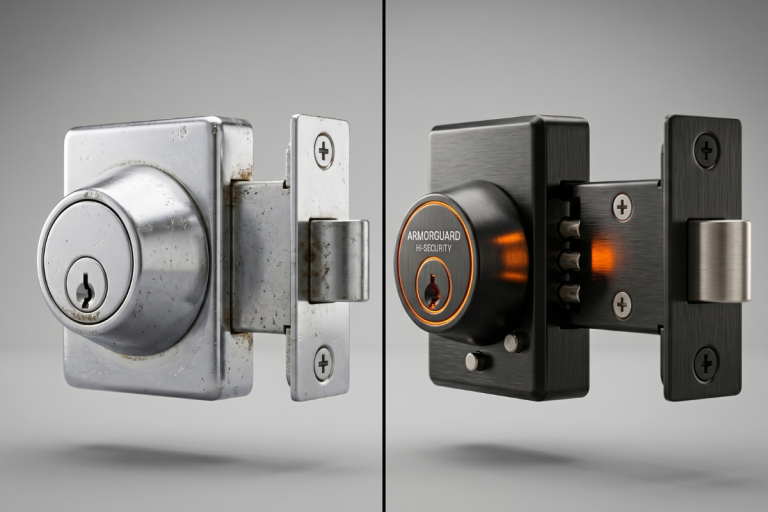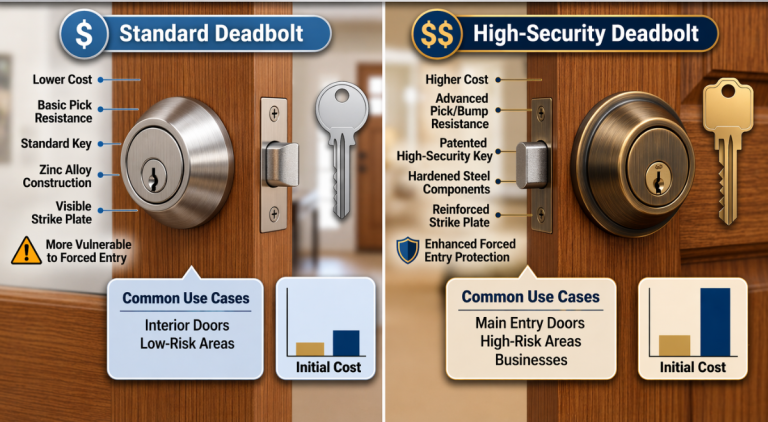
High-security deadbolts stop the three attacks that defeat standard locks — picking, bumping, and drilling — by combining hardened steel inserts, patented restricted keyways, and sidebar-driven pin stacks. A standard Grade 3 deadbolt from a big-box store resists casual attempts but opens in under 90 seconds with a bump key. A high-security Grade 1 deadbolt with ANSI/BHMA certification and UL 437 drill-resistance is engineered for a different threat level entirely — and for most Tempe homeowners and business owners, the price gap is smaller than the repair bill after a forced-entry break-in.
If you’ve been standing in the hardware aisle staring at a $35 deadbolt next to one priced at $180, that gap is real — and so is the confusion about whether the upgrade actually protects your door. Most residential burglaries in the East Valley involve either an unlocked door, a kicked-in frame, or a lock that was manipulated in seconds by someone who knew what they were doing. The deadbolt’s rating is only part of the story; the cylinder engineering, the strike plate, and the door frame reinforcement all share responsibility.
The right answer depends on your door, your threat profile, and how long you plan to stay in the property. A standard deadbolt installed correctly on a reinforced frame can keep out an opportunist. A high-security deadbolt on a weak jamb still fails under a determined kick. Our residential lock change service in Tempe handles both scenarios — and we’ll tell you honestly which one fits your situation.
With more than 15 years of field experience across Tempe, Mesa, Chandler, Scottsdale, and the broader Phoenix metro, our technicians at CallOrange Locksmith Tempe install and service both categories every week. This guide breaks down the real engineering differences, the true cost over time, and when each one is the right call.
How Standard Deadbolts Work — and Where They Fail
A standard residential deadbolt uses a pin tumbler cylinder with five or six brass driver pins stacked over key pins. When the correct key is inserted, the cuts lift the pins to a uniform shear line, allowing the plug to rotate and retract the bolt. This design is over 150 years old, and while it’s adequate for casual security, it has three well-documented weaknesses that anyone with a YouTube connection can learn to exploit.
Picking is the manipulation of each pin to the shear line using tension and a pick. Standard pin stacks with simple brass drivers are vulnerable to single-pin picking or raking in under two minutes by a modestly skilled attacker. Bumping uses a specially cut “bump key” and a sharp tap to jolt all pins to the shear line simultaneously — a standard deadbolt can be bumped open in under 30 seconds with no visible damage. Drilling destroys the shear line with a cordless drill and a standard bit; once the pins are punched through, the plug turns freely.
Grade 3 deadbolts — the category most homeowners buy — are tested to resist 5 strikes with 75 lbs of force and 2 cycles of 300 lbs. They pass minimum residential standards, not attack resistance. That’s a code threshold, not a security threshold. For a full walkthrough of hardware grades and what they actually mean, our residential locksmith team publishes specifications tied to each lock we install.
What Makes a Deadbolt “High-Security”?
The term “high-security” isn’t marketing — it’s a specific combination of engineering features documented under ANSI/BHMA Grade 1 certification and, for the best models, UL 437 listing. A genuine high-security deadbolt checks four boxes at once.
Pick-resistance through sidebar technology, spool drivers, or rotating disc detainers. Medeco’s angled key cuts rotate each pin to a specific position, requiring two separate manipulations at once. Mul-T-Lock’s telescoping pin-in-pin design forces the picker to align inner and outer pins simultaneously. Abloy Protec2 replaces pins entirely with rotating discs — there’s no shear line to find.
Bump-resistance is achieved when the pin design makes a bump key physically unable to transfer energy correctly. Sidebar-dependent locks (Medeco, Mul-T-Lock MT5+) are essentially bump-proof because lifting pins alone doesn’t disengage the secondary locking element.
Drill-resistance comes from hardened steel inserts around the cylinder, anti-drill pins in the pin stack, and ball-bearing reinforcement in the plug face. A Schlage Primus or a Medeco Maxum can resist 10+ minutes of concentrated drilling — long enough that most attackers move on or get noticed.
Key control is the quiet feature that matters most long-term. Standard keys can be copied at any hardware store for $3. High-security systems use patented restricted keyways — the blanks themselves are legally protected and only issued to authorized dealers with ID verification. A disgruntled ex-employee or former tenant cannot walk into Home Depot and duplicate your key. If key control is the reason you’re upgrading, a rekey from a restricted keyway locksmith solves the problem without replacing the lock.
The Real Cost Difference: Upfront Price vs. Lifetime Value
A quality standard deadbolt (Kwikset SmartKey, Schlage B60N) runs $30–$70 at retail, plus $75–$120 for professional installation. A high-security deadbolt (Medeco Maxum, Mul-T-Lock Hercular, Schlage Primus) runs $150–$350 for the hardware, plus $120–$180 for installation because the technician is aligning hardened strike plates and verifying door reinforcement.
On paper, the high-security option costs roughly $180 more per door. Spread across a 15–20 year service life, that’s about $1 per month. Compare that to the average cost of a forced-entry break-in in the Phoenix metro — $2,500 to $7,000 in property loss and door frame repair — and the math shifts quickly. Insurance deductibles on homeowner policies in Arizona average $1,000 to $2,500; the deadbolt upgrade pays for itself the first time it prevents a break-in attempt.
Commercial properties see the cost case even more clearly. Business owners in Tempe and Mesa who store inventory, customer data, or cash face both property loss and liability exposure after a break-in. For commercial doors, our high-security lock installation service pairs the deadbolt with a reinforced strike, a restricted key system, and — where the insurance carrier requires it — documented key-control records.
Quick Diagnosis Table
| Symptom / Scenario | Likely Cause | What a Pro Checks |
|---|---|---|
| Deadbolt turns but bolt barely extends | Worn tailpiece or shallow strike pocket | Bolt throw length, strike box depth, cam engagement |
| Key works on second or third try | Pin tumbler wear or warped key blade | Pin height variance, keyway wear, key profile against master cut |
| Door pushes open when shouldered | Short strike screws or splintered jamb | Strike screw length (should be 3″+), jamb reinforcement, latch alignment |
| Lock feels loose in the door | Loose mounting screws or worn cross-bore | Thumbturn torque, cross-bore diameter, spindle wear |
| Previous tenant may still have a key | Non-restricted keyway, no key control | Rekey vs. cylinder swap to restricted keyway |
| Deadbolt sticks during AZ summer | Door frame expansion from heat | Latch-to-strike alignment, weatherstrip compression, bolt drag |
Standard vs. High-Security Deadbolts — Side by Side
Comparison of hardware tier, attack resistance, and real-world cost.
| Feature | Standard Deadbolt | High-Security Deadbolt |
|---|---|---|
| ANSI/BHMA Grade | Grade 3 (Grade 2 on premium) | Grade 1 + UL 437 listed |
| Pick Resistance | Low Opens in under 2 min | High Sidebar + spool pins |
| Bump Resistance | Vulnerable Under 30 sec | Bump-proof Requires dual manipulation |
| Drill Resistance | Minimal — standard bit defeats in 2 min | Hardened inserts + ball bearings, 10+ min |
| Key Control | Copy at any hardware store — $3 | Patented restricted keyway — ID required |
| Example Models | Kwikset SmartKey, Schlage B60N | Medeco Maxum, Mul-T-Lock Hercular, Schlage Primus, Abloy Protec2 |
| Hardware Cost | $30 – $70 | $150 – $350 |
| Pro Installation (Tempe) | $75 – $120 | $120 – $180 |
| Service Life | 8 – 15 years | 15 – 25 years |
| Best For | Interior doors, secondary entries, low-risk mains | Main entries, rentals, commercial, post-break-in upgrades |
When Standard Deadbolts Are Enough — and When They’re Not
A standard Grade 2 deadbolt installed with 3-inch strike screws, a reinforced strike plate, and a solid-core door is adequate for most interior-facing doors, secondary entries, and low-risk residential main doors in established neighborhoods. If your door has line-of-sight neighbors, visible security cameras, and no history of attempted break-ins on the block, the standard upgrade to Grade 2 with proper installation solves 80% of real-world risk.
A high-security deadbolt is the correct call when any of the following apply:
- You recently bought or rented the property and don’t know who holds copies of the keys
- The property has been broken into before, or there’s been a break-in within 500 feet in the last year
- You store valuables, medications, firearms, or business inventory on site
- You manage a rental property and need documented key control for tenant turnover
- The door is partially hidden from the street — side entries, alley doors, back patios
- You run a commercial property where employees have rotated through master-keyed access
- Your insurance policy offers a premium reduction for certified high-security hardware
Door-frame condition often matters more than the lock itself. We’ve replaced countless standard deadbolts after a break-in where the lock held but the jamb split — the attacker never touched the cylinder. If the door frame is weak, a residential locksmith can install a reinforced strike plate and longer screws as a cost-effective first step before upgrading the deadbolt itself.
Top High-Security Deadbolt Brands Compared
Four brands dominate the high-security residential and light-commercial market in the Phoenix metro. Each has a distinct engineering philosophy, a different price point, and a different answer to the question of key control.
Medeco Maxum — the standard-bearer for residential high-security in North America. Sidebar plus angled key cuts, UL 437 listed, restricted keyway. Keys are cut only at authorized dealers with signed ID verification. Mid-tier high-security pricing, proven field history over 40+ years.
Mul-T-Lock Hercular — Israeli-engineered, telescoping pin-in-pin design with a hardened bolt and cylinder guard. The MT5+ platform offers one of the strictest patented key-control systems on the market, with keys traceable by serial number. Favored in commercial and multi-family installations.
Schlage Primus — the logical upgrade for anyone already running Schlage residential hardware. Patented sidebar, restricted keyway, and a price point between standard Schlage B60 and full high-security Medeco. Compatible with existing Schlage master key systems.
Abloy Protec2 — disc-detainer design rather than pin tumbler, which eliminates the shear line entirely. Virtually pickproof, bumpproof, and drill-resistant through hardened steel construction. Premium pricing; common in high-risk commercial, government, and high-net-worth residential installations.
Installation Factors That Matter More Than the Lock
A $350 high-security deadbolt installed with factory 3/4-inch strike screws into a hollow-core jamb is weaker than a $40 Grade 2 deadbolt installed with 3-inch screws into a reinforced steel strike box. The deadbolt is a component, not a system. Professional installation addresses the full door assembly.
Strike plate and screws — the single highest-ROI upgrade for any door. Standard deadbolts ship with 3/4-inch screws that bite only into the door trim. Replacing them with 3-inch screws that reach the wall stud and adding a reinforced strike plate can triple the kick-in resistance for under $15 in parts.
Bolt throw and strike alignment — a deadbolt that doesn’t fully extend into the strike pocket offers almost no security advantage over a spring latch. The bolt should project a full inch past the door edge and seat fully in the strike box. Misalignment from door sag or frame settling is one of the most common issues we correct during residential lock change calls in Tempe.
Door material and reinforcement — a solid-core wood or steel-wrapped door handles impact very differently than a hollow-core interior door used as an exterior entry. If the door flexes when you push firmly on it, the lock grade is the wrong place to start spending money.
Arizona heat considerations — Tempe summers routinely hit 115°F, which expands metal door frames and can pinch a deadbolt into a misaligned strike. We see seasonal bolt drag from June through September every year. This is a strike-alignment fix, not a lock-replacement fix, and it applies equally to standard and high-security deadbolts.
Frequently Asked Questions — High-Security Deadbolts
Can I install a high-security deadbolt myself?
Technically yes, but the installation is where most of the security lives. A misaligned strike, short screws, or an incorrectly bored door will nullify the hardware’s rating. Professional installation from a licensed locksmith in Tempe is typically $120–$180 and includes strike reinforcement verification.
Are smart locks considered high-security?
Most consumer smart locks (August, Yale Assure, Schlage Encode) are Grade 2 mechanically. A few models — like the Schlage Encode Plus with a Primus cylinder option — can be configured with a high-security mechanical override. The electronic layer adds audit-trail convenience, not attack resistance.
How long does a high-security deadbolt last?
Mechanical service life is 15 to 25 years with normal residential use. Commercial installations with high cycle counts may see 10 to 15 years before the cylinder needs a rebuild. The restricted keyway remains valid for as long as the manufacturer maintains the patent and dealer network.
Will a high-security deadbolt work with my existing door?
Most high-security deadbolts fit the standard 2-1/8″ cross-bore and 1″ edge-bore used in U.S. residential doors. Some commercial-grade units require a larger cross-bore. A technician can confirm fit on-site in under five minutes during an assessment visit.
Can I rekey a high-security deadbolt to match my other locks?
Only within the same restricted keyway family — one Medeco cylinder can be rekeyed to match another Medeco on the same bitting, but mixing brands on a single key is not possible with patented systems. A locksmith can design a master key schedule that includes both high-security and standard locks on separate keyways.
Is the upgrade worth it for rental properties in Tempe or Mesa?
For single-family rentals with tenant turnover, a restricted keyway solves the lingering-copy problem that a standard rekey cannot address. For apartment buildings, the answer depends on insurance and key-control policy. A mid-tier system like Schlage Primus or Medeco KeyMark hits the cost-benefit sweet spot for most East Valley property managers. Call (480) 847-2635 for a property-level recommendation.
Choosing the Right Deadbolt for Your Door
The cost gap between a standard and a high-security deadbolt is real, but it’s narrower than most homeowners assume — and the protection gap is wider. A correctly installed standard deadbolt handles opportunistic threats on a typical residential door; a high-security deadbolt handles the targeted threats that involve key copies, pick attempts, or drilled cylinders. The right choice comes down to threat profile, property value, and key-control needs.
Before you spend $350 on a premium lock, confirm that your door frame, strike plate, and bolt alignment are handling their share of the work. And before you settle for the $35 option, consider whether you’d accept that level of protection on a door that holds everything you own.
Our team at CallOrange Locksmith Tempe has been installing deadbolts across the East Valley since 2008 — residential rekeys, commercial high-security systems, and everything between. Our technicians arrive with Medeco, Mul-T-Lock, Schlage Primus, and Abloy Protec2 inventory on the truck, along with the reinforced strikes and extended screws that make the hardware work as designed. We give upfront pricing before any work begins, and we’ll tell you honestly when a strike-plate upgrade is the right answer instead of a lock replacement.
Call (480) 847-2635 to schedule an on-site assessment, or visit our services page to review the full list of residential and commercial locksmith work we handle across Tempe, Mesa, Chandler, Scottsdale, and the greater Phoenix area. If you’re comparing options for a specific door or property, our contact form routes directly to the dispatch desk and includes a next-available service window.