You came home from a weekend trip, slid your key into the front door, and noticed something that made your stomach drop — fresh scratches around the lock cylinder. Maybe nothing happened this time, but the message is clear: your standard deadbolt is the only thing standing between your family and a determined intruder, and most standard deadbolts can be defeated in under 60 seconds by someone who knows what they’re doing.
The solution is straightforward. High security deadbolts are engineered to resist the exact attack methods burglars use most often: picking, bumping, drilling, and kick-ins. They cost more upfront, but they’re the difference between a locked door and a secured door.
Keep reading to learn exactly what separates a high-security deadbolt from the hardware store special, what you should expect to pay, and whether the extra investment actually makes sense for your home. If you’d rather skip ahead and talk to a technician, CallOrange Locksmith Tempe handles residential locksmith installations across the East Valley.
What Makes a Deadbolt “High-Security”?
A standard deadbolt from a big-box store is built to meet a minimum ANSI Grade 2 or Grade 3 rating. It keeps honest people honest. A high-security deadbolt is a different product category entirely — built to ANSI Grade 1 commercial standards with hardened steel internals, anti-drill pins, anti-pick sidebars, and patented keyways that prevent unauthorized key duplication.
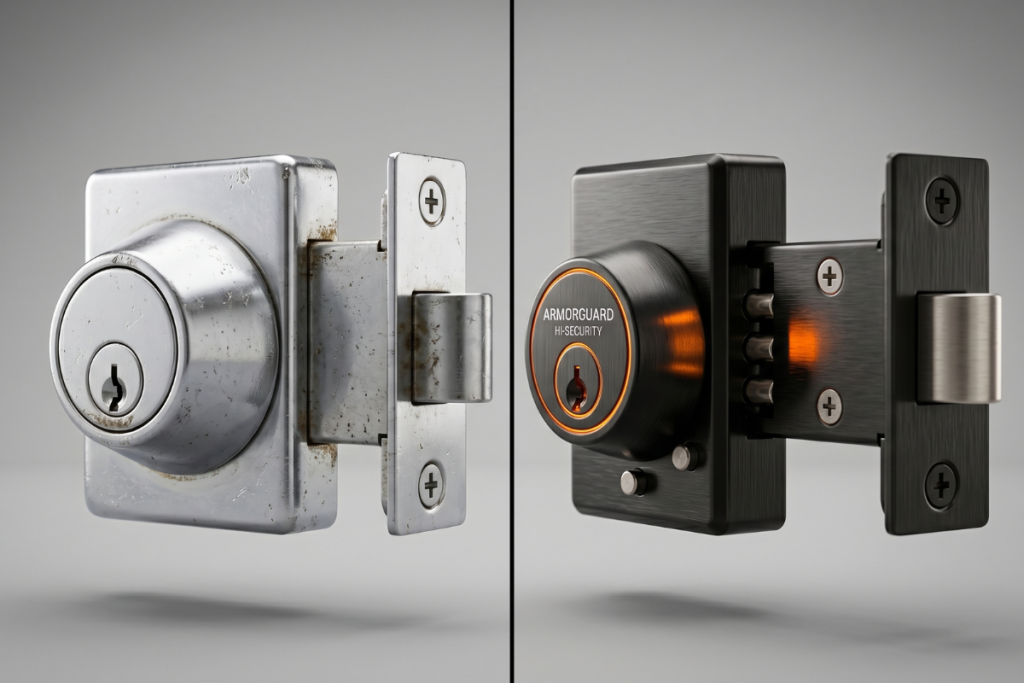
[IMAGE: Insert Image Described Here] Photorealistic close-up side-by-side comparison of two deadbolt cylinders cut in half to show their internal mechanisms. The left cylinder shows a basic pin-tumbler standard deadbolt with brass pins, while the right cylinder shows a high-security deadbolt with hardened steel anti-drill pins, a sidebar mechanism, and a reinforced strike plate, lit with clean studio lighting on a neutral gray background.
The brands professional locksmiths actually install in their own homes — Medeco, Mul-T-Lock, Schlage Primus, and Abloy — share four core features that cheap deadbolts don’t have:
1. Hardened Steel Inserts
Anti-drill pins made of hardened steel or carbide shatter drill bits before the bit can reach the cylinder pins.
2. Patented Keyways
You can’t walk into a hardware store and copy the key. Duplication requires a registered dealer and proof of ownership.
3. Pick and Bump Resistance
Lock bumping — a technique where a specially cut key is tapped to force pins into position — defeats most standard deadbolts. High-security cylinders use sidebars and rotating pins that don’t respond to bumping at all.
4. Reinforced Strike Plates
The lock is only as strong as the frame it’s attached to. High-security kits include heavy-duty strike plates with 3-inch screws that anchor into the wall stud, not just the doorjamb. If your existing hardware is older or you’re not sure it’s anchored properly, a lock change service is the cleanest way to bring the whole door up to standard.
Standard vs. High-Security Deadbolts: Side-by-Side Comparison
| Feature | Standard Deadbolt | High-Security Deadbolt |
|---|---|---|
| ANSI Grade | Grade 2 or 3 | Grade 1 (Commercial) |
| Pick Resistance | Low — 30 seconds to 2 minutes | High — 10+ minutes or unpickable |
| Bump Resistance | Vulnerable | Fully resistant |
| Drill Resistance | Minimal | Hardened steel + carbide pins |
| Key Duplication | Any hardware store | Patented — authorized dealer only |
| Kick-In Resistance | Depends on strike plate | Reinforced 3-inch anchor screws |
| Average Lifespan | 5–7 years | 15–25 years |
| Installation Cost (per door) | $45 – $120 | $180 – $450 |
| Warranty | 1–5 years limited | Lifetime mechanical (most brands) |
The Real Cost Difference — And What You Get For It
A standard Kwikset or basic Schlage deadbolt runs $25 to $60 at a home improvement store, plus $50 to $100 for professional installation. Total: around $75 to $160 per door.
A high-security deadbolt from Medeco or Mul-T-Lock typically costs $150 to $280 for the hardware, plus $80 to $180 for professional installation by a certified locksmith. Total: around $230 to $460 per door.
The gap is real — roughly $150 to $300 more per door. But spread that over a 20-year service life and the math changes. You’re paying about $15 to $25 extra per year for hardware that actually resists the attack methods used in real-world break-ins.
If you’re not ready to replace the full cylinder, a professional lock rekey is a lower-cost alternative that invalidates any existing keys — useful after moving in or losing a copy, though it won’t increase the lock’s security grade.
The Thumbturn Lock Consideration
One upgrade worth discussing with your locksmith is the interior thumbturn lock style. Standard interior thumbturns can be defeated through a technique called “lock flipping” if there’s a nearby window or mail slot — a burglar uses a tool to reach in and rotate the thumbturn. High-security deadbolts offer double-cylinder options (key on both sides) or captive thumbturn designs that prevent this exact attack.
Commercial properties face similar challenges on a larger scale, which is why business owners typically opt for high security locks designed for commercial use with restricted keyways and master key systems.
Pro Tip From 10+ Years in the Field
Here’s what most homeowners get wrong: they spend $400 on a premium deadbolt and screw it into a factory doorframe using the original 3/4-inch screws that came with the builder’s hardware. I’ve responded to dozens of break-in calls where the lock held perfectly — but the frame split in half on the first kick.
If you’re upgrading to a high security deadbolt, insist on three things during installation:
- Three-inch screws through the strike plate into the wall stud. Not the doorjamb. The stud.
- A reinforced box strike, not a flat plate. The box protects the bolt on all four sides.
- Solid-core or metal door. A hollow-core door defeats any lock you put on it.
Any professional locksmith worth hiring will do all three by default. If they don’t bring up the strike plate upgrade, find a different locksmith.
Is the Extra Cost Worth It?
For deadbolt security on a primary residence, the answer is almost always yes — especially if you meet any of these conditions: you live in a ground-floor home, your door is visible from the street, you’ve recently moved in and don’t know who has copies of the old keys, or you have valuables, firearms, or family members you’re responsible for protecting.
If you’re ever locked out mid-upgrade or need emergency access before the new hardware arrives, residential home lockout service gets you back inside without damaging the door. For a rental property or a secondary interior door, a mid-grade Schlage Grade 1 residential deadbolt may be enough. Talk to an insured, certified locksmith who can evaluate your specific situation rather than guessing.
Are high security deadbolts really pick-proof?
No lock is 100% pick-proof, but high-security deadbolts from brands like Medeco and Mul-T-Lock are rated to resist picking for 10+ minutes — far beyond the time most burglars will spend at a front door. Their sidebars, rotating pins, and tight tolerances also make them fully resistant to lock bumping, which defeats most standard deadbolts in seconds.
Can I install a high-security deadbolt myself?
Technically yes, but we don’t recommend it. High-security deadbolts require precise alignment, reinforced strike plate installation with 3-inch screws into the wall stud, and sometimes door frame reinforcement. A professional residential locksmith ensures the hardware performs to its rated security level — a poorly installed premium lock is no better than a cheap one.
How much does a high-security deadbolt cost installed?
Expect to pay between $230 and $460 per door installed, which includes the hardware ($150–$280) and professional installation ($80–$180). Final pricing depends on the brand you choose, door condition, and whether frame reinforcement is needed. Contact CallOrange Locksmith Tempe or call (480) 847-2635 for a specific quote on your home.
What’s the difference between a thumbturn lock and a double-cylinder deadbolt?
A thumbturn lock has a key cylinder on the exterior and a rotating knob on the interior. A double-cylinder deadbolt requires a key on both sides — more secure if there’s a window near the door, but a safety concern during emergencies since you need the key to exit. Your locksmith can help you choose based on your door’s location and local fire code requirements.
Will a high-security deadbolt work with my existing door?
Most high-security deadbolts fit standard 2-1/8 inch door prep, which is the size used on the majority of American residential doors built since the 1970s. If your door is solid-core wood, fiberglass, or metal, you’re a good candidate. Hollow-core interior doors should not receive high-security hardware — the door itself becomes the weak point. A lock change specialist can evaluate your door during a site visit.
How long does installation take?
A single high-security deadbolt installation typically takes 45 minutes to 90 minutes, including strike plate reinforcement and function testing. If you’re upgrading multiple doors or need frame repair, plan for 2 to 4 hours on-site. Most CallOrange locksmith jobs are completed in a single visit.
Ready to Upgrade Your Home Safety?
Every home has different entry points, frame conditions, and security needs. A 15-minute in-person security audit from a certified professional will tell you exactly which doors need high-security hardware and which ones are already well-protected.
CallOrange Locksmith Tempe has been installing high-security deadbolts across Tempe, Mesa, Chandler, Scottsdale, and Phoenix since 2008. Our technicians carry Medeco, Mul-T-Lock, and Schlage Primus hardware on every truck and can complete most installations in a single visit. See the full list of locksmith services we offer, or contact us to schedule directly.
Call (480) 847-2635 to schedule your home security audit or high-security deadbolt installation today.