Broken Key in Ignition or Lock? Step-by-Step Extraction Guide

Broken Key in Ignition or Lock? Step-by-Step Extraction Guide

When a key snaps inside a lock or ignition, the break point is almost never random — metal fatigue builds along the blade’s worn cuts until a single turn causes failure. Extraction requires removing the broken piece without displacing the lock pins or damaging the cylinder housing. In Tempe’s extreme summer heat, metal expands and door frames shift, making an already stressed key blade even more vulnerable. A certified locksmith extracts the fragment, diagnoses whether the lock or ignition cylinder sustained damage, and gets you back in your vehicle or home without replacing the entire hardware unit.
A broken key inside a lock is one of the more disorienting situations a property owner or driver can face. You can see part of the key, but you cannot grab it. Pulling at the exposed fragment usually makes things worse — it drives the piece deeper into the keyway or causes the cylinder pins to drop on top of the fragment, locking it in place.

In Tempe and the East Valley, this problem is more common than it sounds. Arizona’s 110°F+ summers accelerate metal fatigue on key blades, particularly on older keys that have been copied multiple times. Each generation of duplication introduces minor bitting tolerance errors. Over hundreds of uses, those tiny errors create stress points along the cuts. When the blade finally gives, the break almost always happens inside the cylinder — exactly where you cannot reach it.

Broken key extraction is a service CallOrange Locksmith Tempe has handled since 2008. You can find us on Google Maps — we serve Tempe and the surrounding East Valley. The process differs depending on whether the key broke in a residential door lock, a commercial deadbolt, or a car ignition — and the approach a technician takes depends on the cylinder type, the break location, and whether the lock sustained additional damage from the break. Understanding the process helps you avoid the DIY attempts that most commonly cause expensive secondary damage.

Why Keys Break Inside Locks and Ignitions

Key breakage is a mechanical failure, not bad luck. Several compounding factors lead to it.

Metal fatigue from repeated stress cycles is the primary cause. Every time a key is turned, the blade flexes slightly under torque. Over time — and the timeline shortens significantly with cheap key blanks or rough cuts — micro-fractures develop along the highest-stress points in the blade. In a pin tumbler lock, that stress concentrates at the deepest cuts in the bitting pattern, where metal is thinnest.

Heat-related expansion plays a significant role in Arizona. When lock cylinders heat up in direct sun — in Tempe, a car door lock or a deadbolt on a south-facing door can reach 150°F+ in summer — the internal components expand. The clearances between the key blade and the pin stack tighten. Inserting a worn key into a heat-expanded cylinder requires slightly more torque, which is often the final straw for a fatigued blade.

Duplicate-of-duplicate cutting errors are an underappreciated cause. Each time a key is re-cut from a copy rather than from the original, the bitting tolerances drift slightly. By the third or fourth generation, some cuts may be off by 0.003–0.006 inches — enough to bind on specific pins in the cylinder and require extra turning force. If you’ve been experiencing ignition problems — stiffness, wobble, or a key that sticks on the way out — those are warning signs that your key or cylinder is near failure.

Ignition cylinders present a specific problem because the blade must be fully inserted and turned to engage the ignition wafer stack. If the key was already worn at the tip or shoulder, the extra resistance from ignition wafers creates a break point well inside the cylinder housing — sometimes past the depth a standard extraction tool can reach without disassembly.

What Happens During Professional Broken Key Extraction

The extraction process varies by lock type, but the professional approach follows the same core sequence: release the cylinder tension, position the extraction tool alongside the fragment, hook the key’s shoulder or blade notch, and draw it out parallel to the keyway.

For door locks (residential and commercial), a locksmith uses a set of key extractor picks — thin, hook-tipped tools sized to fit alongside a broken blade in a standard keyway. The goal is zero additional torque on the cylinder. The technician positions the hook behind a cut or along the blade edge and draws the fragment out in a smooth, controlled motion. In most cases this takes two to four minutes for an accessible lock in good condition.

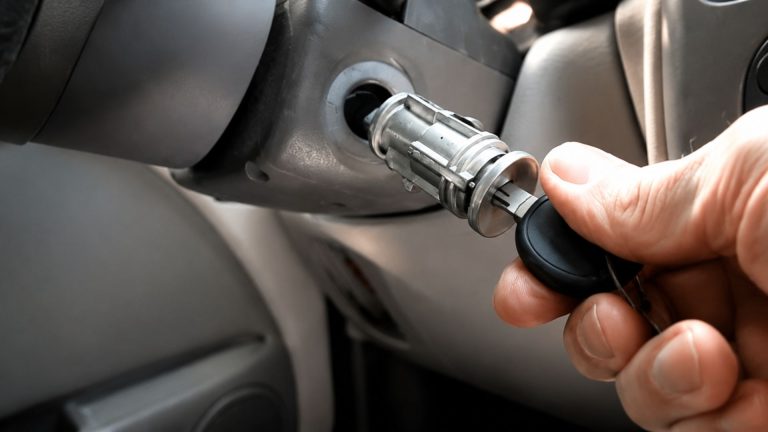
For automotive ignitions, the process is more technical. Car ignition cylinders have a narrower keyway and a deeper barrel than most door locks, and the ignition wafer stack creates additional resistance. If the key broke past the first set of wafers, a direct extraction approach may not reach the fragment. In those cases, the technician may need to remove the ignition cylinder — a process that requires knowledge of the steering column assembly specific to your vehicle’s make and model — extract the fragment under controlled conditions, and reinstall the cylinder. This is a more involved service than a door lock extraction, and it is worth having your ignition inspected for additional wear at the same appointment.

Commercial deadbolts and high-security cylinders add another layer of complexity. Mul-T-Lock, Medeco, and ASSA Abloy cylinders have tighter internal tolerances. The extraction tools must be sized correctly for the specific keyway profile — a tool sized for a Kwikset keyway will not fit cleanly in a Medeco keyway. A locksmith with commercial hardware experience carries the correct extraction tools for the lock brands they service, rather than forcing a generic tool into a precision cylinder and risking pin damage. You can learn more about our commercial locksmith services and the hardware we work with.

Quick Diagnosis: Broken Key Symptoms and What They Mean

Before a technician begins extraction, they assess the fragment’s position, the cylinder’s condition, and whether any secondary damage occurred during the break. The table below covers the most common symptoms our locksmiths evaluate on arrival.

Symptom Likely Cause What a Pro Checks
Key snapped, fragment fully inside Metal fatigue at blade cut under torque Keyway depth, fragment position, cylinder pin condition
Small piece visible at keyway opening Shallow break near key shoulder Extractability without cylinder removal; hook positioning
Key broke and lock won’t turn at all Fragment lodged under cylinder pins Pin stack alignment, whether pins dropped on fragment
Ignition key broke at tip during start Tip wear + ignition wafer resistance Wafer stack condition, fragment depth in barrel, cylinder removal need
Fragment removed but lock still feels stiff Cylinder wear or bent cam tail piece Full cylinder inspection — rekey or replacement assessment
Multiple broken keys on the same lock Cylinder wear, door frame misalignment, or chronic key duplication errors Door frame alignment, cylinder condition, original key code verification
Key broke after battery change on fob Emergency key blade was worn — went unnoticed because fob was used Emergency key blade condition, lock cylinder wear, transponder chip status

If the cylinder shows signs of wear beyond the broken key — loose plug, damaged pin chambers, or a keyway that feels rough — the technician will advise whether a rekey or a full lock change is the right next step after extraction.

After Extraction: What Your Lock or Ignition Actually Needs

Extraction solves the immediate problem, but it does not fix what caused the break. Skipping the follow-up assessment is the most common reason a lock sees a second broken key within weeks.

Cylinder wear check. A cylinder that has been wearing unevenly — loose plug, worn keyway wiper, damaged pin chambers — will continue to stress new keys the same way. A locksmith rotates and probes the cylinder to identify wear before it causes another failure.

Rekeying vs. replacement. If the cylinder itself is in acceptable condition, rekeying your lock changes the pin configuration so you’re operating on a fresh, properly cut key. If the cylinder housing is damaged — cracked plug, deformed keyway, bent cam — a full lock change is the correct next step.

Key replacement for automotive. After a broken key is extracted from an ignition, most vehicles need a new key cut and programmed. If the original key had a transponder chip, the replacement must be programmed to match your vehicle’s immobilizer. Replacement car key services from a locksmith are significantly less expensive than the same service through a dealership, and our mobile technicians complete key programming at your location — no tow required.

If you were also locked out of the vehicle during the incident, our car unlocking service and key extraction can be handled in a single dispatch. Our automotive locksmith services in Tempe cover the full range of vehicle lock and key situations.

Broken Key Extraction in Tempe: What to Expect

Extraction pricing in the Tempe and East Valley market depends on the lock type, the fragment’s position, and the level of access work required. A door lock extraction on a standard residential deadbolt costs less than a car ignition extraction where cylinder removal is involved — and both are significantly less expensive than replacing the lock or ignition outright.

Before any work begins, the CallOrange technician assesses the fragment’s position and gives you an upfront quote. There are no teardown fees charged separately from the quoted service. We operate Monday through Sunday, 6 AM to 10 PM, serving Tempe, Mesa, Chandler, Scottsdale, Phoenix, Gilbert, and Guadalupe. The technician comes to your location — you do not need to transport a vehicle with a broken key in the ignition to a shop.

Learn more about how we work and the team behind the service on our About Us page, or go directly to our full services list.

Get Your Broken Key Out — Call CallOrange Locksmith Tempe

A broken key inside a lock or ignition does not get easier to remove the longer it sits. Continued attempts to turn or extract it without the right tools can drive the fragment deeper, damage the cylinder pins, or score the keyway walls — turning a straightforward extraction into a cylinder replacement.

CallOrange Locksmith Tempe has handled broken key extraction across the East Valley since 2008. Our certified technicians carry extraction tools for the full range of lock types common in Arizona — standard residential keyways, automotive ignition cylinders, commercial deadbolts, and high-security hardware.

Call (480) 847-2635 — tell us where you are and what type of lock is involved, and we will give you a direct quote before dispatch. You can also reach us through our contact page.

Frequently Asked Questions

How much does broken key extraction cost in Tempe?

Pricing depends on the lock type and fragment position. A residential door lock extraction is a straightforward service, while an automotive ignition extraction requiring cylinder removal involves additional labor. CallOrange provides an upfront quote before any work begins — call (480) 847-2635 for a direct estimate.

Can I remove a broken key from my ignition or lock myself?

Most DIY attempts cause additional damage — pushing the fragment deeper, scoring the keyway, or dropping pins on top of the piece. Lock cylinders are precision components with tolerances measured in thousandths of an inch. A locksmith uses sized extraction tools that fit alongside the fragment without disturbing the pin stack.

How long does broken key extraction take?

A residential door lock extraction typically takes 5–10 minutes. An automotive ignition extraction where the fragment is accessible without disassembly runs 10–20 minutes. If the ignition cylinder requires removal, expect 30–45 minutes depending on the vehicle’s make and steering column access.

Will extraction damage my lock or ignition?

Done correctly with the right tools, extraction leaves the cylinder in the same condition as before the break. If the cylinder was already worn — loose plug, damaged pins, cracked housing — the technician will identify that during the assessment and advise whether rekeying or a full lock change is the right next step.

Do I need a new key after the broken piece is removed?

Yes, in all cases. The broken key cannot be rejoined, and operating a lock or ignition with the original broken piece is not safe. For door locks, a new key cut from the existing cylinder code is the most economical solution. For automotive ignitions, a replacement transponder key must be cut and programmed to your vehicle.

What if my car key broke in the ignition and the car won’t start?

Do not attempt to start the vehicle. Torque on a partially lodged fragment can drive it past the wafer stack, making extraction significantly more complex. Call a locksmith before operating the vehicle. CallOrange dispatches to your location across the East Valley — call (480) 847-2635.

The Bottom Line on Broken Key Extraction in Tempe

A key that breaks inside a lock or ignition is a mechanical failure with a mechanical solution — but only when approached with the right tools and technique. Every DIY attempt without a proper extractor risks driving the fragment deeper, collapsing the pin stack on top of it, or scoring the keyway walls. What starts as a simple extraction can turn into a full cylinder replacement if handled incorrectly.

The moment a key breaks inside your lock or ignition, stop turning. Don’t insert another key, don’t use pliers on the exposed piece, and don’t try to start the vehicle. Call a locksmith who carries the correct sized extraction tools for your specific lock type — whether that’s a standard residential deadbolt, an automotive ignition cylinder, or a high-security commercial lock.

CallOrange Locksmith Tempe has handled this exact situation across Tempe, Mesa, Chandler, Scottsdale, Phoenix, Gilbert, and Guadalupe since 2008. Our mobile technicians come to you with the equipment to extract the fragment, assess the cylinder, and get you a replacement key on the spot when needed. Call (480) 847-2635 or visit our contact page — we give you a direct quote before any work begins.

transponder-key-vs-smart-key-tempe

Transponder Key vs. Smart Key: What Does Your Car Need?

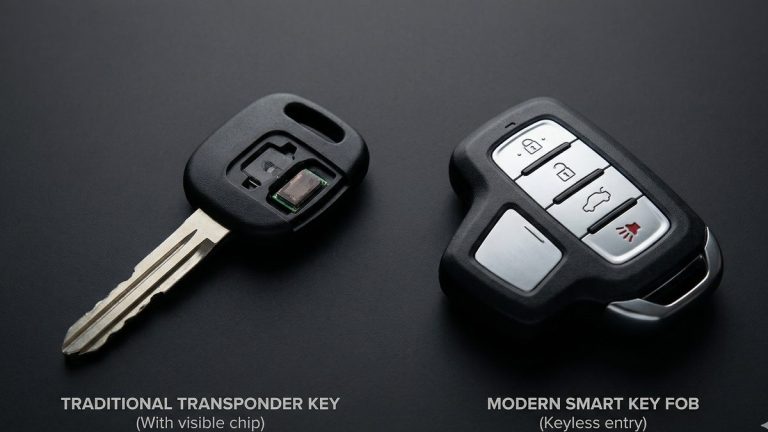
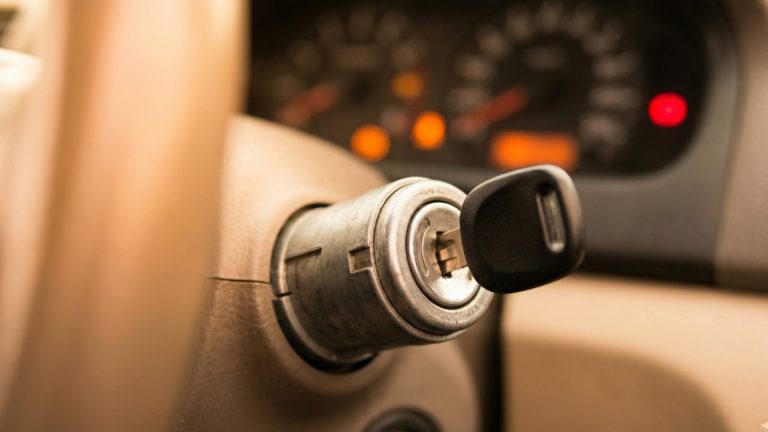
A transponder key uses a microchip embedded in the plastic head that sends a coded signal to the vehicle’s immobilizer when inserted into the ignition cylinder. A smart key (proximity key) communicates wirelessly with the vehicle through radio frequency, allowing push-to-start ignition and keyless entry without ever leaving your pocket. Both systems prevent unauthorized starting, but they use fundamentally different technology — and knowing which one your vehicle requires determines the type of replacement, the programming process, and the cost.
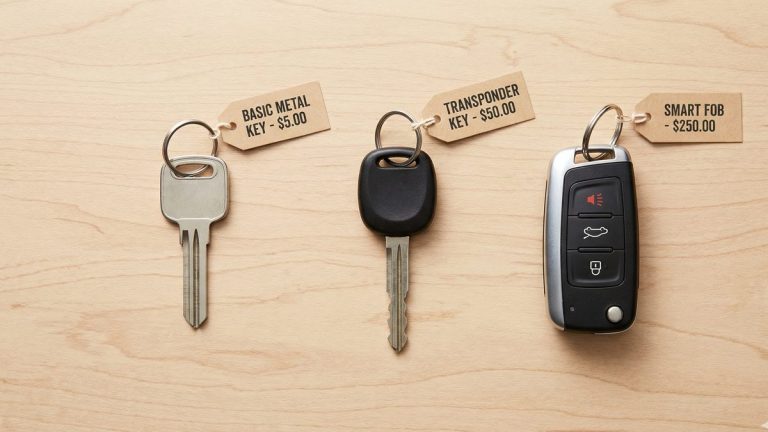
Prices shown reflect general market ranges for the Tempe and Phoenix metro area as of 2026. Actual costs depend on your vehicle’s year, make, model, and the type of key required. Contact us directly for a personalized quote.

You need a new car key, and the first question every locksmith or dealer asks is: does your vehicle use a transponder key or a smart key? For most drivers in Tempe, the answer isn’t obvious. Both key types look different from the basic metal keys that older vehicles used, and the terminology gets confusing when dealerships, auto parts stores, and online sellers use terms like “chip key,” “proximity fob,” “intelligent key,” and “keyless entry remote” interchangeably. The distinction matters because ordering the wrong type wastes money, and attempting to program a transponder key to a smart key vehicle — or vice versa — simply doesn’t work.

The core difference comes down to how the key communicates with your vehicle’s anti-theft system. A transponder key must be physically inserted into the ignition cylinder to transmit its chip signal at close range. A smart key broadcasts a rolling-code signal to the vehicle’s antenna system from several feet away, enabling push-to-start ignition and hands-free door unlocking. The immobilizer system in the vehicle is designed for one type or the other — they’re not interchangeable.

Understanding which system your car uses helps you make an informed decision about replacement car keys, avoid overpaying at the dealership, and communicate clearly with your locksmith about what you actually need. It also helps you understand why the pricing differs so significantly between the two key types.

CallOrange.com has been programming both transponder keys and smart keys for drivers across the Tempe and Phoenix metro area since 2015, with 4.8 stars across 1,451 Google reviews. Our mobile technicians carry blank key inventory and programming equipment for both systems, so diagnosis and replacement happen in a single visit at your location — whether that’s your home in South Tempe, an office near Tempe Town Lake, or a parking lot at Arizona Mills.

Feature Transponder Key Smart Key
How It Starts the Car Insert into ignition cylinder and turn Press brake + push start button (key stays in pocket)
Chip Type Passive chip — no battery, powered by immobilizer field Active transmitter — powered by CR2025/CR2032 battery
Communication Range Less than 2 inches (must be inserted) 3–15 feet (proximity detection)
Keyless Entry Only if combined with separate remote buttons Built-in — doors unlock automatically on approach
Encryption Fixed or rolling code (varies by manufacturer) Rolling-code encryption with bidirectional handshake
Battery Required No (remote buttons need battery if present) Yes — replace every 12–18 months in Arizona
Emergency Backup Mechanical key blade always functional Hidden emergency blade + passive chip for dead battery
Programming Complexity Single system — immobilizer ECU only Multi-system — keyless entry, push-to-start, and immobilizer
Typical Replacement Time 20–40 minutes on-site 30–60 minutes on-site
Common Vehicle Era 1995–2017 (still used on some current models) 2007–present (standard on most vehicles by 2020)
How It Starts the Car
Transponder KeyInsert into ignition cylinder and turn
Smart KeyPress brake + push start button (key stays in pocket)
Chip Type
Transponder KeyPassive chip — no battery, powered by immobilizer field
Smart KeyActive transmitter — powered by CR2025/CR2032 battery
Communication Range
Transponder KeyLess than 2 inches (must be inserted)
Smart Key3–15 feet (proximity detection)
Keyless Entry
Transponder KeyOnly if combined with separate remote buttons
Smart KeyBuilt-in — doors unlock automatically on approach
Encryption
Transponder KeyFixed or rolling code (varies by manufacturer)
Smart KeyRolling-code encryption with bidirectional handshake
Battery Required
Transponder KeyNo (remote buttons need battery if present)
Smart KeyYes — replace every 12–18 months in Arizona
Emergency Backup
Transponder KeyMechanical key blade always functional
Smart KeyHidden emergency blade + passive chip for dead battery
Programming Complexity
Transponder KeySingle system — immobilizer ECU only
Smart KeyMulti-system — keyless entry, push-to-start, and immobilizer
Typical Replacement Time
Transponder Key20–40 minutes on-site
Smart Key30–60 minutes on-site
Common Vehicle Era
Transponder Key1995–2017 (still used on some current models)
Smart Key2007–present (standard on most vehicles by 2020)

How Transponder Keys Work

The transponder key has been standard on most vehicles manufactured after 1995. The word “transponder” comes from “transmitter” and “responder” — which describes exactly what the chip inside the key does. When you insert the key into the ignition and turn it, the vehicle’s immobilizer sends a low-frequency radio signal to the chip. The chip responds with a unique code. If the code matches what the immobilizer expects, the engine starts. If it doesn’t match, the fuel injection and ignition circuits stay locked.

The chip itself is a passive component. It has no battery and generates no signal on its own. It only transmits when energized by the immobilizer’s electromagnetic field at very close range — typically less than two inches. This is why the key must be fully inserted into the ignition cylinder for the system to work. Holding a transponder key near the steering column without inserting it won’t trigger the immobilizer.

The chip is embedded in the plastic or rubber head of the key during manufacturing. It’s a small glass capsule about the size of a grain of rice, sealed inside the key housing. You can’t see it from the outside, but if you hold the key head up to a bright light, you can sometimes see the outline of the capsule. The metal blade portion of the key operates the mechanical ignition cylinder, while the chip handles the electronic authentication — two separate systems working together.

Transponder key programming links a specific chip’s code to a specific vehicle’s immobilizer ECU. Each vehicle can typically store codes for two to eight keys, depending on the make and model. Programming requires professional equipment that connects to the vehicle’s OBD-II diagnostic port and communicates directly with the immobilizer module. The process writes the new key’s code into the ECU’s memory so the vehicle recognizes it as authorized.

Most domestic and Asian vehicles from 1995 through the mid-2010s use transponder keys as their primary anti-theft system. Toyota, Honda, Nissan, Ford, Chevrolet, Dodge, and Hyundai all used various transponder chip types across their lineups during this period. Some vehicles from this era also include a remote head key — a transponder key with built-in lock and unlock buttons — which combines the mechanical key, the transponder chip, and a remote control fob into a single unit.

In Arizona specifically, transponder keys face a unique challenge. The extreme heat inside parked vehicles causes thermal stress on the chip’s glass capsule and the solder connections inside the key head. Over years of heat cycling — dashboard temperatures reaching 150°F or higher during Tempe summers — the chip can delaminate from its antenna coil, causing intermittent or permanent authentication failures. When a transponder key starts working inconsistently, the chip is usually the first component a locksmith tests.

How Smart Keys Work

Smart keys represent the next generation of vehicle authentication technology. Instead of a passive chip that responds only at close range, the smart key contains an active transmitter powered by a small coin-cell battery (typically CR2025 or CR2032). This transmitter broadcasts a coded signal that the vehicle’s antenna system detects from several feet away.

The communication is bidirectional and continuous. When you approach your vehicle with a smart key in your pocket or bag, the vehicle’s exterior antennas detect the key’s signal and automatically unlock the doors — no button press required. When you sit in the driver’s seat and press the start button, interior antennas verify the key’s presence inside the cabin and authorize the engine to start. The key never needs to leave your pocket for any of this to happen.

Smart keys use rolling-code encryption, meaning the authentication code changes every time the vehicle and key communicate. This makes the signal virtually impossible to intercept and replay — a significant security advantage over fixed-code transponder systems. The push-to-start system checks the code, verifies the key’s location relative to the vehicle, and confirms the encrypted handshake before allowing the engine to fire.

Every smart key contains a backup transponder chip and an emergency key blade. The hidden mechanical key — usually released by pressing a small button on the fob — unlocks the driver’s door manually if the smart key battery dies. The backup chip works the same way as a traditional transponder, allowing the vehicle to detect the key at near-zero range when held directly against the start button. This dual-system design means you’re never completely locked out by a dead key fob battery.

Smart key programming is more complex than transponder programming because the locksmith must register the key with multiple vehicle systems — the keyless entry module, the push-to-start module, and the immobilizer ECU. The programming equipment connects to the OBD-II port and walks through a multi-step registration process that varies by manufacturer. Some luxury and European brands require manufacturer-level security access codes, which adds time and complexity to the programming process.

Most vehicles manufactured after 2015 offer smart key systems as standard or optional equipment. By 2020, smart keys became the dominant system across virtually all new vehicle segments. If your vehicle has a push-button start and no ignition cylinder, it uses a smart key system. If it has both a key slot and a push-button, it likely uses a smart key with a mechanical backup.

Arizona heat affects smart keys differently than transponders because smart keys have active electronic components and a battery. The battery drains faster in extreme heat — lasting roughly 12 to 18 months in the Phoenix metro area compared to the manufacturer’s three-to-five-year estimate. The solder joints on the smart key’s circuit board are also vulnerable to thermal cycling, which causes intermittent signal failures that are especially common during summer months. If your smart key starts losing range or working inconsistently between May and October, heat damage to the internal circuitry is the most likely explanation.

Key Differences at a Glance

Understanding the practical differences between transponder and smart keys helps you identify which system your vehicle uses and what to expect during the replacement process. Here’s how the two technologies compare across the factors that matter most to vehicle owners.

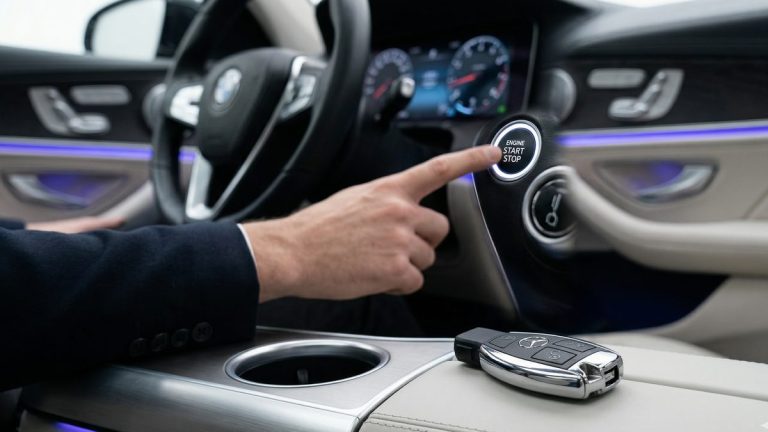
Physical appearance is the easiest way to tell them apart. A transponder key looks like a traditional key with a thicker-than-normal plastic head. The metal blade has cuts that match your ignition cylinder. A smart key is a compact fob — usually rectangular or oval — with no visible blade. The emergency blade is hidden inside the fob body, released by a slider or button. If you carry a key that you insert into the ignition, it’s a transponder. If you press a button to start the car, it’s a smart key.

How you start the vehicle is the defining functional difference. Transponder key: insert into the ignition cylinder, turn to START. Smart key: step on the brake, press the start button. Some vehicles from the transition era (roughly 2010–2015) offered both options — a key slot for the transponder and a push button for the smart key — but the vehicle uses one system or the other based on which key is detected.

Battery requirements differ significantly. Transponder keys have no battery — the chip is powered by the immobilizer’s electromagnetic field. Smart keys require a coin-cell battery that powers the active transmitter. In Arizona’s heat, smart key batteries need replacement every 12 to 18 months to maintain reliable function.

Replacement cost reflects the technology difference. Transponder keys involve a metal blade blank, a compatible chip, cutting to match the ignition, and programming. Smart keys involve a more expensive fob blank with a circuit board, antenna, battery holder, buttons, and the emergency blade — plus multi-system programming. A smart key replacement typically costs more than a transponder key replacement for the same vehicle brand.

Security level is higher with smart keys. Rolling-code encryption, bidirectional communication, and proximity detection make smart keys significantly harder to defeat than fixed-code transponder systems. However, both systems are far more secure than mechanical keys alone, and both effectively prevent hotwiring.

Convenience is the smart key’s main advantage for daily use. Keyless entry, keyless start, and hands-free trunk opening eliminate fumbling for keys. Transponder keys require physical insertion and rotation, which is functional but lacks the walk-up-and-go experience.

Which Vehicles Use Which System

Knowing your vehicle’s key type before you need a replacement saves time and avoids ordering the wrong part. Here’s a general guide organized by brand and era, though specific trim levels and option packages can vary.

Toyota and Lexus transitioned aggressively to smart keys. Most Toyota models from 2018 onward use smart keys as standard equipment. Lexus adopted smart keys earlier — from 2006 onward across most models. Older Toyotas (1998–2017) use transponder keys with various chip types (4C, 4D, G, H). The Camry, Corolla, RAV4, and Highlander all made the switch between 2018 and 2020 depending on trim. Our technicians program both Toyota transponder and smart keys at your location.

Honda and Acura followed a similar timeline. Honda Civic, Accord, CR-V, and Pilot models from 2018 onward typically use smart keys. Earlier models (1998–2017) use transponder keys. Acura adopted smart keys earlier, with most models switching by 2014–2016.

Nissan and Infiniti were early smart key adopters. Nissan’s “Intelligent Key” system appeared in the Altima and Maxima as early as 2007. By 2015, most Nissan models offered smart keys as standard. The Rogue, Sentra, and Pathfinder transitioned between 2013 and 2018. Infiniti has used smart keys across nearly all models since 2008.

Ford and Lincoln vary more by model. The F-150, the most popular vehicle on Arizona roads, transitioned to smart keys with the 2015 model year. Mustang, Explorer, and Escape followed between 2016 and 2020. Older Ford vehicles use transponder keys with the well-known 80-bit or 128-bit chip systems.

Hyundai and Kia made smart keys standard across most lineups by 2018–2020. Earlier models (2006–2017) use transponder keys with various chip types. The Tucson, Santa Fe, Sportage, and Telluride all use smart keys in current production.

Chevrolet, GMC, and other GM brands have mixed timelines. The Silverado and Sierra gained smart keys with the 2019 redesign. Equinox and Traverse transitioned between 2018 and 2020. Older GM vehicles use transponder keys, some with the unique GM “circle plus” key head design.

European brands — BMW, Mercedes-Benz, Audi, and Volkswagen — were among the earliest smart key adopters. BMW’s Comfort Access system dates back to 2004. Mercedes KEYLESS-GO appeared in 2003. These brands use the most complex encryption and the most expensive fob hardware, which is reflected in higher replacement costs compared to domestic and Asian brands.

If you’re not sure which system your vehicle uses, the simplest test is this: look at your dashboard around the steering column. If there’s a slot or cylinder where you insert a key, your vehicle uses a transponder key. If there’s only a start/stop button with no key slot, it uses a smart key. You can also check your owner’s manual or call (480) 847-2635 with your year, make, and model for immediate confirmation.

The Replacement Process for Each Key Type

The process of getting a new key differs between transponder and smart keys in both the steps involved and the equipment required. Understanding the workflow helps you know what to expect when a mobile automotive locksmith arrives at your location.

Transponder key replacement involves four steps. First, the locksmith identifies the correct key blank for your vehicle — this includes both the right blade profile and the right chip type. Second, the blade is cut using either a code cutter (cutting by the factory bitting code) or an impression/decode from the existing lock. Third, the chip is programmed to your vehicle’s immobilizer using diagnostic equipment connected to the OBD-II port. Fourth, the technician tests the new key through multiple start cycles to confirm reliable authentication. The entire process typically takes 20 to 40 minutes for most vehicles.

Smart key replacement involves additional steps because of the multi-system integration. The locksmith identifies the correct fob blank, which must match not just the vehicle but the specific model year and sometimes the trim level. The emergency blade inside the fob is cut to match the driver’s door lock. The fob is then registered with the keyless entry module, the push-to-start module, and the immobilizer ECU through the OBD-II diagnostic interface. Some vehicles require an initialization drive cycle after programming — the technician drives the vehicle a short distance to confirm all systems accept the new key. This process takes 30 to 60 minutes depending on the vehicle’s complexity.

All-keys-lost situations — where you have no working key — add complexity to both processes. Without an existing key for reference, the locksmith must decode the lock to determine the correct blade cuts and may need to access the vehicle’s immobilizer through advanced security protocols rather than the standard “add a key” procedure. All-keys-lost jobs take longer and cost more because of the additional diagnostic and security steps required.

Programming two keys at once is recommended and costs less per key than programming them separately. The vehicle’s ECU handles the registration of both keys in a single programming session. Most immobilizer systems can store four to eight key codes, so having a spare programmed alongside your primary key is both practical and cost-effective. Store the spare in a cool location inside your home — not in the vehicle where Arizona heat will degrade the components.

Pricing Differences in the Tempe Market

The cost difference between transponder and smart key replacement is significant because the technology, parts, and programming complexity differ substantially. Here’s what the Tempe and Phoenix metro market looks like for common replacement scenarios in 2026.

Transponder key replacement costs less because the blank key is simpler — a metal blade with an embedded chip — and the programming process involves a single system (the immobilizer). Domestic brands like Ford, Chevrolet, and Dodge tend to fall at the lower end because their chip systems are well-established and blanks are widely available. Asian brands like Toyota, Honda, and Nissan fall in a similar range. European transponder keys cost more because of proprietary chip encryption and restricted blank availability.

Smart key replacement costs more because the fob blank itself is a complex electronic device — circuit board, antenna, battery compartment, buttons, emergency blade, and housing — and the programming touches multiple vehicle systems. The fob blank alone typically costs two to three times more than a transponder blank. Add the multi-step programming and the higher-security encryption, and the total runs meaningfully higher than a transponder key for the same brand.

Factors that affect pricing for both key types:

  • Vehicle make and year — older vehicles with simpler systems cost less than newer ones with advanced encryption
  • OEM versus aftermarket blanks — OEM parts carry higher cost but guaranteed compatibility, aftermarket offers savings with slight compatibility risk
  • All-keys-lost versus adding a key — no existing working key means more diagnostic work and higher cost
  • Number of keys being programmed — two keys in one session costs less per unit than two separate visits
  • Time of service — standard hours versus evening or weekend availability

Dealership pricing comparison: Both transponder and smart key replacements cost substantially more at the dealership than through a mobile locksmith. The parts are the same. The programming process is the same. The difference is dealership overhead — facility costs, parts markup, and the inconvenience factor of towing your vehicle to the dealer and waiting days for an appointment versus having a mobile technician come to your location and complete the work in under an hour.

Protecting Your Keys in Arizona Heat

Regardless of whether you carry a transponder key or a smart key, Arizona’s desert climate demands proactive care to extend key life and avoid unexpected failures. These maintenance steps apply to both key types with some specific differences.

For transponder keys: The chip itself is sealed and maintenance-free, but the plastic key head that houses it degrades in UV and heat. If the key head shows cracks, replace the housing before the chip capsule is exposed. A cracked housing allows dust and moisture to reach the chip, accelerating failure. Keep your transponder key on a minimal keychain — heavy rings put stress on the ignition cylinder and the key head simultaneously.

For smart keys: Replace the battery every 12 to 18 months — don’t wait for it to die. Store your spare fob indoors, never in the vehicle’s glovebox or center console where summer heat will damage the circuit board. Use a protective silicone case if the fob rides in a pocket with coins or keys. Clean the battery contacts annually with a dry cotton swab.

For both key types: Have a spare key made and programmed while your primary key still works. An all-keys-lost situation costs more and takes longer because the locksmith has to work through additional security protocols. Getting a spare car key made proactively — while you have a working key for reference — is the most cost-effective approach.

Avoid leaving keys in direct sunlight on dashboards, windowsills, or outdoor tables. The concentrated heat degrades both the transponder chip’s antenna coil and the smart key’s solder joints. A few seconds of habit — dropping the key into a shaded pocket or a drawer — adds years to the key’s functional life.

Frequently Asked Questions

How do I know if my car has a transponder or smart key?

Look at your dashboard near the steering column. If there’s a slot where you insert a key and turn it to start the car, you have a transponder key. If there’s only a start/stop button with no key slot, you have a smart key. You can also check by looking at the key itself — a transponder key has a visible metal blade with a thick plastic head, while a smart key is a compact fob with no visible blade.

Why do smart keys cost more to replace than transponder keys?

Smart keys cost more because the fob blank itself is a complex electronic device with a circuit board, antenna, battery holder, and buttons. The programming process is also more involved — it requires registering the key with the keyless entry module, push-to-start system, and immobilizer ECU rather than just the immobilizer alone. The higher parts cost and longer programming time both contribute to the price difference.

Can a locksmith program both key types or only a dealership?

A licensed automotive locksmith with professional programming equipment can program both transponder keys and smart keys for virtually all major vehicle brands. The diagnostic tools connect to the same OBD-II port and use the same protocols as dealership equipment. Mobile locksmiths complete the work at your location, which eliminates the need to tow your vehicle to a dealer.

Does Arizona heat damage transponder and smart keys?

Yes, but in different ways. Transponder keys suffer from thermal stress on the chip’s glass capsule and antenna coil, which can cause intermittent authentication failures over time. Smart keys face battery drain (batteries last 12–18 months instead of 3–5 years), solder joint fatigue on the circuit board, and button membrane degradation from UV exposure. Both key types benefit from being stored away from direct sunlight and extreme cabin heat.

Can I buy a key online and have it programmed locally?

You can, but there’s a compatibility risk. Aftermarket blanks from Amazon or eBay may not match your specific vehicle year and trim, and some use incompatible chip types that won’t program correctly. If the blank doesn’t match, you’ll pay for a service visit with no result. A locksmith who supplies the key guarantees compatibility and typically includes cutting and programming in one price.

What if I lost all my keys and have no spare?

All-keys-lost situations are more complex and cost more than adding a key when you have a working one. The locksmith must decode the lock to determine blade cuts and access the immobilizer through advanced security protocols. The process takes longer but is fully doable on-site. This is why having a spare key programmed proactively — while you still have a working key — is the most cost-effective approach.

Do I need ID for key replacement service?

Yes. A valid government-issued photo ID and current vehicle registration are required before any key cutting or programming begins. This is a security measure that protects vehicle owners from unauthorized key duplication and is standard practice across the entire locksmith industry.

Getting the Right Key for Your Vehicle in Tempe

Whether your car needs a transponder key or a smart key, accurate identification is the first step to a successful replacement. The wrong blank, the wrong chip type, or the wrong programming protocol means a wasted service call and wasted money. A professional locksmith identifies the exact key type your vehicle requires before ordering parts or starting work.

CallOrange.com serves the Tempe and Phoenix metro area with mobile technicians who carry transponder blanks, smart key fobs, cutting equipment, and multi-system programming tools for every major vehicle brand. With 1,451 Google reviews at 4.8 stars and 11 years of operation since 2015, every technician is licensed, insured, and trained to handle both key technologies across domestic, Asian, and European vehicles.

Call (480) 847-2635 with your vehicle’s year, make, model, and trim — we’ll confirm the key type, give you an upfront quote, and schedule a visit at your location. Bring your vehicle registration and a valid photo ID — both are required before any key programming work. You can also reach out through the contact page or learn more about the team on the about us page.

signs-car-ignition-needs-repair-tempe

Signs Your Car Ignition Needs Repair (Before You Get Stranded)

A car ignition that hesitates, sticks, or refuses to turn typically signals worn wafer tumblers inside the ignition cylinder — not a dead battery. Arizona’s extreme heat accelerates the wear on these internal brass components, causing the cylinder to bind against the key blade. A licensed locksmith inspects the wafer stack, tests the electrical switch behind the cylinder, and either repairs or replaces the assembly on-site.
Prices shown reflect general market ranges for the Tempe and Phoenix metro area as of 2026. Actual costs depend on your vehicle’s year, make, model, and the extent of ignition damage. Contact us directly for a personalized quote.

You slide your key into the ignition, turn it, and nothing feels right. Maybe it sticks halfway, maybe it turns but the engine doesn’t crank, or maybe the key won’t go in at all. For drivers in Tempe, these symptoms tend to show up during the hottest months — and they almost never fix themselves. Ignoring an ignition problem doesn’t just mean inconvenience. It means a real chance of getting stranded in a parking lot at Tempe Marketplace or along the 101 when the cylinder finally locks up completely.

The ignition cylinder is a mechanical assembly with a stack of spring-loaded wafer tumblers that match the cuts on your key blade. Every time you insert and turn the key, metal slides against metal. Over thousands of cycles, the wafers lose their precise tolerances. The springs weaken. The cylinder bore accumulates microscopic debris from key blade wear and desert dust that works its way into the keyway. Eventually, the tumblers can’t align properly, and the cylinder either binds, jams, or spins freely without engaging the electrical switch behind it.

The fix depends entirely on what’s actually failing — the cylinder, the electrical switch, the key itself, or the anti-theft immobilizer. A professional diagnosis separates these possibilities before any parts get replaced. That distinction matters because replacing a cylinder when the real problem is a worn key blade wastes money, and replacing a key when the cylinder is shot doesn’t solve anything.

CallOrange.com has been diagnosing and repairing car ignition problems in Tempe since 2015. With 4.8 stars across 1,451 Google reviews and mobile technicians who carry ignition parts and diagnostic tools on every service call, the repair happens wherever your vehicle is — your driveway, a business parking lot, or the side of the road.

Symptom Likely Cause What a Pro Checks
Key is hard to turn Worn wafer tumblers or heat-expanded cylinder bore Tests wafer retraction and spring tension under controlled pressure
Key goes in but won’t rotate Seized wafer stack or steering column lock engaged Rules out column lock, then inspects cylinder bore for scoring and debris
Key turns but engine won’t crank Failed ignition switch contacts behind cylinder Multimeter continuity test across all switch positions (OFF, ACC, ON, START)
Grinding or clicking on key turn Worn actuator coupling or starter solenoid connection Inspects actuator engagement and tests starter circuit voltage
Dashboard lights flicker during start Loose or corroded ignition switch contact points Checks for intermittent resistance spikes while rotating key slowly
Vehicle stalls while driving Ignition switch losing contact in RUN position Tests switch continuity in RUN position under vibration and lateral load
Key is hard to turn
Likely CauseWorn wafer tumblers or heat-expanded cylinder bore
What a Pro ChecksTests wafer retraction and spring tension under controlled pressure
Key goes in but won’t rotate
Likely CauseSeized wafer stack or steering column lock engaged
What a Pro ChecksRules out column lock, then inspects cylinder bore for scoring and debris
Key turns but engine won’t crank
Likely CauseFailed ignition switch contacts behind cylinder
What a Pro ChecksMultimeter continuity test across all switch positions (OFF, ACC, ON, START)
Grinding or clicking on key turn
Likely CauseWorn actuator coupling or starter solenoid connection
What a Pro ChecksInspects actuator engagement and tests starter circuit voltage
Dashboard lights flicker during start
Likely CauseLoose or corroded ignition switch contact points
What a Pro ChecksChecks for intermittent resistance spikes while rotating key slowly
Vehicle stalls while driving
Likely CauseIgnition switch losing contact in RUN position
What a Pro ChecksTests switch continuity in RUN position under vibration and lateral load

Early Warning Signs That Your Ignition Is Failing

Ignition failure rarely happens overnight. The cylinder sends warning signals for weeks or months before it locks up completely. Recognizing these signs early gives you time to schedule a repair instead of dealing with an emergency breakdown.

The key is harder to turn than it used to be. This is the most common early symptom. You find yourself applying more force than normal to rotate the key from ACC to START. The increased resistance means the wafer tumblers inside the cylinder aren’t retracting smoothly. In Arizona, this symptom accelerates during summer because thermal expansion tightens the already-worn tolerances between the wafers and the cylinder bore. What starts as slight stiffness in June can become a stuck key by August.

The key goes in but won’t turn at all. This is a step beyond stiffness — the cylinder is genuinely locked. Before assuming the ignition is broken, check that the steering wheel isn’t in a locked position. Wiggle the wheel left and right while gently turning the key. If that doesn’t work, the wafer stack has likely seized. Forcing the key risks snapping the blade inside the cylinder, which turns a repair into a more involved extraction and replacement job.

The key turns but the engine doesn’t crank. When the mechanical cylinder rotates correctly but nothing electrical happens, the problem is usually the ignition switch — the electrical component mounted behind the cylinder. The switch has contact points that wear over time, especially on vehicles with heavy keychains that put constant lateral pressure on the cylinder and switch assembly. This symptom can also appear intermittently, working on the third or fourth try before failing again.

You hear grinding or clicking when turning the key. Grinding indicates metal-on-metal contact where the cylinder’s actuator engages the switch. Clicking without engine cranking points to a weak starter solenoid connection, which can originate at the switch. Either sound means internal components are physically degrading.

The dashboard lights flicker or cut out during key rotation. Loose internal contacts in the ignition switch cause momentary power interruptions as the key passes through positions. You might notice the radio resetting, dashboard lights blinking, or the clock losing its time setting. These electrical glitches trace back to a switch that can’t maintain steady contact across all positions.

The vehicle stalls while driving. This is the most dangerous symptom. A failing ignition switch can lose contact in the RUN position, killing engine power without warning. If your vehicle has shut off while driving — even once — treat the ignition repair as urgent. A stall on the I-10 or Loop 202 at highway speed is a serious safety risk.

How Arizona Heat Damages Your Ignition System

Desert heat doesn’t just make your car uncomfortable. It directly accelerates the mechanical and electrical wear patterns that cause ignition failure. Understanding the specific heat-related damage mechanisms helps explain why ignition problems are more common in the Phoenix metro area than in milder climates.

Thermal expansion changes metal tolerances. The ignition cylinder, wafer tumblers, key blade, and housing are all metal components with slightly different thermal expansion rates. When cabin temperatures reach 150°F or higher inside a parked vehicle, these components expand unevenly. The wafers may press harder against the cylinder bore, the key blade may fit tighter in the keyway, and the spring tension changes. Over hundreds of heat-cool cycles per summer, the cumulative dimensional changes accelerate wear beyond what the manufacturer designed for.

Plastic components become brittle. The ignition housing, the bezel around the cylinder, and some internal actuator components use engineered plastics. Arizona’s UV exposure through windshields and sustained heat causes these plastics to lose flexibility over three to five years. Brittle plastic components crack under normal use forces, and once the housing cracks, debris enters the cylinder and wafer stack alignment shifts.

Electrical contacts oxidize faster. The ignition switch behind the cylinder uses copper or brass contact points. Heat accelerates oxidation, building a resistive layer on the contacts that weakens electrical flow. The result is intermittent starting failures — the key turns, the contacts touch, but the corroded surface can’t pass enough current to engage the starter reliably. This is why some drivers find their car starts fine in the cool morning but fails to start after sitting in a hot parking lot all afternoon.

Key blades wear faster from expanded cylinders. When you force a key into a heat-expanded cylinder repeatedly, the key blade wears down along its cut edges. A worn key compounds the cylinder problem — now both the key and the cylinder are out of spec. A replacement car key cut to factory specifications often restores smooth operation if the cylinder itself hasn’t crossed the damage threshold.

Dashboard and steering column temperatures concentrate heat. The ignition cylinder sits in the steering column, which is directly exposed to windshield-magnified sunlight. Surface temperatures on the dashboard and steering column regularly exceed ambient cabin temperature. The cylinder absorbs and retains this heat longer than other interior components because of its metal mass, which means the expansion effects persist even after you start the engine and run the AC.

What a Locksmith Checks During Ignition Diagnosis

Professional ignition diagnosis follows a systematic process that isolates the failing component before recommending repair or replacement. This matters because the symptoms of a worn cylinder, a failing switch, a worn key, and an immobilizer fault can overlap significantly.

Key blade inspection comes first. The technician examines the key’s cut edges under magnification, comparing wear patterns against the original bitting depth. A key that’s worn down even a fraction of a millimeter may not engage the wafer tumblers at the correct depth, mimicking a cylinder failure. If the key is worn but the cylinder is intact, cutting a new car key to OEM specifications solves the problem at a fraction of the cost of cylinder replacement.

Cylinder function test follows. Using a calibrated pick set and tension tools, the technician tests whether the wafer tumblers retract and return properly under spring pressure. Tumblers that stick, fail to return, or feel gritty indicate internal wear or debris contamination. The technician also checks for cylinder free-spin — a condition where the actuator coupling has broken and the cylinder rotates without engaging the switch. Free-spin means the cylinder needs replacement regardless of wafer condition.

Electrical switch continuity test. With the cylinder in each key position (OFF, ACC, ON, START), the technician uses a multimeter to verify that the switch passes current to the correct circuits. Resistance readings that spike or drop intermittently confirm worn contact points inside the switch. On some vehicles, the switch can be replaced independently of the cylinder, which reduces the repair cost.

Immobilizer system check. Modern vehicles with transponder keys or smart key systems add an electronic layer to the ignition process. The immobilizer must recognize the key’s transponder chip before allowing the engine to start. If the chip signal is weak — common with heat-damaged transponder keys — the engine cranks but won’t fire, or the security light on the dashboard stays illuminated. The technician uses a diagnostic scanner to read the immobilizer status and determine whether the key, the antenna ring, or the ECU module needs attention.

Steering column inspection. On vehicles where the ignition cylinder is column-mounted, the technician checks for play or looseness in the column housing. A loose housing allows the cylinder to shift under key pressure, which accelerates wear and can cause intermittent contact with the switch. Tightening or shimming the housing is a straightforward fix that extends the life of the cylinder.

Ignition Repair Versus Full Replacement

Not every ignition problem requires a complete cylinder and switch replacement. The right approach depends on which components have actually failed and how far the damage has progressed.

Wafer tumbler rebuild is the least invasive option. If the cylinder bore is still within tolerance and only a few tumblers are worn or broken, a locksmith can disassemble the cylinder, replace the damaged wafers and springs, and reassemble the unit. This restores proper key engagement without replacing the entire cylinder. The advantage is lower cost and keeping your existing key — no new keys to cut or program. This option works best when the problem is caught early, before the cylinder bore itself is scored.

Cylinder replacement is necessary when the bore is worn, scored, or the actuator coupling is broken. The old cylinder comes out, a new one goes in, and the locksmith cuts new keys to match the new cylinder’s wafer pattern. On vehicles with transponder systems, the new keys also need programming to the immobilizer ECU. This is the most common repair for vehicles with more than 100,000 miles or more than eight years of Arizona heat exposure.

Ignition switch replacement addresses the electrical component independently. When the cylinder turns smoothly but electrical symptoms persist — intermittent starting, dashboard flickering, stalling — the switch is the problem. On many vehicles, the switch mounts behind the cylinder with a few screws and a wiring harness connector. Replacing it doesn’t require new keys or reprogramming.

Full ignition assembly replacement covers both the cylinder and switch as a single unit. Some vehicle manufacturers design these as integrated assemblies that can’t be separated. In those cases, replacement means a new cylinder, new switch, new keys, and reprogramming. This is the most involved option but provides a complete fresh start for the entire ignition system.

A technician from CallOrange.com diagnoses the specific failure and recommends only the repair level that the situation actually requires. Replacing the full assembly when only a switch needs attention wastes money. Rebuilding tumblers when the bore is scored wastes time. Accurate diagnosis prevents both.

What Ignition Repair Costs in the Tempe Market

Ignition repair pricing varies based on the scope of work and the vehicle make and model. Here’s what drivers in the Phoenix metro area can expect for the most common ignition services in 2026.

Key duplication and cutting falls at the low end of the cost range. If diagnosis reveals that the ignition cylinder is fine but the key blade is worn, a new key cut to factory specifications resolves the problem without touching the ignition hardware. Transponder keys cost more than standard mechanical keys because the chip needs programming to match the vehicle’s immobilizer.

Wafer rebuild and cylinder service — cleaning, re-pinning, and lubricating the existing cylinder — falls in the mid-range. This is a labor-intensive repair but avoids the cost of new cylinder hardware. It’s the most cost-effective option for vehicles where the damage is limited to a few worn tumblers.

Full cylinder replacement with new keys is the most common repair and carries a higher cost that reflects both parts and programming time. The price depends heavily on the vehicle — domestic brands tend to cost less than European or luxury vehicles because the parts are more readily available and the programming protocols are simpler.

Ignition switch replacement varies by vehicle design. On models where the switch is easily accessible behind the cylinder, it’s a moderate repair. On vehicles where reaching the switch requires significant steering column disassembly, labor time increases the cost.

Factors that influence final pricing:

  • Vehicle make, model, and year — a Honda Civic ignition costs less than a BMW 3 Series
  • Whether the vehicle has a transponder or smart key system requiring programming
  • Whether the repair is cylinder only, switch only, or full assembly
  • Time of service — standard business hours versus evening or weekend
  • Mobile service at your Tempe location versus towing to a shop

Dealership pricing runs significantly higher for the same repair because of facility overhead, parts markup, and the scheduling delays that often mean paying for a tow and waiting days for an appointment. A mobile locksmith performs the same repair on-site, typically within the same day.

Preventing Ignition Problems in the Desert

Proactive maintenance extends the life of your ignition system and reduces the chance of a no-start emergency. These steps are simple and particularly important for vehicles parked outdoors in the Tempe and Phoenix area.

Use your key smoothly — never force it. If the key resists, stop. Wiggle the steering wheel to release the column lock. Jiggling or forcing the key accelerates wear on both the key blade and the wafer tumblers. The 30 seconds you save by muscling the key costs you hundreds in premature cylinder wear.

Keep your keychain light. A heavy keychain hanging from the ignition creates constant lateral force on the cylinder and the switch behind it. Over time, this force wears the cylinder bore unevenly and loosens the switch contacts. Remove everything except the ignition key and one or two small items.

Use a windshield sun shade. Reducing cabin temperature directly reduces thermal stress on the ignition cylinder and all dashboard electronics. A reflective sun shade cuts interior temperatures by 30–40°F. For vehicles parked outdoors all day in Tempe, this is the single most impactful preventive step.

Get a spare key cut before you need one. A worn key accelerates cylinder wear. Having a fresh key cut to factory specifications and rotating between two keys extends the life of both the keys and the cylinder. Your automotive locksmith can cut and program a spare during a routine visit.

Don’t ignore early symptoms. A key that requires extra force today will be a key that gets stuck next month. Schedule a diagnostic visit at the first sign of resistance, grinding, or intermittent starting. Early intervention almost always means a simpler, less expensive repair.

Frequently Asked Questions

How do I know if my ignition needs repair?

The most common signs are a key that’s harder to turn than usual, a key that goes in but won’t rotate, grinding sounds during key rotation, and intermittent starting failures. If your dashboard lights flicker when turning the key or the vehicle has stalled while driving, the ignition switch or cylinder likely needs professional attention.

Can a locksmith fix my ignition or just the dealership?

A licensed automotive locksmith can diagnose, repair, and replace ignition cylinders and switches for virtually all vehicle makes and models. The process uses the same diagnostic approach as a dealership. Mobile locksmiths perform the work at your location, which eliminates towing costs and dealership scheduling delays.

Will I need new keys after ignition replacement?

It depends on the repair. If only the ignition switch is replaced, your existing keys continue to work. If the ignition cylinder is replaced, new keys are cut to match the new cylinder. On vehicles with transponder systems, the new keys also need programming to the vehicle’s immobilizer before the engine will start.

Does Arizona heat cause ignition problems?

Yes. Sustained temperatures above 110°F cause thermal expansion in the ignition cylinder’s metal components, accelerating wear on the wafer tumblers and bore. The heat also degrades plastic housing components, oxidizes electrical contacts in the switch, and shortens the lifespan of the internal springs. Ignition failures are more common in the Phoenix metro area than in milder climates.

How long does ignition repair take on-site?

Most ignition repairs take 45 minutes to 90 minutes once the technician arrives. A simple switch replacement is on the shorter end. A full cylinder replacement with new key cutting and transponder programming takes closer to 90 minutes. The technician carries all parts and tools needed to complete the job in a single visit.

Is it safe to drive with a failing ignition?

No. A failing ignition switch can lose contact in the RUN position and kill the engine without warning while you’re driving. This is especially dangerous at highway speeds on the I-10 or Loop 202. If your vehicle has stalled even once, treat the ignition repair as an urgent safety issue and avoid driving until it’s fixed.

Do I need ID for ignition repair service?

Yes. A valid government-issued photo ID and current vehicle registration are required before any ignition work begins. This is a standard security measure across the locksmith industry that protects vehicle owners from unauthorized access to their ignition system.

Getting Your Ignition Diagnosed in Tempe

A failing ignition gives warning signs before it leaves you stranded. The sooner you address stiffness, grinding, intermittent starting, or dashboard flickering, the simpler and less expensive the fix will be. Waiting until the cylinder locks up completely or the vehicle stalls in traffic turns a routine repair into an emergency.

CallOrange.com has been repairing ignition systems across the Tempe and Phoenix metro area since 2015, with 1,451 Google reviews at 4.8 stars. Every mobile technician carries ignition cylinders, switches, key cutting equipment, and transponder programming tools — so the diagnosis and repair happen in a single visit at your location. Licensed, insured, and equipped to work on every major vehicle brand on the road today.

Call (480) 847-2635 to describe your symptoms and schedule a diagnostic visit. Bring your vehicle registration and a valid photo ID — both are required before any ignition work. You can also reach out through the contact page or learn more about the service team on the about us page.

push-to-start-key-fob-not-working-tempe

Push-to-Start Key Fob Not Working? What to Do in Tempe

A push-to-start key fob that stops responding usually traces back to a depleted coin-cell battery, corroded contact terminals inside the fob housing, or heat-damaged circuitry from Arizona’s extreme summers. A licensed locksmith tests the fob’s signal output, inspects the internal PCB, and either replaces the battery, repairs the contacts, or programs a replacement fob to your vehicle’s receiver module.
Prices shown reflect general market ranges for the Tempe and Phoenix metro area as of 2026. Actual costs depend on your vehicle’s year, make, model, and the type of key fob required. Contact us directly for a personalized quote.

You press the brake, hit the start button, and nothing happens. The dashboard stays dark or flashes a “key not detected” warning. In Tempe, this scenario plays out more often than most drivers expect — especially between May and October when surface temperatures inside parked vehicles regularly exceed 150°F. That kind of heat doesn’t just make your steering wheel untouchable. It warps the plastic housing around delicate electronic components that your fob depends on to communicate with your car.

The push-to-start system relies on a low-frequency signal exchange between your key fob and a receiver antenna built into the steering column or center console. When the fob’s internal transmitter weakens — whether from a dying battery, cracked solder joints, or UV-degraded circuitry — the vehicle can’t authenticate the signal and refuses to start. The problem isn’t always the fob itself, either. The vehicle’s antenna module, the immobilizer ECU, or even a drained car battery can mimic the same symptoms.

The right approach starts with professional diagnosis. A certified locksmith uses frequency-testing equipment to measure whether the fob is transmitting at all, then narrows down the cause to the fob, the vehicle’s receiver, or the programming link between them. That process avoids the common mistake of buying a new fob online only to discover the real issue was somewhere else entirely.

CallOrange.com has been diagnosing and programming push-to-start key fobs in Tempe since 2015. With 4.8 stars across 1,451 Google reviews and mobile technicians who come to your location, the diagnostic and repair process happens wherever your vehicle is parked — your driveway, an office lot in Downtown Tempe, or the ASU campus parking structure off University Drive.

Symptom Likely Cause What a Pro Checks
Fob works only at very close range Weak battery or partially cracked antenna trace on PCB Frequency analyzer measures signal strength at multiple distances
No response from any fob button Dead battery, fried transmitter chip, or broken solder joint Opens fob housing, inspects PCB for burn marks and tests battery voltage
Lock/unlock works but car won’t start Immobilizer rolling-code desynchronization Connects OBD-II diagnostic tool to check ECU-to-fob code alignment
Fob works intermittently in hot weather Thermal solder fatigue on transmitter circuit Inspects solder joints under magnification for micro-cracks
One button works, others don’t Degraded rubber membrane under specific button Removes button pad, checks conductive coating for wear or UV damage
Dashboard shows “key not detected” Vehicle receiver antenna failure or weak 12V battery Tests receiver antenna response with known-good fob; checks vehicle battery voltage
Fob works only at very close range
Likely CauseWeak battery or partially cracked antenna trace on PCB
What a Pro ChecksFrequency analyzer measures signal strength at multiple distances
No response from any fob button
Likely CauseDead battery, fried transmitter chip, or broken solder joint
What a Pro ChecksOpens fob housing, inspects PCB for burn marks and tests battery voltage
Lock/unlock works but car won’t start
Likely CauseImmobilizer rolling-code desynchronization
What a Pro ChecksConnects OBD-II diagnostic tool to check ECU-to-fob code alignment
Fob works intermittently in hot weather
Likely CauseThermal solder fatigue on transmitter circuit
What a Pro ChecksInspects solder joints under magnification for micro-cracks
One button works, others don’t
Likely CauseDegraded rubber membrane under specific button
What a Pro ChecksRemoves button pad, checks conductive coating for wear or UV damage
Dashboard shows “key not detected”
Likely CauseVehicle receiver antenna failure or weak 12V battery
What a Pro ChecksTests receiver antenna response with known-good fob; checks vehicle battery voltage

Why Push-to-Start Fobs Fail in the Phoenix Metro Area

Arizona’s Sonoran Desert climate creates conditions that accelerate electronic component failure in ways that drivers in milder states rarely experience. Understanding what actually breaks inside your fob helps you make smarter decisions about repair versus replacement.

Thermal cycling is the primary culprit. When you park your car at Tempe Marketplace or along Mill Avenue during a July afternoon, the cabin temperature can spike past 160°F within 20 minutes. The fob sitting in your cupholder or center console absorbs that heat directly. Over weeks and months, the repeated cycle of extreme heat during the day and air-conditioned cool at night causes the solder joints on the fob’s printed circuit board to expand, contract, and eventually crack. Once a solder joint fractures, the signal transmission becomes intermittent — the fob works sometimes and fails other times with no obvious pattern.

UV radiation degrades the rubber button membranes that seal the fob’s internal contacts. When those membranes harden and shrink, pressing the lock or unlock button no longer makes reliable contact with the circuit board underneath. You might notice that you have to press harder than you used to, or press multiple times before the car responds. That’s a textbook sign of membrane deterioration, and it’s far more common in Arizona than in northern climates.

The coin-cell battery inside a standard key fob — usually a CR2025 or CR2032 — has a rated shelf life of about five years under normal conditions. Arizona heat cuts that lifespan roughly in half. The chemical reaction inside lithium cells accelerates at higher temperatures, which means a fob battery that would last four years in Seattle might drain in under two years here in the Valley.

Fine desert particulate also works its way into the fob casing through button gaps and seam lines. This dust is abrasive at a microscopic level. It settles on the battery contacts and the PCB traces, creating a resistive layer that weakens the signal output even when the battery is technically still charged.

The Emergency Backup: Starting Your Car with a Dead Fob

Most drivers don’t realize that every push-to-start vehicle has a built-in backup method for when the fob battery dies. This doesn’t fix the underlying problem, but it gets you moving while you arrange professional service.

Hold the dead fob directly against the start button. On most Toyota, Honda, Nissan, Hyundai, and Kia models, the start button contains a secondary antenna coil that can read the fob’s passive RFID chip at near-zero range — even with a completely dead battery. Press the brake pedal, hold the fob flat against the button, and press start. The car should recognize the chip and fire the engine.

On some vehicles — particularly certain Ford, Mazda, and Subaru models — the backup antenna is located in the center console, the steering column, or a marked spot on the dashboard. Check your owner’s manual for the exact location. A few important things to keep in mind:

  • This backup method only works if the fob’s RFID chip is intact — heat damage to the chip itself will prevent even close-range detection
  • The method does not restore remote lock, unlock, or trunk functions — those require active battery power
  • If the vehicle’s own 12V battery is also weak, the passive read may fail because the antenna coil needs vehicle power to operate
  • Starting the car this way is a temporary solution, not a permanent fix — the fob still needs diagnosis and repair
  • Some luxury vehicles like BMW, Mercedes, and Lexus have a physical emergency key blade hidden inside the fob that unlocks the driver’s door manually

If the backup start fails entirely, the problem likely goes beyond just a dead fob battery. That’s when professional automotive locksmith diagnosis becomes necessary to identify whether the fob, the vehicle’s receiver, or the immobilizer module needs attention.

What a Locksmith Actually Tests During Fob Diagnosis

When a mobile locksmith arrives to diagnose your push-to-start issue, the process follows a structured sequence that eliminates possibilities one at a time. Understanding this sequence helps you know what to expect and why the diagnosis matters before jumping straight to a replacement.

Step one is verifying the fob’s output signal. The technician uses a frequency analyzer to check whether the fob is broadcasting on the correct frequency — typically 315 MHz for North American vehicles or 433 MHz for some European models. If there’s no signal at all, the issue is internal to the fob. If the signal is present but weak, the battery contacts or antenna trace may be corroded.

Step two isolates the vehicle’s receiver. Even if the fob is transmitting correctly, the car won’t start if the receiver antenna module isn’t picking up the signal. The technician tests the antenna by attempting communication with a known-good fob or diagnostic tool. Receiver failures are less common than fob failures, but they do happen — especially in vehicles that have been in accidents where the steering column or dashboard took impact.

Step three checks the immobilizer handshake. Modern push-to-start systems use rolling-code encryption between the fob and the vehicle’s ECU. Each time you start the car, the code changes. If the synchronization between fob and ECU falls out of alignment — which can happen after a battery replacement, a jump start, or prolonged disconnection — the system locks out the fob even though the hardware is fine. A locksmith’s diagnostic programming equipment can resynchronize the codes and restore normal operation.

The vehicle’s 12V battery also plays a role. A weak car battery reduces the power available to the receiver antenna and the immobilizer module. In Tempe’s heat, car batteries degrade faster than the national average. If the vehicle cranks slowly or the interior lights dim when you press start, the 12V battery should be tested before assuming the fob is at fault.

Common Fob Symptoms and What They Actually Mean

Not every fob problem means you need a full replacement. Some symptoms point to simple fixes, while others indicate more serious component failure. Here’s what the most common warning signs actually tell a trained technician:

Intermittent response — the fob works from three feet away but not from ten — usually means a weak battery or corroded contacts. The fob is still transmitting, just not with enough power to reach the vehicle’s antenna at normal range. Battery replacement and contact cleaning resolve this about 80% of the time.

No response at all from any button could mean a dead battery, a fried circuit board, or a broken solder joint on the transmitter chip. If pressing the fob against the start button still starts the car, the passive RFID chip is intact and the issue is limited to the active transmitter circuit. If even the backup start fails, the chip itself may be heat-damaged.

Buttons work for lock/unlock but the car won’t start points to a problem with the immobilizer authentication rather than the fob’s radio transmitter. The fob is communicating, but the rolling code exchange is failing. This often happens after a car battery replacement or when someone attempts to program a third-party fob without proper equipment.

One button works but others don’t is almost always a membrane issue. The rubber pad under that specific button has hardened, torn, or lost its conductive coating. In Arizona, UV and heat cause uneven degradation across buttons depending on which side of the fob faces upward in sun-exposed storage.

The fob works only when very close to the car suggests the fob’s internal antenna trace has a partial break. The antenna is a thin copper trace printed on the PCB. Thermal expansion can crack it partially, reducing transmission range dramatically without killing the signal completely.

Market Pricing for Fob Diagnosis and Replacement in 2026

Push-to-start fob service costs vary significantly depending on whether you need a simple battery swap, a circuit repair, or a complete fob replacement with programming. Here’s what the Tempe and Phoenix metro market looks like for the most common scenarios.

A basic fob battery replacement is straightforward and inexpensive. The battery itself costs a few dollars, and most locksmiths include the replacement as part of a diagnostic visit. If the battery is the only issue, you’re looking at the lowest end of the service range.

Fob reprogramming — resynchronizing the rolling codes between a working fob and the vehicle — typically falls in the mid-range. This service requires professional diagnostic equipment that connects to the vehicle’s OBD-II port and communicates directly with the immobilizer ECU. The equipment investment is one reason this isn’t a DIY job.

Complete fob replacement and programming is the most involved service. It includes sourcing a compatible blank fob for your specific make, model, and year, cutting the emergency key blade if applicable, programming the fob’s transponder chip to the vehicle’s immobilizer, and syncing the remote functions. Luxury and European vehicles cost more because their encryption systems require manufacturer-level software access.

A few factors that affect final pricing in this market:

  • Vehicle make and year — a 2024 Toyota Camry fob costs less than a 2024 BMW X5 fob
  • OEM versus aftermarket fob blanks — OEM parts carry higher cost but guaranteed compatibility
  • Number of fobs being programmed — programming two fobs at the same time costs less per unit than programming one
  • Time of service — evening and weekend calls may carry different rates depending on the provider
  • Mobile service — having a technician come to your location is standard for locksmith services in Tempe but some providers charge differently

Dealership pricing for fob replacement and programming typically runs two to three times higher than what a licensed mobile locksmith charges for the same service. The dealership uses the same diagnostic process, but their overhead structure — facility costs, parts markup, scheduling delays — inflates the final bill. Many Tempe drivers discover this after calling the dealer first, then searching for a local alternative.

Which Vehicles Need Special Attention in Arizona

Certain vehicle brands and their push-to-start systems are more vulnerable to heat-related fob failures than others. If you drive one of these vehicles in Tempe or anywhere in the Valley, proactive fob maintenance can save you from an unexpected no-start situation.

Nissan Intelligent Key fobs are among the most common failure cases in Arizona. The plastic housing uses a thin seam that allows fine dust infiltration, and the PCB layout places the battery contacts close to the antenna trace — meaning corrosion from a leaking battery can disable both the active transmitter and the passive chip simultaneously.

Hyundai and Kia Smart Key fobs from 2018 to 2023 use a compact design that traps heat inside the housing. The solder joints on the transmitter module in these fobs are known to fatigue faster in extreme-heat climates. If your Hyundai or Kia fob starts working intermittently during summer months, thermal solder fatigue is the most likely explanation.

Toyota and Lexus Smart Key systems are generally more heat-resilient, but the rubber button membranes degrade at the same rate as other brands. Toyota fobs also use a unique encryption protocol that requires Toyota-specific software for key programming — generic tools won’t complete the pairing process.

Ford and Lincoln push-to-start fobs use a two-piece housing design that’s easier to open for battery replacement but also more susceptible to dust and moisture entry. The positive trade-off is that battery replacement is simpler, which means routine maintenance is less of a barrier.

European brands — BMW, Mercedes-Benz, Audi, and Volkswagen — use the most complex encryption and the most expensive fob hardware. Replacement fobs for these vehicles require dealer-level or advanced aftermarket programming equipment and carry higher parts costs. Having a spare fob programmed before your primary fails is especially worthwhile for these vehicles.

When to Replace Versus When to Repair

The decision between repairing your existing fob and replacing it entirely comes down to the type of failure and the cost comparison. Not every dead fob needs to be thrown away.

Repair makes sense when the fob housing is intact, the PCB shows no visible burn marks or cracked traces, and the issue traces back to a dead battery, dirty contacts, or a worn button membrane. A technician can replace the battery, clean the contacts with electronic-grade solvent, and replace the button pad for a fraction of the cost of a new fob. This is the right call for fobs that are less than five years old with a single point of failure.

Replacement is the better path when the PCB has visible damage — scorched components, multiple cracked solder joints, or a corroded antenna trace. At that point, repairing individual connections becomes unreliable because adjacent components are likely to fail soon after. It’s also the better option when the fob housing itself is cracked open, since a compromised seal means dust and moisture will continue to degrade the internals even after repair.

Programming is required in both cases whenever the immobilizer codes need to be re-synced. Whether you’re restoring a repaired fob or pairing a brand-new one, the vehicle’s ECU needs to recognize and authorize the fob before the push-to-start system works. This is the step that requires professional equipment and training — it’s not something a YouTube tutorial and an Amazon tool can handle reliably.

CallOrange.com technicians carry both repair supplies and blank fob inventory on every mobile service call. That means the diagnosis, the decision, and the fix all happen in a single visit at your location in Tempe, Mesa, Scottsdale, Chandler, or anywhere in the Phoenix metro area.

Keep Your Fob Working Longer in Arizona Heat

Preventive care extends the life of your push-to-start fob and reduces the chance of being stranded with a no-start condition. These maintenance steps are simple but make a measurable difference in a desert climate.

Replace the fob battery every 12 to 18 months instead of waiting for it to die. In Arizona, the standard battery lifecycle is significantly shorter than the manufacturer’s estimate. A proactive swap costs very little and eliminates the most common cause of fob failure.

Store your spare fob indoors, not in the car. Many drivers keep a backup fob in the glovebox or center console. In Tempe’s summer heat, that spare is absorbing the same thermal punishment as the primary fob. Keep it inside your home or office where temperatures stay controlled.

Avoid placing your fob near magnetic sources like phone mounts, tablet cases, or magnetic purse clasps. Strong magnetic fields can interfere with the fob’s internal antenna and gradually demagnetize components that affect signal strength.

Clean the battery contacts annually. Open the fob housing — most use a small flathead slot or a release button — and gently clean the battery contact points with a dry cotton swab. If you see green or white residue, that’s corrosion from the battery. Replace the battery and clean the contacts with isopropyl alcohol before reassembling.

Use a protective silicone case if your fob rides in a pocket with keys, coins, or other metal objects. Physical impact and scratching can compromise the housing seal over time, accelerating dust infiltration.

Frequently Asked Questions

Why did my push-to-start fob suddenly stop working?

The most common cause is a depleted coin-cell battery, especially in the Phoenix metro area where summer heat drains lithium batteries faster than in cooler climates. Other causes include corroded battery contacts, cracked solder joints from thermal cycling, or a desynchronized immobilizer code. A diagnostic test identifies the exact point of failure before any parts are replaced.

Can I start my car if the key fob battery is dead?

Yes. Most push-to-start vehicles have a backup method. Hold the dead fob directly against the start button while pressing the brake. The start button contains a secondary antenna that reads the fob’s passive RFID chip at close range, even with no battery power. Check your owner’s manual for the exact location of the backup reader on your vehicle.

How often should I replace the fob battery in Arizona?

Every 12 to 18 months in the Tempe and Phoenix area. The manufacturer’s estimate of three to five years assumes moderate climates. Arizona’s sustained heat above 110°F accelerates the chemical drain inside lithium coin cells significantly, so proactive replacement before symptoms appear is the safest approach.

Can a locksmith program a new fob or only the dealership?

A licensed automotive locksmith with professional programming equipment can program fobs for virtually all major vehicle brands, including Toyota, Honda, Nissan, Hyundai, Ford, Chevrolet, BMW, and Mercedes-Benz. The process uses the same OBD-II diagnostic interface as the dealership. Mobile locksmiths bring the equipment to your location, which eliminates the need to tow the vehicle.

Do I need my vehicle registration for fob replacement?

Yes. Any reputable locksmith requires your current vehicle registration and a valid government-issued photo ID before performing key fob programming or replacement. This is a security measure that protects vehicle owners from unauthorized key duplication and is standard practice across the locksmith industry.

Is it cheaper to buy a fob online and have it programmed?

Sometimes, but it carries risk. Aftermarket fobs from Amazon or eBay may not be compatible with your specific vehicle year and trim, and some lack the correct encryption chip for programming. If the fob doesn’t match, you’ll pay for a service visit with no result. A locksmith who supplies the fob guarantees compatibility and typically includes programming in the price.

How long does fob programming take on-site?

Most standard fob programming takes 20 to 45 minutes once the technician arrives. Luxury and European vehicles with more complex encryption may take up to 60 minutes. The process includes diagnosis, pairing the fob to the vehicle’s immobilizer ECU, and testing all remote functions before the technician leaves.

Getting Your Fob Diagnosed and Fixed in Tempe

A push-to-start fob that stops working doesn’t always mean you need a new one. In many cases, a battery replacement, contact cleaning, or code resynchronization restores full function at a fraction of the cost of a replacement. The key is accurate diagnosis before spending money on parts you might not need.

CallOrange.com has served the Tempe and Phoenix metro area since 2015, with 1,451 Google reviews and a 4.8-star rating built on transparent pricing and mobile service that comes to you. Every technician carries diagnostic equipment, replacement batteries, fob blanks, and programming tools — so the entire process from diagnosis to fix happens in a single visit. Licensed, insured, and experienced with every major vehicle brand on the road today.

Call (480) 847-2635 to schedule a diagnostic visit at your location. Bring your vehicle registration and a valid photo ID — both are required before any key fob programming or replacement service. You can also reach out through the contact page to describe your fob issue and get a preliminary estimate. Learn more about the team and service history on the about us page.

car-key-replacement-cost-tempe

Car Key Replacement Cost in Tempe, AZ — What You’ll Actually Pay

Car key replacement prices in Tempe range from $45 to $350+ depending on key type, vehicle year, and programming requirements. A basic mechanical key for older models costs the least, while push-to-start proximity fobs for European vehicles sit at the top of the range. A licensed locksmith diagnoses the exact key type your vehicle needs and programs it on-site to match your car’s immobilizer system.
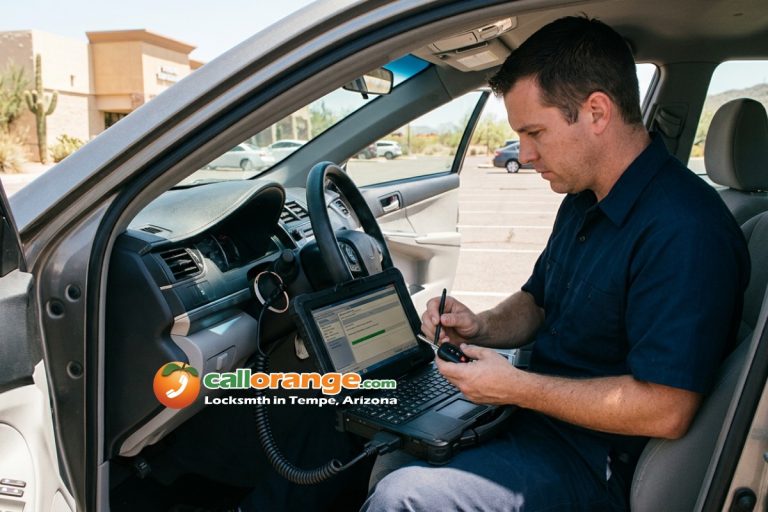
Prices shown reflect general market ranges for the Tempe and Phoenix metro area as of 2026. Your actual cost depends on vehicle make, model, key type, and parts availability. Call (480) 847-2635 for an exact quote before service.

You’re standing in a parking lot somewhere near Mill Avenue or off the 101, holding a key that snapped in the ignition — or maybe you lost the only copy you had. The first thing that crosses your mind is how much this is going to cost. The second is who to call. Both are valid concerns, and the answers depend on several factors most drivers don’t think about until they’re in this exact situation.

The price gap between key types has widened significantly over the past decade. A standard metal key blank and a proximity fob with rolling-code encryption are completely different products, even though both “start your car.” The technology inside each key determines the equipment needed, the time required, and ultimately the cost. In Tempe’s extreme summer heat — where dashboard temperatures regularly exceed 160°F — plastic transponder housings and fob batteries degrade significantly, making replacement more common here than in milder climates.

CallOrange.com has provided automotive locksmith services in Tempe since 2015, programming and cutting keys for virtually every make and model on the road. Our licensed and insured technicians bring the tools and key blanks directly to your location — no tow truck needed, no dealership markup.

Key Type Cost Range Programming Required Common Vehicles
Basic Mechanical Key $45 – $75 No Pre-1997 models, utility vehicles
Transponder Chip Key $75 – $180 Yes — chip to immobilizer Honda Civic, Toyota Corolla, Ford F-150
Remote Head Key $120 – $225 Yes — chip + remote sync Toyota Camry, Honda Accord, Nissan Altima
Proximity / Smart Key Fob $150 – $350+ Yes — encrypted rolling code Toyota RAV4, Hyundai Tucson, Kia Sportage
European Smart Key $250 – $400+ Yes — dealer-level software BMW 3-Series, Mercedes C-Class, Audi A4
All Keys Lost (add-on) + $50 – $150 Full immobilizer reset Any vehicle — no working key available
Ignition + Key Bundle $200 – $450 Yes — ignition + key match Older Honda, GM, Chrysler models
Spare Key (with original) $75 – $120 Clone from existing key Most makes and models

Car Key Types and What Each One Costs

Not every car key is the same, and the type your vehicle uses is the single biggest factor in replacement cost. Here’s what Tempe drivers encounter most often.

Basic mechanical keys are simple metal-cut keys with no electronics. Vehicles manufactured before the mid-1990s typically use these. Replacement runs between $45 and $75, including cutting on-site. These keys don’t require programming because there’s no chip inside — the physical cut pattern is the only security layer.

Transponder chip keys contain a small radio-frequency chip embedded in the plastic head. When you insert the key and turn the ignition, the chip sends a coded signal to your vehicle’s immobilizer. If the codes don’t match, the engine won’t start. Most vehicles from 1997 onward use some form of transponder technology. Replacement typically costs $75 to $180 depending on the vehicle brand and whether the locksmith can clone from an existing key or needs to program from scratch through the OBD-II port.

Remote head keys combine a transponder chip with integrated buttons for lock, unlock, and trunk release — all in one unit. These are standard on most mid-2000s to mid-2010s vehicles. The cost ranges from $120 to $225 because the locksmith must cut the blade, program the transponder chip, and sync the remote functions separately.

Proximity fobs and smart keys are the most advanced and most expensive to replace. These push-to-start key fobs communicate with your vehicle through encrypted radio signals and never need to physically enter the ignition. Replacing one costs between $150 and $350+, depending on the brand. European vehicles like BMW, Mercedes, and Audi tend to be at the higher end because their encryption protocols require specialized software and dealer-level programming tools.

Why Location and Vehicle Brand Affect Your Price

Two drivers in Tempe can need the same service — “replace my car key” — and pay very different amounts. The vehicle brand and the specifics of the situation explain why.

Japanese brands (Toyota, Honda, Nissan, Subaru) generally fall in the moderate range. Their transponder systems use well-documented protocols, and aftermarket key blanks are widely available. A Toyota Camry transponder key might cost $90 to $140 to replace and program on-site.

American brands (Ford, Chevrolet, Dodge, Jeep) vary widely. Older Ford models with the PATS (Passive Anti-Theft System) are straightforward. Newer Dodge and Jeep vehicles with the Fobik key system cost more because the fob and transponder are integrated into a single unit that requires dealer-level access to program.

European brands (BMW, Mercedes-Benz, Volkswagen, Audi) are consistently the most expensive. Their security systems use layered encryption, and many require the locksmith to connect directly to the vehicle’s onboard computer. A Mercedes smart key replacement can run $250 to $400 depending on the model year.

The “all keys lost” scenario is always more expensive than having a spare. When you have at least one working key, a locksmith can often clone or add a new key to the system in minutes. When every key is gone, the technician must access the vehicle’s security system from scratch — resetting the immobilizer, programming a new master key, and sometimes replacing the ignition cylinder entirely. This process adds $50 to $150 to the total cost. If you’re in this situation, our car key replacement specialists handle all-keys-lost jobs daily across the Tempe metro area.

Dealership vs. Locksmith — Comparing Your Options

Most dealerships in the Phoenix metro area charge between $200 and $500 for a replacement key, and the process typically requires towing the vehicle to the dealer, waiting 3 to 7 business days for the key to be ordered, and paying separately for programming. For a car that’s already sitting in your driveway or a parking lot, that’s a significant inconvenience on top of the cost.

A mobile locksmith brings the key blanks, cutting machine, and programming equipment directly to you. The entire process — from arrival to handing you a working key — usually takes 30 to 60 minutes on-site. The cost savings compared to a dealership average 30% to 50%, and there’s no towing expense.

There’s one exception where a dealership might be necessary: some ultra-high-security vehicles (certain Volvo, Tesla, and late-model Mercedes models) use proprietary programming that only authorized dealers can access. A qualified locksmith will tell you upfront if your vehicle falls into this category rather than waste your time.

For the majority of vehicles on Tempe roads — Hondas, Toyotas, Fords, Chevys, Hyundais, Kias — a licensed mobile locksmith handles the job at a lower price and with same-day service. You can request a quote from our team before we dispatch, so there are no surprises when the technician arrives.

How Arizona Heat Damages Car Keys and Fobs

Living in the Tempe and Phoenix metro area means your car keys endure conditions that drivers in other states never deal with. Arizona’s summer heat plays a direct role in how often keys fail and need replacement.

Transponder chip delamination happens when the plastic housing around the chip expands and contracts through repeated heat cycles. Dashboard temperatures inside a parked car in Tempe can hit 170°F between June and September. Over time, this thermal stress cracks the internal antenna connection between the chip and the key housing, causing intermittent starting failures that eventually become permanent.

Key fob battery drain accelerates in extreme heat. The lithium coin-cell batteries inside fobs are rated for moderate temperatures. Consistent exposure to 110°F+ ambient air — common in Tempe from May through October — shortens battery life from the typical 2 to 3 years down to 12 to 18 months. When the battery dies in a proximity fob, many drivers assume the fob itself is broken.

Plastic housing warping affects both transponder keys and fobs. The buttons on remote head keys become soft and unresponsive. The blade on flip keys may not deploy properly because the spring mechanism housing has deformed. We see a noticeable increase in car remote and fob issues every summer at our Tempe location.

UV degradation breaks down rubber gaskets and button pads on key fobs left on dashboards or hung from rearview mirrors. The infrared signal can weaken as the fob’s plastic lens yellows and clouds, reducing the effective range from 30 feet down to 5 feet or less.

The takeaway: store your spare key indoors, not in the glove compartment or center console. If your fob’s range has been decreasing gradually, the battery or the internal antenna may be heat-damaged — not just low on charge.

What to Do When You Need a Replacement Key Right Now

If you’re locked out or stranded with a broken key, here’s the most efficient path to getting back on the road:

  • Check for a spare first. If anyone in your household has a copy, that’s the simplest solution. A locksmith can unlock your car door to get you moving while you arrange a duplicate.
  • Know your vehicle’s year, make, and model. This tells the locksmith exactly which key blank and programming protocol to bring. It also gives you an accurate price quote over the phone.
  • Have your photo ID and registration ready. Every reputable locksmith in Arizona verifies ownership before cutting or programming a key. This protects you from unauthorized key duplication.
  • Ask about the total cost upfront. A transparent locksmith gives you a price that includes the trip charge, key blank, cutting, and programming — no add-on fees after the work is done.
  • Request a warranty. Replacement keys should come with a guarantee on both the physical cut and the electronic programming. CallOrange.com includes a 30-day warranty on parts and labor for every automotive key service.

If your key snapped inside the ignition, don’t try to extract it yourself — metal fragments can damage the ignition wafer stack and turn a key replacement into a costly ignition repair. A locksmith has extraction tools designed for this exact situation.

Saving Money on Car Key Replacement

The most effective way to reduce your cost is to get a spare key made before you lose the original. Cloning an existing key is significantly less expensive than programming from scratch in an all-keys-lost scenario. Most locksmith visits for a spare transponder key cost roughly half of what you’d pay in an emergency.

Insurance coverage is another avenue worth checking. Some auto insurance policies and extended warranty plans cover key replacement, particularly for newer vehicles with expensive fob systems. AAA and similar roadside assistance programs typically cover the lockout service but not the key itself — so read the fine print.

Aftermarket vs. OEM key blanks is a real choice with real cost implications. OEM blanks from the vehicle manufacturer cost more but guarantee compatibility. Aftermarket blanks from reputable suppliers (Ilco, JMA, Keyline) work identically in most cases at 40% to 60% lower cost. A qualified locksmith knows which aftermarket blanks are reliable for your specific vehicle and which models genuinely require OEM parts.

You can also save by combining services. If your ignition has been giving you trouble and you also need a new key, handling both in one visit eliminates a second trip charge. Similarly, if you’ve just moved to Tempe and want to rekey your home locks along with getting a spare car key, bundling those services into one appointment makes financial sense.

Frequently Asked Questions

How much does a car key replacement cost?

Replacement costs range from $45 for a basic mechanical key to $350+ for a push-to-start smart key fob. The price depends on your vehicle’s year, make, model, and key type. European luxury vehicles with encrypted proximity systems sit at the higher end. We provide an exact quote over the phone once we confirm your vehicle details.

Can you make a key if I lost all copies?

Yes. Our technicians handle all-keys-lost situations daily across Tempe and the Phoenix metro area. The process involves accessing your vehicle’s immobilizer system, programming a new master key, and cutting the blade on-site. This costs $50 to $150 more than a standard replacement because of the additional programming required. Bring your photo ID and vehicle registration for ownership verification.

Is a locksmith cheaper than the dealership?

In most cases, yes — by 30% to 50%. Dealerships charge for the key, programming, and often require towing the vehicle to their location. A mobile locksmith comes to you, cuts and programs the key on-site, and completes the job in 30 to 60 minutes. The exception is a small number of ultra-high-security vehicles that require proprietary dealer software.

Do you program transponder keys on-site?

Yes. Our mobile units carry programming equipment for domestic, Japanese, Korean, and most European vehicles. We connect to your vehicle’s OBD-II port, program the transponder chip to match the immobilizer, and test the key before leaving. The entire process typically takes 20 to 45 minutes depending on the vehicle.

Does Arizona heat damage car keys?

Absolutely. Tempe’s summer temperatures cause transponder chip delamination, accelerated fob battery drain, plastic housing warping, and UV degradation of rubber buttons and signal lenses. We recommend storing spare keys indoors rather than in the glove compartment, and replacing fob batteries annually instead of waiting for failure.

What information do I need when I call?

Have your vehicle’s year, make, model, and trim level ready. Let us know if you have a working key or if all keys are lost — this affects the programming method and price. We also ask for your location so we can dispatch the nearest available technician with the correct key blank for your vehicle.

Do you offer a warranty on replacement keys?

Every car key replacement from CallOrange.com includes a 30-day warranty on both the physical key cut and the electronic programming. If the key or fob malfunctions within that period due to a defect in our work, we return and fix it at no additional charge.

Should I get a spare key made now?

Yes — getting a spare while you still have a working key costs roughly half of what you’d pay in an all-keys-lost emergency. Cloning an existing key is simpler, takes less time, and avoids the full immobilizer reset. It also means you’ll never be stranded without a backup if your primary key fails or goes missing.

Making the Right Call on Car Key Replacement in Tempe

Car key replacement costs between $45 and $350+ in Tempe, depending on key type, vehicle brand, and whether you have a spare. The gap between a basic metal key and a push-to-start proximity fob reflects the real difference in technology, equipment, and expertise required.

The smartest move is getting a spare made now while you still have a working key — it cuts your future replacement cost nearly in half and eliminates the stress of being stranded. If you’re already in a situation where you need a key today, a mobile locksmith is the most efficient and cost-effective option for the majority of vehicles.

CallOrange.com has served Tempe and the Phoenix metro area since 2015, with a 4.8-star rating across 1,451 Google reviews. Our technicians are licensed, insured, and bonded, and we carry key blanks and programming equipment for domestic, Japanese, Korean, and European vehicles. Every job includes a 30-day warranty on parts and labor.

Call (480) 847-2635 for an exact quote based on your vehicle. We verify year, make, model, and key type over the phone so you know the price before we arrive. You can also visit us at our Tempe location in Broad River Plaza or reach out through our contact page to schedule service.

Mobile locksmith programming a transponder car key via OBD-II connection in a Tempe AZ parking lot

Transponder Key Programming in Tempe AZ — Locksmith vs Dealer

Transponder key failures in Tempe are frequently misdiagnosed as dead batteries — the real cause is chip delamination from Arizona’s 115°F+ heat, which breaks the internal antenna connection inside the key head. A new battery changes nothing. The fix is chip diagnosis, cloning or transponder replacement, and ECU re-authorization — work a mobile locksmith performs on-site in under an hour without a tow to the dealer.

Every vehicle manufactured after 1995 in the U.S. uses a transponder system. The chip embedded in the key head transmits a rolling code to the immobilizer module near the ignition. If the code doesn’t match, the engine cranks but won’t start — the immobilizer cuts fuel injection regardless of whether the mechanical key blade is the correct cut. In Tempe’s climate, the most common failure point isn’t the chip itself but the antenna wire coiled inside the plastic key head. Thermal expansion and contraction cycles crack the solder points over time, breaking the signal path before the chip shows any visible damage.

Our automotive locksmiths at CallOrange Locksmith in Tempe program transponder keys on-site daily from 6:00 AM to 10:00 PM — no tow required, no dealership appointment. See our location and customer reviews on Google Maps before you call. We carry key blanks and programming equipment for all major platforms on every truck, and we provide a written quote before any work begins.

Founded in 2008, CallOrange has 17+ years of automotive locksmith experience across Tempe, Mesa, Chandler, Scottsdale, and the Metro Phoenix area. Our technicians work with Mul-T-Lock, Schlage Primus, Medeco, ASSA Abloy, Kwikset, and all major OEM transponder systems — the full platform range, not just common domestic vehicles.


How Transponder Keys Work — and Why Arizona Heat Breaks Them

Understanding the failure mode helps you make the right call faster.

A transponder key has three functional components: the mechanical blade that operates the lock cylinder, the chip (typically a Philips, Texas Instruments, or Megamos crystal), and the antenna coil that lets the immobilizer reader energize and interrogate the chip. The antenna is a tight coil of wire inside the plastic key head — not in the chip itself. The immobilizer ring around the ignition cylinder sends a low-frequency RF field, the antenna coil picks it up and powers the chip, and the chip responds with its authorization code.

Tempe’s thermal environment attacks the antenna coil specifically. A key left in a car on a summer day reaches 180°F+. A key pulled from a pocket into a 115°F exterior temperature expands and contracts through the same range every day. The wire coil and the solder joints that connect it to the chip board undergo hundreds of micro-stress cycles per year. Eventually a joint cracks, the coil loses continuity, and the chip goes silent — even though the chip itself is undamaged.

The secondary failure mode is key head delamination. Tempe UV exposure causes the plastic key head to become brittle, and the key head splits where it meets the blade collar. When that happens, the antenna shifts position inside the head and loses reliable contact with the ignition reader — the vehicle starts intermittently, then stops starting entirely.

Neither failure shows any visible damage. A diagnostic tool that reads the chip directly can confirm which component has failed before any replacement is ordered.


Locksmith vs Dealer — The Real Comparison in Tempe

This is the question most Tempe drivers search before calling anyone. The honest answer depends on what you need.

Dealership programming is brand-specific, appointment-based, and requires the vehicle to be on-site. Most Tempe dealerships schedule transponder programming as a service department job — typical wait times run 1–3 days for an appointment, and the vehicle must be driven or towed in. Dealer cost for a transponder key with programming typically runs $150–$400 depending on make and model. For proximity keys and smart fobs, the range is $200–$600. The dealer uses OEM programming software, which is the definitive tool for newer vehicles with rolling-code systems that require factory authorization.

Mobile locksmith programming eliminates the tow and the appointment. A CallOrange technician comes to your location with aftermarket key blanks and professional programming equipment — including tools compatible with EEPROM-based systems, OBD-II pin-detect programming, and proximity key frequency matching. For most vehicles, the programming is completed on-site in 30–60 minutes. Cost is typically lower than dealer pricing, and there’s no tow bill. The written quote you receive before work begins covers both the key and the programming — no separate line items added after.

The scenario where a dealer is the better choice: Vehicles with manufacturer-encrypted systems that require a live connection to the OEM server for authorization — primarily newer BMW, Mercedes-Benz, and select GM platforms with VATS encryption. Our technicians identify these during the initial consultation and tell you directly if a dealer connection is required. We don’t attempt programming we can’t complete.

For the majority of Tempe drivers — domestic trucks and SUVs, Japanese platforms, Korean vehicles, and most European models from 2010–2020 — a mobile locksmith is the faster, lower-cost option with no difference in programming quality. Our replacement car keys service covers the full key-cutting and programming scope, and our push-to-start and keyless ignition service specifically covers proximity keys and smart fobs.


Transponder Key Types — What You Have and What Programming Involves

Fixed-code transponders use a single stored code that never changes. These are found on domestic vehicles from the mid-1990s through the early 2000s and some Japanese platforms. Programming involves writing a new code to the chip and adding it to the immobilizer’s authorized list. These are the most straightforward to program and the most compatible with aftermarket equipment.

Rolling-code transponders generate a new code on each start cycle using a synchronized algorithm between the key and the ECU. Most vehicles from 2005 onward use rolling codes. Programming requires synchronizing the new key’s algorithm with the ECU’s current state — this is a two-step process involving both the key and the vehicle’s OBD-II port.

Proximity keys and smart fobs operate on a different frequency entirely — typically 315 MHz or 433 MHz RF — and contain a transponder backup chip for the mechanical emergency start function. Programming requires pairing the RF frequency to the body control module in addition to the transponder authorization. Our make car key service covers new key origination for vehicles with no working key present — a scenario that requires reading the immobilizer’s stored data directly rather than cloning an existing key.

Cloning vs new programming: If you have a working original key, the fastest approach is cloning — reading the chip data from the original and writing it to a new key blank. Cloning doesn’t require access to the vehicle’s OBD-II port. If the original key is lost, damaged, or non-functional, new programming from the vehicle’s immobilizer data is required. Both approaches are available on our truck.


Quick Diagnosis — What Your Vehicle Is Telling You
Symptom Likely Cause What a Pro Checks
Engine cranks but won’t start Transponder not communicating — immobilizer blocking fuel OBD-II immobilizer read, chip diagnostic, antenna coil continuity
Vehicle starts sometimes, not others Cracked antenna coil or delaminating key head Chip read at multiple positions, key head integrity, solder joint check
Security light stays on after inserting key Immobilizer not receiving valid code from chip Immobilizer module status, chip family verification, ECU authorization count
New battery didn’t fix the no-start Chip failure, not battery — misdiagnosis is common Transponder chip read, antenna signal test, immobilizer log
Key fob buttons work but car won’t start RF and transponder are separate — fob RF works, transponder chip failed Separate chip and RF diagnostics, fob PCB inspection
Only one key left — original lost Need new key programmed from immobilizer data EEPROM read or OBD-II new key origination, VIN-matched blade cut

The Programming Process — What Happens On-Site

When a CallOrange technician arrives at your Tempe location, the job starts with a diagnostic read — not a replacement order.

We connect to the vehicle’s OBD-II port and read the current immobilizer status. This confirms how many keys are currently authorized, whether the ECU is locked from too many failed programming attempts, and which chip family is required for replacement. On vehicles with a working original key, we read the chip data directly using a transponder analyzer.

From that diagnostic read we provide your written quote — key blank cost, programming fee, total. You approve it before we cut or program anything.

Key cutting happens on-site using our mobile cutting equipment calibrated to your vehicle’s VIN data or a direct trace from the original blade. The cut key is tested mechanically in the lock cylinder before programming begins — a key that doesn’t turn the cylinder cleanly won’t start the vehicle even with a valid transponder signal.

Programming is performed via OBD-II connection or emergency bypass procedure depending on the platform. After programming, we verify the new key starts the engine and test the original key (if present) to confirm it still functions. We don’t leave until both tests pass.

See our automotive locksmith services overview for the full scope of what we carry and program, and our ignition repair service if the ignition cylinder itself has wear that’s affecting key turn and start.


Frequently Asked Questions

How much does transponder key programming cost in Tempe? +
Cost depends on vehicle make, model, year, and key type. Standard chip key programming runs significantly less than dealer pricing in most cases. CallOrange provides a written quote after the diagnostic read — you know the full cost before any key is cut or programmed. Call (480) 847-2635 with your year, make, and model for a phone estimate.
Can you program a transponder key without the original? +
Yes. If no working key is present, we perform new key origination from the vehicle’s immobilizer data via OBD-II connection or EEPROM read depending on the platform. The blade is cut to your VIN and the chip is programmed from scratch to the ECU. This takes longer than cloning an existing key but is completed on-site in most cases.
Is a mobile locksmith as good as the dealer for key programming? +
For most vehicles — domestic, Japanese, Korean, and most European platforms — yes. Professional aftermarket programming equipment covers the full key-authorization process for the majority of vehicles on the road. The exception is certain newer European and GM platforms with manufacturer-encrypted OEM-server authorization. We identify those during the initial consultation and tell you directly if a dealer connection is required.
Why did Arizona heat cause my transponder key to fail? +
Tempe’s summer heat cycles — from 115°F ambient to 180°F+ inside a parked car — cause the antenna coil wire inside the key head to expand and contract repeatedly. Over time this cracks the solder joints connecting the coil to the chip board, breaking the signal path. The chip itself is usually undamaged, but without a functioning antenna coil the immobilizer can’t read it. This failure is specific to the Phoenix metro climate and happens faster than in moderate climates.
How long does on-site transponder key programming take? +
Most transponder key jobs — diagnostic read, key cutting, and programming — are completed in 30 to 60 minutes on-site. Proximity key and smart fob programming takes slightly longer due to the RF pairing step in addition to transponder authorization. We don’t leave until the new key has started the engine and all existing keys have been tested.
Do you carry key blanks for all vehicle makes in Tempe? +
We carry blanks for all major domestic, Japanese, European, and Korean platforms on every truck. When you call, give us your year, make, and model and we confirm blank availability before dispatch — we won’t send a technician who doesn’t have the right blank for your vehicle. Specialty or rare platforms may require a blank order, which we communicate upfront.
Can you program a second key so I have a spare? +
Yes, and we recommend it. Programming a second key during the same visit costs less than a separate service call later — the vehicle is already in programming mode and the diagnostic work is already done. A spare transponder key stored somewhere other than your main keychain is the most effective way to avoid a future lockout or no-start in Tempe’s climate.

Getting Back on the Road

A transponder key problem in Tempe doesn’t require a tow or a multi-day wait. The diagnostic, key cutting, and programming happen at your location — most jobs are done in under an hour. The written quote you get before we start covers everything; there are no separate charges added after the engine starts.

CallOrange Locksmith in Tempe has been serving drivers across the Metro Phoenix area since 2008. Our technicians are licensed, insured, and bonded, and they carry blanks and programming equipment for domestic, Japanese, European, and Korean platforms on every truck. Our 5-star Google reviews from Tempe drivers reflect the same standard on every automotive call.

Call (480) 847-2635 to schedule your transponder key service. We’re available every day from 6:00 AM to 10:00 PM. Visit our contact page for non-urgent scheduling, or see our about page to learn more about how our team operates. Our full automotive locksmith services page covers every key type and ignition service we handle in Tempe.

Mobile locksmith unlocking a car door during a car lockout service call in Tempe AZ

Car Lockout Service in Tempe AZ

A car lockout in Tempe isn’t just an inconvenience — standing outside on asphalt that reaches 170°F in summer while your vehicle’s interior climbs past 150°F is a genuine health risk. Getting a trained mobile locksmith to your location fast is the right call. Forcing entry with improvised tools bends door linkage rods and damages weather seals, turning a simple unlock into a repair bill.

Car lockouts happen the same predictable ways: keys left on the seat when the door auto-locks, a fob battery that dies without warning, a broken key blade stuck in the door cylinder, or a spare that never made it off the counter at home. Modern vehicles have multiple layers of door linkage inside the panel — the mechanisms that connect the exterior handle to the latch. The wrong tool in the wrong position bends one of those rods and the door stops responding entirely.

Our mobile locksmiths at CallOrange Locksmith in Tempe are positioned across the Tempe and Metro Phoenix area, available every day from 6:00 AM to 10:00 PM. Find us on Google Maps and read reviews from Tempe drivers before you call — our location, our hours, and our track record are all there. We carry professional entry tools for every vehicle platform on every truck.

Founded in 2008, CallOrange has 17+ years serving Tempe area drivers. Our TechTracker GPS dispatch system routes the nearest available technician to your location the moment you call — no relay, no wait time added by a call center routing you elsewhere.


What Happens on a Car Lockout Call

The process from your call to your door opening is consistent on every job.

When you call (480) 847-2635, we confirm your location, vehicle make and model, and the nature of the lockout. That information goes directly to the nearest technician via TechTracker dispatch. We give you an honest estimated arrival time based on where that technician actually is — not an optimistic number.

On arrival, the technician assesses which entry method applies to your specific vehicle. Entry technique is platform-specific. A door unlock on a late-model Ford F-150 uses different tools and angles than a Honda Civic or a BMW 3 Series with flush door handles. Our technicians — including longtime techs Michael and Liran — work across all makes, including domestic, Japanese, European, and Korean platforms.

After entry, we inspect the door to confirm the linkage is intact and the handle is responding normally. If the lockout happened because of a broken key in the cylinder, we can extract the fragment and cut a new key on-site. If the fob battery died and the vehicle has no mechanical key backup, we diagnose the correct bypass path for your specific push-to-start system. See our unlock car door service for a full breakdown of entry methods by vehicle type, and our push-to-start and keyless ignition service for dead-fob scenarios.


Car Lockout Scenarios in Tempe — What Each One Involves

Keys locked inside, door auto-locked. The most common call. The lock is intact, the key is visible. Professional entry tools — either a long-reach tool through the window seal or an air wedge and rod through the door frame — reach the interior unlock mechanism without touching the door linkage. Properly executed, zero damage.

Broken key in the door cylinder. A key blade that snaps in the cylinder blocks entry and prevents using a spare. Extraction requires broken key extractors sized to the key blank profile. Depending on how far the fragment has traveled and whether it’s rotated in the lock, the cylinder may need to be removed and inspected. We carry replacement cylinders for major vehicle platforms if the lock is damaged beyond rekey. Our ignition repair service covers the same broken-key scenario when the fragment is in the ignition rather than the door.

Key fob battery dead — push-to-start vehicle. Most push-to-start vehicles have a mechanical key blade embedded in the fob. If yours does, the door has a mechanical cylinder behind a cover that accepts that blade. If the fob has no blade, most platforms have an emergency entry point under the door handle cover or a proximity bypass using the fob body held against the start button. Our locksmiths diagnose the correct entry path for your vehicle before touching anything.

Key lost or left at home. A lockout caused by a lost key warrants a different response than one caused by keys locked inside. If the key is lost, we recommend a car key replacement to ensure no one else can use that key. If your key is just at home, a door unlock is the complete solution.


Quick Diagnosis — What Your Situation Calls For
Situation Likely Solution What the Tech Does
Keys locked inside, door closed Professional door entry Long-reach tool or wedge entry — zero damage to linkage or seals
Key fob dead — push-to-start vehicle Emergency mechanical bypass or proximity entry Platform-specific fob bypass, hidden cylinder access if equipped
Key broken inside door cylinder Broken key extraction + new key cut Extractor tools, cylinder inspection, on-site replacement if damaged
Key lost — not inside vehicle Door unlock + replacement key cut Entry via professional tools, new key cut to VIN same visit
Transponder key won’t communicate Transponder diagnosis + programming Chip read, clone or replacement key cut and programmed to ECU
Door handle not responding after DIY attempt Linkage rod inspection + repair Door panel removal, bent rod identification, replacement if needed

Why Not to Use DIY Entry Methods in Tempe

A wire hanger or credit card works in movies. In a modern vehicle, the door panel contains multiple plastic linkage rods connecting the exterior handle, interior handle, latch, and lock cylinder. A wire slipped between the door and the frame with no knowledge of where those rods sit bends the closest one. That bent rod means the exterior handle no longer opens the door, the interior handle may not either, and the door has to be disassembled to replace the rod — typically $150–$300 at a body shop.

Tempe’s heat adds a second problem. Rubber weather stripping gets brittle in sustained UV and heat exposure. Forcing a tool between the glass and the seal when the rubber is hot and dry tears the seal, letting water in during monsoon season and wind noise year-round. Replacement seals for a modern vehicle door run $80–$200 plus labor.

Professional entry tools are designed to avoid both of these outcomes. The time from our arrival to your door opening is typically under 10 minutes. That’s the actual cost comparison.

Our automotive locksmith services page has the full scope of what we handle — lockouts, key cutting, transponder programming, ignition repair — all from mobile units that come to you.


Frequently Asked Questions

How long does it take for a locksmith to arrive in Tempe? +
CallOrange uses TechTracker GPS dispatch to route the nearest available technician to your location. Actual arrival time depends on current technician positions and traffic — we give you an honest estimate when you call, not an optimistic number. Call (480) 847-2635 and we’ll tell you exactly where the nearest tech is.
Will a locksmith damage my car door? +
A trained locksmith using professional entry tools causes zero damage to the door panel, weather seals, or linkage rods. The risk of damage comes from improvised tools — wires, hangers, or credit cards — which have no way to avoid the linkage rods inside the door. Professional long-reach tools and wedges are designed specifically to access the interior mechanism without contacting the panel components.
How much does a car lockout service cost in Tempe? +
CallOrange provides a written quote before any work begins — you know the full cost before the technician touches the door. Cost varies based on vehicle type, lock configuration, and whether additional services like broken key extraction or replacement key cutting are needed. Call (480) 847-2635 for a phone estimate based on your vehicle and situation.
What should I do while waiting for the locksmith? +
Stay in a shaded area or a nearby air-conditioned space if possible. Tempe summer heat causes heat exhaustion within 30 minutes of standing in direct sun — don’t underestimate it. If you’re in a parking lot with shade available, use it. Don’t attempt to enter the vehicle with improvised tools while you wait — that’s the most common way a straightforward lockout becomes a door repair.
Can you unlock any car make or model? +
Yes. CallOrange technicians work across all makes and models — domestic, Japanese, European, Korean, and luxury platforms. Some vehicles with flush door handles or double-locked security require specific entry techniques. When you call, give us the year, make, and model and we confirm the correct approach before dispatch.
Is CallOrange available for car lockouts on weekends in Tempe? +
Yes. CallOrange Locksmith in Tempe is available every day of the week from 6:00 AM to 10:00 PM, including weekends and holidays. Call (480) 847-2635 and we’ll dispatch the closest available technician to your Tempe location.

What to Do Right Now

A car lockout in Tempe has one correct response: call a mobile locksmith and stay in a shaded area while you wait. The door opens without damage, you’re back on the road, and nothing about your vehicle has changed. That’s the only outcome worth pursuing.

If your lockout happened because of a lost key rather than keys locked inside, the right follow-up is a replacement key cut to your VIN to restore full security. We handle that in the same visit. If the lockout revealed a damaged lock cylinder or a fob that’s failing beyond battery, our automotive service team can diagnose and resolve both in one stop.

CallOrange Locksmith in Tempe has served drivers across Tempe, Mesa, Chandler, and the Metro Phoenix area since 2008. Our technicians are licensed, insured, and bonded, and every job comes with a written quote before any work begins — no surprise charges after the door is open. Our 5-star reviews reflect the same standard on every call.

Call (480) 847-2635 right now. We’re available daily from 6:00 AM to 10:00 PM. Visit our contact page for non-emergency scheduling, or see our full services menu for everything CallOrange covers in Tempe.

Car lockout service by auto locksmith in Tempe Arizona opening vehicle door

Auto Locksmith Tempe: Why “Key Not Detected” and Remote Failures Spike in Dust + Heat

“Key Not Detected” is usually a signal-quality or power-quality problem—not a mysterious immobilizer failure. In Tempe heat and dust, fob batteries sag, contacts oxidize, antennas see weaker reception, and interference sources pile up, so the vehicle intermittently loses clean authorization.

If your car starts one minute and refuses the next, the pattern matters: temperature, time of day, parking location, and whether the remote buttons still work. Those clues tell a technician whether you’re dealing with fob power, receiver/antenna sensitivity, RF interference, or mechanical wear in the ignition/door hardware.

For more automotive topics, start with our blog hub: automotive locksmith resources or browse the full library on our blog. When you’re ready to schedule, use our Contact Us page or learn who we are on About Us.

Directions and reviews: Google Maps


Why Tempe and Phoenix conditions make keyless issues more common

A modern key fob system depends on stable voltage, clean electrical contact, and a strong RF “handshake” between the fob and the vehicle. In Tempe, Phoenix, Mesa, Chandler, Scottsdale, and Gilbert, the environment pushes on all three:

  • Heat accelerates battery voltage drop (especially older coin cells) and increases resistance at marginal connections.
  • Dust + fine grit work into button membranes and contact surfaces, causing intermittent button response and signal inconsistency.
  • Daily high-temperature cabin cycles (parked in sun → cooled at night → reheated) stress solder joints and connectors over time.
  • Parking-lot RF noise (dense Wi-Fi, Bluetooth, retail security systems, EV chargers, some LED drivers) can reduce effective reception in “hot spots.”

Bold takeaway: Intermittent failures are usually tolerance failures—barely enough voltage, barely enough signal, barely enough contact.

If the issue is specifically with a push-to-start vehicle, our service page is here: push-to-start keyless ignition support.


The “Key Not Detected” chain: what has to work for a start to happen

Keyless systems vary by make/model, but the logic is similar:

  1. The fob must broadcast a readable signal (powered and transmitting cleanly).
  2. The vehicle must receive that signal (antenna/receiver sensitivity, low interference).
  3. The system must confirm authorization (immobilizer logic—conceptually, not bypassable).
  4. The vehicle must see valid brake/gear/door-state inputs and adequate system voltage to complete the start sequence.

When any step is marginal, you get intermittent messages like:

  • “Key Not Detected”
  • “Key Not In Vehicle”
  • “No Key”
  • Or the car unlocks but won’t start

For key and remote related problems, you can also reference: car remote overview.


Most common root causes we see in Tempe (and why they happen)

1) Weak fob battery under heat load

Coin cells can test “okay” at rest, then sag under actual transmit load—especially in heat. The symptom is classic: the system works in the morning, struggles in the afternoon, then “magically” works again later.

Bold takeaway: Voltage under load matters more than a quick resting test.

2) Dirty or oxidized contact surfaces in the fob

Dust and skin oils can build up on contact points; over time, button presses become inconsistent and transmit strength can drop intermittently.

3) RF interference in specific parking locations

If the failure clusters at one place (apartment garage, a certain retail lot, a campus zone), think interference. The fob is fine—the environment isn’t.

4) Vehicle-side antenna/receiver sensitivity drift

Receiver performance can degrade slowly. A marginal receiver still works when the fob is very close, then fails at normal distance.

5) Low vehicle system voltage or borderline charging health

A weak 12V system can cause modules to behave inconsistently—even if the engine runs fine once started. You’ll often see more warnings and “odd” electronics behavior alongside keyless issues.

6) Mechanical wear that masquerades as an electronic problem

Not every “no start” complaint is purely electronic. If there’s an ignition/lock component with wear (depending on vehicle type), binding and timing issues can create confusing symptoms.

If ignition hardware is part of the complaint set, start here: ignition repair service and the deeper explainer: ignition lock repair.


Quick Diagnosis: symptom → likely cause → what a pro checks

This is a safe, non-bypass diagnostic map. It helps separate fob issues, environment issues, and vehicle-side reception issues.

Symptom Likely cause What a pro checks
Works close-up only Weak transmit or receiver sensitivity Fob power under load, range consistency
Fails in one parking lot RF interference hot spot Location pattern, signal environment
Buttons work, start fails Vehicle-side receive/auth path Receiver behavior, system voltage, inputs
Starts AM, fails PM Heat-driven voltage/contact issue Battery sag pattern, fob contact condition
Random warnings + key issue Low 12V stability Voltage behavior, module stability signs
Unlock works, start doesn’t Different antenna paths Start/immobilizer receive path patterns

Bold takeaway: Pattern beats guesswork. Time + place + distance are diagnostic data.


What a real auto locksmith inspection looks like (no risky shortcuts)

A good auto locksmith workflow focuses on verification and repeatability:

  • Confirm the complaint pattern (distance, location, heat, frequency)
  • Check remote function consistency (buttons vs proximity behavior)
  • Evaluate likely fob power/contact issues (without “hoping”)
  • Identify whether the issue tracks the vehicle environment (interference) or vehicle-side reception
  • If ignition hardware is implicated, evaluate wear/tolerance behavior (no bypass)
  • Document what changed so the next failure is predictable—not surprising

If you need new keys made or replaced as part of the solution path, these pages are helpful:


Heat, dust, and wear: the underappreciated failure multipliers

Heat expansion and tolerance stacking

Components don’t have to “break” to fail—they just have to drift out of tolerance. Heat increases resistance in marginal contacts and reduces headroom in weak batteries.

Dust contamination and button membrane behavior

Dust intrusion can make button presses inconsistent, which can look like “the remote is dead” when it’s actually intermittent contact.

Fleet usage and repeated handling

If a fob is used many times per day (delivery, rideshare, service fleets), mechanical wear and contamination accelerate.

Bold takeaway: High-cycle usage creates intermittent behavior long before total failure.


Table: common Tempe driver scenarios and what they usually mean

Scenario What it often points to Best next step
Only fails after sun exposure Battery sag / contact issues Verify fob power + contact health
Fails at a specific garage/lot RF interference environment Confirm location pattern
Works for unlock, not start Separate receive paths Check start-side reception pattern
Needs the fob “just right” Range/antenna sensitivity Evaluate receiver sensitivity behavior
Multiple electronics warnings Low 12V stability Confirm vehicle voltage stability

When a key/remote problem becomes a business risk

For Tempe businesses with staff vehicles, service vans, or customer-facing operations, intermittent keyless issues become downtime. A technical fix is only half the solution—repeat prevention matters:

  • Standardize key handling (avoid contamination)
  • Replace borderline fobs before they become “random”
  • Don’t ignore early signs (range shrinking, intermittent buttons)

If you’re dealing with broader commercial entry hardware issues at your business location (separate from vehicles), this reference may help: commercial door hardware.


Related security note: if a lost key ring includes home keys

Sometimes a vehicle issue starts with a lost key ring—and that includes house keys. If that’s your situation, it’s smart to reset access at home as well:


FAQs

1) Why does my car say “Key Not Detected” only sometimes?

Intermittent messages usually mean marginal voltage, marginal contact, or marginal reception. Heat and dust push weak batteries and worn contacts over the edge, especially in Tempe summers.

2) The remote buttons work, but the car won’t start—how is that possible?

Many vehicles use different receive paths for button-based commands versus proximity authorization. A locksmith looks for pattern differences (distance sensitivity, location sensitivity) to narrow the cause.

3) Why does it fail in one parking lot but not another?

That’s a classic sign of RF interference. Dense electronics environments can reduce effective reception even when the fob is healthy.

4) Can a weak vehicle battery cause keyless problems?

Yes. A borderline 12V system can make control modules behave inconsistently, causing keyless authorization to fail intermittently or throw confusing warnings.

5) Is this the immobilizer “locking me out”?

Immobilizer logic exists to prevent unauthorized starts, but most “Key Not Detected” complaints are signal or power quality issues—not a sudden security lockout. Diagnosis focuses on what’s missing in the authorization chain.

6) Do push-to-start systems fail more in Arizona heat?

They can. Heat accelerates battery sag and increases resistance in marginal contacts. If the pattern tracks temperature, a technician treats it as a tolerance problem first.

7) Should I replace my key fob right away?

Not always. The best approach is verify the failure pattern, confirm whether it’s fob power/contact, interference, or vehicle-side reception—then choose the correct fix to prevent repeat downtime.

8) What information should I share when I call?

Tell us the exact message, when it happens (morning vs afternoon), where it happens (specific lot/garage), and whether the remote buttons work consistently. That saves time and avoids guesswork.


Wrap-up: keep your start system dependable in Tempe

When you see “Key Not Detected,” the problem is usually signal and voltage stability—a weak fob battery under heat, worn contact surfaces, interference in specific locations, or a vehicle-side reception issue that has drifted out of tolerance.

The correct path forward is to diagnose the pattern, confirm whether the failure is fob-driven, environment-driven, or vehicle-driven, and then apply the fix that prevents repeat incidents—without risky shortcuts or guesswork.

CallOrange has been serving Tempe and the Phoenix metro area since 2008, with a focus on clean diagnostics and verification so your vehicle is consistent again—not just “working for now.”

For push-to-start and remote problems, call (480) 847-2635 or reach out through our Contact Us page. We’ll verify authorization and prioritize damage prevention and legal compliance—because security systems and high-risk openings should be handled carefully.

reliable car remote services

Reliable Car Remote Services in Tempe, AZ

Expert Car Remote Services in Tempe, AZ

When it comes to car remote services in Tempe, AZ, CallOrage Locksmith is the trusted name for fast and professional solutions. We specialize in programming, repairing, and replacing remotes for various of vehicles. Our team ensures your remote functions perfectly, saving you from unnecessary stress and delays.


Car Remote

Why Car Remotes Are Essential

A car remote is more than a convenience; it’s a key part of your vehicle’s security system. It allows you to lock, unlock, and even start your car without inserting a key. However, when your remote malfunctions, it can disrupt your plans. CallOrage Locksmith provides reliable solutions to get your remote working again.

Our Comprehensive Car Remote Services

1. Programming New Car Remotes

Lost your remote? Our technicians program new remotes compatible with your vehicle’s system quickly and efficiently.

2. Car Remote Repairs

If your remote has unresponsive buttons or a weak signal, we diagnose and repair it on the spot.

3. Key Duplication with Car Remote Functionality

Need a spare? We duplicate keys with built-in remote functions to give you added security and convenience.

4. Emergency Automotive Services

Locked out or stranded due to a faulty remote? We offer 24/7 emergency services to get you back on the road fast.

Why Choose CallOrage Locksmith in Tempe?

Expert Technicians

Our skilled professionals use the latest technology to handle any car remote issue efficiently.

Quick Turnaround Time

We value your time. Most services are completed in less than an hour.

Wide Compatibility

We work with remotes for various vehicle makes and models, including luxury and older cars.

Affordable Pricing

Enjoy transparent, competitive pricing with no hidden fees.

Car Remote
How Our Process Works

  1. Assessment
    We inspect your remote and vehicle system to identify the issue.
  2. Solution Proposal
    Our technician explains the problem and recommends a tailored solution.
  3. Service Execution
    We repair, replace, or program your car key efficiently using advanced tools.

Frequently Asked Questions

1. What if I lose my only car remote?

Call us immediately. We’ll program a replacement that works seamlessly with your car.

2. Can you fix water-damaged remotes?

Yes. We’ll assess the damage and attempt repairs before suggesting a replacement.

3. How long does programming a new car remote take?

Typically, 20-30 minutes, depending on the make and model of your vehicle.

4. Do you provide warranties for your services?

Yes, we back our work with a satisfaction guarantee.

Car Remote


Contact CallOrage Locksmith Today!

If you’re in Tempe and need expert car remote services, CallOrage Locksmith is here to help. From quick repairs to complete replacements, we deliver quality and reliability you can count on.

📞 Call now or visit us in Tempe for immediate assistance!

Don’t let a faulty remote delay your day. Contact us and let our experts provide the solution you need.

What Is Car Keys Replacement and How Does It Work?

What Is Car Keys Replacement?

Car keys replacement is the process of creating a new key or fob for your vehicle when your original is lost, damaged, or no longer functional. This service is essential for drivers who have misplaced their keys, had them stolen, or are dealing with a malfunctioning key fob.

At CallOrange Locksmith Tempe, we specialize in automotive services, including car keys replacement for all major vehicle makes and models. Whether you’re stranded or need a spare key, our team is ready to help.

replacement car key

Why Is Car Keys Replacement Important?

This service is vital for ensuring you always have access to your vehicle. Here are some common scenarios where this service becomes crucial:

  1. Lost or Stolen Keys: Misplacing your keys can leave you stranded, while stolen keys can pose a security risk.
  2. Damaged Keys: Physical wear and tear or electronic malfunctions can render keys unusable.
  3. Need for a Spare: Having an extra key provides security and convenience for families or shared vehicles.

In Tempe, having access to reliable services ensures that you can quickly regain access to your vehicle without unnecessary stress.

How Does Car Keys Replacement Work?

1. Assessing Your Needs

Our locksmiths determine whether you need a traditional metal key, a transponder key, or a modern key fob replacement.

2. Programming the Key

For cars with electronic systems, we program the key or fob to ensure it works seamlessly with your vehicle’s security system.

3. Cutting the Key

For traditional keys, we cut a new key based on the specifications of your vehicle.

4. Testing

Before handing the key over, we thoroughly test it to ensure proper functionality, so you’re back on the road without any issues.

car keys replacements

Factors to Consider When Replacing Car Keys

When opting for car keys replacement, it’s important to consider the following:

  • Type of Key: Different vehicles require different keys (standard, transponder, or smart key).
  • Vehicle Make and Model: The process and cost can vary depending on your car’s manufacturer.
  • Emergency Services: For urgent needs, our team offers 24/7 assistance in Tempe and nearby areas.


old car key replace for new

Conclusion

At CallOrange Locksmith Tempe, we make car keys replacement simple and stress-free. Whether you’ve lost your keys, need a spare, or are dealing with a broken key fob, our automotive locksmith services are here to help.

Don’t let a lost or damaged key ruin your day—call us now or visit our website to learn more about our services.