
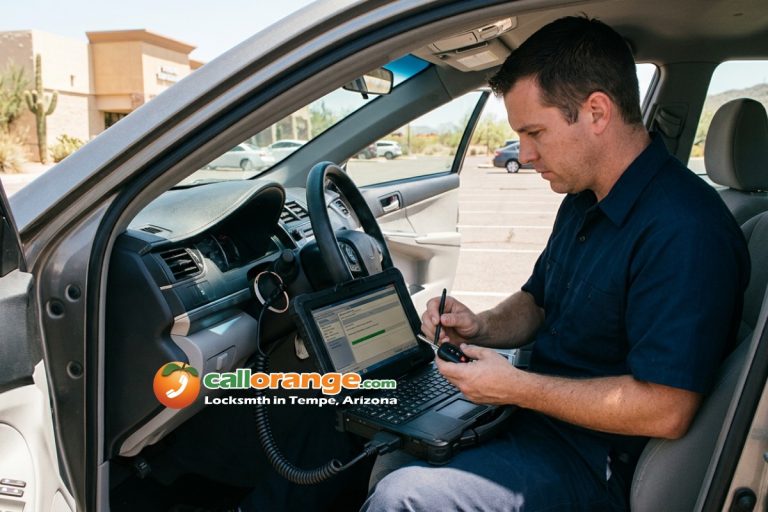
Mobile locksmith programming a transponder car key via OBD-II connection in a Tempe AZ parking lot

Transponder Key Programming in Tempe AZ — Locksmith vs Dealer

Transponder key failures in Tempe are frequently misdiagnosed as dead batteries — the real cause is chip delamination from Arizona’s 115°F+ heat, which breaks the internal antenna connection inside the key head. A new battery changes nothing. The fix is chip diagnosis, cloning or transponder replacement, and ECU re-authorization — work a mobile locksmith performs on-site in under an hour without a tow to the dealer.
Every vehicle manufactured after 1995 in the U.S. uses a transponder system. The chip embedded in the key head transmits a rolling code to the immobilizer module near the ignition. If the code doesn’t match, the engine cranks but won’t start — the immobilizer cuts fuel injection regardless of whether the mechanical key blade is the correct cut. In Tempe’s climate, the most common failure point isn’t the chip itself but the antenna wire coiled inside the plastic key head. Thermal expansion and contraction cycles crack the solder points over time, breaking the signal path before the chip shows any visible damage.

Our automotive locksmiths at CallOrange Locksmith in Tempe program transponder keys on-site daily from 6:00 AM to 10:00 PM — no tow required, no dealership appointment. See our location and customer reviews on Google Maps before you call. We carry key blanks and programming equipment for all major platforms on every truck, and we provide a written quote before any work begins.

Founded in 2008, CallOrange has 17+ years of automotive locksmith experience across Tempe, Mesa, Chandler, Scottsdale, and the Metro Phoenix area. Our technicians work with Mul-T-Lock, Schlage Primus, Medeco, ASSA Abloy, Kwikset, and all major OEM transponder systems — the full platform range, not just common domestic vehicles.


How Transponder Keys Work — and Why Arizona Heat Breaks Them

Understanding the failure mode helps you make the right call faster.

A transponder key has three functional components: the mechanical blade that operates the lock cylinder, the chip (typically a Philips, Texas Instruments, or Megamos crystal), and the antenna coil that lets the immobilizer reader energize and interrogate the chip. The antenna is a tight coil of wire inside the plastic key head — not in the chip itself. The immobilizer ring around the ignition cylinder sends a low-frequency RF field, the antenna coil picks it up and powers the chip, and the chip responds with its authorization code.

Tempe’s thermal environment attacks the antenna coil specifically. A key left in a car on a summer day reaches 180°F+. A key pulled from a pocket into a 115°F exterior temperature expands and contracts through the same range every day. The wire coil and the solder joints that connect it to the chip board undergo hundreds of micro-stress cycles per year. Eventually a joint cracks, the coil loses continuity, and the chip goes silent — even though the chip itself is undamaged.

The secondary failure mode is key head delamination. Tempe UV exposure causes the plastic key head to become brittle, and the key head splits where it meets the blade collar. When that happens, the antenna shifts position inside the head and loses reliable contact with the ignition reader — the vehicle starts intermittently, then stops starting entirely.

Neither failure shows any visible damage. A diagnostic tool that reads the chip directly can confirm which component has failed before any replacement is ordered.


Locksmith vs Dealer — The Real Comparison in Tempe

This is the question most Tempe drivers search before calling anyone. The honest answer depends on what you need.

Dealership programming is brand-specific, appointment-based, and requires the vehicle to be on-site. Most Tempe dealerships schedule transponder programming as a service department job — typical wait times run 1–3 days for an appointment, and the vehicle must be driven or towed in. Dealer cost for a transponder key with programming typically runs $150–$400 depending on make and model. For proximity keys and smart fobs, the range is $200–$600. The dealer uses OEM programming software, which is the definitive tool for newer vehicles with rolling-code systems that require factory authorization.

Mobile locksmith programming eliminates the tow and the appointment. A CallOrange technician comes to your location with aftermarket key blanks and professional programming equipment — including tools compatible with EEPROM-based systems, OBD-II pin-detect programming, and proximity key frequency matching. For most vehicles, the programming is completed on-site in 30–60 minutes. Cost is typically lower than dealer pricing, and there’s no tow bill. The written quote you receive before work begins covers both the key and the programming — no separate line items added after.

The scenario where a dealer is the better choice: Vehicles with manufacturer-encrypted systems that require a live connection to the OEM server for authorization — primarily newer BMW, Mercedes-Benz, and select GM platforms with VATS encryption. Our technicians identify these during the initial consultation and tell you directly if a dealer connection is required. We don’t attempt programming we can’t complete.

For the majority of Tempe drivers — domestic trucks and SUVs, Japanese platforms, Korean vehicles, and most European models from 2010–2020 — a mobile locksmith is the faster, lower-cost option with no difference in programming quality. Our replacement car keys service covers the full key-cutting and programming scope, and our push-to-start and keyless ignition service specifically covers proximity keys and smart fobs.


Transponder Key Types — What You Have and What Programming Involves

Fixed-code transponders use a single stored code that never changes. These are found on domestic vehicles from the mid-1990s through the early 2000s and some Japanese platforms. Programming involves writing a new code to the chip and adding it to the immobilizer’s authorized list. These are the most straightforward to program and the most compatible with aftermarket equipment.

Rolling-code transponders generate a new code on each start cycle using a synchronized algorithm between the key and the ECU. Most vehicles from 2005 onward use rolling codes. Programming requires synchronizing the new key’s algorithm with the ECU’s current state — this is a two-step process involving both the key and the vehicle’s OBD-II port.

Proximity keys and smart fobs operate on a different frequency entirely — typically 315 MHz or 433 MHz RF — and contain a transponder backup chip for the mechanical emergency start function. Programming requires pairing the RF frequency to the body control module in addition to the transponder authorization. Our make car key service covers new key origination for vehicles with no working key present — a scenario that requires reading the immobilizer’s stored data directly rather than cloning an existing key.

Cloning vs new programming: If you have a working original key, the fastest approach is cloning — reading the chip data from the original and writing it to a new key blank. Cloning doesn’t require access to the vehicle’s OBD-II port. If the original key is lost, damaged, or non-functional, new programming from the vehicle’s immobilizer data is required. Both approaches are available on our truck.


Quick Diagnosis — What Your Vehicle Is Telling You
Symptom Likely Cause What a Pro Checks
Engine cranks but won’t start Transponder not communicating — immobilizer blocking fuel OBD-II immobilizer read, chip diagnostic, antenna coil continuity
Vehicle starts sometimes, not others Cracked antenna coil or delaminating key head Chip read at multiple positions, key head integrity, solder joint check
Security light stays on after inserting key Immobilizer not receiving valid code from chip Immobilizer module status, chip family verification, ECU authorization count
New battery didn’t fix the no-start Chip failure, not battery — misdiagnosis is common Transponder chip read, antenna signal test, immobilizer log
Key fob buttons work but car won’t start RF and transponder are separate — fob RF works, transponder chip failed Separate chip and RF diagnostics, fob PCB inspection
Only one key left — original lost Need new key programmed from immobilizer data EEPROM read or OBD-II new key origination, VIN-matched blade cut

The Programming Process — What Happens On-Site

When a CallOrange technician arrives at your Tempe location, the job starts with a diagnostic read — not a replacement order.

We connect to the vehicle’s OBD-II port and read the current immobilizer status. This confirms how many keys are currently authorized, whether the ECU is locked from too many failed programming attempts, and which chip family is required for replacement. On vehicles with a working original key, we read the chip data directly using a transponder analyzer.

From that diagnostic read we provide your written quote — key blank cost, programming fee, total. You approve it before we cut or program anything.

Key cutting happens on-site using our mobile cutting equipment calibrated to your vehicle’s VIN data or a direct trace from the original blade. The cut key is tested mechanically in the lock cylinder before programming begins — a key that doesn’t turn the cylinder cleanly won’t start the vehicle even with a valid transponder signal.

Programming is performed via OBD-II connection or emergency bypass procedure depending on the platform. After programming, we verify the new key starts the engine and test the original key (if present) to confirm it still functions. We don’t leave until both tests pass.

See our automotive locksmith services overview for the full scope of what we carry and program, and our ignition repair service if the ignition cylinder itself has wear that’s affecting key turn and start.


Frequently Asked Questions

How much does transponder key programming cost in Tempe? +
Cost depends on vehicle make, model, year, and key type. Standard chip key programming runs significantly less than dealer pricing in most cases. CallOrange provides a written quote after the diagnostic read — you know the full cost before any key is cut or programmed. Call (480) 847-2635 with your year, make, and model for a phone estimate.
Can you program a transponder key without the original? +
Yes. If no working key is present, we perform new key origination from the vehicle’s immobilizer data via OBD-II connection or EEPROM read depending on the platform. The blade is cut to your VIN and the chip is programmed from scratch to the ECU. This takes longer than cloning an existing key but is completed on-site in most cases.
Is a mobile locksmith as good as the dealer for key programming? +
For most vehicles — domestic, Japanese, Korean, and most European platforms — yes. Professional aftermarket programming equipment covers the full key-authorization process for the majority of vehicles on the road. The exception is certain newer European and GM platforms with manufacturer-encrypted OEM-server authorization. We identify those during the initial consultation and tell you directly if a dealer connection is required.
Why did Arizona heat cause my transponder key to fail? +
Tempe’s summer heat cycles — from 115°F ambient to 180°F+ inside a parked car — cause the antenna coil wire inside the key head to expand and contract repeatedly. Over time this cracks the solder joints connecting the coil to the chip board, breaking the signal path. The chip itself is usually undamaged, but without a functioning antenna coil the immobilizer can’t read it. This failure is specific to the Phoenix metro climate and happens faster than in moderate climates.
How long does on-site transponder key programming take? +
Most transponder key jobs — diagnostic read, key cutting, and programming — are completed in 30 to 60 minutes on-site. Proximity key and smart fob programming takes slightly longer due to the RF pairing step in addition to transponder authorization. We don’t leave until the new key has started the engine and all existing keys have been tested.
Do you carry key blanks for all vehicle makes in Tempe? +
We carry blanks for all major domestic, Japanese, European, and Korean platforms on every truck. When you call, give us your year, make, and model and we confirm blank availability before dispatch — we won’t send a technician who doesn’t have the right blank for your vehicle. Specialty or rare platforms may require a blank order, which we communicate upfront.
Can you program a second key so I have a spare? +
Yes, and we recommend it. Programming a second key during the same visit costs less than a separate service call later — the vehicle is already in programming mode and the diagnostic work is already done. A spare transponder key stored somewhere other than your main keychain is the most effective way to avoid a future lockout or no-start in Tempe’s climate.

Getting Back on the Road

A transponder key problem in Tempe doesn’t require a tow or a multi-day wait. The diagnostic, key cutting, and programming happen at your location — most jobs are done in under an hour. The written quote you get before we start covers everything; there are no separate charges added after the engine starts.

CallOrange Locksmith in Tempe has been serving drivers across the Metro Phoenix area since 2008. Our technicians are licensed, insured, and bonded, and they carry blanks and programming equipment for domestic, Japanese, European, and Korean platforms on every truck. Our 5-star Google reviews from Tempe drivers reflect the same standard on every automotive call.

Call (480) 847-2635 to schedule your transponder key service. We’re available every day from 6:00 AM to 10:00 PM. Visit our contact page for non-urgent scheduling, or see our about page to learn more about how our team operates. Our full automotive locksmith services page covers every key type and ignition service we handle in Tempe.

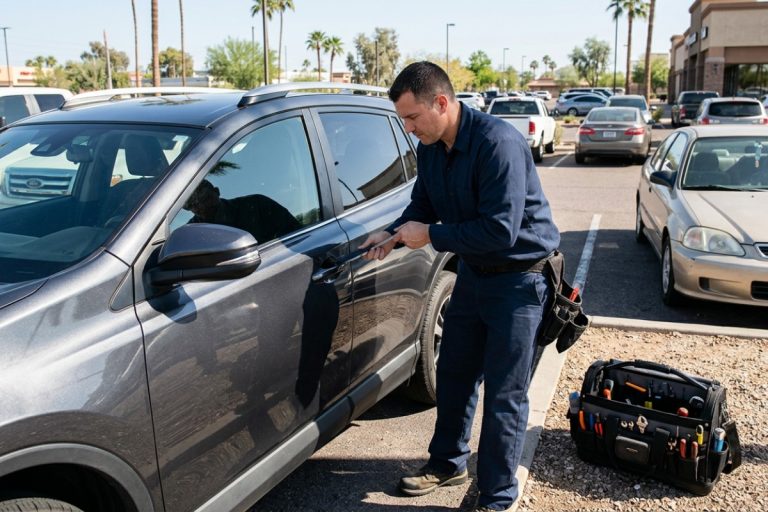
Mobile locksmith unlocking a car door during a car lockout service call in Tempe AZ

Car Lockout Service in Tempe AZ

A car lockout in Tempe isn’t just an inconvenience — standing outside on asphalt that reaches 170°F in summer while your vehicle’s interior climbs past 150°F is a genuine health risk. Getting a trained mobile locksmith to your location fast is the right call. Forcing entry with improvised tools bends door linkage rods and damages weather seals, turning a simple unlock into a repair bill.
Car lockouts happen the same predictable ways: keys left on the seat when the door auto-locks, a fob battery that dies without warning, a broken key blade stuck in the door cylinder, or a spare that never made it off the counter at home. Modern vehicles have multiple layers of door linkage inside the panel — the mechanisms that connect the exterior handle to the latch. The wrong tool in the wrong position bends one of those rods and the door stops responding entirely.

Our mobile locksmiths at CallOrange Locksmith in Tempe are positioned across the Tempe and Metro Phoenix area, available every day from 6:00 AM to 10:00 PM. Find us on Google Maps and read reviews from Tempe drivers before you call — our location, our hours, and our track record are all there. We carry professional entry tools for every vehicle platform on every truck.

Founded in 2008, CallOrange has 17+ years serving Tempe area drivers. Our TechTracker GPS dispatch system routes the nearest available technician to your location the moment you call — no relay, no wait time added by a call center routing you elsewhere.


What Happens on a Car Lockout Call

The process from your call to your door opening is consistent on every job.

When you call (480) 847-2635, we confirm your location, vehicle make and model, and the nature of the lockout. That information goes directly to the nearest technician via TechTracker dispatch. We give you an honest estimated arrival time based on where that technician actually is — not an optimistic number.

On arrival, the technician assesses which entry method applies to your specific vehicle. Entry technique is platform-specific. A door unlock on a late-model Ford F-150 uses different tools and angles than a Honda Civic or a BMW 3 Series with flush door handles. Our technicians — including longtime techs Michael and Liran — work across all makes, including domestic, Japanese, European, and Korean platforms.

After entry, we inspect the door to confirm the linkage is intact and the handle is responding normally. If the lockout happened because of a broken key in the cylinder, we can extract the fragment and cut a new key on-site. If the fob battery died and the vehicle has no mechanical key backup, we diagnose the correct bypass path for your specific push-to-start system. See our unlock car door service for a full breakdown of entry methods by vehicle type, and our push-to-start and keyless ignition service for dead-fob scenarios.


Car Lockout Scenarios in Tempe — What Each One Involves

Keys locked inside, door auto-locked. The most common call. The lock is intact, the key is visible. Professional entry tools — either a long-reach tool through the window seal or an air wedge and rod through the door frame — reach the interior unlock mechanism without touching the door linkage. Properly executed, zero damage.

Broken key in the door cylinder. A key blade that snaps in the cylinder blocks entry and prevents using a spare. Extraction requires broken key extractors sized to the key blank profile. Depending on how far the fragment has traveled and whether it’s rotated in the lock, the cylinder may need to be removed and inspected. We carry replacement cylinders for major vehicle platforms if the lock is damaged beyond rekey. Our ignition repair service covers the same broken-key scenario when the fragment is in the ignition rather than the door.

Key fob battery dead — push-to-start vehicle. Most push-to-start vehicles have a mechanical key blade embedded in the fob. If yours does, the door has a mechanical cylinder behind a cover that accepts that blade. If the fob has no blade, most platforms have an emergency entry point under the door handle cover or a proximity bypass using the fob body held against the start button. Our locksmiths diagnose the correct entry path for your vehicle before touching anything.

Key lost or left at home. A lockout caused by a lost key warrants a different response than one caused by keys locked inside. If the key is lost, we recommend a car key replacement to ensure no one else can use that key. If your key is just at home, a door unlock is the complete solution.


Quick Diagnosis — What Your Situation Calls For
Situation Likely Solution What the Tech Does
Keys locked inside, door closed Professional door entry Long-reach tool or wedge entry — zero damage to linkage or seals
Key fob dead — push-to-start vehicle Emergency mechanical bypass or proximity entry Platform-specific fob bypass, hidden cylinder access if equipped
Key broken inside door cylinder Broken key extraction + new key cut Extractor tools, cylinder inspection, on-site replacement if damaged
Key lost — not inside vehicle Door unlock + replacement key cut Entry via professional tools, new key cut to VIN same visit
Transponder key won’t communicate Transponder diagnosis + programming Chip read, clone or replacement key cut and programmed to ECU
Door handle not responding after DIY attempt Linkage rod inspection + repair Door panel removal, bent rod identification, replacement if needed

Why Not to Use DIY Entry Methods in Tempe

A wire hanger or credit card works in movies. In a modern vehicle, the door panel contains multiple plastic linkage rods connecting the exterior handle, interior handle, latch, and lock cylinder. A wire slipped between the door and the frame with no knowledge of where those rods sit bends the closest one. That bent rod means the exterior handle no longer opens the door, the interior handle may not either, and the door has to be disassembled to replace the rod — typically $150–$300 at a body shop.

Tempe’s heat adds a second problem. Rubber weather stripping gets brittle in sustained UV and heat exposure. Forcing a tool between the glass and the seal when the rubber is hot and dry tears the seal, letting water in during monsoon season and wind noise year-round. Replacement seals for a modern vehicle door run $80–$200 plus labor.

Professional entry tools are designed to avoid both of these outcomes. The time from our arrival to your door opening is typically under 10 minutes. That’s the actual cost comparison.

Our automotive locksmith services page has the full scope of what we handle — lockouts, key cutting, transponder programming, ignition repair — all from mobile units that come to you.


Frequently Asked Questions

How long does it take for a locksmith to arrive in Tempe? +
CallOrange uses TechTracker GPS dispatch to route the nearest available technician to your location. Actual arrival time depends on current technician positions and traffic — we give you an honest estimate when you call, not an optimistic number. Call (480) 847-2635 and we’ll tell you exactly where the nearest tech is.
Will a locksmith damage my car door? +
A trained locksmith using professional entry tools causes zero damage to the door panel, weather seals, or linkage rods. The risk of damage comes from improvised tools — wires, hangers, or credit cards — which have no way to avoid the linkage rods inside the door. Professional long-reach tools and wedges are designed specifically to access the interior mechanism without contacting the panel components.
How much does a car lockout service cost in Tempe? +
CallOrange provides a written quote before any work begins — you know the full cost before the technician touches the door. Cost varies based on vehicle type, lock configuration, and whether additional services like broken key extraction or replacement key cutting are needed. Call (480) 847-2635 for a phone estimate based on your vehicle and situation.
What should I do while waiting for the locksmith? +
Stay in a shaded area or a nearby air-conditioned space if possible. Tempe summer heat causes heat exhaustion within 30 minutes of standing in direct sun — don’t underestimate it. If you’re in a parking lot with shade available, use it. Don’t attempt to enter the vehicle with improvised tools while you wait — that’s the most common way a straightforward lockout becomes a door repair.
Can you unlock any car make or model? +
Yes. CallOrange technicians work across all makes and models — domestic, Japanese, European, Korean, and luxury platforms. Some vehicles with flush door handles or double-locked security require specific entry techniques. When you call, give us the year, make, and model and we confirm the correct approach before dispatch.
Is CallOrange available for car lockouts on weekends in Tempe? +
Yes. CallOrange Locksmith in Tempe is available every day of the week from 6:00 AM to 10:00 PM, including weekends and holidays. Call (480) 847-2635 and we’ll dispatch the closest available technician to your Tempe location.

What to Do Right Now

A car lockout in Tempe has one correct response: call a mobile locksmith and stay in a shaded area while you wait. The door opens without damage, you’re back on the road, and nothing about your vehicle has changed. That’s the only outcome worth pursuing.

If your lockout happened because of a lost key rather than keys locked inside, the right follow-up is a replacement key cut to your VIN to restore full security. We handle that in the same visit. If the lockout revealed a damaged lock cylinder or a fob that’s failing beyond battery, our automotive service team can diagnose and resolve both in one stop.

CallOrange Locksmith in Tempe has served drivers across Tempe, Mesa, Chandler, and the Metro Phoenix area since 2008. Our technicians are licensed, insured, and bonded, and every job comes with a written quote before any work begins — no surprise charges after the door is open. Our 5-star reviews reflect the same standard on every call.

Call (480) 847-2635 right now. We’re available daily from 6:00 AM to 10:00 PM. Visit our contact page for non-emergency scheduling, or see our full services menu for everything CallOrange covers in Tempe.

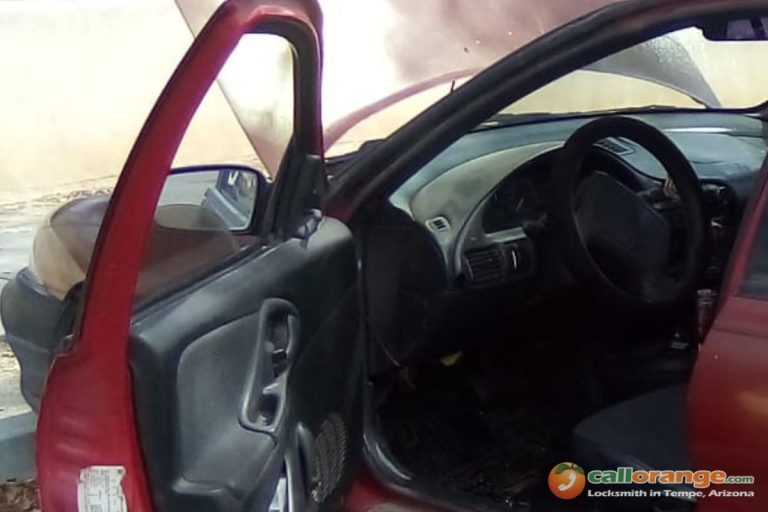
Car lockout service by auto locksmith in Tempe Arizona opening vehicle door

Auto Locksmith Tempe: Why “Key Not Detected” and Remote Failures Spike in Dust + Heat

“Key Not Detected” is usually a signal-quality or power-quality problem—not a mysterious immobilizer failure. In Tempe heat and dust, fob batteries sag, contacts oxidize, antennas see weaker reception, and interference sources pile up, so the vehicle intermittently loses clean authorization.

If your car starts one minute and refuses the next, the pattern matters: temperature, time of day, parking location, and whether the remote buttons still work. Those clues tell a technician whether you’re dealing with fob power, receiver/antenna sensitivity, RF interference, or mechanical wear in the ignition/door hardware.

For more automotive topics, start with our blog hub: automotive locksmith resources or browse the full library on our blog. When you’re ready to schedule, use our Contact Us page or learn who we are on About Us.

Directions and reviews: Google Maps


Why Tempe and Phoenix conditions make keyless issues more common

A modern key fob system depends on stable voltage, clean electrical contact, and a strong RF “handshake” between the fob and the vehicle. In Tempe, Phoenix, Mesa, Chandler, Scottsdale, and Gilbert, the environment pushes on all three:

  • Heat accelerates battery voltage drop (especially older coin cells) and increases resistance at marginal connections.
  • Dust + fine grit work into button membranes and contact surfaces, causing intermittent button response and signal inconsistency.
  • Daily high-temperature cabin cycles (parked in sun → cooled at night → reheated) stress solder joints and connectors over time.
  • Parking-lot RF noise (dense Wi-Fi, Bluetooth, retail security systems, EV chargers, some LED drivers) can reduce effective reception in “hot spots.”

Bold takeaway: Intermittent failures are usually tolerance failures—barely enough voltage, barely enough signal, barely enough contact.

If the issue is specifically with a push-to-start vehicle, our service page is here: push-to-start keyless ignition support.


The “Key Not Detected” chain: what has to work for a start to happen

Keyless systems vary by make/model, but the logic is similar:

  1. The fob must broadcast a readable signal (powered and transmitting cleanly).
  2. The vehicle must receive that signal (antenna/receiver sensitivity, low interference).
  3. The system must confirm authorization (immobilizer logic—conceptually, not bypassable).
  4. The vehicle must see valid brake/gear/door-state inputs and adequate system voltage to complete the start sequence.

When any step is marginal, you get intermittent messages like:

  • “Key Not Detected”
  • “Key Not In Vehicle”
  • “No Key”
  • Or the car unlocks but won’t start

For key and remote related problems, you can also reference: car remote overview.


Most common root causes we see in Tempe (and why they happen)

1) Weak fob battery under heat load

Coin cells can test “okay” at rest, then sag under actual transmit load—especially in heat. The symptom is classic: the system works in the morning, struggles in the afternoon, then “magically” works again later.

Bold takeaway: Voltage under load matters more than a quick resting test.

2) Dirty or oxidized contact surfaces in the fob

Dust and skin oils can build up on contact points; over time, button presses become inconsistent and transmit strength can drop intermittently.

3) RF interference in specific parking locations

If the failure clusters at one place (apartment garage, a certain retail lot, a campus zone), think interference. The fob is fine—the environment isn’t.

4) Vehicle-side antenna/receiver sensitivity drift

Receiver performance can degrade slowly. A marginal receiver still works when the fob is very close, then fails at normal distance.

5) Low vehicle system voltage or borderline charging health

A weak 12V system can cause modules to behave inconsistently—even if the engine runs fine once started. You’ll often see more warnings and “odd” electronics behavior alongside keyless issues.

6) Mechanical wear that masquerades as an electronic problem

Not every “no start” complaint is purely electronic. If there’s an ignition/lock component with wear (depending on vehicle type), binding and timing issues can create confusing symptoms.

If ignition hardware is part of the complaint set, start here: ignition repair service and the deeper explainer: ignition lock repair.


Quick Diagnosis: symptom → likely cause → what a pro checks

This is a safe, non-bypass diagnostic map. It helps separate fob issues, environment issues, and vehicle-side reception issues.

Symptom Likely cause What a pro checks
Works close-up only Weak transmit or receiver sensitivity Fob power under load, range consistency
Fails in one parking lot RF interference hot spot Location pattern, signal environment
Buttons work, start fails Vehicle-side receive/auth path Receiver behavior, system voltage, inputs
Starts AM, fails PM Heat-driven voltage/contact issue Battery sag pattern, fob contact condition
Random warnings + key issue Low 12V stability Voltage behavior, module stability signs
Unlock works, start doesn’t Different antenna paths Start/immobilizer receive path patterns

Bold takeaway: Pattern beats guesswork. Time + place + distance are diagnostic data.


What a real auto locksmith inspection looks like (no risky shortcuts)

A good auto locksmith workflow focuses on verification and repeatability:

  • Confirm the complaint pattern (distance, location, heat, frequency)
  • Check remote function consistency (buttons vs proximity behavior)
  • Evaluate likely fob power/contact issues (without “hoping”)
  • Identify whether the issue tracks the vehicle environment (interference) or vehicle-side reception
  • If ignition hardware is implicated, evaluate wear/tolerance behavior (no bypass)
  • Document what changed so the next failure is predictable—not surprising

If you need new keys made or replaced as part of the solution path, these pages are helpful:


Heat, dust, and wear: the underappreciated failure multipliers

Heat expansion and tolerance stacking

Components don’t have to “break” to fail—they just have to drift out of tolerance. Heat increases resistance in marginal contacts and reduces headroom in weak batteries.

Dust contamination and button membrane behavior

Dust intrusion can make button presses inconsistent, which can look like “the remote is dead” when it’s actually intermittent contact.

Fleet usage and repeated handling

If a fob is used many times per day (delivery, rideshare, service fleets), mechanical wear and contamination accelerate.

Bold takeaway: High-cycle usage creates intermittent behavior long before total failure.


Table: common Tempe driver scenarios and what they usually mean

Scenario What it often points to Best next step
Only fails after sun exposure Battery sag / contact issues Verify fob power + contact health
Fails at a specific garage/lot RF interference environment Confirm location pattern
Works for unlock, not start Separate receive paths Check start-side reception pattern
Needs the fob “just right” Range/antenna sensitivity Evaluate receiver sensitivity behavior
Multiple electronics warnings Low 12V stability Confirm vehicle voltage stability

When a key/remote problem becomes a business risk

For Tempe businesses with staff vehicles, service vans, or customer-facing operations, intermittent keyless issues become downtime. A technical fix is only half the solution—repeat prevention matters:

  • Standardize key handling (avoid contamination)
  • Replace borderline fobs before they become “random”
  • Don’t ignore early signs (range shrinking, intermittent buttons)

If you’re dealing with broader commercial entry hardware issues at your business location (separate from vehicles), this reference may help: commercial door hardware.


Related security note: if a lost key ring includes home keys

Sometimes a vehicle issue starts with a lost key ring—and that includes house keys. If that’s your situation, it’s smart to reset access at home as well:


FAQs

1) Why does my car say “Key Not Detected” only sometimes?

Intermittent messages usually mean marginal voltage, marginal contact, or marginal reception. Heat and dust push weak batteries and worn contacts over the edge, especially in Tempe summers.

2) The remote buttons work, but the car won’t start—how is that possible?

Many vehicles use different receive paths for button-based commands versus proximity authorization. A locksmith looks for pattern differences (distance sensitivity, location sensitivity) to narrow the cause.

3) Why does it fail in one parking lot but not another?

That’s a classic sign of RF interference. Dense electronics environments can reduce effective reception even when the fob is healthy.

4) Can a weak vehicle battery cause keyless problems?

Yes. A borderline 12V system can make control modules behave inconsistently, causing keyless authorization to fail intermittently or throw confusing warnings.

5) Is this the immobilizer “locking me out”?

Immobilizer logic exists to prevent unauthorized starts, but most “Key Not Detected” complaints are signal or power quality issues—not a sudden security lockout. Diagnosis focuses on what’s missing in the authorization chain.

6) Do push-to-start systems fail more in Arizona heat?

They can. Heat accelerates battery sag and increases resistance in marginal contacts. If the pattern tracks temperature, a technician treats it as a tolerance problem first.

7) Should I replace my key fob right away?

Not always. The best approach is verify the failure pattern, confirm whether it’s fob power/contact, interference, or vehicle-side reception—then choose the correct fix to prevent repeat downtime.

8) What information should I share when I call?

Tell us the exact message, when it happens (morning vs afternoon), where it happens (specific lot/garage), and whether the remote buttons work consistently. That saves time and avoids guesswork.


Wrap-up: keep your start system dependable in Tempe

When you see “Key Not Detected,” the problem is usually signal and voltage stability—a weak fob battery under heat, worn contact surfaces, interference in specific locations, or a vehicle-side reception issue that has drifted out of tolerance.

The correct path forward is to diagnose the pattern, confirm whether the failure is fob-driven, environment-driven, or vehicle-driven, and then apply the fix that prevents repeat incidents—without risky shortcuts or guesswork.

CallOrange has been serving Tempe and the Phoenix metro area since 2008, with a focus on clean diagnostics and verification so your vehicle is consistent again—not just “working for now.”

For push-to-start and remote problems, call (480) 847-2635 or reach out through our Contact Us page. We’ll verify authorization and prioritize damage prevention and legal compliance—because security systems and high-risk openings should be handled carefully.