How to program a key fob step-by-step guide — CallOrange Locksmith Tempe

How to Program a Key Fob: Step-by-Step Guide for 2026

Programming a key fob pairs its onboard transponder chip and radio-frequency ID to your vehicle’s immobilizer and body control module — a security handshake, not a battery swap. Some older vehicles accept an on-board sequence from the driver’s seat, but most 2016-and-newer cars require an OBD-II programmer and manufacturer security access. A locksmith handles the diagnosis and the pairing.
You bought a replacement fob online, or the one in your pocket suddenly stopped locking the doors, and now you’re staring at a button that does nothing. That silence usually isn’t the battery — it’s a fob the car has never been taught to recognize, or one that lost its sync after a dead cell or a module reset. Every modern remote carries a coded chip that has to be authorized by the vehicle before it will unlock a door or start the engine, and that authorization is exactly what “programming” means.

For most drivers the practical fix is straightforward once you know which path your car takes, and our automotive locksmith work covers both the on-board method and the scanner-based method for vehicles that lock programming behind a security PIN. If you want to confirm you’re dealing with a local shop and not a call-center dispatcher, you can see our Tempe location and reviews on Google Maps before anyone touches your car.

CallOrange Locksmith has worked on cars across Tempe, Mesa, Chandler, and Scottsdale since 2008, and the pattern is consistent: the fob itself is rarely the hard part — matching it to the vehicle’s security system is. This guide walks through what programming really involves, the three routes to get it done, the general steps, the mistakes that waste an afternoon, and the point where a professional saves you money instead of costing it.

What Key Fob Programming Actually Is

A key fob is a small radio transmitter. Inside it sits a transponder chip and a circuit board that broadcasts on a fixed frequency — usually 315 MHz in North America, sometimes 433 MHz on imports. When you press unlock, the fob sends a coded signal. When you sit in the driver’s seat of a push-to-start car, the fob answers a challenge from the vehicle without you pressing anything at all.

Programming is the process of registering that chip’s unique ID inside two of the car’s computers: the immobilizer, which decides whether the engine is allowed to start, and the body control module (BCM), which handles locks, lights, and the remote functions. Until both accept the fob, the remote is just a plastic shell with a working battery.

This is why a fresh battery doesn’t always bring a fob back to life. A dead cell interrupts power; a lost pairing interrupts trust. If your remote worked yesterday and died today after nothing more than a battery change, the sync may simply need to be re-established. If it’s a brand-new remote, the car has never seen its code and has to be taught it from scratch — the same handshake that happens when we cut and program a new car key after a lost original.

Two more terms are worth knowing before you start:

  • Rolling code: Modern fobs change their transmitted code every press using an encrypted sequence, so a recorded signal can’t be replayed by a thief. This is also why a fob that falls far out of sync can’t just be pressed back into working order.
  • Proximity vs. remote: A basic remote unlocks doors from a distance. A proximity fob on a push-to-start or keyless ignition system also has to be authorized to start the engine — a separate, tighter layer of programming.

Methods to Program a Key Fob: OBD-II, Manual Sync, and Locksmith

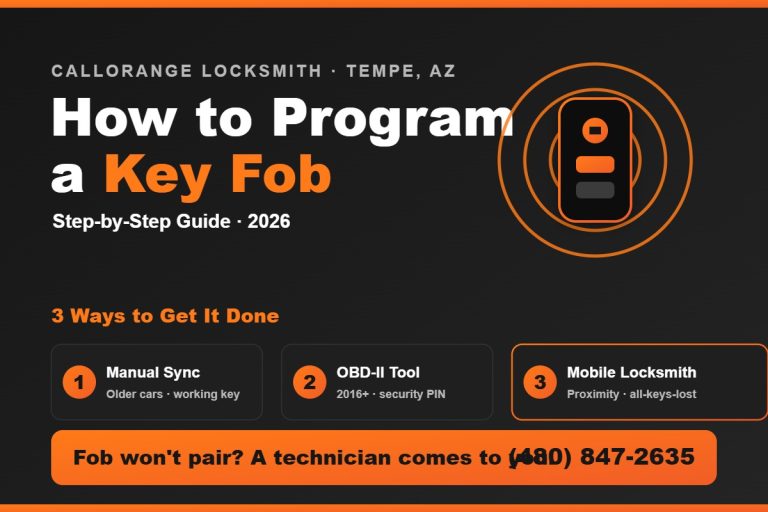
There are three real routes to program a fob. Which one applies depends almost entirely on the make, model, and year of your vehicle — not on how handy you are.

Manual on-board sync. A shrinking number of vehicles — many domestic models built before roughly 2015 — allow an on-board procedure. You use an already-working key and a specific sequence of ignition cycles and button presses to put the car into a learning mode, then register the new remote. It needs no tools, but it only works when the car supports it and you already have at least one recognized key.

OBD-II programming. Most newer vehicles require a scanner plugged into the OBD-II port under the dash. The programmer talks directly to the immobilizer and BCM, and on many models it also requires a security PIN or incode/outcode pulled from the manufacturer before it will authorize a new key. This is the method that covers the majority of 2016-and-newer cars and nearly all proximity systems.

Dealership or professional locksmith. When the vehicle demands manufacturer security access, an all-keys-lost situation, or proximity-key pairing, the job goes to a dealer or a professional automotive locksmith. A locksmith is usually the same-day, lower-cost option and comes to your driveway; the dealer means a tow and an appointment. Both can produce and pair replacement car keys when there’s no working original left to trigger a learning mode.

Tools You Need

If your vehicle is one of the models that supports do-it-yourself programming, this is the realistic checklist:

  • At least one working key or fob — most on-board sequences won’t start without an already-paired remote
  • The new fob, correct by FCC ID and frequency — the number printed on the back must match your vehicle
  • A fresh CR2032 or CR2025 battery installed in the new fob before you begin
  • Your owner’s manual for the exact on-board sequence, which varies by model
  • An OBD-II programmer for any car that won’t accept an on-board method
  • The manufacturer security PIN for models that gate programming behind it
  • A fully charged vehicle battery — a low battery mid-sequence corrupts the pairing

Note the honest catch: an all-keys-lost car, a proximity system, or a PIN-locked model puts most of this out of reach at home. That’s the line where the tool list stops mattering.

Key Fob Programming Methods Compared

Method Best For What You Need Do It Yourself?
Manual on-board sync Many domestic models built before ~2015 A working key, the correct new fob, owner’s manual Often yes
OBD-II programming Most 2016-and-newer vehicles OBD-II programmer, often a manufacturer security PIN Rarely — needs equipment
Proximity / push-to-start pairing Keyless-ignition vehicles Scanner, security access, VIN-matched fob No — professional only
All-keys-lost programming No working key remaining Locksmith equipment and manufacturer access No — professional only
Dealership Any of the above, at higher cost Appointment and usually a tow No — drop-off required

General Steps to Program Your Key Fob

The exact sequence is model-specific, but on vehicles that allow an on-board method the flow generally follows this order. Always confirm your car’s procedure in the owner’s manual first — the wrong sequence can lock the immobilizer into a timeout.

  1. Park, set the brake, and gather your keys. Have the working key and the new fob within reach, battery already installed in the new one.
  2. Enter programming mode. This usually means cycling the ignition from off to on a set number of times within a few seconds, or using the working key to reach the “on” position. The car signals it’s listening with a door-lock cycle or a chime.
  3. Register the new fob. Press the lock button on the new remote once. A confirming lock cycle means the BCM accepted the code.
  4. Add any additional fobs. If you’re pairing more than one, register each while the car is still in learning mode.
  5. Exit and test. Turn the ignition off, remove the key, and test lock, unlock, and — on push-to-start cars — engine start from a normal distance.

If nothing confirms at step two or three, stop. Repeating a failed cycle over and over is the most common way drivers push a car into a security lockout that then needs a scanner to clear. A no-response fob after two clean attempts is a signal the car wants the OBD-II route, not more retries. For proximity and PIN-gated vehicles, there’s no home sequence at all — the pairing has to happen through the port with manufacturer access.

Diagnosis at a Glance: When Programming Doesn’t Take

When a fob won’t cooperate, the symptom usually points to a specific cause a professional can confirm on the spot.

Symptom Likely Cause What a Pro Checks
New fob does nothing after the sequence FCC ID or frequency mismatch on the remote Verifies the fob part number against the VIN before pairing
Doors lock but engine won’t start Fob paired to BCM but not the immobilizer Reads immobilizer status and re-runs key authorization
Fob worked, then quit after a battery change Lost sync / rolling-code drift Re-syncs the remote or re-registers through the port
Car rejects all programming attempts Security PIN required or module in timeout Pulls the manufacturer PIN and clears the lockout
Only one of two fobs responds Second fob never registered in learning mode Re-enters programming mode and adds the missing remote

Common Mistakes When Programming a Fob

Most failed do-it-yourself attempts trace back to a short list of avoidable errors. Knowing them ahead of time saves the afternoon:

  • Buying the wrong fob. A remote that looks identical can carry a different FCC ID or frequency. If the number on the back doesn’t match your vehicle, no sequence will ever pair it.
  • Skipping the battery check. A weak vehicle battery or a half-charged fob cell interrupts the handshake and leaves a partial, corrupted pairing.
  • Assuming every car has an on-board mode. Most 2016-and-newer models don’t. Cycling the ignition on a car that requires a scanner just risks a timeout.
  • Ignoring the security PIN. On PIN-gated vehicles, programming cannot complete without the manufacturer code — there’s no workaround at home.
  • Trying to program with no working key. An all-keys-lost situation almost always needs professional equipment; the on-board method depends on an existing paired key.
  • Retrying a failed sequence repeatedly. Each failed attempt can push the immobilizer further into a protective lockout that then requires a scan to reset.
  • Overlooking a worn key blade. If the physical key won’t turn the ignition cleanly, the problem may be the cylinder, not the fob — which points toward ignition repair rather than reprogramming.

A remote that still won’t respond after a careful attempt isn’t a failure on your part — it usually means the vehicle falls into the professional-only category, and forcing it does more harm than good.

When to Call a Professional Locksmith

Programming a key fob comes down to one question: does your car allow an on-board sequence, or does it lock pairing behind a scanner and a manufacturer PIN? On older models with a working spare, the driveway method is realistic. On most modern vehicles, an all-keys-lost car, or any proximity system, the job needs OBD-II equipment and security access that isn’t available over the counter.

When you hit that wall, the right next step is a mobile automotive locksmith who can come to you, confirm the correct fob against your VIN, and pair it on the spot — without a tow to the dealership. CallOrange Locksmith has cut, coded, and programmed keys for drivers across Tempe, Mesa, Chandler, Scottsdale, Phoenix, Gilbert, and Guadalupe since 2008, working from a fully equipped mobile van rather than a fixed counter. That local experience is why so many East Valley drivers call us before they call the dealer, and you can read more about our Tempe locksmith team and the full range of locksmith services we handle, including residential lock work.

If a fob won’t program, you’re locked out of your car, or you’ve lost your only key, call (480) 847-2635 or reach us through our contact page to get a technician headed your way. We’re available from 6 AM to 10 PM, seven days a week, and we’ll match the right key to your vehicle before we ever start the pairing. You can also browse more locksmith guides on our blog for the next key or lock question that comes up.

Sources: National Highway Traffic Safety Administration on vehicle anti-theft systems and the Federal Communications Commission on radio-frequency key fob devices.

Frequently Asked Questions

How much does it cost to program a key fob?

It depends on the vehicle and the type of fob. A basic remote for a car with an on-board procedure is inexpensive, while proximity and push-to-start fobs that need a scanner and a manufacturer PIN cost more because of the equipment and security access involved. A locksmith gives you an upfront quote for your exact make and model before starting, and it is almost always below dealership pricing.

Can I program a key fob myself?

Sometimes. Many domestic vehicles built before about 2015 allow an on-board sequence using an existing working key. Most 2016-and-newer cars, proximity systems, and any all-keys-lost situation require an OBD-II programmer and manufacturer security access, which are not available over the counter. Check your owner’s manual first to see which category your vehicle falls into.

Why did my key fob stop working after I changed the battery?

A battery change can interrupt the rolling-code sync between the fob and the vehicle. The remote still has power, but it has drifted out of the encrypted sequence the car expects. Re-syncing or re-registering the fob usually restores it, a short procedure a locksmith can do at your location.

Do I need the original key to program a new fob?

For most on-board sequences, yes, the car needs at least one already-paired key to enter learning mode. If you have lost every key, the vehicle is in an all-keys-lost state, which needs professional equipment to authorize a brand-new remote from scratch. That is one of the most common reasons drivers call a locksmith.

How long does key fob programming take?

An on-board sequence takes a few minutes once you have the right fob and procedure. A scanner-based pairing on a modern vehicle typically runs 15 to 30 minutes, including verifying the fob against the VIN and pulling any required security code. Proximity systems on the newest cars can take longer.

Will any replacement fob work with my car?

No. The fob has to match your vehicle by FCC ID and radio frequency, and it must be the correct type for your ignition, standard remote versus proximity. A remote that looks identical can carry different internals. Matching the fob to the VIN before pairing is the single most important step, and getting it wrong is the top reason a self-programmed fob never responds.

Do you come to me in Tempe to program a key fob?

Yes. CallOrange Locksmith runs a mobile service across Tempe, Mesa, Chandler, Scottsdale, Phoenix, Gilbert, and Guadalupe, so a technician comes to your driveway, workplace, or parking lot. Call (480) 847-2635 anytime from 6 AM to 10 PM, seven days a week, and we bring the equipment and blank fobs to your location.

car-key-replacement-cost-tempe

Car Key Replacement Cost in Tempe, AZ — What You’ll Actually Pay

Car key replacement prices in Tempe range from $45 to $350+ depending on key type, vehicle year, and programming requirements. A basic mechanical key for older models costs the least, while push-to-start proximity fobs for European vehicles sit at the top of the range. A licensed locksmith diagnoses the exact key type your vehicle needs and programs it on-site to match your car’s immobilizer system.

Prices shown reflect general market ranges for the Tempe and Phoenix metro area as of 2026. Your actual cost depends on vehicle make, model, key type, and parts availability. Call (480) 847-2635 for an exact quote before service.

You’re standing in a parking lot somewhere near Mill Avenue or off the 101, holding a key that snapped in the ignition — or maybe you lost the only copy you had. The first thing that crosses your mind is how much this is going to cost. The second is who to call. Both are valid concerns, and the answers depend on several factors most drivers don’t think about until they’re in this exact situation.

The price gap between key types has widened significantly over the past decade. A standard metal key blank and a proximity fob with rolling-code encryption are completely different products, even though both “start your car.” The technology inside each key determines the equipment needed, the time required, and ultimately the cost. In Tempe’s extreme summer heat — where dashboard temperatures regularly exceed 160°F — plastic transponder housings and fob batteries degrade significantly, making replacement more common here than in milder climates.

CallOrange.com has provided automotive locksmith services in Tempe since 2015, programming and cutting keys for virtually every make and model on the road. Our licensed and insured technicians bring the tools and key blanks directly to your location — no tow truck needed, no dealership markup.

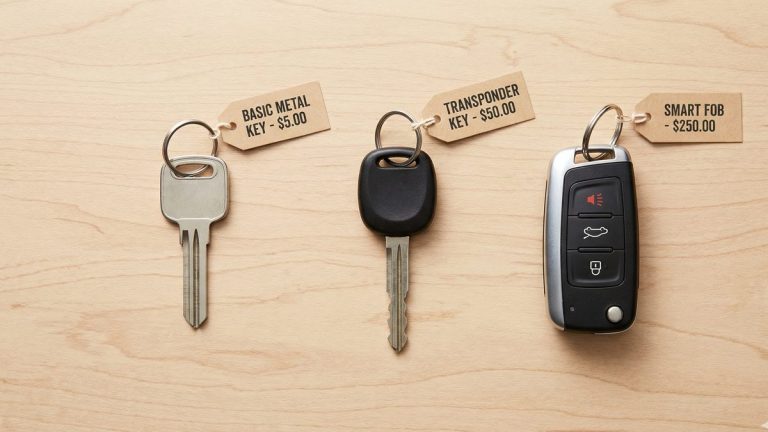
Key Type Cost Range Programming Required Common Vehicles
Basic Mechanical Key $45 – $75 No Pre-1997 models, utility vehicles
Transponder Chip Key $75 – $180 Yes — chip to immobilizer Honda Civic, Toyota Corolla, Ford F-150
Remote Head Key $120 – $225 Yes — chip + remote sync Toyota Camry, Honda Accord, Nissan Altima
Proximity / Smart Key Fob $150 – $350+ Yes — encrypted rolling code Toyota RAV4, Hyundai Tucson, Kia Sportage
European Smart Key $250 – $400+ Yes — dealer-level software BMW 3-Series, Mercedes C-Class, Audi A4
All Keys Lost (add-on) + $50 – $150 Full immobilizer reset Any vehicle — no working key available
Ignition + Key Bundle $200 – $450 Yes — ignition + key match Older Honda, GM, Chrysler models
Spare Key (with original) $75 – $120 Clone from existing key Most makes and models

Car Key Types and What Each One Costs

Not every car key is the same, and the type your vehicle uses is the single biggest factor in replacement cost. Here’s what Tempe drivers encounter most often.

Basic mechanical keys are simple metal-cut keys with no electronics. Vehicles manufactured before the mid-1990s typically use these. Replacement runs between $45 and $75, including cutting on-site. These keys don’t require programming because there’s no chip inside — the physical cut pattern is the only security layer.

Transponder chip keys contain a small radio-frequency chip embedded in the plastic head. When you insert the key and turn the ignition, the chip sends a coded signal to your vehicle’s immobilizer. If the codes don’t match, the engine won’t start. Most vehicles from 1997 onward use some form of transponder technology. Replacement typically costs $75 to $180 depending on the vehicle brand and whether the locksmith can clone from an existing key or needs to program from scratch through the OBD-II port.

Remote head keys combine a transponder chip with integrated buttons for lock, unlock, and trunk release — all in one unit. These are standard on most mid-2000s to mid-2010s vehicles. The cost ranges from $120 to $225 because the locksmith must cut the blade, program the transponder chip, and sync the remote functions separately.

Proximity fobs and smart keys are the most advanced and most expensive to replace. These push-to-start key fobs communicate with your vehicle through encrypted radio signals and never need to physically enter the ignition. Replacing one costs between $150 and $350+, depending on the brand. European vehicles like BMW, Mercedes, and Audi tend to be at the higher end because their encryption protocols require specialized software and dealer-level programming tools.

Why Location and Vehicle Brand Affect Your Price

Two drivers in Tempe can need the same service — “replace my car key” — and pay very different amounts. The vehicle brand and the specifics of the situation explain why.

Japanese brands (Toyota, Honda, Nissan, Subaru) generally fall in the moderate range. Their transponder systems use well-documented protocols, and aftermarket key blanks are widely available. A Toyota Camry transponder key might cost $90 to $140 to replace and program on-site.

American brands (Ford, Chevrolet, Dodge, Jeep) vary widely. Older Ford models with the PATS (Passive Anti-Theft System) are straightforward. Newer Dodge and Jeep vehicles with the Fobik key system cost more because the fob and transponder are integrated into a single unit that requires dealer-level access to program.

European brands (BMW, Mercedes-Benz, Volkswagen, Audi) are consistently the most expensive. Their security systems use layered encryption, and many require the locksmith to connect directly to the vehicle’s onboard computer. A Mercedes smart key replacement can run $250 to $400 depending on the model year.

The “all keys lost” scenario is always more expensive than having a spare. When you have at least one working key, a locksmith can often clone or add a new key to the system in minutes. When every key is gone, the technician must access the vehicle’s security system from scratch — resetting the immobilizer, programming a new master key, and sometimes replacing the ignition cylinder entirely. This process adds $50 to $150 to the total cost. If you’re in this situation, our car key replacement specialists handle all-keys-lost jobs daily across the Tempe metro area.

Dealership vs. Locksmith — Comparing Your Options

Most dealerships in the Phoenix metro area charge between $200 and $500 for a replacement key, and the process typically requires towing the vehicle to the dealer, waiting 3 to 7 business days for the key to be ordered, and paying separately for programming. For a car that’s already sitting in your driveway or a parking lot, that’s a significant inconvenience on top of the cost.

A mobile locksmith brings the key blanks, cutting machine, and programming equipment directly to you. The entire process — from arrival to handing you a working key — usually takes 30 to 60 minutes on-site. The cost savings compared to a dealership average 30% to 50%, and there’s no towing expense.

There’s one exception where a dealership might be necessary: some ultra-high-security vehicles (certain Volvo, Tesla, and late-model Mercedes models) use proprietary programming that only authorized dealers can access. A qualified locksmith will tell you upfront if your vehicle falls into this category rather than waste your time.

For the majority of vehicles on Tempe roads — Hondas, Toyotas, Fords, Chevys, Hyundais, Kias — a licensed mobile locksmith handles the job at a lower price and with same-day service. You can request a quote from our team before we dispatch, so there are no surprises when the technician arrives.

How Arizona Heat Damages Car Keys and Fobs

Living in the Tempe and Phoenix metro area means your car keys endure conditions that drivers in other states never deal with. Arizona’s summer heat plays a direct role in how often keys fail and need replacement.

Transponder chip delamination happens when the plastic housing around the chip expands and contracts through repeated heat cycles. Dashboard temperatures inside a parked car in Tempe can hit 170°F between June and September. Over time, this thermal stress cracks the internal antenna connection between the chip and the key housing, causing intermittent starting failures that eventually become permanent.

Key fob battery drain accelerates in extreme heat. The lithium coin-cell batteries inside fobs are rated for moderate temperatures. Consistent exposure to 110°F+ ambient air — common in Tempe from May through October — shortens battery life from the typical 2 to 3 years down to 12 to 18 months. When the battery dies in a proximity fob, many drivers assume the fob itself is broken.

Plastic housing warping affects both transponder keys and fobs. The buttons on remote head keys become soft and unresponsive. The blade on flip keys may not deploy properly because the spring mechanism housing has deformed. We see a noticeable increase in car remote and fob issues every summer at our Tempe location.

UV degradation breaks down rubber gaskets and button pads on key fobs left on dashboards or hung from rearview mirrors. The infrared signal can weaken as the fob’s plastic lens yellows and clouds, reducing the effective range from 30 feet down to 5 feet or less.

The takeaway: store your spare key indoors, not in the glove compartment or center console. If your fob’s range has been decreasing gradually, the battery or the internal antenna may be heat-damaged — not just low on charge.

What to Do When You Need a Replacement Key Right Now

If you’re locked out or stranded with a broken key, here’s the most efficient path to getting back on the road:

  • Check for a spare first. If anyone in your household has a copy, that’s the simplest solution. A locksmith can unlock your car door to get you moving while you arrange a duplicate.
  • Know your vehicle’s year, make, and model. This tells the locksmith exactly which key blank and programming protocol to bring. It also gives you an accurate price quote over the phone.
  • Have your photo ID and registration ready. Every reputable locksmith in Arizona verifies ownership before cutting or programming a key. This protects you from unauthorized key duplication.
  • Ask about the total cost upfront. A transparent locksmith gives you a price that includes the trip charge, key blank, cutting, and programming — no add-on fees after the work is done.
  • Request a warranty. Replacement keys should come with a guarantee on both the physical cut and the electronic programming. CallOrange.com includes a 30-day warranty on parts and labor for every automotive key service.

If your key snapped inside the ignition, don’t try to extract it yourself — metal fragments can damage the ignition wafer stack and turn a key replacement into a costly ignition repair. A locksmith has extraction tools designed for this exact situation.

Saving Money on Car Key Replacement

The most effective way to reduce your cost is to get a spare key made before you lose the original. Cloning an existing key is significantly less expensive than programming from scratch in an all-keys-lost scenario. Most locksmith visits for a spare transponder key cost roughly half of what you’d pay in an emergency.

Insurance coverage is another avenue worth checking. Some auto insurance policies and extended warranty plans cover key replacement, particularly for newer vehicles with expensive fob systems. AAA and similar roadside assistance programs typically cover the lockout service but not the key itself — so read the fine print.

Aftermarket vs. OEM key blanks is a real choice with real cost implications. OEM blanks from the vehicle manufacturer cost more but guarantee compatibility. Aftermarket blanks from reputable suppliers (Ilco, JMA, Keyline) work identically in most cases at 40% to 60% lower cost. A qualified locksmith knows which aftermarket blanks are reliable for your specific vehicle and which models genuinely require OEM parts.

You can also save by combining services. If your ignition has been giving you trouble and you also need a new key, handling both in one visit eliminates a second trip charge. Similarly, if you’ve just moved to Tempe and want to rekey your home locks along with getting a spare car key, bundling those services into one appointment makes financial sense.

Frequently Asked Questions

How much does a car key replacement cost?

Replacement costs range from $45 for a basic mechanical key to $350+ for a push-to-start smart key fob. The price depends on your vehicle’s year, make, model, and key type. European luxury vehicles with encrypted proximity systems sit at the higher end. We provide an exact quote over the phone once we confirm your vehicle details.

Can you make a key if I lost all copies?

Yes. Our technicians handle all-keys-lost situations daily across Tempe and the Phoenix metro area. The process involves accessing your vehicle’s immobilizer system, programming a new master key, and cutting the blade on-site. This costs $50 to $150 more than a standard replacement because of the additional programming required. Bring your photo ID and vehicle registration for ownership verification.

Is a locksmith cheaper than the dealership?

In most cases, yes — by 30% to 50%. Dealerships charge for the key, programming, and often require towing the vehicle to their location. A mobile locksmith comes to you, cuts and programs the key on-site, and completes the job in 30 to 60 minutes. The exception is a small number of ultra-high-security vehicles that require proprietary dealer software.

Do you program transponder keys on-site?

Yes. Our mobile units carry programming equipment for domestic, Japanese, Korean, and most European vehicles. We connect to your vehicle’s OBD-II port, program the transponder chip to match the immobilizer, and test the key before leaving. The entire process typically takes 20 to 45 minutes depending on the vehicle.

Does Arizona heat damage car keys?

Absolutely. Tempe’s summer temperatures cause transponder chip delamination, accelerated fob battery drain, plastic housing warping, and UV degradation of rubber buttons and signal lenses. We recommend storing spare keys indoors rather than in the glove compartment, and replacing fob batteries annually instead of waiting for failure.

What information do I need when I call?

Have your vehicle’s year, make, model, and trim level ready. Let us know if you have a working key or if all keys are lost — this affects the programming method and price. We also ask for your location so we can dispatch the nearest available technician with the correct key blank for your vehicle.

Do you offer a warranty on replacement keys?

Every car key replacement from CallOrange.com includes a 30-day warranty on both the physical key cut and the electronic programming. If the key or fob malfunctions within that period due to a defect in our work, we return and fix it at no additional charge.

Should I get a spare key made now?

Yes — getting a spare while you still have a working key costs roughly half of what you’d pay in an all-keys-lost emergency. Cloning an existing key is simpler, takes less time, and avoids the full immobilizer reset. It also means you’ll never be stranded without a backup if your primary key fails or goes missing.

Making the Right Call on Car Key Replacement in Tempe

Car key replacement costs between $45 and $350+ in Tempe, depending on key type, vehicle brand, and whether you have a spare. The gap between a basic metal key and a push-to-start proximity fob reflects the real difference in technology, equipment, and expertise required.

The smartest move is getting a spare made now while you still have a working key — it cuts your future replacement cost nearly in half and eliminates the stress of being stranded. If you’re already in a situation where you need a key today, a mobile locksmith is the most efficient and cost-effective option for the majority of vehicles.

CallOrange.com has served Tempe and the Phoenix metro area since 2015, with a 4.8-star rating across 1,451 Google reviews. Our technicians are licensed, insured, and bonded, and we carry key blanks and programming equipment for domestic, Japanese, Korean, and European vehicles. Every job includes a 30-day warranty on parts and labor.

Call (480) 847-2635 for an exact quote based on your vehicle. We verify year, make, model, and key type over the phone so you know the price before we arrive. You can also visit us at our Tempe location in Broad River Plaza or reach out through our contact page to schedule service.