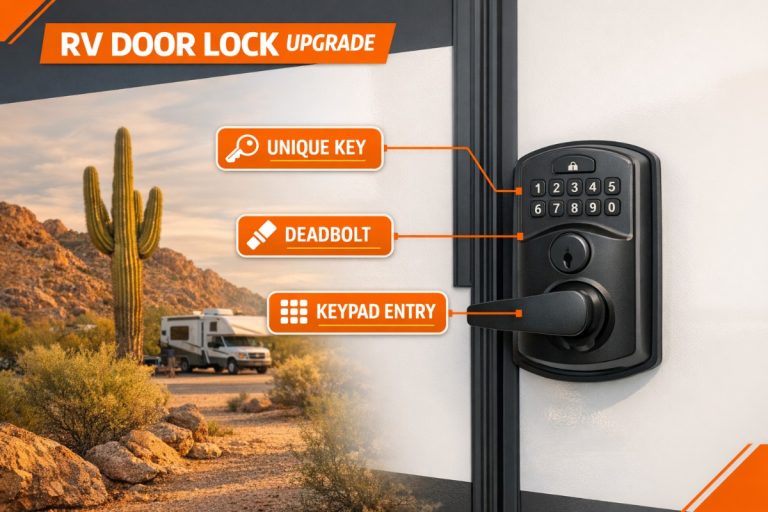
RV door lock upgrade infographic showing unique key, deadbolt, and keypad entry options — CallOrange Locksmith Tempe

RV Door Lock Upgrade: Better Security for Your Home on Wheels

An RV door lock upgrade replaces the keyed-alike factory hardware on your motorhome or travel trailer with a unique, all-metal lock — usually one that adds deadbolt security or a programmable keypad. It closes the single biggest gap in most rigs: a door that a stranger’s key can open.
Pull into any campground and look closely at the entry doors around you. A surprising number of them open with the exact same key. For decades, manufacturers fitted RVs with a small set of universal cylinders — the most common stamped CH751 — so a single key could operate the entry door and storage bays across thousands of separate units. It made assembly simple on the factory floor. It also means the camper parked three spots over may carry a key that opens your door, and you may carry one that opens theirs.

That shared-key design is exactly what an RV door lock upgrade fixes. By swapping the factory cylinder for a keyed-unique lock — or stepping up to a deadbolt or keyless model built for RV doors — you turn a mass-produced weak point into hardware that answers only to you. The payoff is real home safety for a space that holds your gear, your documents, and your family while you sleep. This guide covers why the factory setup falls short, what a proper upgrade includes, and how the main options compare. Read on before your next trip.

Why Factory RV Door Locks Leave You Exposed

The problem starts with the cylinder. Most original-equipment RV locks use thin wafer tumblers inside a soft pot-metal body, and they ship keyed to one of a handful of universal codes. The CH751 is the best known, but it is not alone — several manufacturers rotate through the same short list of factory keys. A would-be intruder does not need to pick anything. A single inexpensive key, sold openly for “RV compartment access,” opens an enormous share of the rigs on the road.

The body of the lock is the second weakness. Lightweight latch assemblies flex under a pry bar, and the deadlatch on many entry handles barely seats into the door frame. Combine a universal key with a flimsy housing and you have an entry point that offers far less protection than the front door on a typical house. For a vehicle that doubles as a residence, that gap matters — both at the campground and when the RV sits in storage or in your driveway between trips.

What an RV Door Lock Upgrade Actually Involves

A good upgrade addresses three things at once: the key, the bolt, and the build quality.

The key is the headline. A replacement lock cut to a unique keyway removes you from the universal-key pool entirely. No more shared codes — your key, and only your key, works.

The bolt is where deadbolt security comes in. Many upgraded RV entry handles add a true deadbolt above the standard latch. A deadbolt throws a solid metal bar deep into the frame and resists the prying and jimmying that defeat a spring latch. On the inside, you operate it with a thumbturn lock — the small lever you rotate by hand to throw or retract the bolt without a key. It is the same convenience you expect on a house door, and it lets you secure the rig from inside in one motion.

The build ties it together. All-metal handles, reinforced strike points, and a snug deadlatch make the whole assembly harder to force. Some owners go further and choose a keyless keypad lock, which adds a programmable code, an optional fob, and a physical key as backup — useful when your hands are full or when you want to share a code with a family member without handing over a key.

Comparing Your RV Door Lock Upgrade Options

Not every rig needs the same solution. A weekend travel trailer and a full-time Class A motorhome face different risks. The table below lays out the common upgrade paths so you can match hardware to how you actually use your RV.

RV Door Lock Upgrade Options: Security & Features Compared
Lock Option How It Works Keyed Unique? Adds Deadbolt? Keyless? Best For
Factory CH751 Cylinder Universal wafer cylinder ✗ No ✗ No ✗ No Baseline — replace this
All-Metal Keyed Replacement Unique-cut cylinder, metal body ✓ Yes ~ Some ✗ No A simple unique-key fix
Deadbolt Entry Handle Latch plus separate deadbolt throw ✓ Yes ✓ Yes ✗ No Stronger forced-entry resistance
Keypad Keyless Lock Programmable code, key/fob backup ✓ Yes ✓ Yes ✓ Yes Hands-full access, code sharing
High-Security Cylinder Swap Pick- and bump-resistant cylinder ✓ Yes ~ Depends ✗ No Maximum cylinder protection
Full Handle + Deadbolt Combo Integrated metal handle and bolt ✓ Yes ✓ Yes ~ Optional Class A / full-time living

Direct-fit replacements from brands such as Bauer, TriMark, Global Link, and RVLock bolt into the standard rectangular RV door cutout. A professional locksmith can confirm the right fit for your door and latch type.

Brands such as Bauer, TriMark, Global Link, and RVLock build direct-fit replacements for the standard rectangular RV door cutout, so most upgrades bolt into the existing opening without cutting new holes. The right pick depends on your door style, your latch type, and how much forced-entry resistance you want.

Pro Tip From the Road

In years of working on residential and vehicle locks, the mistake I see most often is owners upgrading the entry door and forgetting the baggage bays. Those exterior storage compartments almost always still wear the original CH751 cylinders — and that is where chargers, tools, generators, and leveling gear live. When you re-key the door, re-key the bays to match. A single unique key for the whole rig is both more secure and far easier to live with than a ring of universal keys that anyone can duplicate. While you are at it, check that the new deadbolt actually seats fully into the frame; a bolt that only travels halfway gives you the look of security without the substance.

Where RV Lock Security Meets Home Security

An RV is a home on wheels, and the same principles that protect a house apply here. The grading standards locksmiths use for residential hardware — published by the Builders Hardware Manufacturers Association — favor solid bolts, reinforced strikes, and pick-resistant cylinders, and those same priorities translate directly to your rig. Our full range of residential lock services is built on those standards. If you have already invested in good locks at home through lock changes and deadbolt installations, it makes sense to bring your RV up to the same level rather than leaving it as the weak link.

Working with a licensed professional locksmith gives you more than a parts swap. A technician can rekey every lock on the rig to a single key, confirm the deadbolt seats correctly, and flag a worn handle before it fails on the road. For motorhomes, we can also handle the ignition side of things — cutting and programming a spare key so a lost set never strands you. And if you want the strongest possible cylinders, our high-security lock options carry over neatly from commercial work to a well-used RV.

Book an RV Door Lock Upgrade With CallOrange Locksmith Tempe

Your RV deserves the same care you give your house — a lock that answers only to your key, a deadbolt that holds, and hardware built to last the miles. The team at CallOrange Locksmith Tempe has served the East Valley since 2008 and works with RV owners across Tempe, Mesa, Chandler, Scottsdale, and beyond — we come to your rig wherever it is parked. Find us on Google Maps or reach out through our contact page to schedule a security review.

Ready to close the universal-key gap for good? Call (480) 847-2635 and let a professional locksmith match the right RV door lock upgrade to your home on wheels.

Frequently Asked Questions — RV Door Lock Upgrade

Common questions from RV owners in Tempe, Mesa, Chandler, Scottsdale, and the East Valley.

?

What is the CH751 key and why is it a security risk for my RV?

CH751 is a universal key code used across a huge number of RV storage compartments and many factory entry locks. Because manufacturers keyed thousands of separate units to the same handful of codes, a single inexpensive key can open an enormous share of the rigs on the road. The camper next to you may carry a key that opens your door. An RV door lock upgrade to a keyed-unique cylinder removes you from that shared-key pool entirely.

?

Will a new RV door lock fit my existing door, or do I need to cut new holes?

Most upgrades are direct-fit. Brands such as Bauer, TriMark, Global Link, and RVLock build replacements sized for the standard rectangular RV door cutout, so they bolt into the existing opening. Fit still depends on your door style and latch type, which is why a locksmith confirms the measurements before installing rather than assuming every handle is interchangeable.

?

What is a thumbturn lock on an RV deadbolt?

A thumbturn lock is the small interior lever you rotate by hand to throw or retract the deadbolt without a key — the same mechanism found on most house doors. On an upgraded RV entry handle, the thumbturn lets you secure the rig from inside in one motion, while the deadbolt drives a solid metal bar into the door frame for stronger resistance against prying.

?

Is a keyless keypad lock more secure than a keyed RV lock?

A keypad lock removes the universal-key weakness and adds the convenience of a programmable code you can share or change, with a physical key or fob as backup. Security depends on the build quality and the deadbolt behind the keypad — not the electronics alone. A solid keyed deadbolt and a keypad lock can both be strong choices; the right one comes down to how you use your rig and who needs access.

?

Should I upgrade the storage compartment locks too?

Yes. The exterior baggage bays almost always keep their original CH751 cylinders, and that is where chargers, tools, generators, and leveling gear live. Re-keying the entry door but leaving the bays untouched only solves half the problem. The better approach is to re-key the bays to match the new door, so one unique key operates the whole rig.

?

Can a professional locksmith rekey my whole RV to one key?

A professional locksmith can match every cylinder on the rig — entry door and storage bays — to a single unique key, confirm the deadbolt seats fully into the frame, and flag worn hardware before it fails on the road. For motorhomes, the same technician can also cut and program a spare ignition key. Call CallOrange Locksmith Tempe at (480) 847-2635 to schedule a security review.

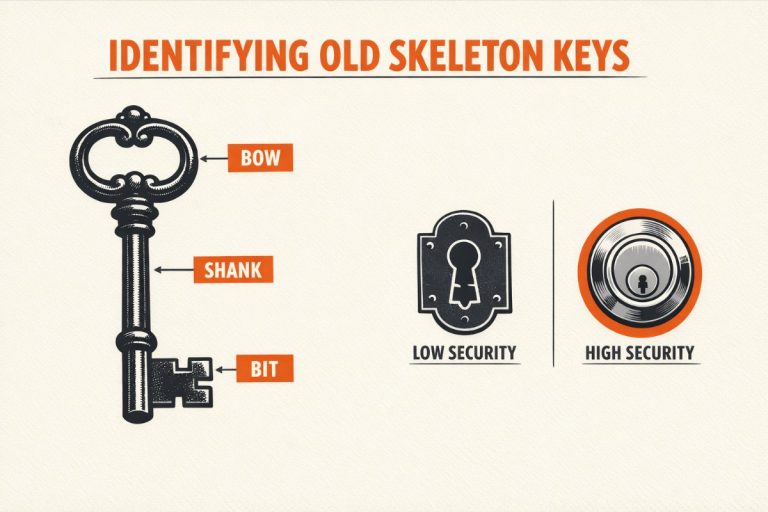
Infographic identifying the parts of an old skeleton key and comparing antique warded locks to modern deadbolt security

Found an Old Key? A Guide to Identifying Old Skeleton Keys

Identifying old skeleton keys comes down to reading three parts: the looped bow you hold, the long shank in the middle, and the flat bit at the end that turns the lock. Most antique keys found around the house once opened warded locks — a simple style standard in American homes before the 1940s. The shape of that bit is the clearest clue to what the key originally opened.
You clean out a drawer, an attic box, or a relative’s old desk, and there it sits — a heavy metal key with a fancy looped top that matches nothing in the house. It won’t slide into a single modern door, and you have no idea what it was meant to open. That puzzle is common, and it usually has a simple answer. Most of these mystery keys are antique skeleton keys built for lock styles no longer used on American doors. The good news is that you can learn to read one. In this guide, a professional locksmith walks through how to name the key in your hand, what it likely opened, and what it means for the safety of your home today. Keep reading to put a name to that old key.

What Is a Skeleton Key, Anyway?

A skeleton key is a key that has been filed down — or purpose-built — so the central shaft and a single thin bit can slip past the wards inside a warded lock. “Wards” are the small obstructions cast into a lock that block the wrong key from turning. A true skeleton key strips away everything except the part that actually moves the bolt, which lets one key open many similar warded locks. That same simplicity is why these locks faded out for exterior doors: the design that makes them charming also makes them easy to bypass.

For a deeper look at how the mechanism works, the overview of the warded lock on Wikipedia is a solid starting point.

How to Start Identifying Old Skeleton Keys

Identifying old skeleton keys comes down to four features. Examine each part of the key in good light before you guess.

The Bow, Shank, and Bit

The bow is the decorative loop you grip. Ornate, scrolled bows often point to furniture or cabinet keys, while plain rounded bows lean toward door locks. The shank is the long stem between the bow and the bit. A solid shank usually means a bit key made for a door; a hollow shank — one that would slide over a pin inside the lock — marks a barrel key, common on clocks and older cabinets. The bit is the flat blade at the end that does the work. The notches and grooves cut into that bit are the fingerprint of the lock it once matched.

Size and Material

Large iron or steel keys, roughly three to six inches long, were typically made for the interior and exterior doors of older houses. Smaller brass keys usually belonged to cabinets, desks, chests, or trunks. Hand-filed edges, uneven casting, and natural tarnish are signs of real age rather than a modern reproduction sold for decoration.

Markings and Maker Stamps

Turn the key over and check the bow and shank for stamped numbers, letters, or a maker’s name. Brand and pattern details documented in collector references for antique keys can help you trace an origin. A number stamped on the bow is usually a lock-pairing code, not a year.

Key Types Compared

Use this table to match the key in your hand to its most likely purpose and the level of protection it offered.

Key Type Typical Era What It Opened Protection Level Common Today?
Bit key (skeleton) Pre-1940s Interior & exterior warded door locks Low Rare
Barrel key 1800s–1900s Clocks, cabinets, older furniture Low Rare
Furniture / cabinet key 1800s–early 1900s Desks, chests, trunks Low Occasional
Lever-lock key 1800s–today Lever-tumbler locks & some safes Medium Some
Tubular key 1930s–today Bike locks, vending, some cabinets Medium Some
Pin-tumbler key (modern) 1900s–today Modern deadbolts & knob locks High Standard
Dimple key 1970s–today High-security cylinders High Growing
Smart / electronic credential 2000s–today Keypad & smart deadbolts High Growing

On a phone, swipe the table sideways to see every column.

Antique Keys and Your Home Safety Today

Here is the part many homeowners miss. If a warded lock and its skeleton key are still installed on an interior or exterior door, that opening is not protected against anyone holding a generic passkey. Antique skeleton keys are wonderful to collect and display — but they were never built to meet modern home safety standards.

A current exterior door should rely on a deadbolt with a pin-tumbler cylinder. Real deadbolt security comes from a one-inch throw bolt seated in a reinforced strike plate, paired on the inside with a thumbturn lock you can operate by hand without a key. If you’ve inherited or bought an older property that still runs on warded hardware, upgrading those locks is one of the more meaningful steps you can take for the household. A professional locksmith can rekey or swap the cylinders so every door answers to one modern key instead of a passkey almost anyone could own. Homeowners across Tempe and the wider East Valley ask us about exactly this when they move into an older home.

For hands-on help, our team handles lock change and lock rekey for houses throughout the area. If a door has been standing open to you and now sticks or jams, a home lockout visit can get you back in, and you can review every residential locksmith option on one page.

Pro Tip From the Field

After years of opening older homes around Tempe, here is the test I use right on the doorstep: insert the key and try to wiggle it gently side to side. If a key rocks loosely in the keyway yet still turns the bolt, you are almost certainly looking at a warded lock — and a skeleton key will likely operate it. On a modern pin-tumbler deadbolt, the key seats snugly with no play at all. That simple wiggle tells you, before you remove a single screw, if the door is protected by current hardware or by a mechanism from another era. When it is the latter, treat the lock as decorative history on the door — not as security.

Turn That Old Key Into a Smarter Lock

That antique key is a great find — frame it, hang it, or add it to a collection. Just don’t let an old warded lock stand guard over a door your family uses every day. If you’ve discovered original hardware in a Tempe-area home and want to know what is actually protecting the household, our professional locksmith team can assess your doors and recommend an upgrade that fits the house. Call CallOrange Locksmith Tempe at (480) 847-2635 to schedule a lock change or a full security audit. Learn more about us or contact our team to get started.

Frequently Asked Questions

How can I tell if my old key is a real skeleton key?

Look at the bit — the flat blade at the end. A genuine skeleton key has had most of its bit filed away, leaving a thin profile that slips past the wards inside the lock. Pair that with a looped bow, a long shank, and hand-filed edges, and you are almost certainly holding an antique skeleton key.

What kind of lock does a skeleton key open?

Skeleton keys are made for warded locks, a design built around fixed obstructions called wards. They were standard on American interior and exterior doors before the 1940s and still appear on antique furniture, cabinets, and older homes that were never upgraded.

Are antique skeleton keys worth anything?

Many are collectible, especially keys with ornate bows, maker stamps, or ties to a specific brand or era. Condition, rarity, and original hardware matter most to collectors. A decorative reproduction, by contrast, will usually show machine-cut edges and little tarnish.

Can one skeleton key open every door in my house?

If your doors still use warded locks, a single generic passkey can often operate several of them — which is exactly why warded hardware is no longer suitable for an entry door. Modern deadbolt security uses pin-tumbler cylinders that respond only to one cut key.

Should I keep using an antique lock on my front door?

For home safety, an antique warded lock is better treated as a display piece than as front-door security. A pin-tumbler deadbolt with a one-inch throw bolt and an interior thumbturn lock offers far stronger protection. A professional locksmith can upgrade the hardware while keeping the look of the door intact.

Can a locksmith make a key for an old lock?

Often, yes. A locksmith can cut a working key for many vintage warded and lever locks, or rekey the mechanism so a fresh key operates it. If the goal is real security on an active door, replacing the cylinder is usually the better route. Call CallOrange Locksmith Tempe at (480) 847-2635 to talk through the options.

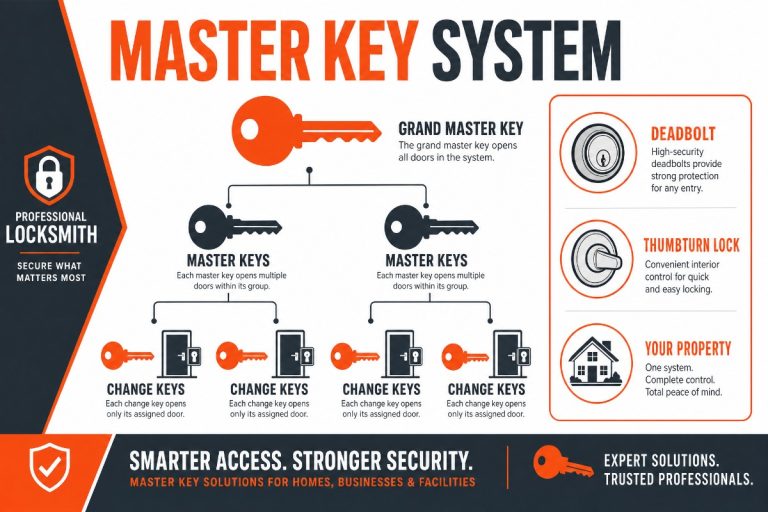
Master key system chart showing grand master, master, and change key hierarchy

Master Key Chart Management: How to Create and Manage a Professional System

Most property owners only notice the weak spot in their key setup at the wrong moment — an employee leaves with a key no one tracked, a tenant copies a spare without asking, or a heavy ring of keys turns a simple walk-through into a guessing game. The larger the building, the harder it becomes to know which key opens which door, and who is holding what.

A master key chart is the organized record that maps every lock, every key, and every access level in one system — so a single master key can open a defined group of doors while each individual key stays limited to its own. Built correctly, it replaces a confusing pile of keys with a clear, controllable hierarchy.

This guide walks through how a professional locksmith designs a master key chart, the steps to manage it as your property changes, and the security habits that keep the whole system protected. Read on to set yours up the right way.

What Is a Master Key Chart?

A master key chart is the written blueprint of a master key system. The system itself is a hierarchy of keys cut to specific patterns, where higher-level keys open more doors than lower-level ones. The chart records every lock, every keyway, and every key that fits — usually as coded entries rather than plain instructions.

Inside each lock cylinder sit small pin stacks. A standard lock has one shear line, so one key works. A master-keyed cylinder adds tiny extra pins called master wafers, which create a second working point. That is what lets two different keys — a change key and a master key — turn the same lock.

A typical hierarchy has three levels:

  • Change key (CK): opens one specific lock only.
  • Master key (MK): opens a defined group of locks, such as one floor or department.
  • Grand master key (GMK): opens every lock in the system.

For a homeowner, even a simple version helps — one key for the front deadbolt, the back door, and the garage instead of three. Our residential locksmith services cover this kind of setup for houses across the area.

How to Create a Professional Master Key Chart

Building a chart follows a clear sequence. A professional locksmith handles the technical pinning, but the planning starts with you.

  1. Inventory every door and lock. Note the location, the lock brand, the keyway, and the hardware type — knob, lever, or deadbolt.
  2. Define access groups. Decide who should reach which areas. Group doors by role: owner, manager, staff, maintenance.
  3. Assign the hierarchy. Map change keys to single doors, master keys to groups, and a grand master at the top.
  4. Code the system. Record entries as bitting codes and symbols, never as open instructions anyone could read and duplicate.
  5. Pin the cylinders. The locksmith sets the pins and master wafers in each cylinder to match the chart, then tests every key against every lock.

If you are moving into a new home or office, this is also the point to consider a lock rekey so old keys from previous occupants stop working.

Master Key System Types and Security Levels

Not every property needs a full grand master setup. The comparison below ranks common keying approaches by control and security, so you can match the system to the building.

Keying Approach How Access Works Best Fit Control Level Security Level
Individual keys (no master) One unique key per lock Single door, one user Low Basic
Keyed-alike One key opens several locks Home, small unit Low Basic
Master key Change keys plus one master Small office, rental Medium Moderate
Grand master Master keys grouped under a grand master Multi-area building High High
Grand master + restricted keyway Tiered keys with duplication-controlled blanks High-security site High Very high

Best Practices for Master Key Chart Management

Strong master key chart management is mostly about discipline after installation. A few habits keep the system both usable and secure:

  • Store the chart securely. Keep it in an encrypted file or a locked location, separate from the keys themselves.
  • Use codes, not cuts. A chart that lists actual key cuts in the open is a liability — anyone who sees it can have keys made.
  • Track issuance. Log who holds each key. When access needs change, you know exactly which keys to collect or void.
  • Re-pin after a loss. If a master key goes missing, re-pin the affected cylinders rather than ignoring the gap.
  • Review when access changes. Update the chart every time you add a door, change staff, or expand a group.

Pro Tip From the Field

After more than fifteen years pinning systems across homes and businesses, the lesson that saves clients the most trouble is simple: never let the working chart leave with the bitting cuts written on it. Keep a coded version for everyday use and store the actual cuts in a separate secured reference. When a master key disappears, the chart tells you precisely which cylinders that key touched — so you re-pin only those locks instead of the entire property. That one habit turns a building-wide scramble into a contained fix.

Pairing Your Chart With Strong Door Hardware

A master key chart is only as secure as the locks it controls. Deadbolt security matters most on exterior doors: a Grade 1 deadbolt with a hardened bolt resists kick-ins and prying far better than a basic knob lock. On the inside, a thumbturn lock lets people exit without a key, which supports both home safety and code compliance — but pair a thumbturn with a solid strike plate and long screws so the door holds under force.

For higher-risk doors, ask about high security locks with restricted keyways, which block unauthorized key duplication. Upgrading worn hardware through a lock change is often the missing step that makes a master key system genuinely secure. For residential standards, the Builders Hardware Manufacturers Association publishes the ANSI/BHMA grades that rank lock durability.

Set Up Your Master Key System With a Local Professional

A master key chart gives you controlled access and a single record you can actually manage — but the design and pinning are best handled by an experienced hand, ideally one affiliated with the Associated Locksmiths of America. The team at CallOrange Locksmith Tempe has built and maintained these systems for homes and businesses since 2008, serving Tempe, Mesa, Chandler, and Scottsdale.

To plan a new system or book a security audit of your current locks, call (480) 847-2635 or reach us through our contact page. You can also find us on the map at our Tempe location. Learn more about our work and let a professional help you lock down access the right way.

Frequently Asked Questions

Q What is a master key chart?

It is the written blueprint of a master key system. The chart records every lock, keyway, and key in coded form, showing which key opens which door and how the change keys, master keys, and grand master key relate to one another.

Q Can a master key system work on home deadbolts?

Yes. Most residential deadbolts and knob locks can be master keyed by a professional locksmith. A homeowner can run one master key for the front deadbolt, back door, and garage while keeping deadbolt security on each entry.

Q Is a master key less secure than individual keys?

A master-keyed cylinder adds extra pins, which slightly increases the number of keys that could turn it. Good chart management, restricted keyways, and Grade 1 hardware offset that and keep the system strong.

Q What happens if a master key is lost?

Re-pin the affected cylinders so the lost key no longer works. A well-kept chart shows exactly which locks that key touched, so you correct only those cylinders instead of the whole property.

Q Can existing locks be master keyed, or do I need new ones?

Many existing locks can be re-pinned to join a master key system, as long as the keyways match. Where hardware is worn or low-grade, a lock change is the better starting point.

Q How do restricted keyways improve master key security?

Restricted keyways use patented blanks that hardware stores cannot copy, so keys are duplicated only through an authorized locksmith. Pairing them with high security locks tightens control over who can make a key. Questions? Call (480) 847-2635.

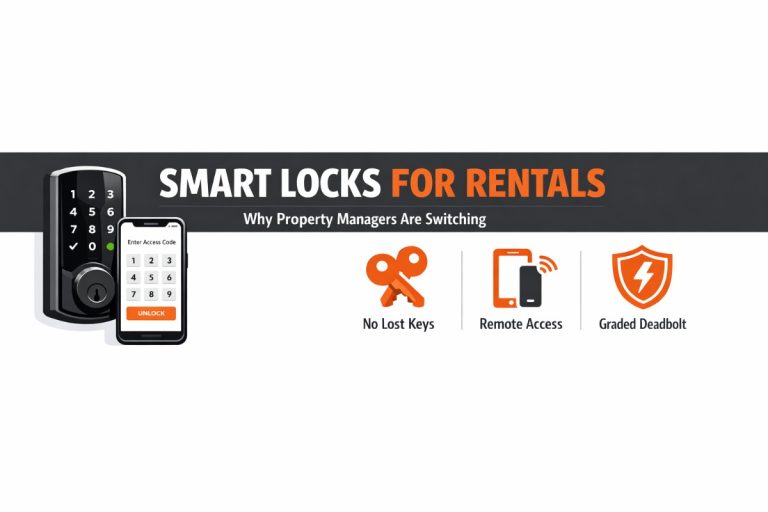
Infographic banner on smart locks for rentals in Tempe rental properties

Smart Locks for Rentals: Why Property Managers Are Switching to Smart Locks for Every Unit

Managing keys across a portfolio of rental units is one of the quiet headaches no property manager talks about until a tenant moves out without returning a single key. Smart locks for rentals solve the core problem of physical key control — they let you grant, change, and revoke access from a phone or dashboard, so a vacated unit is secured the moment a lease ends. Below, a professional locksmith perspective on why electronic access is replacing the brass key, what to look for in the hardware, and how to roll it out across every door without creating new risks. Keep reading to see the full comparison and the questions other managers ask most.
The Hidden Cost of Traditional Keys in Rental Properties

Every metal key cut for a unit is a copy you can no longer account for. Tenants make duplicates at the hardware store, hand spares to friends, and forget how many are floating around by the time they leave. For a property manager, that uncertainty is a liability. The standard fix has always been a lock rekey between tenants, which works well — but it still depends on coordinating a visit, tracking pins, and physically touching every door at turnover.

A residential locksmith sees the same pattern across Tempe, Mesa, and Chandler properties: lost keys, missing spares, and the scramble to secure a unit after a tenant disappears. Smart locks remove the variable that causes most of it — the key itself.

What “Smart Locks for Rentals” Actually Means

A smart lock is an electronic locking mechanism that opens with a code, a fob, a smartphone, or a combination of these instead of a cut key. For rentals, the value is in the management layer behind it: a dashboard where you issue a unique entry code per tenant, set it to start on move-in day, and expire it on move-out day. No handoff, no return, no rekey scramble.

Most quality models still pair their electronics with a mechanical deadbolt security bolt — the same hardened bolt that throws into the door frame on a traditional lock. That matters. The “smart” part handles access; the deadbolt handles force. A unit’s home safety depends on both working together, which is why hardware selection should never be left to the cheapest model on the shelf.

Key Terms, Explained Simply

  • Thumbturn lock: The interior knob a tenant turns by hand to lock or unlock the deadbolt from inside. On smart models, this stays manual, so a tenant is never trapped if the battery dies.
  • Deadbolt: The solid metal bolt that extends into the frame. Grade matters far more than the brand name on the front.
  • Auto-lock: A setting that re-engages the bolt after a set delay, so a unit is never left open behind a forgetful tenant.

Why Property Managers Are Making the Switch

The shift comes down to control. With electronic access, a manager handles turnover remotely, audits who entered and when, and stops chasing returned keys. Maintenance crews and cleaners get their own temporary codes that you switch off when the job ends. If a tenant reports a home lockout, you can often resolve it from the dashboard instead of dispatching anyone.

There is also a tenant-experience angle. Renters increasingly expect keyless entry the way they expect a working dishwasher. Offering it across every unit positions a property as modern without a major renovation. Pairing the rollout with a clean lock change on older doors brings the whole entry system up to a consistent standard.

Smart Lock Tiers for Rental Units: A Comparison

Not every smart lock belongs in a rental. The table below compares the main categories a property manager evaluates, focused on security and management features.

Lock Type Access Method Deadbolt Grade Best For Management Control
Keypad deadbolt PIN code ANSI Grade 2–3 Single units, light turnover Manual code reset
App-connected smart lock Phone + code ANSI Grade 1–2 Multi-unit portfolios Remote, per-tenant codes
Smart lock + hub Phone, code, remote ANSI Grade 1 High-turnover buildings Full dashboard + audit log
Mechanical + thumbturn (legacy) Cut key ANSI Grade 1–3 Owner units, low turnover Physical rekey only
Commercial electronic strike Fob, code, mobile Grade 1 / fire-rated Shared entries, lobbies Centralized, scheduled

Grades reference the ANSI/BHMA durability standard. A professional locksmith can match the right tier to each door.

The right tier depends on how often a unit turns over and how many people need access. A duplex owner has different needs than a manager running fifty doors. A professional locksmith can match the grade and management layer to the property rather than the marketing.

Pro Tip: The Mistake That Undoes a Good Smart Lock

After installing smart hardware on hundreds of doors across the East Valley, the most common failure is not the electronics — it is the door itself. A premium smart deadbolt mounted on a worn strike plate with short screws will pull loose under a shoulder strike, no matter how advanced the lock. Before any smart lock goes on, reinforce the strike plate with three-inch screws that bite into the wall stud, and confirm the deadbolt fully extends without binding. The electronics protect against unauthorized access; the strike plate and frame protect against force. Get both right, or the upgrade is only half done.

It is also worth standardizing one brand and one battery type across a portfolio. Mixed hardware means mixed dashboards, mismatched fobs, and maintenance crews carrying four chargers. Consistency is what makes a fleet of smart locks manageable instead of a second job.

Rolling It Out Across Every Unit

A full conversion does not have to happen overnight. Many managers start with units at turnover, installing smart hardware as each lease ends, and standardize the rest within a season. A locksmith handling the install can verify door prep, confirm deadbolt grade, and set up the management dashboard so codes are ready before the next tenant signs. For older buildings, combining the smart upgrade with high-security cylinder hardware closes the gap on doors that were never properly secured in the first place. You can review the full range of residential and commercial services to plan a phased rollout.

External standards help here. Reviewing the ANSI/BHMA grading system before buying tells you whether a lock’s deadbolt is rated for residential or commercial duty, and the Consumer Product Safety Commission publishes guidance on door and entry hardware that property managers can lean on when setting a standard.

Secure Every Door With Professional Installation

Smart locks give property managers something brass keys never could: real control over who enters a unit and when. But the hardware only performs as well as the installation behind it. If you manage rentals across Tempe, Mesa, Scottsdale, or Phoenix and want every unit on a consistent, secure access system, talk to a professional locksmith before you buy. CallOrange Locksmith Tempe can audit your doors, recommend the right grade for each entry, and handle the full install. Call (480) 847-2635 or reach out through our contact page to schedule a security audit for your property.

Smart Locks for Rentals — Frequently Asked Questions

Are smart locks secure enough for rental units?

A quality smart lock pairs electronic access with a graded mechanical deadbolt, so it resists force the same way a traditional lock does. Security depends on the deadbolt grade and the door prep behind it, not just the electronics. A professional locksmith can confirm the unit is rated for the duty you need.

What happens to a smart lock if the batteries die?

Most rental-grade smart locks keep a manual thumbturn on the inside, so a tenant can always exit. Many also include a physical key override or external contacts to power the keypad. Choosing a model with a low-battery alert helps a property manager swap cells before access is interrupted.

Can I reuse the same smart lock for a new tenant?

Yes. Instead of a physical rekey, you delete the previous tenant’s code and issue a new one from the dashboard. This is the main advantage of smart locks for rentals — turnover access is handled without touching the hardware or cutting a new key.

Do I need a professional locksmith to install them?

A locksmith verifies the door prep, reinforces the strike plate, and confirms the deadbolt extends fully before the electronics go on. Across a multi-unit portfolio, professional installation also keeps every door on a consistent standard and dashboard, which is what makes the system manageable.

What deadbolt grade should a rental smart lock have?

For most rental doors, an ANSI/BHMA Grade 1 or Grade 2 deadbolt is the standard to aim for. Grade 1 is built to commercial duty, while Grade 2 suits typical residential entries. The grade tells you how the bolt holds up under repeated use and force.

Should I switch every unit at once or phase it in?

Many property managers convert units at turnover and standardize the rest over a season. Phasing it in spreads out the work while still bringing the whole property onto one access system. A locksmith can plan the rollout so codes are ready before each new tenant signs.

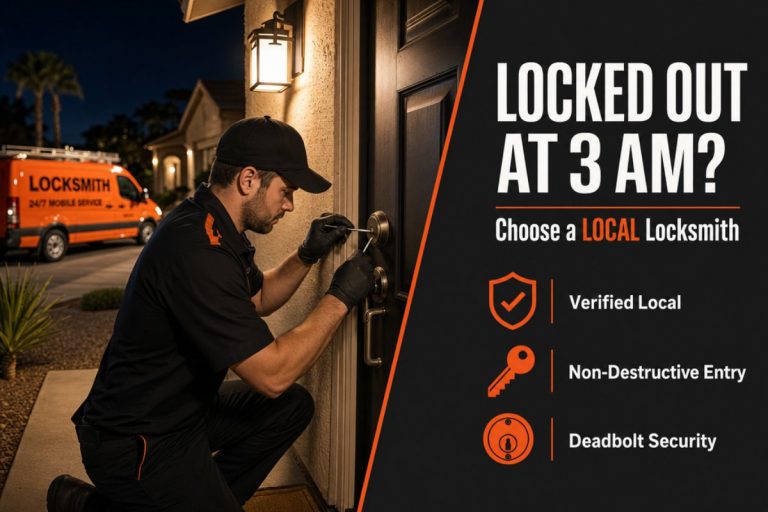
Locksmith technician opening a front door deadbolt at night in Tempe with infographic panel about choosing a local locksmith

Locked Out at 3 AM? Why the Right “24 Hour Locksmith Near Me” Is Always Local

When a door locks behind you, the locksmith you choose matters more than the ad that ranks first. A local professional locksmith arrives in a marked vehicle, verifies your identity, and opens your lock without damaging it — while out-of-state call centers dispatch unvetted subcontractors who often drill first and explain later.
It happens to careful people every day across the Valley: the door swings shut while you grab the trash, the key fob stays in the ignition at a Mill Avenue parking garage, or you arrive home from a red-eye flight to discover your house key is still in a hotel room two states away. Standing outside your own home or car with no way in is stressful, and that stress is exactly what bad actors in this industry count on.

The solution is knowing — before the emergency happens — how to identify a legitimate local locksmith and what a professional service call should look like. CallOrange Locksmith Tempe has served Tempe, Mesa, Chandler, Scottsdale, and Phoenix since 2008, and this guide draws on that field experience. Keep reading to learn how to vet a search result, what non-destructive entry actually involves, and which deadbolt security upgrades prevent the next lockout entirely.


Why “Local” Is the Most Important Word in a 24 Hour Locksmith Near Me Search

Search results for emergency locksmiths are crowded with lead-generation websites that look local but aren’t. These operations buy ads in hundreds of cities, route your call to a national dispatch center, and sell the job to whichever subcontractor accepts it. The person who shows up may have no storefront, no local accountability, and no incentive to protect your hardware.

A genuinely local company works differently. CallOrange Locksmith Tempe operates from a physical shop at 2101 E Broadway Rd Ste 2 in Tempe — you can see it on Google Maps — with technicians who drive these streets daily and answer to local reviews. That accountability changes how the job gets done. You can read more about the company’s background on the About Us page.


How to Vet Any “24 Hour Locksmith Near Me” Result Before You Call

The Federal Trade Commission has documented widespread locksmith scams, and its consumer protection resources recommend checking credentials before anyone touches your locks. From a technician’s perspective, here are the signals that matter most:

  • A verifiable physical address. If the website hides its location or lists a P.O. box, keep scrolling.
  • A company name the dispatcher will say. Scam call centers answer with a generic “locksmith services” greeting because they operate under dozens of names.
  • A marked vehicle and ID on arrival. A professional locksmith shows up identifiable, not in an unmarked sedan.
  • Drilling presented as a last resort. The overwhelming majority of residential and automotive lockouts can be opened non-destructively. A technician who reaches for the drill immediately is either untrained or running up the bill.

Local Locksmith vs. National Call Center Dispatch

What to Compare Local Locksmith (CallOrange Tempe) National Call Center
Physical address Verifiable shop at 2101 E Broadway Rd Ste 2, Tempe, AZ Often hidden, virtual, or out of state
Who answers the phone Dispatcher who knows the service area Generic operator covering hundreds of cities
Who shows up Company technician in a marked vehicle Unvetted subcontractor, often unmarked car
Entry method Non-destructive picking and bypass first Drilling presented as the only option
Quote accuracy Scope confirmed before work begins Lowball phone quote, inflated on arrival
Accountability Local Google reviews tied to one business Operates under many interchangeable names
Automotive capability Key cutting and programming done on-site Varies by whichever subcontractor accepts
Follow-up service Same company for rekeys, upgrades, audits No continuity — different person each call
Community track record Serving the East Valley since 2008 No local history to verify

What a Professional Locksmith Actually Does During a Lockout

For a home lockout, a trained technician evaluates the lock type first — pin tumbler, smart deadbolt, knob lock — then selects the gentlest method that works: picking, bypass tools, or decoding. Your lock stays intact and your key still works afterward.

Vehicle lockouts follow the same principle. Modern cars require specialized air wedges and reach tools to unlock a car door without damaging weather stripping, wiring, or side-impact airbags hidden in the door panel. And if the problem is a lost key rather than a locked one, mobile technicians can make a car key on-site, including programming for transponder and push-to-start systems.

Quick Diagnosis: Which Service Do You Actually Need?

Your Situation What It Means The Right Service
Keys visible inside the car Lockout only — no new key needed Car door unlocking
Keys lost, no spare exists Key origination + programming Replacement car keys
Key turns but engine won’t crank Worn ignition cylinder Ignition repair
Locked out of the house Non-destructive entry Home lockout service
Just moved into a new home Unknown key copies in circulation Lock rekey

After the Lockout: Deadbolt Security and Home Safety Upgrades Worth Making

A lockout is a useful prompt to look at your overall home safety. Deadbolts are graded by the Builders Hardware Manufacturers Association (BHMA) — Grade 1 offers the strongest resistance to forced entry, and most builder-installed hardware is only Grade 3. Upgrading is a simple lock change that meaningfully hardens your entry doors.

Pay attention to the thumbturn lock as well — the small interior knob that throws the deadbolt. If glass sits within reach of your thumbturn, an intruder can break the pane and turn it from outside. A double-cylinder deadbolt or a relocated lock solves this, and for properties with higher requirements, high security locks add pick and drill resistance on top.

Pro Tip from the Field

After years of lockout calls across Tempe and Mesa, the pattern is clear: almost every home lockout traces back to a single point of failure — one key, one pocket, one door that locks on close. Hide-a-key rocks are the first place intruders check, so skip them. Instead, leave a spare with a neighbor you know well, or install a keypad deadbolt on one secondary door so a forgotten key never strands you again. Renters: ask your landlord before changing any hardware, since a rekey usually satisfies both parties.


Save a Local Number Before You Need It

The worst moment to research locksmiths is while standing in a dark parking lot with a phone at 4% battery. Save a verified local number now. CallOrange Locksmith Tempe dispatches mobile technicians for automotive, residential, and commercial locksmith services across Tempe, Mesa, Chandler, Scottsdale, Phoenix, and Gilbert.

Call (480) 847-2635 for emergency lockout help, or reach out through the contact page to schedule a deadbolt security audit. A professional locksmith can walk your property, grade your existing hardware, and recommend exactly what your doors need — nothing more.


Frequently Asked Questions

How do I know a locksmith search result is actually local?

Look for a verifiable street address, a company name the dispatcher states when answering, and Google reviews tied to one consistent business. CallOrange Locksmith Tempe operates from 2101 E Broadway Rd Ste 2 in Tempe, AZ — you can confirm the location on Google Maps before calling.

Will the locksmith have to drill my lock to get me in?

Almost never. A trained technician opens the vast majority of residential and automotive lockouts with non-destructive methods like picking, bypass tools, and decoding. Drilling is a last resort reserved for damaged or high-security hardware — and it should always be explained before it happens.

What should I have ready when I call about a lockout?

Your exact location, the type of lock or vehicle involved, and a photo ID. A professional locksmith verifies that you live in the home or own the car before opening it — that verification protects you as the property owner.

Can a locksmith make me a new car key on the spot?

Yes. Mobile technicians carry key-cutting and programming equipment for most makes and models, including transponder keys and push-to-start fobs. See the make car key service for details on what’s possible for your vehicle.

Should I rekey or replace my locks after moving into a new home?

If the existing hardware is in good condition, a lock rekey renders every old key useless while keeping your current locks. If the hardware is worn or below BHMA Grade 2, a lock change upgrades your deadbolt security at the same visit.

What is a thumbturn lock and why does its placement matter?

The thumbturn is the small interior knob that throws your deadbolt. If a glass panel sits within arm’s reach of it, an intruder can break the glass and turn the bolt from outside. A security audit identifies this risk and recommends the right fix — a double-cylinder deadbolt, relocated hardware, or reinforced glazing.

Electronic keyless entry system smart lock on residential door in Tempe AZ — CallOrange Locksmith

Go Keyless: Why Your Next Home Lock Should Be an Electronic Keyless Entry System

Go Keyless: Why Your Next Home Lock Should Be an Electronic Keyless Entry System

Most homeowners don’t think about their front door lock until a key goes missing — and by then, the question isn’t just “where is it?” but “who might have it?” A lost or unaccounted-for key is enough to compromise your entire home’s security, since standard locks offer no way to track duplicates or revoke access. Electronic keyless entry systems close that gap entirely. In this guide, you’ll learn how these systems work, which type fits your home, and why the installation process matters just as much as the product you choose.

What Are Keyless Entry Systems?

A keyless entry system is an electronic lock that authenticates the person — not a physical key. Access is granted through a PIN code, fingerprint scan, smartphone app, or RFID fob, depending on the model. Most residential units are designed to fit a standard deadbolt backset, so they integrate with existing doors without structural modifications.

Unlike a traditional lock-and-key setup, these systems let you create and revoke credentials without calling a residential locksmith for a rekey. Change a code in seconds. Add a temporary PIN for a contractor. Delete access when someone moves out. The control stays with you.


Why Standard Deadbolts Leave Gaps in Your Home Safety

A traditional deadbolt provides solid resistance to brute-force entry — but it has vulnerabilities that go unnoticed until they’re exploited:

  • Untracked duplication: Any hardware store can copy a house key in minutes. You have no way of knowing how many copies exist or who has them.
  • Lock bumping: A specially cut “bump key” can manipulate the standard pin-tumbler mechanism in most residential deadbolts, a technique documented extensively by security researchers at organizations like the American National Standards Institute (ANSI).
  • Thumbturn lock exposure: Interior-facing thumbturn locks can be turned from outside if an intruder breaks a glass panel adjacent to the door — a risk that keyless systems with no thumbturn exposure eliminate.
  • Zero access history: Standard locks offer no log. You have no record of who entered or when.

Electronic keyless entry systems address every one of these points at the hardware level.


4 Types of Keyless Entry Systems for Homes

1. Keypad Deadbolts

The most accessible entry into keyless security. A numeric keypad replaces the traditional cylinder. Set a personal code for your household, a separate temporary code for guests or service workers, and delete it when it’s no longer needed. These work entirely offline — no Wi-Fi, no app, no dependency on a phone.

2. Smart Locks with App Control

These connect via Bluetooth or Wi-Fi and pair with a smartphone app. Lock or unlock your door from anywhere, receive entry alerts, and manage access codes remotely. Popular brands like Schlage, Yale, and August integrate with Google Home and Amazon Alexa for voice control.

3. Biometric Fingerprint Locks

Fingerprint scanners store individual prints and grant access in under a second. There’s no code to share, no fob to lose — access is literally on your hand. High-end models store up to 100 fingerprints, making them practical for households with multiple family members.

4. RFID / Key Fob Proximity Locks

A programmed card or fob held near the reader unlocks the door. Common in commercial applications, these are gaining traction in residential settings, especially as part of a broader high-security lock setup that combines multiple access layers.


Keyless Entry Systems Comparison

Use this overview to identify which system aligns with your household’s needs before consulting your locksmith:

Feature Keypad Deadbolt Smart Lock Biometric Lock RFID / Fob Lock
Physical key required No Optional backup No No
Remote access No Yes (app) No No
Temporary access codes Yes Yes No Yes (fobs)
Access log Basic Full history Some models Yes
Works offline Yes Yes (offline mode) Yes Yes
Thumbturn bypass risk Low Low Low Low
Best for Budget upgrade Tech-savvy owners High security Multi-user homes

Deadbolt Security Grades: What the ANSI Rating Actually Means

ANSI classifies residential locks into three grades. Grade 1 is the highest — engineered to withstand over 250,000 open/close cycles and kick-in forces exceeding 250 lbs. Most quality smart locks are built on a Grade 1 or Grade 2 deadbolt frame, meaning the electronic component rides on a mechanically sound foundation.

That said, a Grade 1 lock installed on a weak door frame still fails. When a professional locksmith from CallOrange installs your system in Tempe, Mesa, or Chandler, the assessment always includes the door frame and strike plate — not just the lock itself.


Pro Tip: The Strike Plate Is the Most Overlooked Part of Any Lock Installation

After installing keyless systems across Tempe and the East Valley, the most consistent finding is this: most builder-grade homes ship with a 2-inch strike plate held by half-inch screws that bite into the door jamb alone. A well-placed kick bypasses even the strongest deadbolt in that scenario.

The fix is simple: replace it with a 6-inch reinforced strike plate using 3-inch screws that anchor into the structural stud behind the jamb. This single upgrade dramatically increases door-kick resistance — no new lock required. When you pair it with a quality keyless deadbolt, you’ve addressed two of the most common residential entry points at once.


Before You Buy: 5 Home Safety Checks for Keyless Lock Installation

  1. Door frame integrity — Inspect for rot, previous damage, or gaps around the latch area before installing any lock.
  2. Door thickness — Most smart locks fit doors 1-3/8″ to 1-3/4″ thick. Confirm your door’s measurement before ordering.
  3. Wi-Fi signal strength at the door — App-controlled locks require a stable signal. A weak connection causes intermittent failures.
  4. Existing lock condition — If your current deadbolt is worn or misaligned, start with a lock change before adding electronics on top of a failing mechanism.
  5. Backup access plan — Every keyless lock should have a secondary entry method: a physical key override slot, a backup code, or a mechanical bypass kept in a secure location.

Do You Still Need a Traditional Deadbolt Alongside a Keyless Lock?

In most cases, no — because keyless entry systems are deadbolts. The locking bolt mechanism is identical; only the access method changes. Some retrofit smart locks slide over your existing deadbolt cylinder, preserving the mechanical bolt while adding electronic control. Others fully replace the cylinder.

If your existing lock is still structurally sound, a lock rekey followed by a smart retrofit may be the most cost-effective path. If the hardware is worn or outdated, a full lock replacement sets a cleaner foundation.


Schedule a Keyless Lock Installation or Home Security Audit in Tempe

Switching to a keyless entry system is one of the most practical home safety upgrades available — but the product is only as good as the installation behind it. Misaligned bolts, incorrect backset sizing, and skipped strike plate reinforcement are all common errors in DIY setups that compromise the security you paid for.

The team at CallOrange Locksmith Tempe has been installing and servicing residential locks across Tempe, Mesa, Chandler, Scottsdale, and Phoenix since 2008. We’ll assess your door, recommend the right system, and complete the installation correctly the first time.

Call (480) 847-2635 or visit our contact page to schedule a consultation. You can also find us on Google Maps for directions to our Tempe location.

Frequently Asked Questions

Are keyless entry systems safe against hacking or code theft?
Quality keyless entry systems use AES-128 or AES-256 encryption for wireless communication, making remote interception impractical for standard residential attacks. Rolling code technology changes the authentication signal with every use, so a captured signal can’t be replayed. The greater vulnerability is usually a weak or reused PIN code — not the hardware itself. A residential locksmith can advise on best practices for code management and layered security.
What happens if the battery dies on a keyless lock?
Nearly all residential keyless locks include a low-battery warning — typically an audible alert or flashing indicator — well before power fails completely. Most models also have a physical key override cylinder as a backup. A select few higher-end units include an emergency terminal on the exterior that accepts a 9V battery for one more code entry. Replacing the batteries once or twice a year prevents the situation entirely.
Can a keyless entry lock be installed on any residential door?
Most standard keyless locks fit doors between 1-3/8″ and 1-3/4″ thick with a standard 2-1/8″ bore hole — covering the vast majority of residential exterior doors. Doors outside those dimensions may require adapters or a different product line. A professional locksmith will verify these specs during a site visit to avoid compatibility issues at installation.
Do keyless entry systems require Wi-Fi to function?
No — only smart locks with app control require a Wi-Fi or Bluetooth connection. Keypad deadbolts, biometric locks, and RFID systems operate entirely offline with no network dependency. Smart locks also function locally when the internet is down; you simply lose the remote-access feature until connectivity is restored.
Is it better to install a keyless lock myself or hire a professional locksmith?
Simple keypad deadbolts are designed for DIY installation on a properly prepared door. However, professional installation ensures correct bolt alignment, door frame integrity assessment, and proper programming. For biometric, RFID, or smart locks with wiring components, professional installation is the recommended path. See our lock change service for what a professional installation includes.
Can I keep my existing deadbolt and just add a keyless entry system?
Yes — retrofit smart locks attach to the interior side of your existing deadbolt and motorize the thumbturn, so your exterior hardware stays the same while you gain electronic control. If the existing deadbolt is worn or low-grade, a full lock replacement first is recommended for the strongest foundation.
Have a question not listed here? Call (480) 847-2635 or visit our contact page — our team in Tempe is available to help.
Lock bumping protection guide — CallOrange Locksmith Tempe

Stop Lock Bumping: How to Upgrade Your Home’s Vulnerable Entryways

Stop Lock Bumping: How to Upgrade Your Home’s Vulnerable Entryways for Real Lock Bumping Protection

Lock bumping is a low-tech break-in method that opens standard pin tumbler deadbolts in seconds using only a modified key and a blunt object — no drilling, no forced entry, and no visible damage left behind.
Most homeowners assume a deadbolt means safety. The reality: a technique called lock bumping renders the majority of standard residential locks open in a single strike, and most people never know it happened until valuables are already gone. The fix isn’t complicated — but it requires knowing which hardware actually holds up and when to bring in a professional locksmith for a full residential security review. In this guide, you’ll find exactly what to look for, which upgrades deliver genuine protection, and how to build real lock bumping protection at every entryway in your home.

What Is Lock Bumping and Why Does It Threaten Home Safety?

Lock bumping exploits a fundamental flaw in the pin tumbler mechanism — the internal design found in virtually every standard residential deadbolt on the market. A bump key is a specially cut key modified so each cut reaches the maximum depth allowed by the keyway. The key is inserted into the target lock, and when struck sharply with a mallet or blunt object, the kinetic energy causes all driver pins to jump simultaneously. For a fraction of a second, the pins clear the shear line and the cylinder turns freely.

The entire process takes under thirty seconds. It leaves no scratches on the keyway, no damaged frame, and no evidence of forced entry. On insurance claims and police reports, it often registers as an unexplained entry. According to ALOA (Associated Locksmiths of America), bump keys can be manufactured from standard key blanks and have been extensively documented in security research since the early 2000s.

Is Your Current Deadbolt at Risk?

If your deadbolt carries a standard ANSI/BHMA Grade 2 or Grade 3 rating and uses a conventional pin tumbler cylinder, it’s likely vulnerable. This covers the majority of builder-grade locks installed in rental properties and tract homes across Tempe, Mesa, Chandler, Scottsdale, and the broader East Valley.

Signs your current hardware may not be delivering adequate home safety:

  • The lock was installed by the original builder or left behind by a previous occupant
  • No “bump-resistant” or “high-security” designation appears on the packaging
  • The cylinder uses a standard 5- or 6-pin configuration without secondary anti-bump features

If you’re unsure what’s installed at your entries, a residential security assessment from our team can identify every vulnerability before it becomes an entry point for an intruder.

Lock Bumping Protection: The Deadbolts and Hardware That Actually Hold Up

Bump-Resistant vs. Bump-Proof — Know the Difference

There’s a meaningful distinction between these two terms. Bump-resistant locks use modified pin chambers or secondary locking elements that raise the difficulty of a successful bump attempt — but they are not impervious with enough persistence. Bump-proof locks eliminate the pin tumbler mechanism entirely:

  • Disc detainer locks — use rotating discs instead of driver pins. No bump key geometry can exploit this mechanism.
  • Sidebar locks (e.g., Medeco Maxum, Mul-T-Lock MT5+) — require both a rotational and a lateral movement to turn the cylinder, making them mechanically resistant to both bumping and picking.
  • Dimple locks — use a different keyway orientation that standard bump keys cannot target.

For whole-home deadbolt security, look for locks carrying an ANSI/BHMA Grade 1 rating with documented anti-bump, anti-pick, and anti-drill certifications. Our licensed technicians handle deadbolt upgrades and full lock changes for residential clients throughout Tempe and the East Valley.

The Thumbturn Lock: How It Fits Into Your Defense

A thumbturn lock — the interior rotating knob on a single-cylinder deadbolt — doesn’t directly resist a bump entry from outside. However, its configuration matters in composite attack scenarios. Doors with decorative glass panels are especially vulnerable: a bump entry is followed by a hand reaching through shattered glass to turn the interior thumbturn. For those specific openings, a double-cylinder deadbolt requiring a key on both sides is worth serious consideration. For standard solid wood or fiberglass doors, a quality single-cylinder thumbturn paired with a certified Grade 1 deadbolt delivers solid protection.

🔐 Pro Tip — From the Field

In servicing locks throughout Tempe and the East Valley, the single most overlooked upgrade is the strike plate. A standard builder-grade strike plate uses 3/4-inch screws driven into soft wood framing — it offers almost no resistance to a coordinated kick. Replacing it with a reinforced steel strike plate secured with 3-inch screws into the door stud — at the same time as the deadbolt upgrade — closes both the bump vulnerability and the kick-in vulnerability in one visit. Address them together or you’ve only solved half the problem.

Home Safety Goes Beyond the Cylinder

Upgrading the cylinder is step one. A layered home safety strategy closes the remaining gaps that a new deadbolt alone cannot address:

  • Door reinforcement kits — door jamb armor and hinge reinforcers protect against kick-in attacks that can defeat even a bump-proof lock if the frame gives way first
  • Smart locks with tamper alerts — models with app-based tamper notifications add a detection layer, even when the underlying cylinder remains a pin tumbler design
  • Entry-point cameras — visible surveillance deters opportunistic bump attempts before they start
  • Rekeying after every occupancy change — a professional lock rekey ensures no copied keys from former tenants or contractors remain in circulation

For commercial and multi-tenant properties, the same principles scale up. Commercial locksmith services address high-security cylinder replacements for mortise lock bodies, cylindrical commercial hardware, and access control integration at high-traffic entries.

Get a Professional Locksmith Security Audit — Don’t Wait for a Break-In

Real lock bumping protection isn’t a product you pick up from a hardware store shelf — it’s the right hardware, installed correctly, at every vulnerable entry point in your home. A licensed locksmith can walk every exterior door, assess the cylinder grade, inspect strike plate depth, flag glass-panel risks, and recommend targeted upgrades without replacing hardware that’s already performing at the level your home needs.

CallOrange Locksmith Tempe provides residential security assessments and deadbolt upgrades throughout Tempe, Mesa, Chandler, Scottsdale, Phoenix, and Gilbert. Find us on Google Maps, or reach our team directly at (480) 847-2635 to schedule a home security review.

Don’t let an intruder reveal the gap in your deadbolt security. Contact CallOrange Locksmith Tempe today and have every entry point assessed by a licensed professional who knows the East Valley.

Lock Type Comparison: Bump Resistance & Security Grade
Lock Type Mechanism Bump Resistant? ANSI Grade Best Application
Standard Pin Tumbler Deadbolt 5–6 pin tumbler ✗ No Grade 2–3 Builder-grade residential
Kwikset SmartKey Re-keyable side-locking bar ~ Partial Grade 2 Budget residential upgrade
Schlage B60N Deadbolt Pin tumbler + alarm alert ~ Partial Grade 1 Mid-range residential
Smart Lock (e.g., Schlage Encode) Pin tumbler + electronics ~ Partial Grade 1 Modern smart home
Double-Cylinder Deadbolt Pin tumbler — keyed both sides ~ Partial Grade 1–2 Doors with glass panels
Medeco Maxum Deadbolt Sidebar + rotating pins ✓ Yes Grade 1 High-security residential
Mul-T-Lock MT5+ Telescopic pin tumbler ✓ Yes Grade 1 High-security residential / commercial
Abloy Protec2 Disc detainer (no pins) ✓ Yes Grade 1 Premium residential / commercial
High-Security Mortise Lock Mortise cylinder + deadbolt ✓ Yes* Grade 1 Commercial & multi-unit residential

* Bump resistance depends on the cylinder installed. ANSI/BHMA Grade 1 = highest residential/commercial standard.

Frequently Asked Questions — Lock Bumping Protection

Common questions from homeowners in Tempe, Mesa, Chandler, and the East Valley.

?

What exactly is lock bumping and how does it work?

Lock bumping is a non-destructive entry technique that exploits the pin tumbler mechanism inside most standard deadbolts. An attacker inserts a specially cut bump key into the keyway and strikes it sharply. The impact causes all the driver pins to jump simultaneously, momentarily clearing the shear line and allowing the cylinder to turn. The process leaves no visible damage, making it difficult to detect on a police report or insurance claim.

?

How do I know if my current deadbolt is vulnerable to bumping?

If your deadbolt is a standard pin tumbler model rated ANSI/BHMA Grade 2 or Grade 3 — which covers the vast majority of builder-grade hardware — it’s likely vulnerable. Look at the lock packaging or the lock body itself. If you don’t see designations like “bump-resistant,” “high-security,” or an ANSI Grade 1 rating with additional certifications, assume the lock can be bumped. A licensed locksmith can assess every entry in your home and give you a clear picture of where you stand.

?

What are the best locks for lock bumping protection?

Locks that eliminate the pin tumbler mechanism entirely provide the strongest protection. Disc detainer locks (like the Abloy Protec2) and sidebar locks (like the Medeco Maxum or Mul-T-Lock MT5+) are considered bump-proof by design. For homeowners looking for a strong upgrade without going to the highest tier, ANSI Grade 1 deadbolts with documented anti-bump certifications offer a meaningful improvement over standard builder hardware. Have a professional locksmith assess your specific doors before selecting a model.

?

What is a thumbturn lock and does it affect bump resistance?

A thumbturn lock is the interior rotating knob on a single-cylinder deadbolt — the part you turn from the inside without a key. It doesn’t directly affect how resistant the lock is to bumping from outside. However, its design becomes relevant for doors with glass panels. On those doors, a break-in may combine a bump entry with a reach-through to turn the interior thumbturn. For glass-panel doors, a double-cylinder deadbolt — requiring a key on both sides — removes that secondary vulnerability entirely.

?

Can a smart lock be bumped the same way?

It depends on the model. Many smart locks still use a traditional pin tumbler cylinder as a physical backup, which means they remain vulnerable to bumping despite the electronic access component. Smart locks that rely exclusively on electronic or motorized mechanisms — with no physical keyway at all — are immune to bump attacks. If you use a smart lock with a physical key backup, check the cylinder grade and verify it carries anti-bump certification.

?

Do I need a professional locksmith to upgrade my locks, or can I do it myself?

High-security locks — particularly sidebar and disc detainer models — require precise installation to function correctly. An improperly installed bump-proof lock can fail to engage fully, defeating its purpose entirely. Beyond the cylinder itself, a professional locksmith inspects the strike plate, checks door alignment, and assesses the entire entry. For standard Grade 1 deadbolt upgrades, a competent DIYer can manage installation, but a security audit from a licensed locksmith identifies vulnerabilities a product swap alone won’t solve.

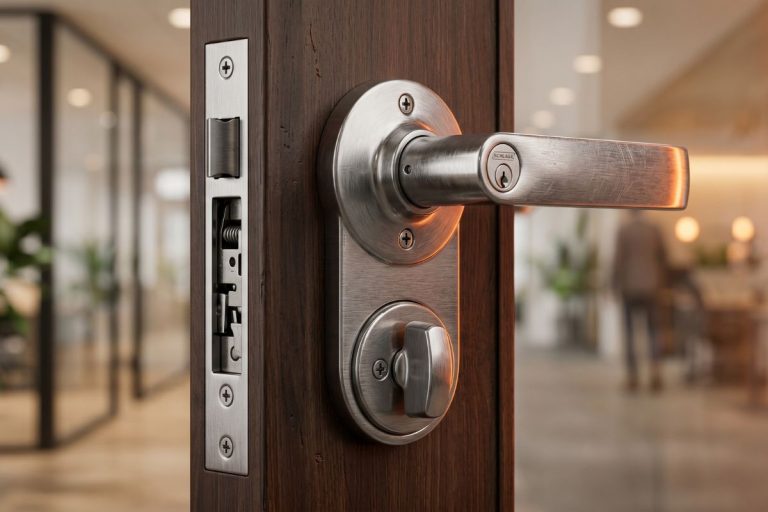
Commercial door hardware

Choosing the Right Commercial Door Hardware for High-Traffic Offices

Office managers across Tempe and Mesa face a recurring headache: door hardware that fails months after installation. Handles loosen, latches misalign, and locks jam during peak business hours, leaving employees locked out and clients waiting in lobbies. The solution is straightforward — match the right grade of commercial door hardware to your actual traffic volume and security needs from day one. Keep reading to learn how to specify the correct hardware for your office, avoid the most common mistakes, and protect your building without overpaying for features you’ll never use.
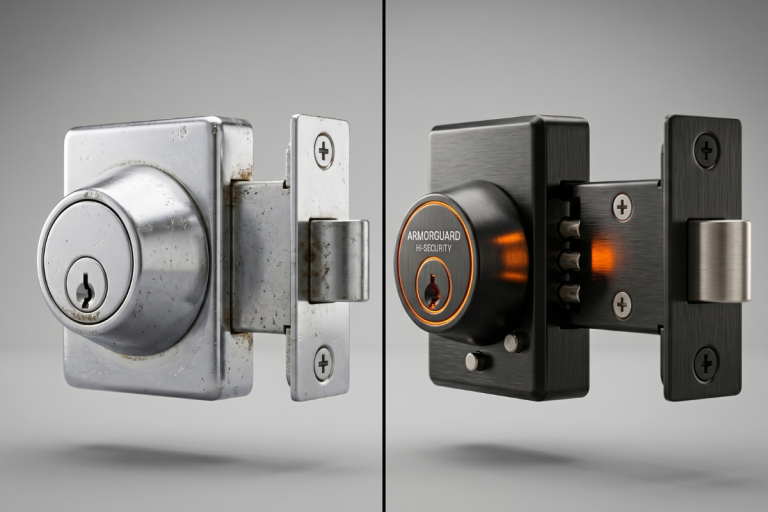
Why Standard Hardware Fails in Commercial Settings

Residential-grade locks and handles are engineered for a household — perhaps 20 to 30 cycles per day. A busy office door, by contrast, can see 1,000 or more cycles in a single workday. That mismatch is the single biggest reason commercial properties end up calling a professional locksmith for emergency repairs within the first year of occupancy.

[IMAGE: Insert Image Described Here]

Image prompt: A photorealistic close-up of a polished stainless steel commercial lever handle installed on a glass office door, with a blurred background showing employees walking through a modern Tempe office lobby. Natural daylight from large windows highlights the brushed metal finish and the heavy-duty mortise lock body visible at the door edge.

The American National Standards Institute (ANSI) and the Builders Hardware Manufacturers Association (BHMA) classify commercial hardware into three grades. Understanding these grades is the foundation of every smart purchasing decision.

ANSI/BHMA Grades Explained

The grading system measures cycles, force resistance, and finish durability. Most office buildings only need to remember one rule: pick the grade that matches your door’s daily volume.

Hardware Grade Cycle Rating Best For Lifespan in Office Use
Grade 1 (Heavy Duty) 800,000+ cycles Main entrances, conference rooms, server rooms 10–15 years
Grade 2 (Medium Duty) 400,000 cycles Interior offices, break rooms, supply closets 5–8 years
Grade 3 (Light Duty) 200,000 cycles Residential only — not recommended for offices 2–3 years in commercial use
Mortise Lock (Grade 1) 1,000,000+ cycles High-security entries, executive suites 15+ years


A Grade 3 lock on a main lobby door will fail. Period. We’ve replaced hundreds of them across Tempe office buildings where contractors cut corners during the build-out.

The Four Hardware Components Every Office Needs

A complete commercial door system is more than just a lock. Each component plays a role in security, code compliance, and daily usability.

1. The Lockset

For high-traffic openings, a mortise lockset is the gold standard. The lock body sits inside a pocket cut into the door edge, distributing force across a large internal mechanism rather than relying on a small bored hole. Cylindrical locksets are acceptable for medium-traffic interior doors but are not built for main entrances.

2. The Deadbolt

Strong deadbolt security is non-negotiable for any door that locks the building down at end of day. Look for a 1-inch throw bolt with a hardened steel insert and a reinforced strike plate secured with 3-inch screws into the door frame stud. A standard half-inch latch is not a deadbolt — it’s a courtesy lock that any motivated intruder can defeat in seconds.

3. The Handle Trim

Lever handles are required by the Americans with Disabilities Act (ADA) on most commercial doors. Avoid round knobs unless you have a specific exemption. Stainless steel and solid brass levers outlast plated zinc-alloy handles by a factor of three or more.

4. The Closer and Exit Device

Doors with panic bars and automatic closers are governed by local fire codes. Grade 1 closers maintain consistent door speed and latching pressure across temperature swings — critical in Arizona, where summer heat warps cheaper hardware fast.

Thumbturn vs. Double-Cylinder: Which Is Safer?

A common debate in commercial security is whether to install a thumbturn lock on the interior or a double-cylinder deadbolt requiring a key on both sides. The answer depends on the door.

A thumbturn allows anyone inside to exit immediately without a key — a major advantage during fire emergencies and a requirement under most building codes for primary egress doors. Double-cylinder locks add a layer of security on glass doors where an intruder could break a pane and reach the interior knob, but they create a serious life-safety risk and are prohibited on egress paths in many jurisdictions.

For most office front doors in the East Valley, a Grade 1 deadbolt with a thumbturn interior is both code-compliant and secure when paired with a reinforced strike plate.

Pro Tip from the Field

After 15+ years of commercial installs across Mesa, Chandler, and Scottsdale, here’s the single upgrade that saves clients the most money long-term: replace the factory strike plate. Almost every commercial door ships with a strike plate held by half-inch screws into the door frame casing — not the structural stud. Swap those for 3-inch screws that bite into the framing lumber behind the casing. This one $5 fix increases kick-in resistance by roughly 400% and takes 10 minutes per door. Most break-ins through commercial doors fail at the frame, not the lock itself.

Common Specification Mistakes to Avoid

When reviewing your office’s hardware schedule, watch for these red flags:

  • Mixing grades on a single door. A Grade 1 lockset paired with a Grade 3 closer will still fail at the closer.
  • Ignoring keying alignment. Master key systems must be planned before purchase, not retrofitted afterward.
  • Skipping the strike plate upgrade. As noted above — this is where most security plans collapse.
  • Choosing finish over function. Polished brass looks elegant but pits and tarnishes within months in Arizona’s dry, dusty climate. Satin chrome and oil-rubbed bronze hold up far better.

Home safety principles apply at the office too: layered security beats a single expensive lock every time. A Grade 1 lockset, a reinforced strike, a working closer, and a documented key control policy together cost less than one emergency board-up after a break-in.

Frequently Asked Questions

What grade of commercial door hardware should I install on my office’s main entrance?

Grade 1 hardware is the standard for any main entrance with high foot traffic. It’s tested for over 800,000 cycles and built with reinforced internal components that handle the daily wear of a busy commercial property. Grade 2 is acceptable for interior offices, but Grade 3 should never be used on a primary commercial door.

Is a thumbturn lock secure enough for a commercial office door?

A thumbturn lock is secure and code-compliant for most office front doors when paired with a Grade 1 deadbolt and a reinforced strike plate. It also satisfies fire egress requirements by allowing immediate exit without a key. The exception is glass doors, where a double-cylinder option may be considered if local code permits.

How long does professionally installed commercial door hardware last?

Grade 1 commercial hardware typically lasts 10 to 15 years in heavy office use, and mortise locks can exceed 15 years with proper maintenance. Lower-grade hardware installed in commercial settings often fails within 2 to 3 years, which is why grade selection is the most important specification decision.

Can I upgrade my existing office hardware without replacing the doors?

In most cases, yes. A professional locksmith can replace locksets, deadbolts, strike plates, and closers on existing doors without removing the door itself. Mortise lock retrofits are more involved and may require door modification, but standard cylindrical and deadbolt upgrades are straightforward same-day work.

What’s the most cost-effective security upgrade for a commercial door?

Replacing the factory strike plate with a reinforced strike using 3-inch screws into the framing stud. This single upgrade dramatically increases kick-in resistance and pairs with any existing Grade 1 or Grade 2 deadbolt. It’s the highest-impact, lowest-investment improvement available for home safety and commercial security alike.

Does CallOrange Locksmith Tempe service commercial properties outside of Tempe?

Yes. We provide commercial door hardware installation and security audits across Tempe, Mesa, Chandler, Scottsdale, Phoenix, and Gilbert. Call (480) 847-2635 to schedule a walkthrough of your property.

Getting It Right the First Time

Specifying commercial door hardware is a one-time decision with a 10-year impact. The wrong choice means recurring service calls, frustrated tenants, and avoidable security gaps. The right choice means doors that simply work — every cycle, every day, for the life of the building.

If you’re planning a new office build-out, a tenant improvement, or a security upgrade across an existing portfolio, schedule a walkthrough with a commercial locksmith who works on your specific door types. Call CallOrange Locksmith Tempe at (480) 847-2635 for a no-obligation security audit of your office hardware. We’ll evaluate every opening, flag the weak points, and give you a written specification you can hand directly to your contractor or facilities team.

Contact us today to schedule your commercial security audit.

High security deadbolts

Standard vs. High-Security Deadbolts: Is the Extra Cost Worth It?

You came home from a weekend trip, slid your key into the front door, and noticed something that made your stomach drop — fresh scratches around the lock cylinder. Maybe nothing happened this time, but the message is clear: your standard deadbolt is the only thing standing between your family and a determined intruder, and most standard deadbolts can be defeated in under 60 seconds by someone who knows what they’re doing.

The solution is straightforward. High security deadbolts are engineered to resist the exact attack methods burglars use most often: picking, bumping, drilling, and kick-ins. They cost more upfront, but they’re the difference between a locked door and a secured door.

Keep reading to learn exactly what separates a high-security deadbolt from the hardware store special, what you should expect to pay, and whether the extra investment actually makes sense for your home. If you’d rather skip ahead and talk to a technician, CallOrange Locksmith Tempe handles residential locksmith installations across the East Valley.

What Makes a Deadbolt “High-Security”?

A standard deadbolt from a big-box store is built to meet a minimum ANSI Grade 2 or Grade 3 rating. It keeps honest people honest. A high-security deadbolt is a different product category entirely — built to ANSI Grade 1 commercial standards with hardened steel internals, anti-drill pins, anti-pick sidebars, and patented keyways that prevent unauthorized key duplication.

[IMAGE: Insert Image Described Here] Photorealistic close-up side-by-side comparison of two deadbolt cylinders cut in half to show their internal mechanisms. The left cylinder shows a basic pin-tumbler standard deadbolt with brass pins, while the right cylinder shows a high-security deadbolt with hardened steel anti-drill pins, a sidebar mechanism, and a reinforced strike plate, lit with clean studio lighting on a neutral gray background.

The brands professional locksmiths actually install in their own homes — Medeco, Mul-T-Lock, Schlage Primus, and Abloy — share four core features that cheap deadbolts don’t have:

1. Hardened Steel Inserts

Anti-drill pins made of hardened steel or carbide shatter drill bits before the bit can reach the cylinder pins.

2. Patented Keyways

You can’t walk into a hardware store and copy the key. Duplication requires a registered dealer and proof of ownership.

3. Pick and Bump Resistance

Lock bumping — a technique where a specially cut key is tapped to force pins into position — defeats most standard deadbolts. High-security cylinders use sidebars and rotating pins that don’t respond to bumping at all.

4. Reinforced Strike Plates

The lock is only as strong as the frame it’s attached to. High-security kits include heavy-duty strike plates with 3-inch screws that anchor into the wall stud, not just the doorjamb. If your existing hardware is older or you’re not sure it’s anchored properly, a lock change service is the cleanest way to bring the whole door up to standard.

Standard vs. High-Security Deadbolts: Side-by-Side Comparison

Feature Standard Deadbolt High-Security Deadbolt
ANSI Grade Grade 2 or 3 Grade 1 (Commercial)
Pick Resistance Low — 30 seconds to 2 minutes High — 10+ minutes or unpickable
Bump Resistance Vulnerable Fully resistant
Drill Resistance Minimal Hardened steel + carbide pins
Key Duplication Any hardware store Patented — authorized dealer only
Kick-In Resistance Depends on strike plate Reinforced 3-inch anchor screws
Average Lifespan 5–7 years 15–25 years
Installation Cost (per door) $45 – $120 $180 – $450
Warranty 1–5 years limited Lifetime mechanical (most brands)

The Real Cost Difference — And What You Get For It

A standard Kwikset or basic Schlage deadbolt runs $25 to $60 at a home improvement store, plus $50 to $100 for professional installation. Total: around $75 to $160 per door.

A high-security deadbolt from Medeco or Mul-T-Lock typically costs $150 to $280 for the hardware, plus $80 to $180 for professional installation by a licensed locksmith. Total: around $230 to $460 per door.

The gap is real — roughly $150 to $300 more per door. But spread that over a 20-year service life and the math changes. You’re paying about $15 to $25 extra per year for hardware that actually resists the attack methods used in real-world break-ins.

If you’re not ready to replace the full cylinder, a professional lock rekey is a lower-cost alternative that invalidates any existing keys — useful after moving in or losing a copy, though it won’t increase the lock’s security grade.

The Thumbturn Lock Consideration

One upgrade worth discussing with your locksmith is the interior thumbturn lock style. Standard interior thumbturns can be defeated through a technique called “lock flipping” if there’s a nearby window or mail slot — a burglar uses a tool to reach in and rotate the thumbturn. High-security deadbolts offer double-cylinder options (key on both sides) or captive thumbturn designs that prevent this exact attack.

Commercial properties face similar challenges on a larger scale, which is why business owners typically opt for high security locks designed for commercial use with restricted keyways and master key systems.

Pro Tip From 10+ Years in the Field

Here’s what most homeowners get wrong: they spend $400 on a premium deadbolt and screw it into a factory doorframe using the original 3/4-inch screws that came with the builder’s hardware. I’ve responded to dozens of break-in calls where the lock held perfectly — but the frame split in half on the first kick.

If you’re upgrading to a high security deadbolt, insist on three things during installation:

  1. Three-inch screws through the strike plate into the wall stud. Not the doorjamb. The stud.
  2. A reinforced box strike, not a flat plate. The box protects the bolt on all four sides.
  3. Solid-core or metal door. A hollow-core door defeats any lock you put on it.

Any professional locksmith worth hiring will do all three by default. If they don’t bring up the strike plate upgrade, find a different locksmith.

Is the Extra Cost Worth It?

For deadbolt security on a primary residence, the answer is almost always yes — especially if you meet any of these conditions: you live in a ground-floor home, your door is visible from the street, you’ve recently moved in and don’t know who has copies of the old keys, or you have valuables, firearms, or family members you’re responsible for protecting.

If you’re ever locked out mid-upgrade or need emergency access before the new hardware arrives, residential home lockout service gets you back inside without damaging the door. For a rental property or a secondary interior door, a mid-grade Schlage Grade 1 residential deadbolt may be enough. Talk to a licensed locksmith who can evaluate your specific situation rather than guessing.

Are high security deadbolts really pick-proof?

No lock is 100% pick-proof, but high-security deadbolts from brands like Medeco and Mul-T-Lock are rated to resist picking for 10+ minutes — far beyond the time most burglars will spend at a front door. Their sidebars, rotating pins, and tight tolerances also make them fully resistant to lock bumping, which defeats most standard deadbolts in seconds.

Can I install a high-security deadbolt myself?

Technically yes, but we don’t recommend it. High-security deadbolts require precise alignment, reinforced strike plate installation with 3-inch screws into the wall stud, and sometimes door frame reinforcement. A professional residential locksmith ensures the hardware performs to its rated security level — a poorly installed premium lock is no better than a cheap one.

How much does a high-security deadbolt cost installed?

Expect to pay between $230 and $460 per door installed, which includes the hardware ($150–$280) and professional installation ($80–$180). Final pricing depends on the brand you choose, door condition, and whether frame reinforcement is needed. Contact CallOrange Locksmith Tempe or call (480) 847-2635 for a specific quote on your home.

What’s the difference between a thumbturn lock and a double-cylinder deadbolt?

A thumbturn lock has a key cylinder on the exterior and a rotating knob on the interior. A double-cylinder deadbolt requires a key on both sides — more secure if there’s a window near the door, but a safety concern during emergencies since you need the key to exit. Your locksmith can help you choose based on your door’s location and local fire code requirements.

Will a high-security deadbolt work with my existing door?

Most high-security deadbolts fit standard 2-1/8 inch door prep, which is the size used on the majority of American residential doors built since the 1970s. If your door is solid-core wood, fiberglass, or metal, you’re a good candidate. Hollow-core interior doors should not receive high-security hardware — the door itself becomes the weak point. A lock change specialist can evaluate your door during a site visit.

How long does installation take?

A single high-security deadbolt installation typically takes 45 minutes to 90 minutes, including strike plate reinforcement and function testing. If you’re upgrading multiple doors or need frame repair, plan for 2 to 4 hours on-site. Most CallOrange locksmith jobs are completed in a single visit.

Ready to Upgrade Your Home Safety?

Every home has different entry points, frame conditions, and security needs. A 15-minute in-person security audit from a licensed professional will tell you exactly which doors need high-security hardware and which ones are already well-protected.

CallOrange Locksmith Tempe has been installing high-security deadbolts across Tempe, Mesa, Chandler, Scottsdale, and Phoenix since 2008. Our technicians carry Medeco, Mul-T-Lock, and Schlage Primus hardware on every truck and can complete most installations in a single visit. See the full list of locksmith services we offer, or contact us to schedule directly.

Call (480) 847-2635 to schedule your home security audit or high-security deadbolt installation today.