
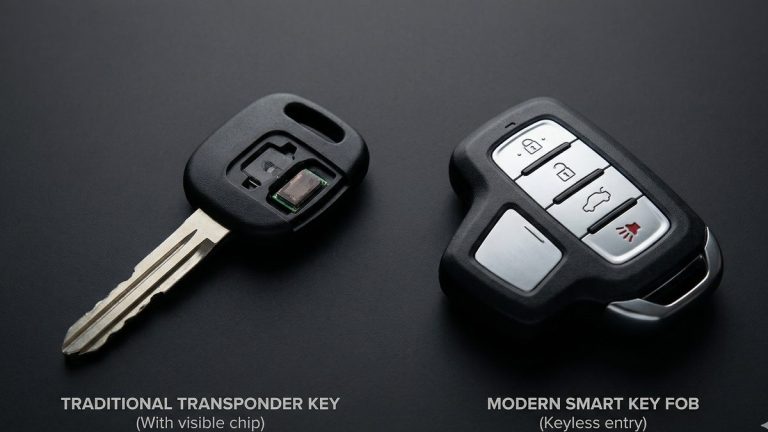
A transponder key uses a microchip embedded in the plastic head that sends a coded signal to the vehicle’s immobilizer when inserted into the ignition cylinder. A smart key (proximity key) communicates wirelessly with the vehicle through radio frequency, allowing push-to-start ignition and keyless entry without ever leaving your pocket. Both systems prevent unauthorized starting, but they use fundamentally different technology — and knowing which one your vehicle requires determines the type of replacement, the programming process, and the cost.
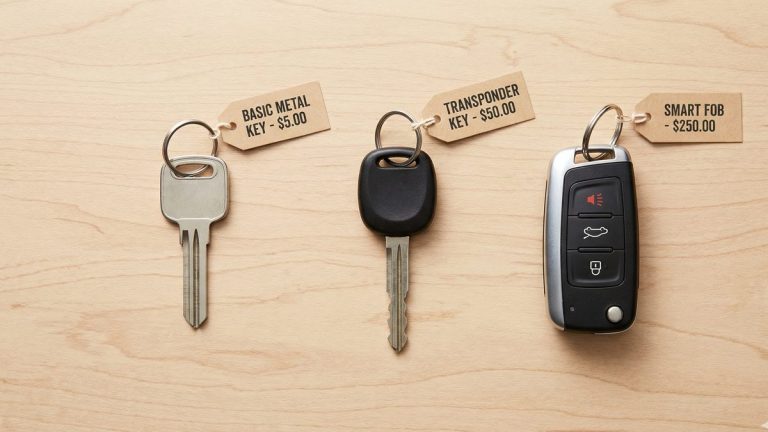
Prices shown reflect general market ranges for the Tempe and Phoenix metro area as of 2026. Actual costs depend on your vehicle’s year, make, model, and the type of key required. Contact us directly for a personalized quote.
You need a new car key, and the first question every locksmith or dealer asks is: does your vehicle use a transponder key or a smart key? For most drivers in Tempe, the answer isn’t obvious. Both key types look different from the basic metal keys that older vehicles used, and the terminology gets confusing when dealerships, auto parts stores, and online sellers use terms like “chip key,” “proximity fob,” “intelligent key,” and “keyless entry remote” interchangeably. The distinction matters because ordering the wrong type wastes money, and attempting to program a transponder key to a smart key vehicle — or vice versa — simply doesn’t work.
The core difference comes down to how the key communicates with your vehicle’s anti-theft system. A transponder key must be physically inserted into the ignition cylinder to transmit its chip signal at close range. A smart key broadcasts a rolling-code signal to the vehicle’s antenna system from several feet away, enabling push-to-start ignition and hands-free door unlocking. The immobilizer system in the vehicle is designed for one type or the other — they’re not interchangeable.
Understanding which system your car uses helps you make an informed decision about replacement car keys, avoid overpaying at the dealership, and communicate clearly with your locksmith about what you actually need. It also helps you understand why the pricing differs so significantly between the two key types.
CallOrange.com has been programming both transponder keys and smart keys for drivers across the Tempe and Phoenix metro area since 2015, with 4.8 stars across 1,451 Google reviews. Our mobile technicians carry blank key inventory and programming equipment for both systems, so diagnosis and replacement happen in a single visit at your location — whether that’s your home in South Tempe, an office near Tempe Town Lake, or a parking lot at Arizona Mills.
| Feature | Transponder Key | Smart Key |
|---|---|---|
| How It Starts the Car | Insert into ignition cylinder and turn | Press brake + push start button (key stays in pocket) |
| Chip Type | Passive chip — no battery, powered by immobilizer field | Active transmitter — powered by CR2025/CR2032 battery |
| Communication Range | Less than 2 inches (must be inserted) | 3–15 feet (proximity detection) |
| Keyless Entry | Only if combined with separate remote buttons | Built-in — doors unlock automatically on approach |
| Encryption | Fixed or rolling code (varies by manufacturer) | Rolling-code encryption with bidirectional handshake |
| Battery Required | No (remote buttons need battery if present) | Yes — replace every 12–18 months in Arizona |
| Emergency Backup | Mechanical key blade always functional | Hidden emergency blade + passive chip for dead battery |
| Programming Complexity | Single system — immobilizer ECU only | Multi-system — keyless entry, push-to-start, and immobilizer |
| Typical Replacement Time | 20–40 minutes on-site | 30–60 minutes on-site |
| Common Vehicle Era | 1995–2017 (still used on some current models) | 2007–present (standard on most vehicles by 2020) |
How Transponder Keys Work
The transponder key has been standard on most vehicles manufactured after 1995. The word “transponder” comes from “transmitter” and “responder” — which describes exactly what the chip inside the key does. When you insert the key into the ignition and turn it, the vehicle’s immobilizer sends a low-frequency radio signal to the chip. The chip responds with a unique code. If the code matches what the immobilizer expects, the engine starts. If it doesn’t match, the fuel injection and ignition circuits stay locked.
The chip itself is a passive component. It has no battery and generates no signal on its own. It only transmits when energized by the immobilizer’s electromagnetic field at very close range — typically less than two inches. This is why the key must be fully inserted into the ignition cylinder for the system to work. Holding a transponder key near the steering column without inserting it won’t trigger the immobilizer.
The chip is embedded in the plastic or rubber head of the key during manufacturing. It’s a small glass capsule about the size of a grain of rice, sealed inside the key housing. You can’t see it from the outside, but if you hold the key head up to a bright light, you can sometimes see the outline of the capsule. The metal blade portion of the key operates the mechanical ignition cylinder, while the chip handles the electronic authentication — two separate systems working together.
Transponder key programming links a specific chip’s code to a specific vehicle’s immobilizer ECU. Each vehicle can typically store codes for two to eight keys, depending on the make and model. Programming requires professional equipment that connects to the vehicle’s OBD-II diagnostic port and communicates directly with the immobilizer module. The process writes the new key’s code into the ECU’s memory so the vehicle recognizes it as authorized.
Most domestic and Asian vehicles from 1995 through the mid-2010s use transponder keys as their primary anti-theft system. Toyota, Honda, Nissan, Ford, Chevrolet, Dodge, and Hyundai all used various transponder chip types across their lineups during this period. Some vehicles from this era also include a remote head key — a transponder key with built-in lock and unlock buttons — which combines the mechanical key, the transponder chip, and a remote control fob into a single unit.
In Arizona specifically, transponder keys face a unique challenge. The extreme heat inside parked vehicles causes thermal stress on the chip’s glass capsule and the solder connections inside the key head. Over years of heat cycling — dashboard temperatures reaching 150°F or higher during Tempe summers — the chip can delaminate from its antenna coil, causing intermittent or permanent authentication failures. When a transponder key starts working inconsistently, the chip is usually the first component a locksmith tests.
How Smart Keys Work
Smart keys represent the next generation of vehicle authentication technology. Instead of a passive chip that responds only at close range, the smart key contains an active transmitter powered by a small coin-cell battery (typically CR2025 or CR2032). This transmitter broadcasts a coded signal that the vehicle’s antenna system detects from several feet away.
The communication is bidirectional and continuous. When you approach your vehicle with a smart key in your pocket or bag, the vehicle’s exterior antennas detect the key’s signal and automatically unlock the doors — no button press required. When you sit in the driver’s seat and press the start button, interior antennas verify the key’s presence inside the cabin and authorize the engine to start. The key never needs to leave your pocket for any of this to happen.
Smart keys use rolling-code encryption, meaning the authentication code changes every time the vehicle and key communicate. This makes the signal virtually impossible to intercept and replay — a significant security advantage over fixed-code transponder systems. The push-to-start system checks the code, verifies the key’s location relative to the vehicle, and confirms the encrypted handshake before allowing the engine to fire.
Every smart key contains a backup transponder chip and an emergency key blade. The hidden mechanical key — usually released by pressing a small button on the fob — unlocks the driver’s door manually if the smart key battery dies. The backup chip works the same way as a traditional transponder, allowing the vehicle to detect the key at near-zero range when held directly against the start button. This dual-system design means you’re never completely locked out by a dead key fob battery.
Smart key programming is more complex than transponder programming because the locksmith must register the key with multiple vehicle systems — the keyless entry module, the push-to-start module, and the immobilizer ECU. The programming equipment connects to the OBD-II port and walks through a multi-step registration process that varies by manufacturer. Some luxury and European brands require manufacturer-level security access codes, which adds time and complexity to the programming process.
Most vehicles manufactured after 2015 offer smart key systems as standard or optional equipment. By 2020, smart keys became the dominant system across virtually all new vehicle segments. If your vehicle has a push-button start and no ignition cylinder, it uses a smart key system. If it has both a key slot and a push-button, it likely uses a smart key with a mechanical backup.
Arizona heat affects smart keys differently than transponders because smart keys have active electronic components and a battery. The battery drains faster in extreme heat — lasting roughly 12 to 18 months in the Phoenix metro area compared to the manufacturer’s three-to-five-year estimate. The solder joints on the smart key’s circuit board are also vulnerable to thermal cycling, which causes intermittent signal failures that are especially common during summer months. If your smart key starts losing range or working inconsistently between May and October, heat damage to the internal circuitry is the most likely explanation.
Key Differences at a Glance
Understanding the practical differences between transponder and smart keys helps you identify which system your vehicle uses and what to expect during the replacement process. Here’s how the two technologies compare across the factors that matter most to vehicle owners.
Physical appearance is the easiest way to tell them apart. A transponder key looks like a traditional key with a thicker-than-normal plastic head. The metal blade has cuts that match your ignition cylinder. A smart key is a compact fob — usually rectangular or oval — with no visible blade. The emergency blade is hidden inside the fob body, released by a slider or button. If you carry a key that you insert into the ignition, it’s a transponder. If you press a button to start the car, it’s a smart key.
How you start the vehicle is the defining functional difference. Transponder key: insert into the ignition cylinder, turn to START. Smart key: step on the brake, press the start button. Some vehicles from the transition era (roughly 2010–2015) offered both options — a key slot for the transponder and a push button for the smart key — but the vehicle uses one system or the other based on which key is detected.
Battery requirements differ significantly. Transponder keys have no battery — the chip is powered by the immobilizer’s electromagnetic field. Smart keys require a coin-cell battery that powers the active transmitter. In Arizona’s heat, smart key batteries need replacement every 12 to 18 months to maintain reliable function.
Replacement cost reflects the technology difference. Transponder keys involve a metal blade blank, a compatible chip, cutting to match the ignition, and programming. Smart keys involve a more expensive fob blank with a circuit board, antenna, battery holder, buttons, and the emergency blade — plus multi-system programming. A smart key replacement typically costs more than a transponder key replacement for the same vehicle brand.
Security level is higher with smart keys. Rolling-code encryption, bidirectional communication, and proximity detection make smart keys significantly harder to defeat than fixed-code transponder systems. However, both systems are far more secure than mechanical keys alone, and both effectively prevent hotwiring.
Convenience is the smart key’s main advantage for daily use. Keyless entry, keyless start, and hands-free trunk opening eliminate fumbling for keys. Transponder keys require physical insertion and rotation, which is functional but lacks the walk-up-and-go experience.
Which Vehicles Use Which System
Knowing your vehicle’s key type before you need a replacement saves time and avoids ordering the wrong part. Here’s a general guide organized by brand and era, though specific trim levels and option packages can vary.
Toyota and Lexus transitioned aggressively to smart keys. Most Toyota models from 2018 onward use smart keys as standard equipment. Lexus adopted smart keys earlier — from 2006 onward across most models. Older Toyotas (1998–2017) use transponder keys with various chip types (4C, 4D, G, H). The Camry, Corolla, RAV4, and Highlander all made the switch between 2018 and 2020 depending on trim. Our technicians program both Toyota transponder and smart keys at your location.
Honda and Acura followed a similar timeline. Honda Civic, Accord, CR-V, and Pilot models from 2018 onward typically use smart keys. Earlier models (1998–2017) use transponder keys. Acura adopted smart keys earlier, with most models switching by 2014–2016.
Nissan and Infiniti were early smart key adopters. Nissan’s “Intelligent Key” system appeared in the Altima and Maxima as early as 2007. By 2015, most Nissan models offered smart keys as standard. The Rogue, Sentra, and Pathfinder transitioned between 2013 and 2018. Infiniti has used smart keys across nearly all models since 2008.
Ford and Lincoln vary more by model. The F-150, the most popular vehicle on Arizona roads, transitioned to smart keys with the 2015 model year. Mustang, Explorer, and Escape followed between 2016 and 2020. Older Ford vehicles use transponder keys with the well-known 80-bit or 128-bit chip systems.
Hyundai and Kia made smart keys standard across most lineups by 2018–2020. Earlier models (2006–2017) use transponder keys with various chip types. The Tucson, Santa Fe, Sportage, and Telluride all use smart keys in current production.
Chevrolet, GMC, and other GM brands have mixed timelines. The Silverado and Sierra gained smart keys with the 2019 redesign. Equinox and Traverse transitioned between 2018 and 2020. Older GM vehicles use transponder keys, some with the unique GM “circle plus” key head design.
European brands — BMW, Mercedes-Benz, Audi, and Volkswagen — were among the earliest smart key adopters. BMW’s Comfort Access system dates back to 2004. Mercedes KEYLESS-GO appeared in 2003. These brands use the most complex encryption and the most expensive fob hardware, which is reflected in higher replacement costs compared to domestic and Asian brands.
If you’re not sure which system your vehicle uses, the simplest test is this: look at your dashboard around the steering column. If there’s a slot or cylinder where you insert a key, your vehicle uses a transponder key. If there’s only a start/stop button with no key slot, it uses a smart key. You can also check your owner’s manual or call (480) 847-2635 with your year, make, and model for immediate confirmation.
The Replacement Process for Each Key Type
The process of getting a new key differs between transponder and smart keys in both the steps involved and the equipment required. Understanding the workflow helps you know what to expect when a mobile automotive locksmith arrives at your location.
Transponder key replacement involves four steps. First, the locksmith identifies the correct key blank for your vehicle — this includes both the right blade profile and the right chip type. Second, the blade is cut using either a code cutter (cutting by the factory bitting code) or an impression/decode from the existing lock. Third, the chip is programmed to your vehicle’s immobilizer using diagnostic equipment connected to the OBD-II port. Fourth, the technician tests the new key through multiple start cycles to confirm reliable authentication. The entire process typically takes 20 to 40 minutes for most vehicles.
Smart key replacement involves additional steps because of the multi-system integration. The locksmith identifies the correct fob blank, which must match not just the vehicle but the specific model year and sometimes the trim level. The emergency blade inside the fob is cut to match the driver’s door lock. The fob is then registered with the keyless entry module, the push-to-start module, and the immobilizer ECU through the OBD-II diagnostic interface. Some vehicles require an initialization drive cycle after programming — the technician drives the vehicle a short distance to confirm all systems accept the new key. This process takes 30 to 60 minutes depending on the vehicle’s complexity.
All-keys-lost situations — where you have no working key — add complexity to both processes. Without an existing key for reference, the locksmith must decode the lock to determine the correct blade cuts and may need to access the vehicle’s immobilizer through advanced security protocols rather than the standard “add a key” procedure. All-keys-lost jobs take longer and cost more because of the additional diagnostic and security steps required.
Programming two keys at once is recommended and costs less per key than programming them separately. The vehicle’s ECU handles the registration of both keys in a single programming session. Most immobilizer systems can store four to eight key codes, so having a spare programmed alongside your primary key is both practical and cost-effective. Store the spare in a cool location inside your home — not in the vehicle where Arizona heat will degrade the components.
Pricing Differences in the Tempe Market
The cost difference between transponder and smart key replacement is significant because the technology, parts, and programming complexity differ substantially. Here’s what the Tempe and Phoenix metro market looks like for common replacement scenarios in 2026.
Transponder key replacement costs less because the blank key is simpler — a metal blade with an embedded chip — and the programming process involves a single system (the immobilizer). Domestic brands like Ford, Chevrolet, and Dodge tend to fall at the lower end because their chip systems are well-established and blanks are widely available. Asian brands like Toyota, Honda, and Nissan fall in a similar range. European transponder keys cost more because of proprietary chip encryption and restricted blank availability.
Smart key replacement costs more because the fob blank itself is a complex electronic device — circuit board, antenna, battery compartment, buttons, emergency blade, and housing — and the programming touches multiple vehicle systems. The fob blank alone typically costs two to three times more than a transponder blank. Add the multi-step programming and the higher-security encryption, and the total runs meaningfully higher than a transponder key for the same brand.
Factors that affect pricing for both key types:
- Vehicle make and year — older vehicles with simpler systems cost less than newer ones with advanced encryption
- OEM versus aftermarket blanks — OEM parts carry higher cost but guaranteed compatibility, aftermarket offers savings with slight compatibility risk
- All-keys-lost versus adding a key — no existing working key means more diagnostic work and higher cost
- Number of keys being programmed — two keys in one session costs less per unit than two separate visits
- Time of service — standard hours versus evening or weekend availability
Dealership pricing comparison: Both transponder and smart key replacements cost substantially more at the dealership than through a mobile locksmith. The parts are the same. The programming process is the same. The difference is dealership overhead — facility costs, parts markup, and the inconvenience factor of towing your vehicle to the dealer and waiting days for an appointment versus having a mobile technician come to your location and complete the work in under an hour.
Protecting Your Keys in Arizona Heat
Regardless of whether you carry a transponder key or a smart key, Arizona’s desert climate demands proactive care to extend key life and avoid unexpected failures. These maintenance steps apply to both key types with some specific differences.
For transponder keys: The chip itself is sealed and maintenance-free, but the plastic key head that houses it degrades in UV and heat. If the key head shows cracks, replace the housing before the chip capsule is exposed. A cracked housing allows dust and moisture to reach the chip, accelerating failure. Keep your transponder key on a minimal keychain — heavy rings put stress on the ignition cylinder and the key head simultaneously.
For smart keys: Replace the battery every 12 to 18 months — don’t wait for it to die. Store your spare fob indoors, never in the vehicle’s glovebox or center console where summer heat will damage the circuit board. Use a protective silicone case if the fob rides in a pocket with coins or keys. Clean the battery contacts annually with a dry cotton swab.
For both key types: Have a spare key made and programmed while your primary key still works. An all-keys-lost situation costs more and takes longer because the locksmith has to work through additional security protocols. Getting a spare car key made proactively — while you have a working key for reference — is the most cost-effective approach.
Avoid leaving keys in direct sunlight on dashboards, windowsills, or outdoor tables. The concentrated heat degrades both the transponder chip’s antenna coil and the smart key’s solder joints. A few seconds of habit — dropping the key into a shaded pocket or a drawer — adds years to the key’s functional life.
Frequently Asked Questions
How do I know if my car has a transponder or smart key?
Look at your dashboard near the steering column. If there’s a slot where you insert a key and turn it to start the car, you have a transponder key. If there’s only a start/stop button with no key slot, you have a smart key. You can also check by looking at the key itself — a transponder key has a visible metal blade with a thick plastic head, while a smart key is a compact fob with no visible blade.
Why do smart keys cost more to replace than transponder keys?
Smart keys cost more because the fob blank itself is a complex electronic device with a circuit board, antenna, battery holder, and buttons. The programming process is also more involved — it requires registering the key with the keyless entry module, push-to-start system, and immobilizer ECU rather than just the immobilizer alone. The higher parts cost and longer programming time both contribute to the price difference.
Can a locksmith program both key types or only a dealership?
A licensed automotive locksmith with professional programming equipment can program both transponder keys and smart keys for virtually all major vehicle brands. The diagnostic tools connect to the same OBD-II port and use the same protocols as dealership equipment. Mobile locksmiths complete the work at your location, which eliminates the need to tow your vehicle to a dealer.
Does Arizona heat damage transponder and smart keys?
Yes, but in different ways. Transponder keys suffer from thermal stress on the chip’s glass capsule and antenna coil, which can cause intermittent authentication failures over time. Smart keys face battery drain (batteries last 12–18 months instead of 3–5 years), solder joint fatigue on the circuit board, and button membrane degradation from UV exposure. Both key types benefit from being stored away from direct sunlight and extreme cabin heat.
Can I buy a key online and have it programmed locally?
You can, but there’s a compatibility risk. Aftermarket blanks from Amazon or eBay may not match your specific vehicle year and trim, and some use incompatible chip types that won’t program correctly. If the blank doesn’t match, you’ll pay for a service visit with no result. A locksmith who supplies the key guarantees compatibility and typically includes cutting and programming in one price.
What if I lost all my keys and have no spare?
All-keys-lost situations are more complex and cost more than adding a key when you have a working one. The locksmith must decode the lock to determine blade cuts and access the immobilizer through advanced security protocols. The process takes longer but is fully doable on-site. This is why having a spare key programmed proactively — while you still have a working key — is the most cost-effective approach.
Do I need ID for key replacement service?
Yes. A valid government-issued photo ID and current vehicle registration are required before any key cutting or programming begins. This is a security measure that protects vehicle owners from unauthorized key duplication and is standard practice across the entire locksmith industry.
Getting the Right Key for Your Vehicle in Tempe
Whether your car needs a transponder key or a smart key, accurate identification is the first step to a successful replacement. The wrong blank, the wrong chip type, or the wrong programming protocol means a wasted service call and wasted money. A professional locksmith identifies the exact key type your vehicle requires before ordering parts or starting work.
CallOrange.com serves the Tempe and Phoenix metro area with mobile technicians who carry transponder blanks, smart key fobs, cutting equipment, and multi-system programming tools for every major vehicle brand. With 1,451 Google reviews at 4.8 stars and 11 years of operation since 2015, every technician is licensed, insured, and trained to handle both key technologies across domestic, Asian, and European vehicles.
Call (480) 847-2635 with your vehicle’s year, make, model, and trim — we’ll confirm the key type, give you an upfront quote, and schedule a visit at your location. Bring your vehicle registration and a valid photo ID — both are required before any key programming work. You can also reach out through the contact page or learn more about the team on the about us page.