
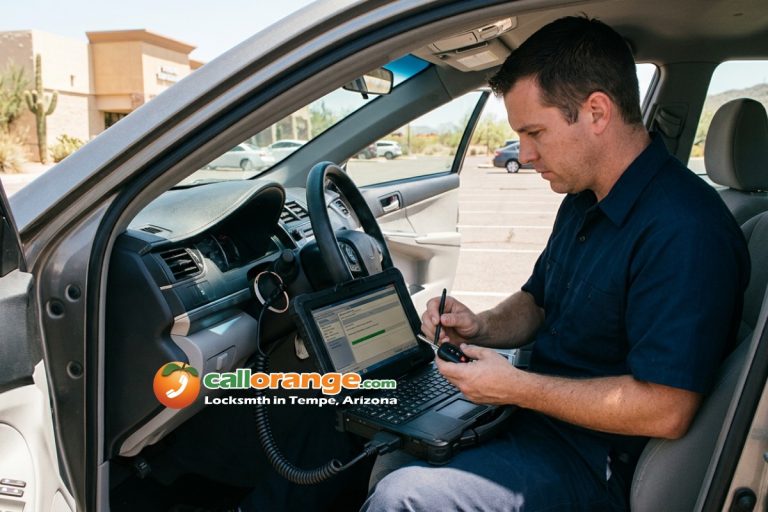
Transponder key failures in Tempe are frequently misdiagnosed as dead batteries — the real cause is chip delamination from Arizona’s 115°F+ heat, which breaks the internal antenna connection inside the key head. A new battery changes nothing. The fix is chip diagnosis, cloning or transponder replacement, and ECU re-authorization — work a mobile locksmith performs on-site in under an hour without a tow to the dealer.
Every vehicle manufactured after 1995 in the U.S. uses a transponder system. The chip embedded in the key head transmits a rolling code to the immobilizer module near the ignition. If the code doesn’t match, the engine cranks but won’t start — the immobilizer cuts fuel injection regardless of whether the mechanical key blade is the correct cut. In Tempe’s climate, the most common failure point isn’t the chip itself but the antenna wire coiled inside the plastic key head. Thermal expansion and contraction cycles crack the solder points over time, breaking the signal path before the chip shows any visible damage.
Our automotive locksmiths at CallOrange Locksmith in Tempe program transponder keys on-site daily from 6:00 AM to 10:00 PM — no tow required, no dealership appointment. See our location and customer reviews on Google Maps before you call. We carry key blanks and programming equipment for all major platforms on every truck, and we provide a written quote before any work begins.
Founded in 2008, CallOrange has 17+ years of automotive locksmith experience across Tempe, Mesa, Chandler, Scottsdale, and the Metro Phoenix area. Our technicians work with Mul-T-Lock, Schlage Primus, Medeco, ASSA Abloy, Kwikset, and all major OEM transponder systems — the full platform range, not just common domestic vehicles.
How Transponder Keys Work — and Why Arizona Heat Breaks Them
Understanding the failure mode helps you make the right call faster.
A transponder key has three functional components: the mechanical blade that operates the lock cylinder, the chip (typically a Philips, Texas Instruments, or Megamos crystal), and the antenna coil that lets the immobilizer reader energize and interrogate the chip. The antenna is a tight coil of wire inside the plastic key head — not in the chip itself. The immobilizer ring around the ignition cylinder sends a low-frequency RF field, the antenna coil picks it up and powers the chip, and the chip responds with its authorization code.
Tempe’s thermal environment attacks the antenna coil specifically. A key left in a car on a summer day reaches 180°F+. A key pulled from a pocket into a 115°F exterior temperature expands and contracts through the same range every day. The wire coil and the solder joints that connect it to the chip board undergo hundreds of micro-stress cycles per year. Eventually a joint cracks, the coil loses continuity, and the chip goes silent — even though the chip itself is undamaged.
The secondary failure mode is key head delamination. Tempe UV exposure causes the plastic key head to become brittle, and the key head splits where it meets the blade collar. When that happens, the antenna shifts position inside the head and loses reliable contact with the ignition reader — the vehicle starts intermittently, then stops starting entirely.
Neither failure shows any visible damage. A diagnostic tool that reads the chip directly can confirm which component has failed before any replacement is ordered.
Locksmith vs Dealer — The Real Comparison in Tempe
This is the question most Tempe drivers search before calling anyone. The honest answer depends on what you need.
Dealership programming is brand-specific, appointment-based, and requires the vehicle to be on-site. Most Tempe dealerships schedule transponder programming as a service department job — typical wait times run 1–3 days for an appointment, and the vehicle must be driven or towed in. Dealer cost for a transponder key with programming typically runs $150–$400 depending on make and model. For proximity keys and smart fobs, the range is $200–$600. The dealer uses OEM programming software, which is the definitive tool for newer vehicles with rolling-code systems that require factory authorization.
Mobile locksmith programming eliminates the tow and the appointment. A CallOrange technician comes to your location with aftermarket key blanks and professional programming equipment — including tools compatible with EEPROM-based systems, OBD-II pin-detect programming, and proximity key frequency matching. For most vehicles, the programming is completed on-site in 30–60 minutes. Cost is typically lower than dealer pricing, and there’s no tow bill. The written quote you receive before work begins covers both the key and the programming — no separate line items added after.
The scenario where a dealer is the better choice: Vehicles with manufacturer-encrypted systems that require a live connection to the OEM server for authorization — primarily newer BMW, Mercedes-Benz, and select GM platforms with VATS encryption. Our technicians identify these during the initial consultation and tell you directly if a dealer connection is required. We don’t attempt programming we can’t complete.
For the majority of Tempe drivers — domestic trucks and SUVs, Japanese platforms, Korean vehicles, and most European models from 2010–2020 — a mobile locksmith is the faster, lower-cost option with no difference in programming quality. Our replacement car keys service covers the full key-cutting and programming scope, and our push-to-start and keyless ignition service specifically covers proximity keys and smart fobs.
Transponder Key Types — What You Have and What Programming Involves
Fixed-code transponders use a single stored code that never changes. These are found on domestic vehicles from the mid-1990s through the early 2000s and some Japanese platforms. Programming involves writing a new code to the chip and adding it to the immobilizer’s authorized list. These are the most straightforward to program and the most compatible with aftermarket equipment.
Rolling-code transponders generate a new code on each start cycle using a synchronized algorithm between the key and the ECU. Most vehicles from 2005 onward use rolling codes. Programming requires synchronizing the new key’s algorithm with the ECU’s current state — this is a two-step process involving both the key and the vehicle’s OBD-II port.
Proximity keys and smart fobs operate on a different frequency entirely — typically 315 MHz or 433 MHz RF — and contain a transponder backup chip for the mechanical emergency start function. Programming requires pairing the RF frequency to the body control module in addition to the transponder authorization. Our make car key service covers new key origination for vehicles with no working key present — a scenario that requires reading the immobilizer’s stored data directly rather than cloning an existing key.
Cloning vs new programming: If you have a working original key, the fastest approach is cloning — reading the chip data from the original and writing it to a new key blank. Cloning doesn’t require access to the vehicle’s OBD-II port. If the original key is lost, damaged, or non-functional, new programming from the vehicle’s immobilizer data is required. Both approaches are available on our truck.
| Symptom | Likely Cause | What a Pro Checks |
|---|---|---|
| Engine cranks but won’t start | Transponder not communicating — immobilizer blocking fuel | OBD-II immobilizer read, chip diagnostic, antenna coil continuity |
| Vehicle starts sometimes, not others | Cracked antenna coil or delaminating key head | Chip read at multiple positions, key head integrity, solder joint check |
| Security light stays on after inserting key | Immobilizer not receiving valid code from chip | Immobilizer module status, chip family verification, ECU authorization count |
| New battery didn’t fix the no-start | Chip failure, not battery — misdiagnosis is common | Transponder chip read, antenna signal test, immobilizer log |
| Key fob buttons work but car won’t start | RF and transponder are separate — fob RF works, transponder chip failed | Separate chip and RF diagnostics, fob PCB inspection |
| Only one key left — original lost | Need new key programmed from immobilizer data | EEPROM read or OBD-II new key origination, VIN-matched blade cut |
The Programming Process — What Happens On-Site
When a CallOrange technician arrives at your Tempe location, the job starts with a diagnostic read — not a replacement order.
We connect to the vehicle’s OBD-II port and read the current immobilizer status. This confirms how many keys are currently authorized, whether the ECU is locked from too many failed programming attempts, and which chip family is required for replacement. On vehicles with a working original key, we read the chip data directly using a transponder analyzer.
From that diagnostic read we provide your written quote — key blank cost, programming fee, total. You approve it before we cut or program anything.
Key cutting happens on-site using our mobile cutting equipment calibrated to your vehicle’s VIN data or a direct trace from the original blade. The cut key is tested mechanically in the lock cylinder before programming begins — a key that doesn’t turn the cylinder cleanly won’t start the vehicle even with a valid transponder signal.
Programming is performed via OBD-II connection or emergency bypass procedure depending on the platform. After programming, we verify the new key starts the engine and test the original key (if present) to confirm it still functions. We don’t leave until both tests pass.
See our automotive locksmith services overview for the full scope of what we carry and program, and our ignition repair service if the ignition cylinder itself has wear that’s affecting key turn and start.
Frequently Asked Questions
How much does transponder key programming cost in Tempe? +
Can you program a transponder key without the original? +
Is a mobile locksmith as good as the dealer for key programming? +
Why did Arizona heat cause my transponder key to fail? +
How long does on-site transponder key programming take? +
Do you carry key blanks for all vehicle makes in Tempe? +
Can you program a second key so I have a spare? +
Getting Back on the Road
A transponder key problem in Tempe doesn’t require a tow or a multi-day wait. The diagnostic, key cutting, and programming happen at your location — most jobs are done in under an hour. The written quote you get before we start covers everything; there are no separate charges added after the engine starts.
CallOrange Locksmith in Tempe has been serving drivers across the Metro Phoenix area since 2008. Our technicians are licensed, insured, and bonded, and they carry blanks and programming equipment for domestic, Japanese, European, and Korean platforms on every truck. Our 5-star Google reviews from Tempe drivers reflect the same standard on every automotive call.
Call (480) 847-2635 to schedule your transponder key service. We’re available every day from 6:00 AM to 10:00 PM. Visit our contact page for non-urgent scheduling, or see our about page to learn more about how our team operates. Our full automotive locksmith services page covers every key type and ignition service we handle in Tempe.