
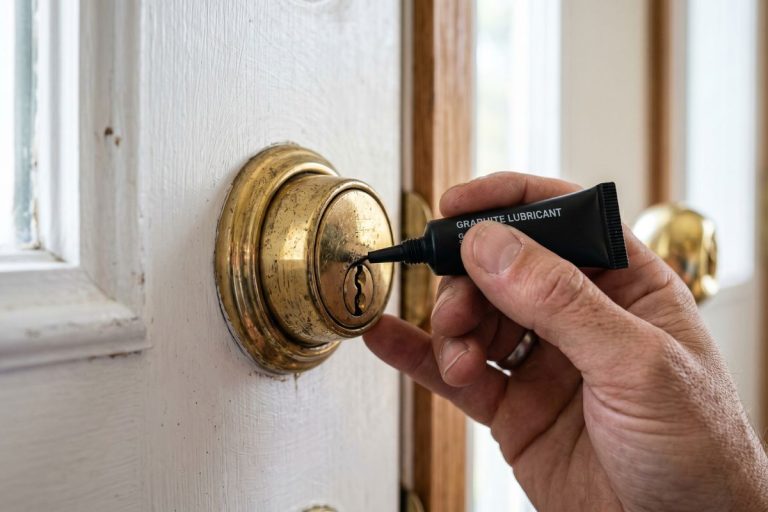
You walk up to your front door after a long day, slide your key in, and… nothing. The key won’t turn, the deadbolt feels gritty, and the thumbturn fights back like it’s personal. A sticky door lock is one of the most common household frustrations homeowners in Tempe and across the East Valley deal with every single year. The good news? Most cases of a stiff or stuck lock can be solved in under ten minutes with tools you already own — no service call required. Keep reading and I’ll walk you through exactly how I diagnose and fix sticky locks in the field, what products to use (and which ones to avoid), and when the problem points to something bigger.
Why Door Locks Get Sticky in the First Place
Before we jump into the sticky door lock fix, it helps to understand what’s happening inside the cylinder. A standard pin tumbler lock has five or six tiny spring-loaded pins that rise to a precise height when the correct key is inserted. Over time, three things go wrong:
- Dust, lint, and grit build up around the pins
- Old lubricant turns into sticky residue
- The key itself wears down and stops aligning the pins cleanly
Add Arizona’s dry heat and fine desert dust to the equation, and even a brand-new deadbolt can start dragging within a year or two. The result is a lock that catches halfway, requires jiggling, or refuses to turn at all. If your lock has reached the point where no amount of cleaning helps, our residential locksmith team can diagnose it on-site.
The 3-Step Sticky Door Lock Fix Anyone Can Do
Here is the exact sequence I use when a customer calls me about a stiff lock. Try this before anything else.
Step 1 — Clean the Keyway
Grab a can of compressed air (the same kind you use for keyboards) and give the keyway three short bursts. You’ll be surprised how much pocket lint, dust, and old grease comes flying out. If you don’t have compressed air, a thin plastic coffee stirrer works to scrape debris loose.
Step 2 — Apply the Right Lubricant
This is where most homeowners go wrong. Do not use WD-40, 3-in-1 oil, or any wet spray lubricant on a pin tumbler lock. Oil-based products attract dust and turn into sludge inside the cylinder within weeks, making the problem worse. Use one of these instead:
- Powdered graphite (best for older locks)
- Dry Teflon (PTFE) spray (best for modern deadbolts and smart locks)
- Silicone spray (good for the latch and strike plate)
Insert the applicator straw into the keyway and give it one short squeeze. Less is more.
Step 3 — Cycle the Key
Insert your key, turn it gently left and right ten to fifteen times. This works the lubricant down into the pins. Wipe any excess off the key with a clean cloth so it doesn’t stain your door.
That’s it. In most cases, a sticky lock turns smooth again at this point. If yours doesn’t, it may be time for a lock change rather than another round of lubricant.
Sticky Lock Lubricant Comparison
| Lubricant Type | Recommended Use | Lasts | Risk to Lock |
|---|---|---|---|
| Powdered Graphite | Older pin tumbler locks, traditional deadbolts | 12–18 months | None |
| Dry Teflon (PTFE) Spray | Modern deadbolts, smart locks, electronic locks | 8–12 months | None |
| Silicone Spray | Latch, hinges, strike plate (NOT keyway) | 6 months | Low |
| WD-40 | ❌ Not recommended | Days | High — gums up pins |
| 3-in-1 Household Oil | ❌ Not recommended | Weeks | High — attracts dust |
When the Problem Isn’t the Lock
Sometimes the lock cylinder is fine — the issue is the door itself. Arizona homes shift with temperature swings, and a door that’s gone slightly out of square will bind against the strike plate. Signs that point to a misaligned door rather than a sticky cylinder:
- The deadbolt extends fine when the door is open but binds when closed
- You see scrape marks on the strike plate
- The thumbturn moves freely from the inside but the key fights from outside
In these cases, loosening the strike plate screws and shifting it 1/16 of an inch in the direction the bolt needs to travel usually solves it. Homeowners across Mesa, Chandler, Scottsdale, and Phoenix deal with this every season as the desert heat expands and contracts wood frames.
Pro Tip From the Field
After 10+ years of pulling apart locks across Tempe, Mesa, and Chandler, I can tell you the single biggest cause of premature lock failure isn’t wear — it’s using a copy of a copy of a copy of the original key. Each duplication loses a tiny amount of precision. By the third generation, the key is cutting the pins at slightly wrong heights and grinding them down every time you use it. If your lock got sticky after you started using a duplicate, throw the duplicate away and cut a fresh one from the original or have a lock rekey done so you start fresh.
When to Stop and Call a Locksmith
The DIY fix above handles roughly 80% of sticky lock cases. Stop and bring in a professional if:
- The key broke off inside the cylinder
- The lock turns but the deadbolt won’t extend or retract
- You hear grinding metal sounds
- The cylinder spins freely without engaging the bolt
- The lock is on a high-security or smart deadbolt under warranty
- You’re locked out and can’t access the lock at all — see our home lockout service
Forcing a damaged lock can crack the cylinder housing, snap pins, or shear the cam — turning a $0 fix into a full lock replacement. Browse all of our locksmith services to see what we cover across the Tempe metro.
Frequently Asked Questions
Why is my door lock suddenly hard to turn?
The most common cause is dust and old lubricant buildup inside the cylinder. Arizona’s dry climate pulls fine particles into the keyway, where they mix with any leftover oil and form a sticky residue around the pins. A quick cleaning with compressed air and a dry graphite or Teflon lubricant usually restores smooth operation.
Can I use WD-40 to fix a sticky door lock?
No. WD-40 is a petroleum-based solvent that attracts dust and turns into sludge inside a pin tumbler lock within days. It will give you temporary relief but make the problem significantly worse over the following weeks. Always use powdered graphite or a dry Teflon (PTFE) spray on lock cylinders.
What’s the difference between a sticky lock and a misaligned door?
If the deadbolt extends and retracts smoothly when the door is open but binds when the door is closed, the issue is door alignment, not the lock. You’ll often see scrape marks on the strike plate. Loosening the strike plate screws and shifting it slightly usually corrects it.
How often should I lubricate my deadbolt?
Once a year is usually enough for most homes. If you live near a construction zone, on a dirt road, or in a high-traffic household, every six months is a better schedule. Use a dry lubricant only — never wet oil.
When should I replace a sticky lock instead of fixing it?
Replace the lock if the cylinder spins without engaging the bolt, the key has broken inside, you hear grinding metal sounds, or the lock has been forced repeatedly over months. At that point the internal components are likely worn beyond repair. A professional lock change will install a new deadbolt and rekey it to match your existing keys.
Does fixing a sticky lock improve my home security?
Yes. A lock that’s been fought with for months develops worn pins and weaker springs, which reduces pick resistance and can leave the deadbolt sitting in an incomplete locked position. Restoring smooth operation — or upgrading to a higher-grade deadbolt — directly improves your home safety.
Keep Your Home Security Strong
A smooth-turning lock isn’t just about convenience — it’s a core piece of your deadbolt security and overall home safety. A lock that’s been forced or fought with for months has worn pins, weakened springs, and reduced pick resistance. If your thumbturn lock has been giving you trouble for more than a few weeks, or you’ve never had a security audit on your front and back doors, it’s worth having a professional locksmith take a look.
Contact CallOrange Locksmith Tempe at (480) 847-2635 to schedule a home security assessment or a same-visit deadbolt installation. Get help now.