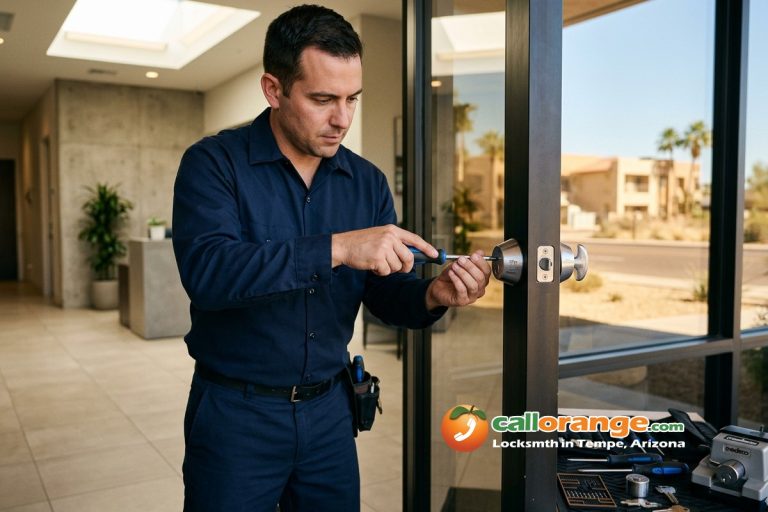
Locksmith installing a high-security deadbolt on a commercial door in Tempe AZ

High Security Locks in Tempe AZ — What Businesses and Homeowners Need to Know

A standard residential deadbolt can be bumped open in under 10 seconds with a $5 tool — high-security cylinders from Medeco, Schlage Primus, and Mul-T-Lock are specifically engineered to defeat that attack, along with picking, drilling, and unauthorized key duplication. The difference isn’t marketing language — it’s measurable engineering in the cylinder tolerances, key control systems, and hardened materials. Understanding what those differences actually are helps you decide whether a high-security upgrade is warranted for your specific property in Tempe.
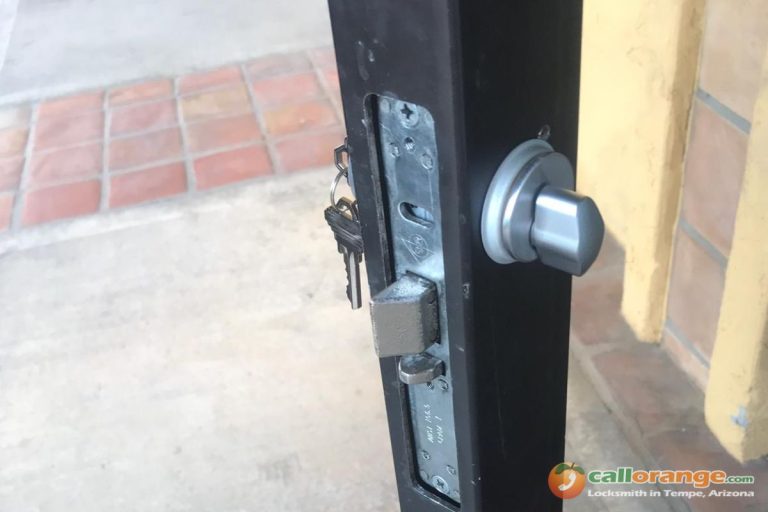
Most Tempe properties run builder-grade Kwikset or standard Schlage deadbolts — hardware that meets code, operates reliably, and costs $25–$50 at a hardware store. That hardware does what it’s designed to do. What it’s designed to do is resist casual entry attempts, not targeted attacks by someone who has bought a bump key or a basic pick set. The gap between builder-grade and high-security isn’t a gap in everyday function — both turn smoothly with the right key. The gap is in what happens when someone tries to open the lock without a key.

Our locksmiths at CallOrange Locksmith in Tempe install and service high-security cylinders from Medeco, Schlage Primus, Mul-T-Lock, and ASSA Abloy on residential and commercial properties throughout Tempe and Metro Phoenix. Find our location and read reviews from Tempe property owners on Google Maps before you call. We carry high-security hardware on every truck and provide a written quote before any installation begins.

Founded in 2008, CallOrange has 17+ years of commercial and residential locksmith experience in the Tempe area. Techs Michael and Liran work high-security installations regularly — this isn’t hardware we special-order; it’s on the truck.


What Makes a Lock “High Security” — The Three Measurable Differences

The term gets used loosely in hardware store marketing. In the locksmith industry, high security has a specific meaning rooted in three engineering characteristics.

Pick resistance through tight tolerances and security pins. A standard pin tumbler cylinder uses simple driver pins and key pins. The tolerances between the pin diameter and the cylinder bore allow enough variation that a skilled pick can manipulate each stack individually — a technique called single-pin picking. High-security cylinders use spool pins, serrated pins, or mushroom pins that create false sets — the pick detects what feels like a shear line but isn’t one. Combined with tighter manufacturing tolerances that reduce the working room available to a pick, these cylinders require significantly more skill and time to pick, and many are effectively resistant to all common pick attacks.

Bump resistance through sidebar or secondary locking mechanisms. Key bumping uses a modified blank cut to maximum depth. When struck, the impact briefly separates all pin stacks simultaneously, and a fast rotation at that moment opens the cylinder. High-security cylinders defeat this with a sidebar mechanism — a secondary locking bar that must be engaged by rotating elements in the key itself, not just the pin stacks. A bump key has no sidebar profile and cannot engage that mechanism. Medeco cylinders use a combination of rotating key elements and a sidebar. Schlage Primus uses a secondary set of pins in a separate channel. Mul-T-Lock uses a telescoping pin system inside each stack. All three defeat standard bump attacks by design.

Key control through restricted keyways and patented blanks. A standard Kwikset key blank is available at every hardware store and locksmith supply house. Anyone with your key for 30 seconds can have a copy cut anywhere. High-security systems use patented keyways with restricted blanks — key duplication requires factory authorization or a licensed dealer account. Medeco keys can only be duplicated by authorized Medeco dealers with written authorization from the registered key owner. Mul-T-Lock uses a similar registered system. This means that even if a key leaves your control temporarily, an unauthorized copy cannot be made.


High-Security Cylinders We Install in Tempe — What Each One Is Best For

Medeco is the highest-recognition high-security brand in the U.S. market. Medeco cylinders combine the sidebar mechanism with key elements that rotate in the cylinder in addition to the standard vertical pin movement — the correct key must both lift all pins to the shear line and rotate each element to the correct angular position to engage the sidebar. This dual-axis requirement makes Medeco one of the most pick-resistant cylinders commercially available. Medeco is available as a deadbolt cylinder, knob cylinder, rim cylinder for commercial doors, and high-security padlock. It’s the standard choice for commercial properties in Tempe that need documented key control and maximum cylinder resistance.

Schlage Primus uses a secondary pin system in a separate keyway channel alongside the standard pin stacks. The Primus key has a standard cut profile for the primary pins plus a secondary milled track on the blade that engages the Primus pins in a separate channel. Both sets must align simultaneously. Primus keys cannot be duplicated on standard key cutting equipment — the secondary track requires Primus-specific blanks available only through authorized Schlage dealers. For Tempe homeowners and commercial operators already running Schlage hardware, the Primus upgrade integrates with existing Schlage door prep without modification.

Mul-T-Lock uses a telescoping pin system where each standard pin contains a second spring-loaded element inside it, creating a lock within a lock. To reach the shear line, both the outer pin and the inner element must be aligned simultaneously. The key has a standard external cut plus a dimple pattern on the blade face that operates the inner elements. Mul-T-Lock is widely used in Israeli government and military applications and is one of the most drill-resistant cylinders in the civilian market due to the hardened steel inserts around the pin chambers. It’s the preferred choice for high-value commercial applications in Tempe where both pick resistance and physical attack resistance are priorities.

ASSA Abloy covers a broad range of high-security hardware for commercial door systems, including mortise cylinders, exit device cylinders, and master key systems at the high-security tier. For commercial Tempe properties with mortise locks or Adams Rite-style door hardware, ASSA Abloy provides high-security options that integrate with existing commercial door prep.

Our high-security locks service covers installation, rekeying, and key duplication management for all four brands, plus compatibility assessment for your existing door hardware.


Residential vs Commercial High-Security Applications in Tempe

The hardware is the same. The installation context and key control requirements differ.

Residential applications in Tempe where high-security is worth the investment: rental properties where tenant turnover creates key control challenges, homes with previous break-in attempts, properties with high-value contents, and any home where the standard rekey cycle isn’t sufficient because the concern is targeted entry rather than unauthorized keys.

For most Tempe homeowners, the realistic upgrade path is a Schlage Primus deadbolt on the primary entry doors — it integrates with standard Schlage door prep, the key control system is straightforward to manage, and the cost is a fraction of a security system installation with meaningfully better physical deterrence than a builder-grade deadbolt. Our lock change service covers the hardware swap, and our lock rekey service handles key consolidation if you’re upgrading multiple entry points.

Commercial applications in Tempe where high-security is a standard requirement rather than an upgrade: medical offices with HIPAA-relevant access control, law offices, financial services locations, retail businesses with significant after-hours inventory exposure, and any commercial property where documented key control is part of a compliance obligation.

For commercial properties, the key control documentation aspect of high-security systems matters as much as the cylinder resistance. A registered Medeco or Mul-T-Lock key system creates an auditable record of who has been issued keys and who has authorization to duplicate them. When a key is reported lost, the restricted blank means an unauthorized copy cannot be in circulation — and rekeying under a new authorization eliminates the lost key’s validity entirely. Our commercial locksmith services cover the full scope of commercial lock installations in Tempe.


Tempe-Specific Factors — How the Climate Affects High-Security Hardware

High-security cylinders are tighter-tolerance instruments than builder-grade hardware, and Tempe’s conditions affect them in specific ways worth knowing before installation.

Thermal expansion. The precision tolerances that make Medeco and Mul-T-Lock cylinders pick-resistant also make them slightly more sensitive to thermal expansion than standard cylinders. A cylinder installed on an exterior door in direct Tempe sun can reach 160°F+ on a summer afternoon. This is within the operational range of properly installed high-security cylinders, but it means installation alignment matters more — a cylinder that’s slightly misaligned at 70°F may bind at 150°F. Our technicians verify smooth operation across the temperature range by testing after installation and before leaving.

Dust infiltration. The fine particulate in Tempe’s desert air affects all cylinders, but high-security cylinders with tighter tolerances require more consistent lubrication maintenance to prevent particulate from causing binding. We use cylinder lubricants appropriate for high-security hardware — not graphite, which works into tight tolerances and attracts particulate — and we advise on a maintenance schedule based on the cylinder brand and the door’s exposure level.

UV degradation of key head plastic. The restricted key blanks for Medeco and Mul-T-Lock use plastic key heads that hold the brand identifier and registration information. Tempe UV degrades these heads faster than in moderate climates. We recommend keeping one key stored indoors as the original and using UV-resistant key covers on daily-carry keys.


Quick Diagnosis — Which High-Security Option Fits Your Property
Situation Recommended Brand Why
Residential upgrade — currently running Schlage hardware Schlage Primus Integrates with existing Schlage door prep — no modification required, restricted key control added
Commercial property — documented key control required Medeco or Mul-T-Lock Factory-registered key system with auditable authorization — unauthorized duplication is not possible
High-value commercial — maximum drill and pick resistance Mul-T-Lock Hardened steel inserts around pin chambers — highest physical attack resistance in the civilian market
Commercial mortise or exit device cylinder replacement ASSA Abloy High-security cylinders designed for commercial door hardware formats including mortise and rim configurations
Rental property — tenant turnover key control Schlage Primus or Mul-T-Lock Restricted blanks prevent unauthorized copies — rekey under new authorization when tenant turns over
Maximum pick and bump resistance — residential or commercial Medeco Dual-axis key requirement engages sidebar — defeats standard pick and bump attacks by design

Frequently Asked Questions

How much do high-security locks cost in Tempe? +
Hardware cost varies by brand and cylinder type. Schlage Primus cylinders typically run $80–$150 per cylinder. Medeco and Mul-T-Lock cylinders range from $150–$300 depending on the format. Installation labor is separate. CallOrange provides a written quote covering hardware and labor before any work begins — call (480) 847-2635 with your property type and door count for a phone estimate.
Can high-security locks be rekeyed if a key is lost? +
Yes. High-security cylinders are rekeyed the same way standard cylinders are — the pin stacks are changed and a new key is issued. The advantage is that the restricted blank means an unauthorized copy of the lost key cannot be in circulation. Rekeying under a new authorization eliminates the lost key’s validity and updates the key control record.
Are high-security locks worth it for a Tempe home? +
For most homes, a Schlage Primus upgrade on primary entry doors is a cost-effective improvement over builder-grade hardware — the key control benefit alone justifies it for properties with tenant history or high turnover of key holders. Full Medeco or Mul-T-Lock installation makes the most sense for homes with documented security concerns or high-value contents. We assess your specific situation and give you an honest recommendation, not a default toward the highest-cost option.
Will high-security locks work in Tempe’s heat? +
Yes, with proper installation and maintenance. High-security cylinders have tighter tolerances than standard hardware, which makes correct installation alignment more important in Tempe’s extreme heat range. Our technicians verify smooth operation at installation and advise on lubrication maintenance to prevent dust-related binding over time.
Where can I get high-security keys duplicated in Tempe? +
High-security keys use restricted blanks that cannot be duplicated at hardware stores or standard key kiosks. Duplication requires authorization from the registered key owner and must be performed by a licensed dealer for that brand. CallOrange is a licensed dealer for the brands we install — key duplication is handled through us with proper authorization documentation.
Can high-security cylinders be installed in my existing door hardware? +
In most cases, yes. High-security cylinders are available in standard residential deadbolt formats, knob and lever formats, mortise formats, and rim formats. Schlage Primus cylinders install directly in existing Schlage-prep doors. Medeco and Mul-T-Lock are available in formats that fit most standard residential and commercial door prep. We confirm compatibility with your existing hardware before ordering anything.
Do high-security locks prevent all break-ins? +
No lock prevents all entry — a determined attacker with enough time and the right tools can defeat any cylinder. What high-security locks do is eliminate the fastest and most common attack methods: bumping, basic picking, and unauthorized key duplication. They force a longer, noisier, more visible forced entry if the cylinder is to be defeated — which is a meaningful deterrent in most real-world scenarios. Cylinder resistance is one layer of a complete door security assessment that also includes strike plate depth, door frame condition, and hinge security.

The Right Next Step

High-security hardware in Tempe isn’t a premium purchase for its own sake — it’s a specific answer to a specific problem. If the problem is key control over a managed property, Schlage Primus or Mul-T-Lock provides a documented system that standard hardware cannot replicate. If the problem is cylinder resistance on a commercial property with real after-hours exposure, Medeco or Mul-T-Lock addresses that directly. If the problem is a builder-grade deadbolt on a home where someone has made you uncomfortable about who might have a key, a Schlage Primus upgrade closes that gap at a cost well below what most people expect.

CallOrange Locksmith in Tempe installs Medeco, Schlage Primus, Mul-T-Lock, and ASSA Abloy hardware on residential and commercial properties throughout Tempe and Metro Phoenix. Our technicians are licensed, insured, and bonded, carry high-security hardware on every truck, and complete most installations in a single visit. Founded in 2008, with 17+ years of locksmith experience and a 5-star Google rating from Tempe property owners.

Call (480) 847-2635 to schedule your high-security assessment. We’re available every day from 6:00 AM to 10:00 PM. Visit our contact page for non-urgent scheduling, or see our commercial locksmith services and residential locksmith services for the full scope of what CallOrange covers in Tempe.

Residential door lock replacement service by locksmith in Tempe Arizona

Locksmith Tempe AZ: Business Door Hardware Issues That Cause Lockouts (Panic Bars, Closers, Strikes)

Most commercial “lockouts” in Tempe aren’t a bad key—they’re a door hardware timing problem. Heat expansion, door sag, and worn components throw off latch timing, panic bar retraction, or closer control, so the door looks unlocked but won’t open (or won’t secure).

Tempe businesses see this more than they expect—especially on high-traffic entries, back doors, and office suites that cycle hundreds of times a day. If you’re dealing with a door that suddenly binds, a panic bar that feels “mushy,” or a latch that won’t catch unless you pull the door hard, the hardware stack is telling you something is out of tolerance.

For broader commercial topics we publish, start in our commercial locksmith article hub on the blog category page: commercial locksmith resources. You can also browse the full library on our blog.

If you need help on a live site, CallOrange is a local team established in 2008, focused on correct diagnosis—door geometry first, then lock hardware, then authorization (keys/access) in the right order. See our About Us and contact us from the Contact page when you’re ready.

Directions and reviews: Google Maps


Why commercial doors fail differently in Tempe

Commercial openings are systems—hinges, door leaf, frame, closer, latch/lock, strike, sometimes a panic device, and sometimes an electronic or smart lock layer. When one part drifts, everything downstream suffers.

Phoenix-area conditions amplify common failure modes:

  • Heat expansion: Metal frames, strikes, and latch components expand. Small clearance issues become big friction issues.
  • Dust + grit: Fine dust works into latch and strike interfaces, accelerating wear and binding.
  • High cycle counts: Retail and office doors see constant use; springs, linkages, and latch components fatigue.
  • Door sag over time: Hinge wear changes latch alignment by millimeters—enough to cause a “won’t latch” or “won’t open” complaint.

Bold takeaway: If the door doesn’t close cleanly, the lock can’t “behave.” Lock hardware is not designed to compensate for poor closing geometry.

If you want a technical reference point for commercial components we commonly evaluate, see: commercial door hardware overview.


The hardware stack that causes most business lockouts

Below are the components that most often create “lockout-like” symptoms in Tempe businesses:

1) Strike plate and latch alignment

When the latch hits the strike wrong, you get:

  • “Door only locks if I lift/pull it”
  • “Key turns but door won’t open”
  • “Latch won’t catch unless slammed”

We check:

  • Strike height and lateral alignment
  • Latch-to-strike clearance
  • Frame condition (warped, shifted, paint buildup, loose screws)

Related reading: commercial lockout service.

2) Door closer control and latch timing

A closer that’s mis-set or failing changes the closing speed and “latching energy.” Too slow and the latch never seats. Too fast and components slam/wear.

We evaluate:

  • Sweep and latch speeds
  • Backcheck behavior
  • Arm geometry and mounting points
  • Door seals/weatherstripping drag

Bold takeaway: A closer problem often looks like a lock problem.

3) Panic bars (exit devices) on retail / public doors

A panic device can create lockouts even when it “moves”:

  • Worn linkage doesn’t retract latch fully
  • Binding latchbolt from misalignment
  • Loose mounting causes inconsistent retraction

If your building has panic hardware, this is a must-read: panic push bar installation insights.

4) Cylinder tolerances and keyway wear (pin-tumbler behavior)

Commercial cylinders live hard lives. Keys get copied on worn blanks, pins and springs fatigue, and tolerances stack up. In desert heat and dust, lubrication dries out and friction climbs.

We look for:

  • Key blank wear and poor cuts
  • Cylinder plug drag
  • Pin wear / spring fatigue
  • Keyway contamination (dust + dried lubricant)

If you’re deciding whether to rekey after turnover or staffing changes, see: office rekey guidance.

5) High-security cylinders and restricted key systems

High-security hardware improves control, but it’s less forgiving of poor door geometry. If the door is sagging or the strike is off, the system feels “tight” and can fail early.

Our commercial service page: high-security locks.


Quick Diagnosis: symptom → likely cause → what a pro checks

No bypass steps here—just safe, legal diagnostic direction. This is how we separate “door” problems from “lock” problems quickly.

Symptom Likely cause What a pro checks
Key turns, door won’t open Latch not retracting fully Latch travel, strike interference
Door won’t latch unless pulled Door sag / strike misaligned Hinge wear, latch-to-strike height
Panic bar feels soft/mushy Linkage wear / loose mounts Device mounting, latch retraction
Door closes but won’t stay closed Closer mis-set / latch speed Latch speed, sweep, seal drag
Key sticks on hot afternoons Expansion + friction in cylinder Plug drag, key wear, lubrication state
Smart lock works but door won’t lock Alignment/timing issue Bolt path, strike pocket clearance

Bold takeaway: When the symptom changes with temperature or time of day, think clearance and friction—not “bad luck.”


Rekey vs lock change for businesses: what actually drives the decision

Tempe businesses often ask whether they should rekey after employee changes, tenant transitions, or lost keys.

Important commercial nuance: If the door geometry is the true failure point, rekeying alone won’t stop future “lockouts.” Fix alignment first, then address key control.


Smart locks on commercial doors: why alignment matters more than features

Commercial smart locks often fail in predictable ways:

  • Bolt path is tight due to strike pocket misalignment
  • Door closer is slamming, loosening mounting and drifting alignment
  • Door seals create drag, stopping full closure before bolt engagement

If your business is considering smart hardware, reference: commercial smart lock installation discussion.

Bold takeaway: Smart locks still need “dumb” fundamentals—square doors, correct strikes, stable closers.


How we approach commercial hardware calls (what you should expect)

When you call a locksmith for commercial door hardware in Tempe, you want a process that prevents repeat failures:

  1. Door geometry first: hinges, sag, closer behavior, latch timing
  2. Strike and latch interface: alignment, clearance, fasteners, frame condition
  3. Lock cylinder health: key quality, tolerances, friction, wear pattern
  4. Key control and access policy: rekey plan, restricted keys (if needed)
  5. Document what changed: so your facilities team has a baseline

You can start from our Services page and reach us through Contact Us. If you’re new to CallOrange, begin at the homepage for the full service breakdown.


Technical notes: components that quietly cause repeated failures

Key blank wear and poor duplication

Worn keys and off-spec blanks cause intermittent cylinder binding. A key might “work” but feel gritty or require jiggle. That’s a tolerance clue—not something you want escalating at a critical entry.

Related automotive reading (for key/remote wear patterns): car remote behavior and car keys replacement.

Wafer vs pin-tumbler behavior (high level)

  • Pin-tumbler cylinders are common in commercial doors; friction and contamination show up as sticking/drag.
  • Wafer systems are more common in certain automotive and cabinet contexts; wear shows up differently.

We keep this at a conceptual level to avoid misuse, but it’s helpful for understanding why some locks “age” badly in dust-heavy environments.

Authorization concepts (no bypass)

For restricted systems, the “lockout” is sometimes organizational—keys issued, keys lost, access policy unclear. We can help you reset key control the right way (rekeying, restricted keyways where appropriate), without risky shortcuts.


FAQs

1) Why does my business door only lock if I pull it hard?

That usually indicates door sag or strike misalignment. A locksmith will check hinge wear, latch height, and the strike pocket clearance before touching the cylinder.

2) The key turns, but the door still won’t open—what’s happening?

Often the latch isn’t retracting fully due to strike interference, latch drag, or linkage issues (especially with panic devices). The right fix starts with measuring latch travel and contact points.

3) Can a door closer cause lockouts?

Yes. If the closer doesn’t provide proper latch speed, the door may never seat enough for the latch to engage. It looks like a lock issue, but it’s a timing and closing-energy issue.

4) Are panic bars supposed to feel “soft” when they’re worn?

A change in feel can signal loose mounts, internal wear, or binding at the latch. A pro checks retraction consistency and alignment—because partial retraction can trap you outside even when the device moves.

5) Should we rekey or replace locks after employee turnover?

Rekeying is often enough when the hardware is in good condition and you’re restoring key control. If the lock is worn, binding, or mismatched across doors, a lock change or upgrade may be smarter.

6) Do smart locks fix door alignment problems?

No—smart locks still require correct alignment. If the bolt path is tight or the door doesn’t fully close, the lock may fail or drain power faster due to repeated attempts.

7) Why do these issues seem worse in Tempe summers?

Heat expansion reduces clearances, dust increases friction, and high door usage accelerates wear. The combination makes small tolerance issues become operational failures.

8) What should I prepare before calling a locksmith for a commercial door issue?

Have the door location, a description of the symptom pattern (time of day, temperature, frequency), and whether it’s a panic bar, closer, or standard lever/deadbolt setup. That helps prioritize the right diagnostic checks.


Wrap-up: keep your entry doors dependable

Commercial lockouts in Tempe are frequently door hardware timing failures—strike alignment, door sag, closer behavior, or panic device retraction issues that make a door act “locked” even when it isn’t.

The correct path forward is to diagnose the opening as a system: confirm geometry and closing behavior first, restore latch/strike alignment, then address cylinder health and key control (rekeying or upgrades) based on what the hardware is actually doing.

CallOrange is a local Tempe team established in 2008, and our work is built around repeatable diagnostics, durable fixes, and clear verification—so your staff isn’t fighting the same door next week.

If your business door is binding, won’t latch, or keeps creating lockout situations, call (480) 847-2635. We’ll confirm authorization and keep changes compliant—because high-security openings require legal verification and careful handling to prevent damage and reduce security risk.