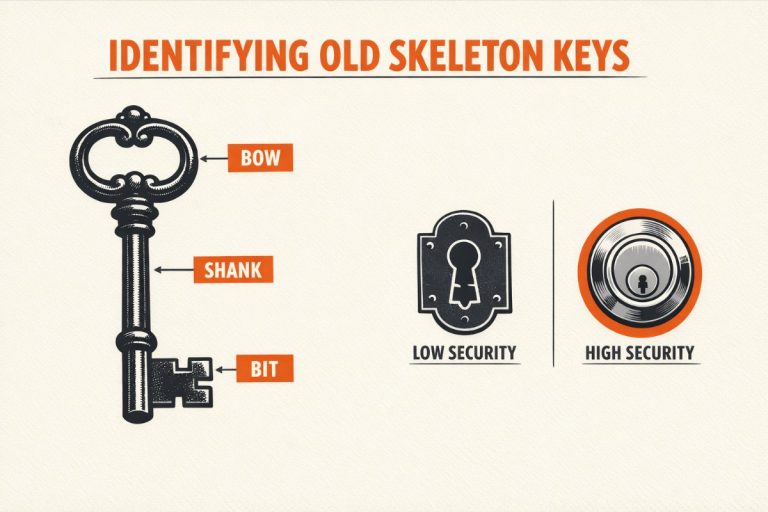
Infographic identifying the parts of an old skeleton key and comparing antique warded locks to modern deadbolt security

Found an Old Key? A Guide to Identifying Old Skeleton Keys

Identifying old skeleton keys comes down to reading three parts: the looped bow you hold, the long shank in the middle, and the flat bit at the end that turns the lock. Most antique keys found around the house once opened warded locks — a simple style standard in American homes before the 1940s. The shape of that bit is the clearest clue to what the key originally opened.
You clean out a drawer, an attic box, or a relative’s old desk, and there it sits — a heavy metal key with a fancy looped top that matches nothing in the house. It won’t slide into a single modern door, and you have no idea what it was meant to open. That puzzle is common, and it usually has a simple answer. Most of these mystery keys are antique skeleton keys built for lock styles no longer used on American doors. The good news is that you can learn to read one. In this guide, a professional locksmith walks through how to name the key in your hand, what it likely opened, and what it means for the safety of your home today. Keep reading to put a name to that old key.

What Is a Skeleton Key, Anyway?

A skeleton key is a key that has been filed down — or purpose-built — so the central shaft and a single thin bit can slip past the wards inside a warded lock. “Wards” are the small obstructions cast into a lock that block the wrong key from turning. A true skeleton key strips away everything except the part that actually moves the bolt, which lets one key open many similar warded locks. That same simplicity is why these locks faded out for exterior doors: the design that makes them charming also makes them easy to bypass.

For a deeper look at how the mechanism works, the overview of the warded lock on Wikipedia is a solid starting point.

How to Start Identifying Old Skeleton Keys

Identifying old skeleton keys comes down to four features. Examine each part of the key in good light before you guess.

The Bow, Shank, and Bit

The bow is the decorative loop you grip. Ornate, scrolled bows often point to furniture or cabinet keys, while plain rounded bows lean toward door locks. The shank is the long stem between the bow and the bit. A solid shank usually means a bit key made for a door; a hollow shank — one that would slide over a pin inside the lock — marks a barrel key, common on clocks and older cabinets. The bit is the flat blade at the end that does the work. The notches and grooves cut into that bit are the fingerprint of the lock it once matched.

Size and Material

Large iron or steel keys, roughly three to six inches long, were typically made for the interior and exterior doors of older houses. Smaller brass keys usually belonged to cabinets, desks, chests, or trunks. Hand-filed edges, uneven casting, and natural tarnish are signs of real age rather than a modern reproduction sold for decoration.

Markings and Maker Stamps

Turn the key over and check the bow and shank for stamped numbers, letters, or a maker’s name. Brand and pattern details documented in collector references for antique keys can help you trace an origin. A number stamped on the bow is usually a lock-pairing code, not a year.

Key Types Compared

Use this table to match the key in your hand to its most likely purpose and the level of protection it offered.

Key Type Typical Era What It Opened Protection Level Common Today?
Bit key (skeleton) Pre-1940s Interior & exterior warded door locks Low Rare
Barrel key 1800s–1900s Clocks, cabinets, older furniture Low Rare
Furniture / cabinet key 1800s–early 1900s Desks, chests, trunks Low Occasional
Lever-lock key 1800s–today Lever-tumbler locks & some safes Medium Some
Tubular key 1930s–today Bike locks, vending, some cabinets Medium Some
Pin-tumbler key (modern) 1900s–today Modern deadbolts & knob locks High Standard
Dimple key 1970s–today High-security cylinders High Growing
Smart / electronic credential 2000s–today Keypad & smart deadbolts High Growing

On a phone, swipe the table sideways to see every column.

Antique Keys and Your Home Safety Today

Here is the part many homeowners miss. If a warded lock and its skeleton key are still installed on an interior or exterior door, that opening is not protected against anyone holding a generic passkey. Antique skeleton keys are wonderful to collect and display — but they were never built to meet modern home safety standards.

A current exterior door should rely on a deadbolt with a pin-tumbler cylinder. Real deadbolt security comes from a one-inch throw bolt seated in a reinforced strike plate, paired on the inside with a thumbturn lock you can operate by hand without a key. If you’ve inherited or bought an older property that still runs on warded hardware, upgrading those locks is one of the more meaningful steps you can take for the household. A professional locksmith can rekey or swap the cylinders so every door answers to one modern key instead of a passkey almost anyone could own. Homeowners across Tempe and the wider East Valley ask us about exactly this when they move into an older home.

For hands-on help, our team handles lock change and lock rekey for houses throughout the area. If a door has been standing open to you and now sticks or jams, a home lockout visit can get you back in, and you can review every residential locksmith option on one page.

Pro Tip From the Field

After years of opening older homes around Tempe, here is the test I use right on the doorstep: insert the key and try to wiggle it gently side to side. If a key rocks loosely in the keyway yet still turns the bolt, you are almost certainly looking at a warded lock — and a skeleton key will likely operate it. On a modern pin-tumbler deadbolt, the key seats snugly with no play at all. That simple wiggle tells you, before you remove a single screw, if the door is protected by current hardware or by a mechanism from another era. When it is the latter, treat the lock as decorative history on the door — not as security.

Turn That Old Key Into a Smarter Lock

That antique key is a great find — frame it, hang it, or add it to a collection. Just don’t let an old warded lock stand guard over a door your family uses every day. If you’ve discovered original hardware in a Tempe-area home and want to know what is actually protecting the household, our professional locksmith team can assess your doors and recommend an upgrade that fits the house. Call CallOrange Locksmith Tempe at (480) 847-2635 to schedule a lock change or a full security audit. Learn more about us or contact our team to get started.

Frequently Asked Questions

How can I tell if my old key is a real skeleton key?

Look at the bit — the flat blade at the end. A genuine skeleton key has had most of its bit filed away, leaving a thin profile that slips past the wards inside the lock. Pair that with a looped bow, a long shank, and hand-filed edges, and you are almost certainly holding an antique skeleton key.

What kind of lock does a skeleton key open?

Skeleton keys are made for warded locks, a design built around fixed obstructions called wards. They were standard on American interior and exterior doors before the 1940s and still appear on antique furniture, cabinets, and older homes that were never upgraded.

Are antique skeleton keys worth anything?

Many are collectible, especially keys with ornate bows, maker stamps, or ties to a specific brand or era. Condition, rarity, and original hardware matter most to collectors. A decorative reproduction, by contrast, will usually show machine-cut edges and little tarnish.

Can one skeleton key open every door in my house?

If your doors still use warded locks, a single generic passkey can often operate several of them — which is exactly why warded hardware is no longer suitable for an entry door. Modern deadbolt security uses pin-tumbler cylinders that respond only to one cut key.

Should I keep using an antique lock on my front door?

For home safety, an antique warded lock is better treated as a display piece than as front-door security. A pin-tumbler deadbolt with a one-inch throw bolt and an interior thumbturn lock offers far stronger protection. A professional locksmith can upgrade the hardware while keeping the look of the door intact.

Can a locksmith make a key for an old lock?

Often, yes. A locksmith can cut a working key for many vintage warded and lever locks, or rekey the mechanism so a fresh key operates it. If the goal is real security on an active door, replacing the cylinder is usually the better route. Call CallOrange Locksmith Tempe at (480) 847-2635 to talk through the options.

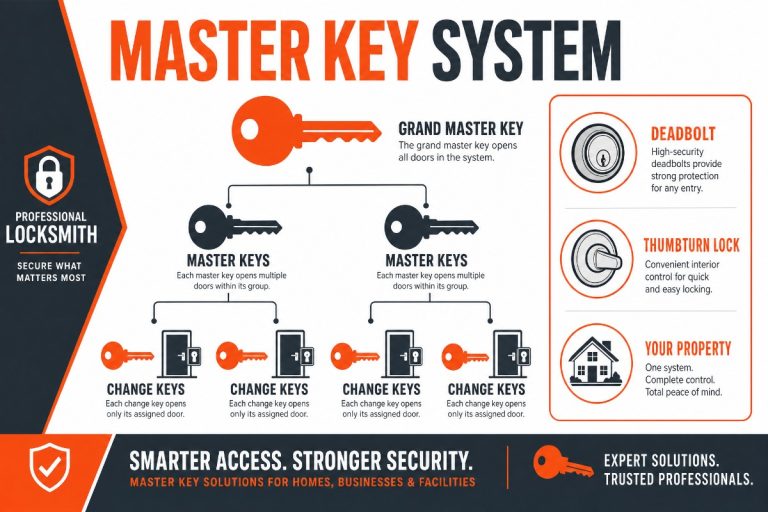
Master key system chart showing grand master, master, and change key hierarchy

Master Key Chart Management: How to Create and Manage a Professional System

Most property owners only notice the weak spot in their key setup at the wrong moment — an employee leaves with a key no one tracked, a tenant copies a spare without asking, or a heavy ring of keys turns a simple walk-through into a guessing game. The larger the building, the harder it becomes to know which key opens which door, and who is holding what.

A master key chart is the organized record that maps every lock, every key, and every access level in one system — so a single master key can open a defined group of doors while each individual key stays limited to its own. Built correctly, it replaces a confusing pile of keys with a clear, controllable hierarchy.

This guide walks through how a professional locksmith designs a master key chart, the steps to manage it as your property changes, and the security habits that keep the whole system protected. Read on to set yours up the right way.

What Is a Master Key Chart?

A master key chart is the written blueprint of a master key system. The system itself is a hierarchy of keys cut to specific patterns, where higher-level keys open more doors than lower-level ones. The chart records every lock, every keyway, and every key that fits — usually as coded entries rather than plain instructions.

Inside each lock cylinder sit small pin stacks. A standard lock has one shear line, so one key works. A master-keyed cylinder adds tiny extra pins called master wafers, which create a second working point. That is what lets two different keys — a change key and a master key — turn the same lock.

A typical hierarchy has three levels:

  • Change key (CK): opens one specific lock only.
  • Master key (MK): opens a defined group of locks, such as one floor or department.
  • Grand master key (GMK): opens every lock in the system.

For a homeowner, even a simple version helps — one key for the front deadbolt, the back door, and the garage instead of three. Our residential locksmith services cover this kind of setup for houses across the area.

How to Create a Professional Master Key Chart

Building a chart follows a clear sequence. A professional locksmith handles the technical pinning, but the planning starts with you.

  1. Inventory every door and lock. Note the location, the lock brand, the keyway, and the hardware type — knob, lever, or deadbolt.
  2. Define access groups. Decide who should reach which areas. Group doors by role: owner, manager, staff, maintenance.
  3. Assign the hierarchy. Map change keys to single doors, master keys to groups, and a grand master at the top.
  4. Code the system. Record entries as bitting codes and symbols, never as open instructions anyone could read and duplicate.
  5. Pin the cylinders. The locksmith sets the pins and master wafers in each cylinder to match the chart, then tests every key against every lock.

If you are moving into a new home or office, this is also the point to consider a lock rekey so old keys from previous occupants stop working.

Master Key System Types and Security Levels

Not every property needs a full grand master setup. The comparison below ranks common keying approaches by control and security, so you can match the system to the building.

Keying Approach How Access Works Best Fit Control Level Security Level
Individual keys (no master) One unique key per lock Single door, one user Low Basic
Keyed-alike One key opens several locks Home, small unit Low Basic
Master key Change keys plus one master Small office, rental Medium Moderate
Grand master Master keys grouped under a grand master Multi-area building High High
Grand master + restricted keyway Tiered keys with duplication-controlled blanks High-security site High Very high

Best Practices for Master Key Chart Management

Strong master key chart management is mostly about discipline after installation. A few habits keep the system both usable and secure:

  • Store the chart securely. Keep it in an encrypted file or a locked location, separate from the keys themselves.
  • Use codes, not cuts. A chart that lists actual key cuts in the open is a liability — anyone who sees it can have keys made.
  • Track issuance. Log who holds each key. When access needs change, you know exactly which keys to collect or void.
  • Re-pin after a loss. If a master key goes missing, re-pin the affected cylinders rather than ignoring the gap.
  • Review when access changes. Update the chart every time you add a door, change staff, or expand a group.

Pro Tip From the Field

After more than fifteen years pinning systems across homes and businesses, the lesson that saves clients the most trouble is simple: never let the working chart leave with the bitting cuts written on it. Keep a coded version for everyday use and store the actual cuts in a separate secured reference. When a master key disappears, the chart tells you precisely which cylinders that key touched — so you re-pin only those locks instead of the entire property. That one habit turns a building-wide scramble into a contained fix.

Pairing Your Chart With Strong Door Hardware

A master key chart is only as secure as the locks it controls. Deadbolt security matters most on exterior doors: a Grade 1 deadbolt with a hardened bolt resists kick-ins and prying far better than a basic knob lock. On the inside, a thumbturn lock lets people exit without a key, which supports both home safety and code compliance — but pair a thumbturn with a solid strike plate and long screws so the door holds under force.

For higher-risk doors, ask about high security locks with restricted keyways, which block unauthorized key duplication. Upgrading worn hardware through a lock change is often the missing step that makes a master key system genuinely secure. For residential standards, the Builders Hardware Manufacturers Association publishes the ANSI/BHMA grades that rank lock durability.

Set Up Your Master Key System With a Local Professional

A master key chart gives you controlled access and a single record you can actually manage — but the design and pinning are best handled by an experienced hand, ideally one affiliated with the Associated Locksmiths of America. The team at CallOrange Locksmith Tempe has built and maintained these systems for homes and businesses since 2008, serving Tempe, Mesa, Chandler, and Scottsdale.

To plan a new system or book a security audit of your current locks, call (480) 847-2635 or reach us through our contact page. You can also find us on the map at our Tempe location. Learn more about our work and let a professional help you lock down access the right way.

Frequently Asked Questions

Q What is a master key chart?

It is the written blueprint of a master key system. The chart records every lock, keyway, and key in coded form, showing which key opens which door and how the change keys, master keys, and grand master key relate to one another.

Q Can a master key system work on home deadbolts?

Yes. Most residential deadbolts and knob locks can be master keyed by a professional locksmith. A homeowner can run one master key for the front deadbolt, back door, and garage while keeping deadbolt security on each entry.

Q Is a master key less secure than individual keys?

A master-keyed cylinder adds extra pins, which slightly increases the number of keys that could turn it. Good chart management, restricted keyways, and Grade 1 hardware offset that and keep the system strong.

Q What happens if a master key is lost?

Re-pin the affected cylinders so the lost key no longer works. A well-kept chart shows exactly which locks that key touched, so you correct only those cylinders instead of the whole property.

Q Can existing locks be master keyed, or do I need new ones?

Many existing locks can be re-pinned to join a master key system, as long as the keyways match. Where hardware is worn or low-grade, a lock change is the better starting point.

Q How do restricted keyways improve master key security?

Restricted keyways use patented blanks that hardware stores cannot copy, so keys are duplicated only through an authorized locksmith. Pairing them with high security locks tightens control over who can make a key. Questions? Call (480) 847-2635.

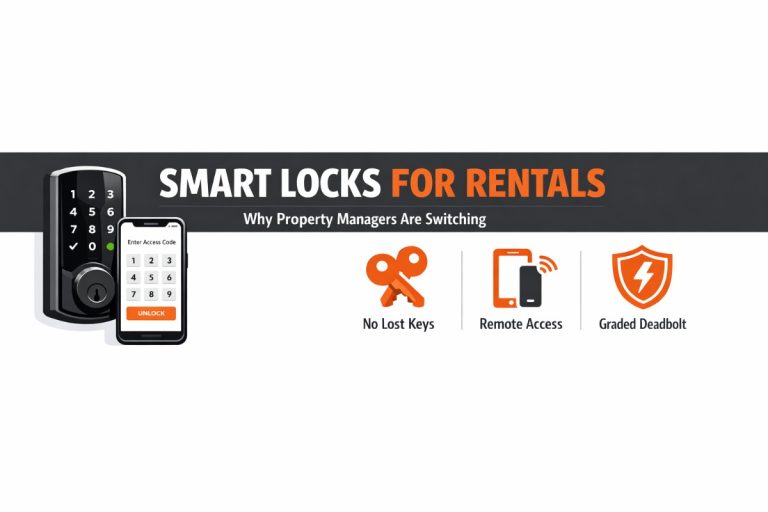
Infographic banner on smart locks for rentals in Tempe rental properties

Smart Locks for Rentals: Why Property Managers Are Switching to Smart Locks for Every Unit

Managing keys across a portfolio of rental units is one of the quiet headaches no property manager talks about until a tenant moves out without returning a single key. Smart locks for rentals solve the core problem of physical key control — they let you grant, change, and revoke access from a phone or dashboard, so a vacated unit is secured the moment a lease ends. Below, a professional locksmith perspective on why electronic access is replacing the brass key, what to look for in the hardware, and how to roll it out across every door without creating new risks. Keep reading to see the full comparison and the questions other managers ask most.
The Hidden Cost of Traditional Keys in Rental Properties

Every metal key cut for a unit is a copy you can no longer account for. Tenants make duplicates at the hardware store, hand spares to friends, and forget how many are floating around by the time they leave. For a property manager, that uncertainty is a liability. The standard fix has always been a lock rekey between tenants, which works well — but it still depends on coordinating a visit, tracking pins, and physically touching every door at turnover.

A residential locksmith sees the same pattern across Tempe, Mesa, and Chandler properties: lost keys, missing spares, and the scramble to secure a unit after a tenant disappears. Smart locks remove the variable that causes most of it — the key itself.

What “Smart Locks for Rentals” Actually Means

A smart lock is an electronic locking mechanism that opens with a code, a fob, a smartphone, or a combination of these instead of a cut key. For rentals, the value is in the management layer behind it: a dashboard where you issue a unique entry code per tenant, set it to start on move-in day, and expire it on move-out day. No handoff, no return, no rekey scramble.

Most quality models still pair their electronics with a mechanical deadbolt security bolt — the same hardened bolt that throws into the door frame on a traditional lock. That matters. The “smart” part handles access; the deadbolt handles force. A unit’s home safety depends on both working together, which is why hardware selection should never be left to the cheapest model on the shelf.

Key Terms, Explained Simply

  • Thumbturn lock: The interior knob a tenant turns by hand to lock or unlock the deadbolt from inside. On smart models, this stays manual, so a tenant is never trapped if the battery dies.
  • Deadbolt: The solid metal bolt that extends into the frame. Grade matters far more than the brand name on the front.
  • Auto-lock: A setting that re-engages the bolt after a set delay, so a unit is never left open behind a forgetful tenant.

Why Property Managers Are Making the Switch

The shift comes down to control. With electronic access, a manager handles turnover remotely, audits who entered and when, and stops chasing returned keys. Maintenance crews and cleaners get their own temporary codes that you switch off when the job ends. If a tenant reports a home lockout, you can often resolve it from the dashboard instead of dispatching anyone.

There is also a tenant-experience angle. Renters increasingly expect keyless entry the way they expect a working dishwasher. Offering it across every unit positions a property as modern without a major renovation. Pairing the rollout with a clean lock change on older doors brings the whole entry system up to a consistent standard.

Smart Lock Tiers for Rental Units: A Comparison

Not every smart lock belongs in a rental. The table below compares the main categories a property manager evaluates, focused on security and management features.

Lock Type Access Method Deadbolt Grade Best For Management Control
Keypad deadbolt PIN code ANSI Grade 2–3 Single units, light turnover Manual code reset
App-connected smart lock Phone + code ANSI Grade 1–2 Multi-unit portfolios Remote, per-tenant codes
Smart lock + hub Phone, code, remote ANSI Grade 1 High-turnover buildings Full dashboard + audit log
Mechanical + thumbturn (legacy) Cut key ANSI Grade 1–3 Owner units, low turnover Physical rekey only
Commercial electronic strike Fob, code, mobile Grade 1 / fire-rated Shared entries, lobbies Centralized, scheduled

Grades reference the ANSI/BHMA durability standard. A professional locksmith can match the right tier to each door.

The right tier depends on how often a unit turns over and how many people need access. A duplex owner has different needs than a manager running fifty doors. A professional locksmith can match the grade and management layer to the property rather than the marketing.

Pro Tip: The Mistake That Undoes a Good Smart Lock

After installing smart hardware on hundreds of doors across the East Valley, the most common failure is not the electronics — it is the door itself. A premium smart deadbolt mounted on a worn strike plate with short screws will pull loose under a shoulder strike, no matter how advanced the lock. Before any smart lock goes on, reinforce the strike plate with three-inch screws that bite into the wall stud, and confirm the deadbolt fully extends without binding. The electronics protect against unauthorized access; the strike plate and frame protect against force. Get both right, or the upgrade is only half done.

It is also worth standardizing one brand and one battery type across a portfolio. Mixed hardware means mixed dashboards, mismatched fobs, and maintenance crews carrying four chargers. Consistency is what makes a fleet of smart locks manageable instead of a second job.

Rolling It Out Across Every Unit

A full conversion does not have to happen overnight. Many managers start with units at turnover, installing smart hardware as each lease ends, and standardize the rest within a season. A locksmith handling the install can verify door prep, confirm deadbolt grade, and set up the management dashboard so codes are ready before the next tenant signs. For older buildings, combining the smart upgrade with high-security cylinder hardware closes the gap on doors that were never properly secured in the first place. You can review the full range of residential and commercial services to plan a phased rollout.

External standards help here. Reviewing the ANSI/BHMA grading system before buying tells you whether a lock’s deadbolt is rated for residential or commercial duty, and the Consumer Product Safety Commission publishes guidance on door and entry hardware that property managers can lean on when setting a standard.

Secure Every Door With Professional Installation

Smart locks give property managers something brass keys never could: real control over who enters a unit and when. But the hardware only performs as well as the installation behind it. If you manage rentals across Tempe, Mesa, Scottsdale, or Phoenix and want every unit on a consistent, secure access system, talk to a professional locksmith before you buy. CallOrange Locksmith Tempe can audit your doors, recommend the right grade for each entry, and handle the full install. Call (480) 847-2635 or reach out through our contact page to schedule a security audit for your property.

Smart Locks for Rentals — Frequently Asked Questions

Are smart locks secure enough for rental units?

A quality smart lock pairs electronic access with a graded mechanical deadbolt, so it resists force the same way a traditional lock does. Security depends on the deadbolt grade and the door prep behind it, not just the electronics. A professional locksmith can confirm the unit is rated for the duty you need.

What happens to a smart lock if the batteries die?

Most rental-grade smart locks keep a manual thumbturn on the inside, so a tenant can always exit. Many also include a physical key override or external contacts to power the keypad. Choosing a model with a low-battery alert helps a property manager swap cells before access is interrupted.

Can I reuse the same smart lock for a new tenant?

Yes. Instead of a physical rekey, you delete the previous tenant’s code and issue a new one from the dashboard. This is the main advantage of smart locks for rentals — turnover access is handled without touching the hardware or cutting a new key.

Do I need a professional locksmith to install them?

A locksmith verifies the door prep, reinforces the strike plate, and confirms the deadbolt extends fully before the electronics go on. Across a multi-unit portfolio, professional installation also keeps every door on a consistent standard and dashboard, which is what makes the system manageable.

What deadbolt grade should a rental smart lock have?

For most rental doors, an ANSI/BHMA Grade 1 or Grade 2 deadbolt is the standard to aim for. Grade 1 is built to commercial duty, while Grade 2 suits typical residential entries. The grade tells you how the bolt holds up under repeated use and force.

Should I switch every unit at once or phase it in?

Many property managers convert units at turnover and standardize the rest over a season. Phasing it in spreads out the work while still bringing the whole property onto one access system. A locksmith can plan the rollout so codes are ready before each new tenant signs.

Sticky door lock fix

How to Fix a Sticky Door Lock in Minutes Without Calling a Pro

You walk up to your front door after a long day, slide your key in, and… nothing. The key won’t turn, the deadbolt feels gritty, and the thumbturn fights back like it’s personal. A sticky door lock is one of the most common household frustrations homeowners in Tempe and across the East Valley deal with every single year. The good news? Most cases of a stiff or stuck lock can be solved in under ten minutes with tools you already own — no service call required. Keep reading and I’ll walk you through exactly how I diagnose and fix sticky locks in the field, what products to use (and which ones to avoid), and when the problem points to something bigger.

Why Door Locks Get Sticky in the First Place

Before we jump into the sticky door lock fix, it helps to understand what’s happening inside the cylinder. A standard pin tumbler lock has five or six tiny spring-loaded pins that rise to a precise height when the correct key is inserted. Over time, three things go wrong:

  1. Dust, lint, and grit build up around the pins
  2. Old lubricant turns into sticky residue
  3. The key itself wears down and stops aligning the pins cleanly

Add Arizona’s dry heat and fine desert dust to the equation, and even a brand-new deadbolt can start dragging within a year or two. The result is a lock that catches halfway, requires jiggling, or refuses to turn at all. If your lock has reached the point where no amount of cleaning helps, our residential locksmith team can diagnose it on-site.

The 3-Step Sticky Door Lock Fix Anyone Can Do

Here is the exact sequence I use when a customer calls me about a stiff lock. Try this before anything else.

Step 1 — Clean the Keyway

Grab a can of compressed air (the same kind you use for keyboards) and give the keyway three short bursts. You’ll be surprised how much pocket lint, dust, and old grease comes flying out. If you don’t have compressed air, a thin plastic coffee stirrer works to scrape debris loose.

Step 2 — Apply the Right Lubricant

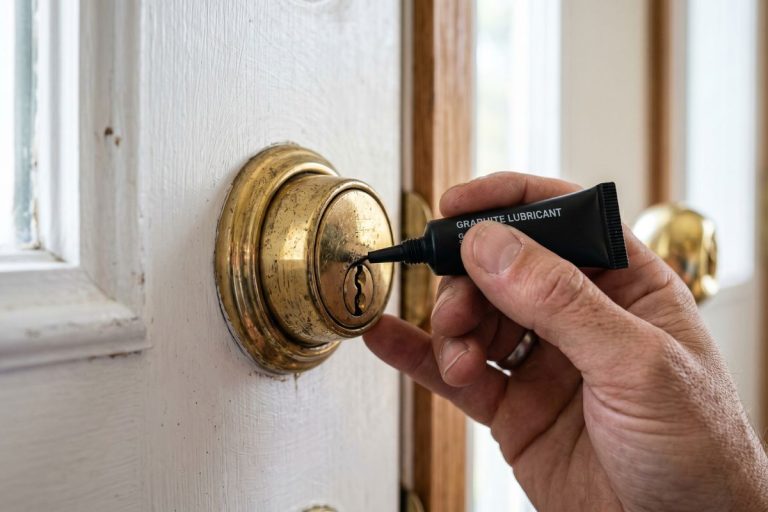
This is where most homeowners go wrong. Do not use WD-40, 3-in-1 oil, or any wet spray lubricant on a pin tumbler lock. Oil-based products attract dust and turn into sludge inside the cylinder within weeks, making the problem worse. Use one of these instead:

  • Powdered graphite (best for older locks)
  • Dry Teflon (PTFE) spray (best for modern deadbolts and smart locks)
  • Silicone spray (good for the latch and strike plate)

Insert the applicator straw into the keyway and give it one short squeeze. Less is more.

Step 3 — Cycle the Key

Insert your key, turn it gently left and right ten to fifteen times. This works the lubricant down into the pins. Wipe any excess off the key with a clean cloth so it doesn’t stain your door.

That’s it. In most cases, a sticky lock turns smooth again at this point. If yours doesn’t, it may be time for a lock change rather than another round of lubricant.

Sticky Lock Lubricant Comparison

Lubricant Type Recommended Use Lasts Risk to Lock
Powdered Graphite Older pin tumbler locks, traditional deadbolts 12–18 months None
Dry Teflon (PTFE) Spray Modern deadbolts, smart locks, electronic locks 8–12 months None
Silicone Spray Latch, hinges, strike plate (NOT keyway) 6 months Low
WD-40 ❌ Not recommended Days High — gums up pins
3-in-1 Household Oil ❌ Not recommended Weeks High — attracts dust

When the Problem Isn’t the Lock

Sometimes the lock cylinder is fine — the issue is the door itself. Arizona homes shift with temperature swings, and a door that’s gone slightly out of square will bind against the strike plate. Signs that point to a misaligned door rather than a sticky cylinder:

  • The deadbolt extends fine when the door is open but binds when closed
  • You see scrape marks on the strike plate
  • The thumbturn moves freely from the inside but the key fights from outside

In these cases, loosening the strike plate screws and shifting it 1/16 of an inch in the direction the bolt needs to travel usually solves it. Homeowners across Mesa, Chandler, Scottsdale, and Phoenix deal with this every season as the desert heat expands and contracts wood frames.

Pro Tip From the Field

After 10+ years of pulling apart locks across Tempe, Mesa, and Chandler, I can tell you the single biggest cause of premature lock failure isn’t wear — it’s using a copy of a copy of a copy of the original key. Each duplication loses a tiny amount of precision. By the third generation, the key is cutting the pins at slightly wrong heights and grinding them down every time you use it. If your lock got sticky after you started using a duplicate, throw the duplicate away and cut a fresh one from the original or have a lock rekey done so you start fresh.

When to Stop and Call a Locksmith

The DIY fix above handles roughly 80% of sticky lock cases. Stop and bring in a professional if:

  • The key broke off inside the cylinder
  • The lock turns but the deadbolt won’t extend or retract
  • You hear grinding metal sounds
  • The cylinder spins freely without engaging the bolt
  • The lock is on a high-security or smart deadbolt under warranty
  • You’re locked out and can’t access the lock at all — see our home lockout service

Forcing a damaged lock can crack the cylinder housing, snap pins, or shear the cam — turning a $0 fix into a full lock replacement. Browse all of our locksmith services to see what we cover across the Tempe metro.

Frequently Asked Questions

Why is my door lock suddenly hard to turn?

The most common cause is dust and old lubricant buildup inside the cylinder. Arizona’s dry climate pulls fine particles into the keyway, where they mix with any leftover oil and form a sticky residue around the pins. A quick cleaning with compressed air and a dry graphite or Teflon lubricant usually restores smooth operation.

Can I use WD-40 to fix a sticky door lock?

No. WD-40 is a petroleum-based solvent that attracts dust and turns into sludge inside a pin tumbler lock within days. It will give you temporary relief but make the problem significantly worse over the following weeks. Always use powdered graphite or a dry Teflon (PTFE) spray on lock cylinders.

What’s the difference between a sticky lock and a misaligned door?

If the deadbolt extends and retracts smoothly when the door is open but binds when the door is closed, the issue is door alignment, not the lock. You’ll often see scrape marks on the strike plate. Loosening the strike plate screws and shifting it slightly usually corrects it.

How often should I lubricate my deadbolt?

Once a year is usually enough for most homes. If you live near a construction zone, on a dirt road, or in a high-traffic household, every six months is a better schedule. Use a dry lubricant only — never wet oil.

When should I replace a sticky lock instead of fixing it?

Replace the lock if the cylinder spins without engaging the bolt, the key has broken inside, you hear grinding metal sounds, or the lock has been forced repeatedly over months. At that point the internal components are likely worn beyond repair. A professional lock change will install a new deadbolt and rekey it to match your existing keys.

Does fixing a sticky lock improve my home security?

Yes. A lock that’s been fought with for months develops worn pins and weaker springs, which reduces pick resistance and can leave the deadbolt sitting in an incomplete locked position. Restoring smooth operation — or upgrading to a higher-grade deadbolt — directly improves your home safety.

Keep Your Home Security Strong

A smooth-turning lock isn’t just about convenience — it’s a core piece of your deadbolt security and overall home safety. A lock that’s been forced or fought with for months has worn pins, weakened springs, and reduced pick resistance. If your thumbturn lock has been giving you trouble for more than a few weeks, or you’ve never had a security audit on your front and back doors, it’s worth having a professional locksmith take a look.

Contact CallOrange Locksmith Tempe at (480) 847-2635 to schedule a home security assessment or a same-visit deadbolt installation. Get help now.