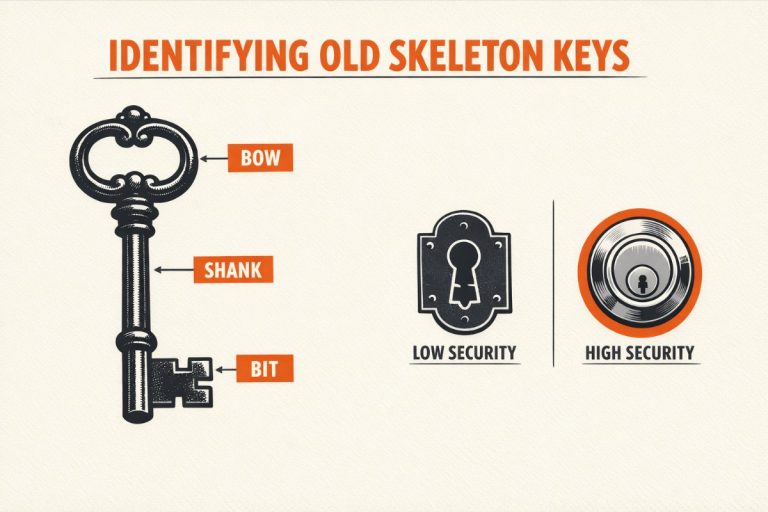
Infographic identifying the parts of an old skeleton key and comparing antique warded locks to modern deadbolt security

Found an Old Key? A Guide to Identifying Old Skeleton Keys

Identifying old skeleton keys comes down to reading three parts: the looped bow you hold, the long shank in the middle, and the flat bit at the end that turns the lock. Most antique keys found around the house once opened warded locks — a simple style standard in American homes before the 1940s. The shape of that bit is the clearest clue to what the key originally opened.
You clean out a drawer, an attic box, or a relative’s old desk, and there it sits — a heavy metal key with a fancy looped top that matches nothing in the house. It won’t slide into a single modern door, and you have no idea what it was meant to open. That puzzle is common, and it usually has a simple answer. Most of these mystery keys are antique skeleton keys built for lock styles no longer used on American doors. The good news is that you can learn to read one. In this guide, a professional locksmith walks through how to name the key in your hand, what it likely opened, and what it means for the safety of your home today. Keep reading to put a name to that old key.

What Is a Skeleton Key, Anyway?

A skeleton key is a key that has been filed down — or purpose-built — so the central shaft and a single thin bit can slip past the wards inside a warded lock. “Wards” are the small obstructions cast into a lock that block the wrong key from turning. A true skeleton key strips away everything except the part that actually moves the bolt, which lets one key open many similar warded locks. That same simplicity is why these locks faded out for exterior doors: the design that makes them charming also makes them easy to bypass.

For a deeper look at how the mechanism works, the overview of the warded lock on Wikipedia is a solid starting point.

How to Start Identifying Old Skeleton Keys

Identifying old skeleton keys comes down to four features. Examine each part of the key in good light before you guess.

The Bow, Shank, and Bit

The bow is the decorative loop you grip. Ornate, scrolled bows often point to furniture or cabinet keys, while plain rounded bows lean toward door locks. The shank is the long stem between the bow and the bit. A solid shank usually means a bit key made for a door; a hollow shank — one that would slide over a pin inside the lock — marks a barrel key, common on clocks and older cabinets. The bit is the flat blade at the end that does the work. The notches and grooves cut into that bit are the fingerprint of the lock it once matched.

Size and Material

Large iron or steel keys, roughly three to six inches long, were typically made for the interior and exterior doors of older houses. Smaller brass keys usually belonged to cabinets, desks, chests, or trunks. Hand-filed edges, uneven casting, and natural tarnish are signs of real age rather than a modern reproduction sold for decoration.

Markings and Maker Stamps

Turn the key over and check the bow and shank for stamped numbers, letters, or a maker’s name. Brand and pattern details documented in collector references for antique keys can help you trace an origin. A number stamped on the bow is usually a lock-pairing code, not a year.

Key Types Compared

Use this table to match the key in your hand to its most likely purpose and the level of protection it offered.

Key Type Typical Era What It Opened Protection Level Common Today?
Bit key (skeleton) Pre-1940s Interior & exterior warded door locks Low Rare
Barrel key 1800s–1900s Clocks, cabinets, older furniture Low Rare
Furniture / cabinet key 1800s–early 1900s Desks, chests, trunks Low Occasional
Lever-lock key 1800s–today Lever-tumbler locks & some safes Medium Some
Tubular key 1930s–today Bike locks, vending, some cabinets Medium Some
Pin-tumbler key (modern) 1900s–today Modern deadbolts & knob locks High Standard
Dimple key 1970s–today High-security cylinders High Growing
Smart / electronic credential 2000s–today Keypad & smart deadbolts High Growing

On a phone, swipe the table sideways to see every column.

Antique Keys and Your Home Safety Today

Here is the part many homeowners miss. If a warded lock and its skeleton key are still installed on an interior or exterior door, that opening is not protected against anyone holding a generic passkey. Antique skeleton keys are wonderful to collect and display — but they were never built to meet modern home safety standards.

A current exterior door should rely on a deadbolt with a pin-tumbler cylinder. Real deadbolt security comes from a one-inch throw bolt seated in a reinforced strike plate, paired on the inside with a thumbturn lock you can operate by hand without a key. If you’ve inherited or bought an older property that still runs on warded hardware, upgrading those locks is one of the more meaningful steps you can take for the household. A professional locksmith can rekey or swap the cylinders so every door answers to one modern key instead of a passkey almost anyone could own. Homeowners across Tempe and the wider East Valley ask us about exactly this when they move into an older home.

For hands-on help, our team handles lock change and lock rekey for houses throughout the area. If a door has been standing open to you and now sticks or jams, a home lockout visit can get you back in, and you can review every residential locksmith option on one page.

Pro Tip From the Field

After years of opening older homes around Tempe, here is the test I use right on the doorstep: insert the key and try to wiggle it gently side to side. If a key rocks loosely in the keyway yet still turns the bolt, you are almost certainly looking at a warded lock — and a skeleton key will likely operate it. On a modern pin-tumbler deadbolt, the key seats snugly with no play at all. That simple wiggle tells you, before you remove a single screw, if the door is protected by current hardware or by a mechanism from another era. When it is the latter, treat the lock as decorative history on the door — not as security.

Turn That Old Key Into a Smarter Lock

That antique key is a great find — frame it, hang it, or add it to a collection. Just don’t let an old warded lock stand guard over a door your family uses every day. If you’ve discovered original hardware in a Tempe-area home and want to know what is actually protecting the household, our professional locksmith team can assess your doors and recommend an upgrade that fits the house. Call CallOrange Locksmith Tempe at (480) 847-2635 to schedule a lock change or a full security audit. Learn more about us or contact our team to get started.

Frequently Asked Questions

How can I tell if my old key is a real skeleton key?

Look at the bit — the flat blade at the end. A genuine skeleton key has had most of its bit filed away, leaving a thin profile that slips past the wards inside the lock. Pair that with a looped bow, a long shank, and hand-filed edges, and you are almost certainly holding an antique skeleton key.

What kind of lock does a skeleton key open?

Skeleton keys are made for warded locks, a design built around fixed obstructions called wards. They were standard on American interior and exterior doors before the 1940s and still appear on antique furniture, cabinets, and older homes that were never upgraded.

Are antique skeleton keys worth anything?

Many are collectible, especially keys with ornate bows, maker stamps, or ties to a specific brand or era. Condition, rarity, and original hardware matter most to collectors. A decorative reproduction, by contrast, will usually show machine-cut edges and little tarnish.

Can one skeleton key open every door in my house?

If your doors still use warded locks, a single generic passkey can often operate several of them — which is exactly why warded hardware is no longer suitable for an entry door. Modern deadbolt security uses pin-tumbler cylinders that respond only to one cut key.

Should I keep using an antique lock on my front door?

For home safety, an antique warded lock is better treated as a display piece than as front-door security. A pin-tumbler deadbolt with a one-inch throw bolt and an interior thumbturn lock offers far stronger protection. A professional locksmith can upgrade the hardware while keeping the look of the door intact.

Can a locksmith make a key for an old lock?

Often, yes. A locksmith can cut a working key for many vintage warded and lever locks, or rekey the mechanism so a fresh key operates it. If the goal is real security on an active door, replacing the cylinder is usually the better route. Call CallOrange Locksmith Tempe at (480) 847-2635 to talk through the options.

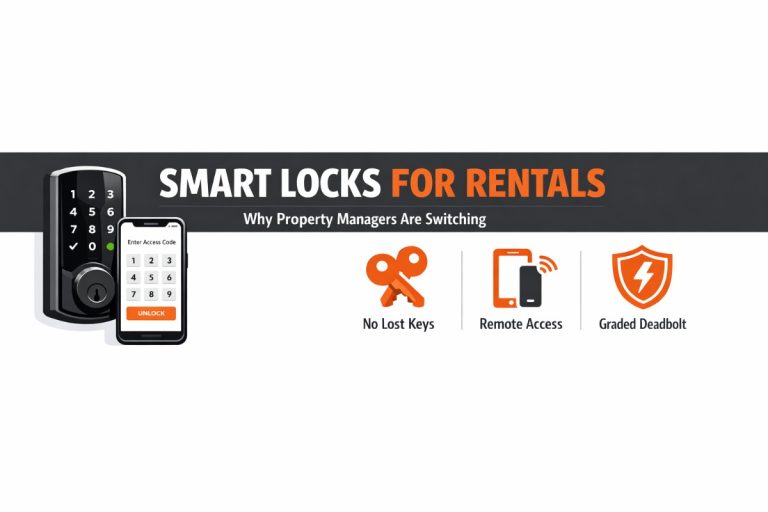
Infographic banner on smart locks for rentals in Tempe rental properties

Smart Locks for Rentals: Why Property Managers Are Switching to Smart Locks for Every Unit

Managing keys across a portfolio of rental units is one of the quiet headaches no property manager talks about until a tenant moves out without returning a single key. Smart locks for rentals solve the core problem of physical key control — they let you grant, change, and revoke access from a phone or dashboard, so a vacated unit is secured the moment a lease ends. Below, a professional locksmith perspective on why electronic access is replacing the brass key, what to look for in the hardware, and how to roll it out across every door without creating new risks. Keep reading to see the full comparison and the questions other managers ask most.
The Hidden Cost of Traditional Keys in Rental Properties

Every metal key cut for a unit is a copy you can no longer account for. Tenants make duplicates at the hardware store, hand spares to friends, and forget how many are floating around by the time they leave. For a property manager, that uncertainty is a liability. The standard fix has always been a lock rekey between tenants, which works well — but it still depends on coordinating a visit, tracking pins, and physically touching every door at turnover.

A residential locksmith sees the same pattern across Tempe, Mesa, and Chandler properties: lost keys, missing spares, and the scramble to secure a unit after a tenant disappears. Smart locks remove the variable that causes most of it — the key itself.

What “Smart Locks for Rentals” Actually Means

A smart lock is an electronic locking mechanism that opens with a code, a fob, a smartphone, or a combination of these instead of a cut key. For rentals, the value is in the management layer behind it: a dashboard where you issue a unique entry code per tenant, set it to start on move-in day, and expire it on move-out day. No handoff, no return, no rekey scramble.

Most quality models still pair their electronics with a mechanical deadbolt security bolt — the same hardened bolt that throws into the door frame on a traditional lock. That matters. The “smart” part handles access; the deadbolt handles force. A unit’s home safety depends on both working together, which is why hardware selection should never be left to the cheapest model on the shelf.

Key Terms, Explained Simply

  • Thumbturn lock: The interior knob a tenant turns by hand to lock or unlock the deadbolt from inside. On smart models, this stays manual, so a tenant is never trapped if the battery dies.
  • Deadbolt: The solid metal bolt that extends into the frame. Grade matters far more than the brand name on the front.
  • Auto-lock: A setting that re-engages the bolt after a set delay, so a unit is never left open behind a forgetful tenant.

Why Property Managers Are Making the Switch

The shift comes down to control. With electronic access, a manager handles turnover remotely, audits who entered and when, and stops chasing returned keys. Maintenance crews and cleaners get their own temporary codes that you switch off when the job ends. If a tenant reports a home lockout, you can often resolve it from the dashboard instead of dispatching anyone.

There is also a tenant-experience angle. Renters increasingly expect keyless entry the way they expect a working dishwasher. Offering it across every unit positions a property as modern without a major renovation. Pairing the rollout with a clean lock change on older doors brings the whole entry system up to a consistent standard.

Smart Lock Tiers for Rental Units: A Comparison

Not every smart lock belongs in a rental. The table below compares the main categories a property manager evaluates, focused on security and management features.

Lock Type Access Method Deadbolt Grade Best For Management Control
Keypad deadbolt PIN code ANSI Grade 2–3 Single units, light turnover Manual code reset
App-connected smart lock Phone + code ANSI Grade 1–2 Multi-unit portfolios Remote, per-tenant codes
Smart lock + hub Phone, code, remote ANSI Grade 1 High-turnover buildings Full dashboard + audit log
Mechanical + thumbturn (legacy) Cut key ANSI Grade 1–3 Owner units, low turnover Physical rekey only
Commercial electronic strike Fob, code, mobile Grade 1 / fire-rated Shared entries, lobbies Centralized, scheduled

Grades reference the ANSI/BHMA durability standard. A professional locksmith can match the right tier to each door.

The right tier depends on how often a unit turns over and how many people need access. A duplex owner has different needs than a manager running fifty doors. A professional locksmith can match the grade and management layer to the property rather than the marketing.

Pro Tip: The Mistake That Undoes a Good Smart Lock

After installing smart hardware on hundreds of doors across the East Valley, the most common failure is not the electronics — it is the door itself. A premium smart deadbolt mounted on a worn strike plate with short screws will pull loose under a shoulder strike, no matter how advanced the lock. Before any smart lock goes on, reinforce the strike plate with three-inch screws that bite into the wall stud, and confirm the deadbolt fully extends without binding. The electronics protect against unauthorized access; the strike plate and frame protect against force. Get both right, or the upgrade is only half done.

It is also worth standardizing one brand and one battery type across a portfolio. Mixed hardware means mixed dashboards, mismatched fobs, and maintenance crews carrying four chargers. Consistency is what makes a fleet of smart locks manageable instead of a second job.

Rolling It Out Across Every Unit

A full conversion does not have to happen overnight. Many managers start with units at turnover, installing smart hardware as each lease ends, and standardize the rest within a season. A locksmith handling the install can verify door prep, confirm deadbolt grade, and set up the management dashboard so codes are ready before the next tenant signs. For older buildings, combining the smart upgrade with high-security cylinder hardware closes the gap on doors that were never properly secured in the first place. You can review the full range of residential and commercial services to plan a phased rollout.

External standards help here. Reviewing the ANSI/BHMA grading system before buying tells you whether a lock’s deadbolt is rated for residential or commercial duty, and the Consumer Product Safety Commission publishes guidance on door and entry hardware that property managers can lean on when setting a standard.

Secure Every Door With Professional Installation

Smart locks give property managers something brass keys never could: real control over who enters a unit and when. But the hardware only performs as well as the installation behind it. If you manage rentals across Tempe, Mesa, Scottsdale, or Phoenix and want every unit on a consistent, secure access system, talk to a professional locksmith before you buy. CallOrange Locksmith Tempe can audit your doors, recommend the right grade for each entry, and handle the full install. Call (480) 847-2635 or reach out through our contact page to schedule a security audit for your property.

Smart Locks for Rentals — Frequently Asked Questions

Are smart locks secure enough for rental units?

A quality smart lock pairs electronic access with a graded mechanical deadbolt, so it resists force the same way a traditional lock does. Security depends on the deadbolt grade and the door prep behind it, not just the electronics. A professional locksmith can confirm the unit is rated for the duty you need.

What happens to a smart lock if the batteries die?

Most rental-grade smart locks keep a manual thumbturn on the inside, so a tenant can always exit. Many also include a physical key override or external contacts to power the keypad. Choosing a model with a low-battery alert helps a property manager swap cells before access is interrupted.

Can I reuse the same smart lock for a new tenant?

Yes. Instead of a physical rekey, you delete the previous tenant’s code and issue a new one from the dashboard. This is the main advantage of smart locks for rentals — turnover access is handled without touching the hardware or cutting a new key.

Do I need a professional locksmith to install them?

A locksmith verifies the door prep, reinforces the strike plate, and confirms the deadbolt extends fully before the electronics go on. Across a multi-unit portfolio, professional installation also keeps every door on a consistent standard and dashboard, which is what makes the system manageable.

What deadbolt grade should a rental smart lock have?

For most rental doors, an ANSI/BHMA Grade 1 or Grade 2 deadbolt is the standard to aim for. Grade 1 is built to commercial duty, while Grade 2 suits typical residential entries. The grade tells you how the bolt holds up under repeated use and force.

Should I switch every unit at once or phase it in?

Many property managers convert units at turnover and standardize the rest over a season. Phasing it in spreads out the work while still bringing the whole property onto one access system. A locksmith can plan the rollout so codes are ready before each new tenant signs.

Sticky door lock fix

How to Fix a Sticky Door Lock in Minutes Without Calling a Pro

You walk up to your front door after a long day, slide your key in, and… nothing. The key won’t turn, the deadbolt feels gritty, and the thumbturn fights back like it’s personal. A sticky door lock is one of the most common household frustrations homeowners in Tempe and across the East Valley deal with every single year. The good news? Most cases of a stiff or stuck lock can be solved in under ten minutes with tools you already own — no service call required. Keep reading and I’ll walk you through exactly how I diagnose and fix sticky locks in the field, what products to use (and which ones to avoid), and when the problem points to something bigger.
Why Door Locks Get Sticky in the First Place

Before we jump into the sticky door lock fix, it helps to understand what’s happening inside the cylinder. A standard pin tumbler lock has five or six tiny spring-loaded pins that rise to a precise height when the correct key is inserted. Over time, three things go wrong:

  1. Dust, lint, and grit build up around the pins
  2. Old lubricant turns into sticky residue
  3. The key itself wears down and stops aligning the pins cleanly

Add Arizona’s dry heat and fine desert dust to the equation, and even a brand-new deadbolt can start dragging within a year or two. The result is a lock that catches halfway, requires jiggling, or refuses to turn at all. If your lock has reached the point where no amount of cleaning helps, our residential locksmith team can diagnose it on-site.

The 3-Step Sticky Door Lock Fix Anyone Can Do

Here is the exact sequence I use when a customer calls me about a stiff lock. Try this before anything else.

Step 1 — Clean the Keyway

Grab a can of compressed air (the same kind you use for keyboards) and give the keyway three short bursts. You’ll be surprised how much pocket lint, dust, and old grease comes flying out. If you don’t have compressed air, a thin plastic coffee stirrer works to scrape debris loose.

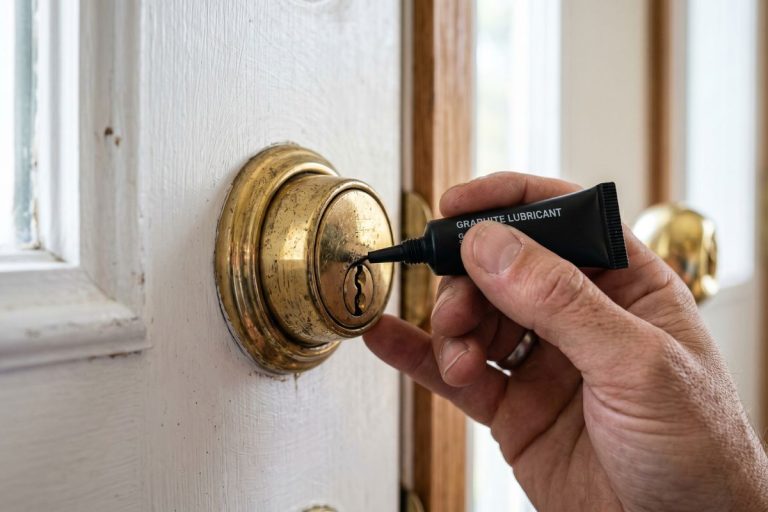
Step 2 — Apply the Right Lubricant

This is where most homeowners go wrong. Do not use WD-40, 3-in-1 oil, or any wet spray lubricant on a pin tumbler lock. Oil-based products attract dust and turn into sludge inside the cylinder within weeks, making the problem worse. Use one of these instead:

  • Powdered graphite (best for older locks)
  • Dry Teflon (PTFE) spray (best for modern deadbolts and smart locks)
  • Silicone spray (good for the latch and strike plate)

Insert the applicator straw into the keyway and give it one short squeeze. Less is more.

Step 3 — Cycle the Key

Insert your key, turn it gently left and right ten to fifteen times. This works the lubricant down into the pins. Wipe any excess off the key with a clean cloth so it doesn’t stain your door.

That’s it. In most cases, a sticky lock turns smooth again at this point. If yours doesn’t, it may be time for a lock change rather than another round of lubricant.

Sticky Lock Lubricant Comparison

Lubricant Type Recommended Use Lasts Risk to Lock
Powdered Graphite Older pin tumbler locks, traditional deadbolts 12–18 months None
Dry Teflon (PTFE) Spray Modern deadbolts, smart locks, electronic locks 8–12 months None
Silicone Spray Latch, hinges, strike plate (NOT keyway) 6 months Low
WD-40 ❌ Not recommended Days High — gums up pins
3-in-1 Household Oil ❌ Not recommended Weeks High — attracts dust

When the Problem Isn’t the Lock

Sometimes the lock cylinder is fine — the issue is the door itself. Arizona homes shift with temperature swings, and a door that’s gone slightly out of square will bind against the strike plate. Signs that point to a misaligned door rather than a sticky cylinder:

  • The deadbolt extends fine when the door is open but binds when closed
  • You see scrape marks on the strike plate
  • The thumbturn moves freely from the inside but the key fights from outside

In these cases, loosening the strike plate screws and shifting it 1/16 of an inch in the direction the bolt needs to travel usually solves it. Homeowners across Mesa, Chandler, Scottsdale, and Phoenix deal with this every season as the desert heat expands and contracts wood frames.

Pro Tip From the Field

After 10+ years of pulling apart locks across Tempe, Mesa, and Chandler, I can tell you the single biggest cause of premature lock failure isn’t wear — it’s using a copy of a copy of a copy of the original key. Each duplication loses a tiny amount of precision. By the third generation, the key is cutting the pins at slightly wrong heights and grinding them down every time you use it. If your lock got sticky after you started using a duplicate, throw the duplicate away and cut a fresh one from the original or have a lock rekey done so you start fresh.

When to Stop and Call a Locksmith

The DIY fix above handles roughly 80% of sticky lock cases. Stop and bring in a professional if:

  • The key broke off inside the cylinder
  • The lock turns but the deadbolt won’t extend or retract
  • You hear grinding metal sounds
  • The cylinder spins freely without engaging the bolt
  • The lock is on a high-security or smart deadbolt under warranty
  • You’re locked out and can’t access the lock at all — see our home lockout service

Forcing a damaged lock can crack the cylinder housing, snap pins, or shear the cam — turning a $0 fix into a full lock replacement. Browse all of our locksmith services to see what we cover across the Tempe metro.

Frequently Asked Questions

Why is my door lock suddenly hard to turn?

The most common cause is dust and old lubricant buildup inside the cylinder. Arizona’s dry climate pulls fine particles into the keyway, where they mix with any leftover oil and form a sticky residue around the pins. A quick cleaning with compressed air and a dry graphite or Teflon lubricant usually restores smooth operation.

Can I use WD-40 to fix a sticky door lock?

No. WD-40 is a petroleum-based solvent that attracts dust and turns into sludge inside a pin tumbler lock within days. It will give you temporary relief but make the problem significantly worse over the following weeks. Always use powdered graphite or a dry Teflon (PTFE) spray on lock cylinders.

What’s the difference between a sticky lock and a misaligned door?

If the deadbolt extends and retracts smoothly when the door is open but binds when the door is closed, the issue is door alignment, not the lock. You’ll often see scrape marks on the strike plate. Loosening the strike plate screws and shifting it slightly usually corrects it.

How often should I lubricate my deadbolt?

Once a year is usually enough for most homes. If you live near a construction zone, on a dirt road, or in a high-traffic household, every six months is a better schedule. Use a dry lubricant only — never wet oil.

When should I replace a sticky lock instead of fixing it?

Replace the lock if the cylinder spins without engaging the bolt, the key has broken inside, you hear grinding metal sounds, or the lock has been forced repeatedly over months. At that point the internal components are likely worn beyond repair. A professional lock change will install a new deadbolt and rekey it to match your existing keys.

Does fixing a sticky lock improve my home security?

Yes. A lock that’s been fought with for months develops worn pins and weaker springs, which reduces pick resistance and can leave the deadbolt sitting in an incomplete locked position. Restoring smooth operation — or upgrading to a higher-grade deadbolt — directly improves your home safety.

Keep Your Home Security Strong

A smooth-turning lock isn’t just about convenience — it’s a core piece of your deadbolt security and overall home safety. A lock that’s been forced or fought with for months has worn pins, weakened springs, and reduced pick resistance. If your thumbturn lock has been giving you trouble for more than a few weeks, or you’ve never had a security audit on your front and back doors, it’s worth having a professional locksmith take a look.

Contact CallOrange Locksmith Tempe at (480) 847-2635 to schedule a home security assessment or a same-visit deadbolt installation. Get help now.

Residential locksmith rekeying a deadbolt cylinder at a home in Tempe AZ

Rekey vs Lock Change in Tempe AZ — Which One Do You Actually Need?

Rekeying and lock replacement are two different solutions to two different problems — and choosing the wrong one costs either money you didn’t need to spend or security you can’t recover. Rekeying reconfigures the pins inside the existing cylinder so the old key stops working and a new key takes its place. Lock replacement swaps the entire hardware unit. The right choice depends on the condition of the hardware, the reason you need the change, and what level of security you want going forward.
The most common reason Tempe homeowners call about rekeying is a life transition: a move into a new home, a roommate or tenant moving out, a relationship ending, or a key that was lost or stolen. In every one of those scenarios, the question isn’t whether the lock works — it’s whether the wrong person might still have a key that works. That’s a rekeying situation, not a hardware replacement situation, unless the lock itself is damaged or you want to upgrade security at the same time.

Our locksmiths at CallOrange Locksmith in Tempe handle both rekeying and lock replacement from mobile units, available every day from 6:00 AM to 10:00 PM. See our location and read reviews from Tempe homeowners on Google Maps — our track record on residential lock work is documented there. We provide a written quote before any work begins, and we carry replacement hardware for all major residential lock brands on every truck.

Founded in 2008, CallOrange has 17+ years of residential locksmith experience across Tempe, Mesa, Chandler, and the Metro Phoenix area. Techs Michael and Liran work Tempe area calls regularly and carry Schlage Primus, Medeco, Mul-T-Lock, ASSA Abloy, and Kwikset hardware for same-visit upgrades when the job calls for it.


What Rekeying Actually Does — and What It Doesn’t

Rekeying changes which key operates the lock. It does not change the lock itself.

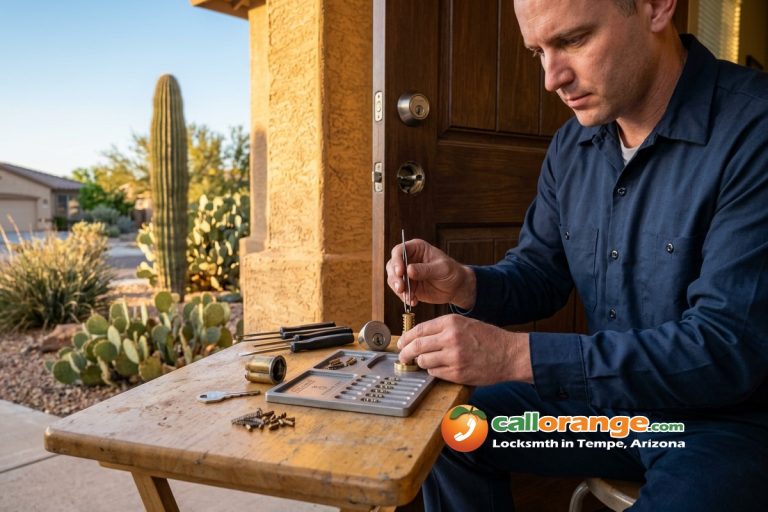
Inside every pin tumbler cylinder is a stack of driver pins and key pins — typically five or six pin stacks depending on the keyway. The key lifts each stack to a precise height determined by its cuts. When all stacks align at the shear line, the cylinder turns. Rekeying replaces the key pins at the bottom of each stack with pins of different heights, calibrated to a new key blank. The old key’s cuts no longer align the stacks. The new key does.

The entire process takes 15–20 minutes per lock. The cylinder is removed from the door hardware, the retaining clip is released, the plug is pushed out, and the pin stacks are swapped using a plug follower and pinning tray. The cylinder goes back in, the new key is tested, and the job is done. The existing lock hardware — the deadbolt body, the latch assembly, the strike plate, the door prep — stays exactly where it is. Nothing on the door changes except which key turns it.

What rekeying doesn’t do: it doesn’t upgrade the pick resistance of the cylinder, doesn’t change the bump resistance of the lock, and doesn’t address physical damage to the hardware. If the deadbolt throw is short, the strike plate is loose, or the cylinder has wear from years of use, rekeying fixes the key control problem but leaves every other vulnerability in place. That’s the distinction that determines when a full lock change is worth the additional cost.

Our lock rekey service covers all standard residential pin tumbler cylinders, including deadbolts and knob/lever sets.


What a Lock Change Involves — and When It’s the Right Answer

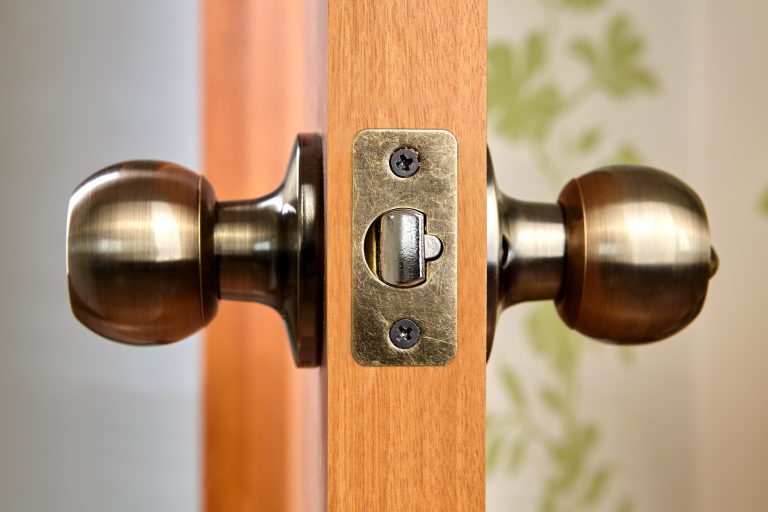
A lock change replaces the entire hardware unit: deadbolt body, cylinder, latch or bolt mechanism, and exterior and interior trim. The door prep — the holes drilled for the lock and the latch — stays the same if the new hardware matches the existing bore dimensions. Most residential deadbolts use a standard 2-1/8″ bore, which covers the vast majority of replacement options at every price point.

Lock replacement is the right answer in four specific scenarios:

The hardware is physically damaged. A cylinder that’s been drilled, a deadbolt body that’s been forced, a latch that’s seized or misaligned — damaged components don’t rekey correctly and can fail under normal use. Replacement is the only reliable fix.

The lock is worn to the point of functional unreliability. Tempe’s dust and heat accelerate cylinder wear faster than in moderate climates. Fine particulate from desert conditions works into the keyway and acts as an abrasive on the pin stacks. A cylinder that’s been through a decade of Tempe summers without lubrication may have tolerances too loose for accurate rekeying. A new cylinder performs to factory specification.

You want a security upgrade at the same time. Rekeying a builder-grade Kwikset to a new key does nothing for its pick resistance or bump resistance. If you’re rekeying after a security concern — a break-in attempt, a lost key in a high-risk situation — upgrading to a high-security cylinder like a Schlage Primus, Medeco, or Mul-T-Lock at the same time addresses the key control problem and the hardware vulnerability in one visit. Our high-security locks service covers what distinguishes a high-security cylinder from a standard residential lock.

You’re replacing a deadbolt with a smart lock. Smart lock installation is a lock change by definition — the entire hardware platform changes. The cylinder is replaced with an electronic module, and the interior assembly changes entirely. Our lock change service covers standard replacement, and for smart lock conversions, we address the door prep if the new hardware requires it.


The Cost Difference — What You’re Actually Paying For

Rekeying costs less than lock replacement in almost every scenario. The cost of a rekey is labor plus a minimal parts cost — a set of key pins and a new key blank. The lock hardware itself is untouched.

Lock replacement costs more because you’re paying for new hardware in addition to labor. The hardware cost varies widely: a builder-grade Kwikset deadbolt runs $20–$40. A mid-grade Schlage B60N runs $40–$70. A high-security Schlage Primus or Medeco cylinder runs $150–$300 for the cylinder alone. The labor to install any of them is roughly the same.

The scenario where lock replacement actually saves money: If you’re moving into a Tempe home and the existing locks are worn builder-grade hardware from 2005, rekeying them gives you key control but leaves aging hardware on the door. Replacing them with mid-grade deadbolts gives you key control, new hardware tolerances, and a warranty — for a cost difference that’s modest when you’re already paying for a locksmith visit.

We give you the honest comparison on-site. A written quote covers both options when they apply, and you decide which direction matches your situation and budget. There’s no pressure toward the higher-cost option — our job is to solve your security problem, not to sell hardware you don’t need.


Tempe-Specific Factors That Affect This Decision

Arizona’s climate creates two residential lock issues that don’t come up in the same way in moderate markets.

Cylinder wear from dust. The fine particulate common in Tempe’s air — particularly during haboob season — works into keyways and pin chambers over time. A well-maintained cylinder with periodic lubrication handles this without issue. A cylinder that’s been running dry for years may have pin stack tolerances loose enough that rekeying produces an unreliable result. When we assess a cylinder before rekeying, we’re looking for this wear pattern.

UV and heat damage to rubber gaskets and plastic components. Exterior lock hardware in Tempe takes UV and thermal stress that interior hardware doesn’t. Rubber gaskets around the cylinder and interior the deadbolt body degrade and crack. On some older hardware, the plastic cam at the back of the cylinder becomes brittle. Neither of these is visible from the outside, and neither prevents rekeying — but both are signs that the hardware has more years behind it than ahead of it, which factors into the rekey-vs-replace recommendation.

When we assess your locks in Tempe, we account for both. The recommendation you get reflects the actual condition of your specific hardware, not a default preference for one service over the other.

Quick Diagnosis — Which Service Your Situation Calls For
Situation Recommended Service Why
Moved into a new home in Tempe Rekey (or replace if hardware is worn) Previous owner, agent, and contractor keys all stop working — same hardware, new key control
Lost or stolen key Rekey immediately Lost key is no longer valid — hardware condition permitting, no replacement needed
Tenant or roommate moved out Rekey Key access revoked without hardware replacement — faster and lower cost than new locks
Lock physically damaged or forced Lock replacement Damaged hardware can’t be rekeyed reliably — replacement restores full function
Hardware is worn — builder-grade 10+ years old Lock replacement Loose pin tolerances from Tempe dust wear make rekeying unreliable — new hardware performs to spec
Want pick or bump resistance upgrade Lock replacement — high-security cylinder Rekeying doesn’t change cylinder security rating — only new hardware upgrades resistance
Multiple doors — want one key for all Rekey to matching key or master key system All compatible cylinders rekeyed to same bitting — one key operates all doors


Master Keying and Key Consolidation — A Third Option Worth Knowing

If you’re a Tempe homeowner or landlord managing multiple units or entry points, rekeying also opens the option of master key consolidation — configuring multiple cylinders to operate on a single master key while each lock still has its own individual key. This is accomplished through a bitting hierarchy in the pin stacks that creates two shear lines: one for the individual key, one for the master.

Master keying is more complex than standard rekeying and requires planning the key hierarchy before any pins are cut — you can’t add master keying to an existing standard rekey after the fact without redoing the job. If key consolidation is relevant to your situation, tell us when you call and we’ll plan the pinning accordingly.

For rental properties where tenants need individual key control and the owner needs master access, this is a standard approach that eliminates the need to replace hardware every time a tenant turns over. Our lock rekey service and lock change service both support master key configurations.

Frequently Asked Questions

How much does rekeying cost in Tempe compared to lock replacement? +
Rekeying costs significantly less than lock replacement because the hardware stays in place — you’re paying for labor and a minimal parts cost for new key pins. Lock replacement adds the cost of the new hardware on top of labor. We provide a written quote for both options when they apply so you can make an informed decision. Call (480) 847-2635 for a phone estimate based on your specific locks and situation.
Should I rekey when I move into a new home in Tempe? +
Yes — it’s the first thing most security-conscious homeowners do after closing. The previous owner, real estate agents, contractors, and anyone they gave keys to all still have working keys to your home until you rekey. The lock hardware is perfectly functional; the only thing that changes is which key turns it. A standard three-door residential rekey takes under an hour.
Can any lock be rekeyed? +
Any standard pin tumbler lock can be rekeyed — which covers nearly all residential deadbolts and knob or lever sets. Wafer tumbler locks (common on older interior doors and some padlocks) use a different mechanism and cannot be rekeyed the same way. Smart locks with electronic cylinders are replaced rather than rekeyed. If you’re unsure what type of lock you have, describe it when you call and we’ll tell you which applies.
How long does a residential rekey take in Tempe? +
Each individual lock takes 15–20 minutes. A standard Tempe home with a front door deadbolt, front door knob, and back door deadbolt is typically rekeyed in under an hour. We test the new key in each cylinder before moving to the next lock, and we test it in all locks at the end to confirm they all work on the same key.
Does Tempe heat affect residential lock hardware? +
Yes, in two specific ways. Desert dust and fine particulate work into keyways and act as an abrasive on pin stacks over years of use, loosening tolerances. UV and heat degrade rubber gaskets and plastic cylinder components on exterior-facing hardware. These factors accelerate hardware wear compared to moderate climates, which is why we assess cylinder condition before recommending a rekey vs replacement on older Tempe hardware.
Can you rekey my locks so they all use the same key? +
Yes — key consolidation is one of the most common rekey requests we get in Tempe. As long as all the cylinders use the same keyway profile, we rekey them all to a single key blank. If they use different keyways, cylinder replacement with matching hardware is required. We assess compatibility on-site before quoting.
Is rekeying as secure as replacing the locks? +
For key control purposes, yes — a rekeyed lock is just as effective as a new lock at preventing entry with the old key. For overall security level, the answer depends on the hardware. Rekeying a builder-grade deadbolt gives you key control but the same pick and bump resistance as before. If security level matters, upgrading to a high-security cylinder during the same visit is the way to address both issues at once.


Making the Right Call

Most Tempe homeowners who need to change who has access to their home need a rekey — not new hardware. The lock works fine; the problem is that someone else has a key that also works fine. Rekeying solves that in 15–20 minutes per lock at a fraction of the cost of new hardware.

Lock replacement is the right call when the hardware itself is the issue: physical damage, excessive wear, a security upgrade, or a smart lock conversion. We assess your existing hardware on-site and tell you which situation you’re actually in before quoting either option.

CallOrange Locksmith in Tempe has served Tempe homeowners since 2008. Our technicians are licensed, insured, and bonded, carry Schlage, Medeco, Mul-T-Lock, and Kwikset hardware on every truck, and complete most residential rekey and lock change jobs in a single visit. Every job comes with a written quote before work begins and a warranty on parts and labor.

Call (480) 847-2635 to schedule your rekey or lock assessment. We’re available every day from 6:00 AM to 10:00 PM. Visit our contact page for non-urgent scheduling, or see our residential locksmith services for everything we cover in Tempe.

Residential Locksmith

Rekeying Locks

There are many reasons why you might want to have your door locks rekeyed. It’s possible that your house key was stolen, or maybe a roommate had a spare key to the apartment and is now gone, or maybe you’ve just bought a new home and want it secure from the start. In any case, with rekeying there is no need to replace the entire lock and all the hardware (which can be costly). CallOrange locksmiths are professional and are available day & night in Tempe, AZ to rekey your locks. Call us anytime for fast mobile service or to schedule a future appointment! Call (480) 847-2635.

#residentiallocksmith #rekeylock