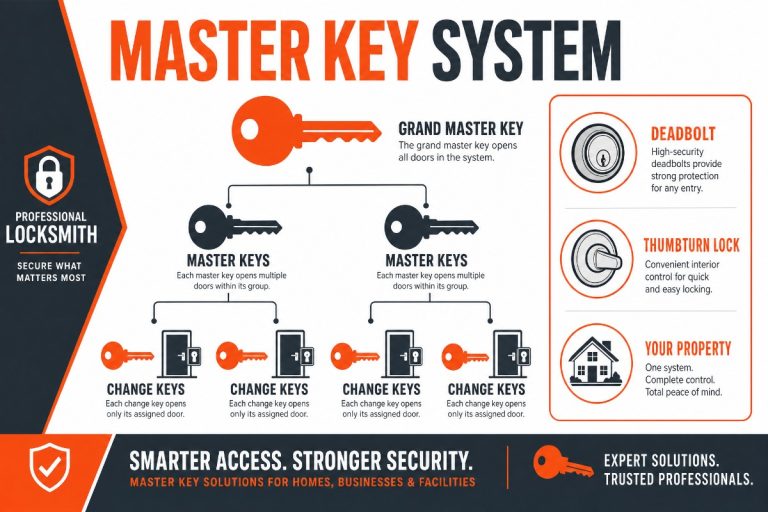
Master key system chart showing grand master, master, and change key hierarchy

Master Key Chart Management: How to Create and Manage a Professional System

Most property owners only notice the weak spot in their key setup at the wrong moment — an employee leaves with a key no one tracked, a tenant copies a spare without asking, or a heavy ring of keys turns a simple walk-through into a guessing game. The larger the building, the harder it becomes to know which key opens which door, and who is holding what.

A master key chart is the organized record that maps every lock, every key, and every access level in one system — so a single master key can open a defined group of doors while each individual key stays limited to its own. Built correctly, it replaces a confusing pile of keys with a clear, controllable hierarchy.

This guide walks through how a professional locksmith designs a master key chart, the steps to manage it as your property changes, and the security habits that keep the whole system protected. Read on to set yours up the right way.

What Is a Master Key Chart?

A master key chart is the written blueprint of a master key system. The system itself is a hierarchy of keys cut to specific patterns, where higher-level keys open more doors than lower-level ones. The chart records every lock, every keyway, and every key that fits — usually as coded entries rather than plain instructions.

Inside each lock cylinder sit small pin stacks. A standard lock has one shear line, so one key works. A master-keyed cylinder adds tiny extra pins called master wafers, which create a second working point. That is what lets two different keys — a change key and a master key — turn the same lock.

A typical hierarchy has three levels:

  • Change key (CK): opens one specific lock only.
  • Master key (MK): opens a defined group of locks, such as one floor or department.
  • Grand master key (GMK): opens every lock in the system.

For a homeowner, even a simple version helps — one key for the front deadbolt, the back door, and the garage instead of three. Our residential locksmith services cover this kind of setup for houses across the area.

How to Create a Professional Master Key Chart

Building a chart follows a clear sequence. A professional locksmith handles the technical pinning, but the planning starts with you.

  1. Inventory every door and lock. Note the location, the lock brand, the keyway, and the hardware type — knob, lever, or deadbolt.
  2. Define access groups. Decide who should reach which areas. Group doors by role: owner, manager, staff, maintenance.
  3. Assign the hierarchy. Map change keys to single doors, master keys to groups, and a grand master at the top.
  4. Code the system. Record entries as bitting codes and symbols, never as open instructions anyone could read and duplicate.
  5. Pin the cylinders. The locksmith sets the pins and master wafers in each cylinder to match the chart, then tests every key against every lock.

If you are moving into a new home or office, this is also the point to consider a lock rekey so old keys from previous occupants stop working.

Master Key System Types and Security Levels

Not every property needs a full grand master setup. The comparison below ranks common keying approaches by control and security, so you can match the system to the building.

Keying Approach How Access Works Best Fit Control Level Security Level
Individual keys (no master) One unique key per lock Single door, one user Low Basic
Keyed-alike One key opens several locks Home, small unit Low Basic
Master key Change keys plus one master Small office, rental Medium Moderate
Grand master Master keys grouped under a grand master Multi-area building High High
Grand master + restricted keyway Tiered keys with duplication-controlled blanks High-security site High Very high

Best Practices for Master Key Chart Management

Strong master key chart management is mostly about discipline after installation. A few habits keep the system both usable and secure:

  • Store the chart securely. Keep it in an encrypted file or a locked location, separate from the keys themselves.
  • Use codes, not cuts. A chart that lists actual key cuts in the open is a liability — anyone who sees it can have keys made.
  • Track issuance. Log who holds each key. When access needs change, you know exactly which keys to collect or void.
  • Re-pin after a loss. If a master key goes missing, re-pin the affected cylinders rather than ignoring the gap.
  • Review when access changes. Update the chart every time you add a door, change staff, or expand a group.

Pro Tip From the Field

After more than fifteen years pinning systems across homes and businesses, the lesson that saves clients the most trouble is simple: never let the working chart leave with the bitting cuts written on it. Keep a coded version for everyday use and store the actual cuts in a separate secured reference. When a master key disappears, the chart tells you precisely which cylinders that key touched — so you re-pin only those locks instead of the entire property. That one habit turns a building-wide scramble into a contained fix.

Pairing Your Chart With Strong Door Hardware

A master key chart is only as secure as the locks it controls. Deadbolt security matters most on exterior doors: a Grade 1 deadbolt with a hardened bolt resists kick-ins and prying far better than a basic knob lock. On the inside, a thumbturn lock lets people exit without a key, which supports both home safety and code compliance — but pair a thumbturn with a solid strike plate and long screws so the door holds under force.

For higher-risk doors, ask about high security locks with restricted keyways, which block unauthorized key duplication. Upgrading worn hardware through a lock change is often the missing step that makes a master key system genuinely secure. For residential standards, the Builders Hardware Manufacturers Association publishes the ANSI/BHMA grades that rank lock durability.

Set Up Your Master Key System With a Local Professional

A master key chart gives you controlled access and a single record you can actually manage — but the design and pinning are best handled by an experienced hand, ideally one affiliated with the Associated Locksmiths of America. The team at CallOrange Locksmith Tempe has built and maintained these systems for homes and businesses since 2008, serving Tempe, Mesa, Chandler, and Scottsdale.

To plan a new system or book a security audit of your current locks, call (480) 847-2635 or reach us through our contact page. You can also find us on the map at our Tempe location. Learn more about our work and let a professional help you lock down access the right way.

Frequently Asked Questions

Q What is a master key chart?

It is the written blueprint of a master key system. The chart records every lock, keyway, and key in coded form, showing which key opens which door and how the change keys, master keys, and grand master key relate to one another.

Q Can a master key system work on home deadbolts?

Yes. Most residential deadbolts and knob locks can be master keyed by a professional locksmith. A homeowner can run one master key for the front deadbolt, back door, and garage while keeping deadbolt security on each entry.

Q Is a master key less secure than individual keys?

A master-keyed cylinder adds extra pins, which slightly increases the number of keys that could turn it. Good chart management, restricted keyways, and Grade 1 hardware offset that and keep the system strong.

Q What happens if a master key is lost?

Re-pin the affected cylinders so the lost key no longer works. A well-kept chart shows exactly which locks that key touched, so you correct only those cylinders instead of the whole property.

Q Can existing locks be master keyed, or do I need new ones?

Many existing locks can be re-pinned to join a master key system, as long as the keyways match. Where hardware is worn or low-grade, a lock change is the better starting point.

Q How do restricted keyways improve master key security?

Restricted keyways use patented blanks that hardware stores cannot copy, so keys are duplicated only through an authorized locksmith. Pairing them with high security locks tightens control over who can make a key. Questions? Call (480) 847-2635.

Lock bumping protection guide — CallOrange Locksmith Tempe

Stop Lock Bumping: How to Upgrade Your Home’s Vulnerable Entryways

Stop Lock Bumping: How to Upgrade Your Home’s Vulnerable Entryways for Real Lock Bumping Protection

Lock bumping is a low-tech break-in method that opens standard pin tumbler deadbolts in seconds using only a modified key and a blunt object — no drilling, no forced entry, and no visible damage left behind.

Most homeowners assume a deadbolt means safety. The reality: a technique called lock bumping renders the majority of standard residential locks open in a single strike, and most people never know it happened until valuables are already gone. The fix isn’t complicated — but it requires knowing which hardware actually holds up and when to bring in a professional locksmith for a full residential security review. In this guide, you’ll find exactly what to look for, which upgrades deliver genuine protection, and how to build real lock bumping protection at every entryway in your home.

What Is Lock Bumping and Why Does It Threaten Home Safety?

Lock bumping exploits a fundamental flaw in the pin tumbler mechanism — the internal design found in virtually every standard residential deadbolt on the market. A bump key is a specially cut key modified so each cut reaches the maximum depth allowed by the keyway. The key is inserted into the target lock, and when struck sharply with a mallet or blunt object, the kinetic energy causes all driver pins to jump simultaneously. For a fraction of a second, the pins clear the shear line and the cylinder turns freely.

The entire process takes under thirty seconds. It leaves no scratches on the keyway, no damaged frame, and no evidence of forced entry. On insurance claims and police reports, it often registers as an unexplained entry. According to ALOA (Associated Locksmiths of America), bump keys can be manufactured from standard key blanks and have been extensively documented in security research since the early 2000s.

Is Your Current Deadbolt at Risk?

If your deadbolt carries a standard ANSI/BHMA Grade 2 or Grade 3 rating and uses a conventional pin tumbler cylinder, it’s likely vulnerable. This covers the majority of builder-grade locks installed in rental properties and tract homes across Tempe, Mesa, Chandler, Scottsdale, and the broader East Valley.

Signs your current hardware may not be delivering adequate home safety:

  • The lock was installed by the original builder or left behind by a previous occupant
  • No “bump-resistant” or “high-security” designation appears on the packaging
  • The cylinder uses a standard 5- or 6-pin configuration without secondary anti-bump features

If you’re unsure what’s installed at your entries, a residential security assessment from our team can identify every vulnerability before it becomes an entry point for an intruder.

Lock Bumping Protection: The Deadbolts and Hardware That Actually Hold Up

Bump-Resistant vs. Bump-Proof — Know the Difference

There’s a meaningful distinction between these two terms. Bump-resistant locks use modified pin chambers or secondary locking elements that raise the difficulty of a successful bump attempt — but they are not impervious with enough persistence. Bump-proof locks eliminate the pin tumbler mechanism entirely:

  • Disc detainer locks — use rotating discs instead of driver pins. No bump key geometry can exploit this mechanism.
  • Sidebar locks (e.g., Medeco Maxum, Mul-T-Lock MT5+) — require both a rotational and a lateral movement to turn the cylinder, making them mechanically resistant to both bumping and picking.
  • Dimple locks — use a different keyway orientation that standard bump keys cannot target.

For whole-home deadbolt security, look for locks carrying an ANSI/BHMA Grade 1 rating with documented anti-bump, anti-pick, and anti-drill certifications. Our licensed technicians handle deadbolt upgrades and full lock changes for residential clients throughout Tempe and the East Valley.

The Thumbturn Lock: How It Fits Into Your Defense

A thumbturn lock — the interior rotating knob on a single-cylinder deadbolt — doesn’t directly resist a bump entry from outside. However, its configuration matters in composite attack scenarios. Doors with decorative glass panels are especially vulnerable: a bump entry is followed by a hand reaching through shattered glass to turn the interior thumbturn. For those specific openings, a double-cylinder deadbolt requiring a key on both sides is worth serious consideration. For standard solid wood or fiberglass doors, a quality single-cylinder thumbturn paired with a certified Grade 1 deadbolt delivers solid protection.

🔐 Pro Tip — From the Field

In servicing locks throughout Tempe and the East Valley, the single most overlooked upgrade is the strike plate. A standard builder-grade strike plate uses 3/4-inch screws driven into soft wood framing — it offers almost no resistance to a coordinated kick. Replacing it with a reinforced steel strike plate secured with 3-inch screws into the door stud — at the same time as the deadbolt upgrade — closes both the bump vulnerability and the kick-in vulnerability in one visit. Address them together or you’ve only solved half the problem.

Home Safety Goes Beyond the Cylinder

Upgrading the cylinder is step one. A layered home safety strategy closes the remaining gaps that a new deadbolt alone cannot address:

  • Door reinforcement kits — door jamb armor and hinge reinforcers protect against kick-in attacks that can defeat even a bump-proof lock if the frame gives way first
  • Smart locks with tamper alerts — models with app-based tamper notifications add a detection layer, even when the underlying cylinder remains a pin tumbler design
  • Entry-point cameras — visible surveillance deters opportunistic bump attempts before they start
  • Rekeying after every occupancy change — a professional lock rekey ensures no copied keys from former tenants or contractors remain in circulation

For commercial and multi-tenant properties, the same principles scale up. Commercial locksmith services address high-security cylinder replacements for mortise lock bodies, cylindrical commercial hardware, and access control integration at high-traffic entries.

Get a Professional Locksmith Security Audit — Don’t Wait for a Break-In

Real lock bumping protection isn’t a product you pick up from a hardware store shelf — it’s the right hardware, installed correctly, at every vulnerable entry point in your home. A licensed locksmith can walk every exterior door, assess the cylinder grade, inspect strike plate depth, flag glass-panel risks, and recommend targeted upgrades without replacing hardware that’s already performing at the level your home needs.

CallOrange Locksmith Tempe provides residential security assessments and deadbolt upgrades throughout Tempe, Mesa, Chandler, Scottsdale, Phoenix, and Gilbert. Find us on Google Maps, or reach our team directly at (480) 847-2635 to schedule a home security review.

Don’t let an intruder reveal the gap in your deadbolt security. Contact CallOrange Locksmith Tempe today and have every entry point assessed by a licensed professional who knows the East Valley.

Lock Type Comparison: Bump Resistance & Security Grade
Lock Type Mechanism Bump Resistant? ANSI Grade Best Application
Standard Pin Tumbler Deadbolt 5–6 pin tumbler ✗ No Grade 2–3 Builder-grade residential
Kwikset SmartKey Re-keyable side-locking bar ~ Partial Grade 2 Budget residential upgrade
Schlage B60N Deadbolt Pin tumbler + alarm alert ~ Partial Grade 1 Mid-range residential
Smart Lock (e.g., Schlage Encode) Pin tumbler + electronics ~ Partial Grade 1 Modern smart home
Double-Cylinder Deadbolt Pin tumbler — keyed both sides ~ Partial Grade 1–2 Doors with glass panels
Medeco Maxum Deadbolt Sidebar + rotating pins ✓ Yes Grade 1 High-security residential
Mul-T-Lock MT5+ Telescopic pin tumbler ✓ Yes Grade 1 High-security residential / commercial
Abloy Protec2 Disc detainer (no pins) ✓ Yes Grade 1 Premium residential / commercial
High-Security Mortise Lock Mortise cylinder + deadbolt ✓ Yes* Grade 1 Commercial & multi-unit residential

* Bump resistance depends on the cylinder installed. ANSI/BHMA Grade 1 = highest residential/commercial standard.

Frequently Asked Questions — Lock Bumping Protection

Common questions from homeowners in Tempe, Mesa, Chandler, and the East Valley.

?

What exactly is lock bumping and how does it work?

Lock bumping is a non-destructive entry technique that exploits the pin tumbler mechanism inside most standard deadbolts. An attacker inserts a specially cut bump key into the keyway and strikes it sharply. The impact causes all the driver pins to jump simultaneously, momentarily clearing the shear line and allowing the cylinder to turn. The process leaves no visible damage, making it difficult to detect on a police report or insurance claim.

?

How do I know if my current deadbolt is vulnerable to bumping?

If your deadbolt is a standard pin tumbler model rated ANSI/BHMA Grade 2 or Grade 3 — which covers the vast majority of builder-grade hardware — it’s likely vulnerable. Look at the lock packaging or the lock body itself. If you don’t see designations like “bump-resistant,” “high-security,” or an ANSI Grade 1 rating with additional certifications, assume the lock can be bumped. A licensed locksmith can assess every entry in your home and give you a clear picture of where you stand.

?

What are the best locks for lock bumping protection?

Locks that eliminate the pin tumbler mechanism entirely provide the strongest protection. Disc detainer locks (like the Abloy Protec2) and sidebar locks (like the Medeco Maxum or Mul-T-Lock MT5+) are considered bump-proof by design. For homeowners looking for a strong upgrade without going to the highest tier, ANSI Grade 1 deadbolts with documented anti-bump certifications offer a meaningful improvement over standard builder hardware. Have a professional locksmith assess your specific doors before selecting a model.

?

What is a thumbturn lock and does it affect bump resistance?

A thumbturn lock is the interior rotating knob on a single-cylinder deadbolt — the part you turn from the inside without a key. It doesn’t directly affect how resistant the lock is to bumping from outside. However, its design becomes relevant for doors with glass panels. On those doors, a break-in may combine a bump entry with a reach-through to turn the interior thumbturn. For glass-panel doors, a double-cylinder deadbolt — requiring a key on both sides — removes that secondary vulnerability entirely.

?

Can a smart lock be bumped the same way?

It depends on the model. Many smart locks still use a traditional pin tumbler cylinder as a physical backup, which means they remain vulnerable to bumping despite the electronic access component. Smart locks that rely exclusively on electronic or motorized mechanisms — with no physical keyway at all — are immune to bump attacks. If you use a smart lock with a physical key backup, check the cylinder grade and verify it carries anti-bump certification.

?

Do I need a professional locksmith to upgrade my locks, or can I do it myself?

High-security locks — particularly sidebar and disc detainer models — require precise installation to function correctly. An improperly installed bump-proof lock can fail to engage fully, defeating its purpose entirely. Beyond the cylinder itself, a professional locksmith inspects the strike plate, checks door alignment, and assesses the entire entry. For standard Grade 1 deadbolt upgrades, a competent DIYer can manage installation, but a security audit from a licensed locksmith identifies vulnerabilities a product swap alone won’t solve.