“Key Not Detected” is usually a signal-quality or power-quality problem—not a mysterious immobilizer failure. In Tempe heat and dust, fob batteries sag, contacts oxidize, antennas see weaker reception, and interference sources pile up, so the vehicle intermittently loses clean authorization.
If your car starts one minute and refuses the next, the pattern matters: temperature, time of day, parking location, and whether the remote buttons still work. Those clues tell a technician whether you’re dealing with fob power, receiver/antenna sensitivity, RF interference, or mechanical wear in the ignition/door hardware.
For more automotive topics, start with our blog hub: automotive locksmith resources or browse the full library on our blog. When you’re ready to schedule, use our Contact Us page or learn who we are on About Us.
Directions and reviews: Google Maps
Why Tempe and Phoenix conditions make keyless issues more common
A modern key fob system depends on stable voltage, clean electrical contact, and a strong RF “handshake” between the fob and the vehicle. In Tempe, Phoenix, Mesa, Chandler, Scottsdale, and Gilbert, the environment pushes on all three:
- Heat accelerates battery voltage drop (especially older coin cells) and increases resistance at marginal connections.
- Dust + fine grit work into button membranes and contact surfaces, causing intermittent button response and signal inconsistency.
- Daily high-temperature cabin cycles (parked in sun → cooled at night → reheated) stress solder joints and connectors over time.
- Parking-lot RF noise (dense Wi-Fi, Bluetooth, retail security systems, EV chargers, some LED drivers) can reduce effective reception in “hot spots.”
Bold takeaway: Intermittent failures are usually tolerance failures—barely enough voltage, barely enough signal, barely enough contact.
If the issue is specifically with a push-to-start vehicle, our service page is here: push-to-start keyless ignition support.
The “Key Not Detected” chain: what has to work for a start to happen
Keyless systems vary by make/model, but the logic is similar:
- The fob must broadcast a readable signal (powered and transmitting cleanly).
- The vehicle must receive that signal (antenna/receiver sensitivity, low interference).
- The system must confirm authorization (immobilizer logic—conceptually, not bypassable).
- The vehicle must see valid brake/gear/door-state inputs and adequate system voltage to complete the start sequence.
When any step is marginal, you get intermittent messages like:
- “Key Not Detected”
- “Key Not In Vehicle”
- “No Key”
- Or the car unlocks but won’t start
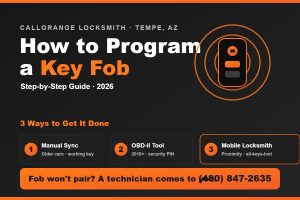
For key and remote related problems, you can also reference: car remote overview.
Most common root causes we see in Tempe (and why they happen)
1) Weak fob battery under heat load
Coin cells can test “okay” at rest, then sag under actual transmit load—especially in heat. The symptom is classic: the system works in the morning, struggles in the afternoon, then “magically” works again later.
Bold takeaway: Voltage under load matters more than a quick resting test.
2) Dirty or oxidized contact surfaces in the fob
Dust and skin oils can build up on contact points; over time, button presses become inconsistent and transmit strength can drop intermittently.
3) RF interference in specific parking locations
If the failure clusters at one place (apartment garage, a certain retail lot, a campus zone), think interference. The fob is fine—the environment isn’t.
4) Vehicle-side antenna/receiver sensitivity drift
Receiver performance can degrade slowly. A marginal receiver still works when the fob is very close, then fails at normal distance.
5) Low vehicle system voltage or borderline charging health
A weak 12V system can cause modules to behave inconsistently—even if the engine runs fine once started. You’ll often see more warnings and “odd” electronics behavior alongside keyless issues.
6) Mechanical wear that masquerades as an electronic problem
Not every “no start” complaint is purely electronic. If there’s an ignition/lock component with wear (depending on vehicle type), binding and timing issues can create confusing symptoms.
If ignition hardware is part of the complaint set, start here: ignition repair service and the deeper explainer: ignition lock repair.
Quick Diagnosis: symptom → likely cause → what a pro checks
This is a safe, non-bypass diagnostic map. It helps separate fob issues, environment issues, and vehicle-side reception issues.
| Symptom | Likely cause | What a pro checks |
|---|---|---|
| Works close-up only | Weak transmit or receiver sensitivity | Fob power under load, range consistency |
| Fails in one parking lot | RF interference hot spot | Location pattern, signal environment |
| Buttons work, start fails | Vehicle-side receive/auth path | Receiver behavior, system voltage, inputs |
| Starts AM, fails PM | Heat-driven voltage/contact issue | Battery sag pattern, fob contact condition |
| Random warnings + key issue | Low 12V stability | Voltage behavior, module stability signs |
| Unlock works, start doesn’t | Different antenna paths | Start/immobilizer receive path patterns |
Bold takeaway: Pattern beats guesswork. Time + place + distance are diagnostic data.
What a real auto locksmith inspection looks like (no risky shortcuts)
A good auto locksmith workflow focuses on verification and repeatability:
- Confirm the complaint pattern (distance, location, heat, frequency)
- Check remote function consistency (buttons vs proximity behavior)
- Evaluate likely fob power/contact issues (without “hoping”)
- Identify whether the issue tracks the vehicle environment (interference) or vehicle-side reception
- If ignition hardware is implicated, evaluate wear/tolerance behavior (no bypass)
- Document what changed so the next failure is predictable—not surprising
If you need new keys made or replaced as part of the solution path, these pages are helpful:
Heat, dust, and wear: the underappreciated failure multipliers
Heat expansion and tolerance stacking
Components don’t have to “break” to fail—they just have to drift out of tolerance. Heat increases resistance in marginal contacts and reduces headroom in weak batteries.
Dust contamination and button membrane behavior
Dust intrusion can make button presses inconsistent, which can look like “the remote is dead” when it’s actually intermittent contact.
Fleet usage and repeated handling
If a fob is used many times per day (delivery, rideshare, service fleets), mechanical wear and contamination accelerate.
Bold takeaway: High-cycle usage creates intermittent behavior long before total failure.
Table: common Tempe driver scenarios and what they usually mean
| Scenario | What it often points to | Best next step |
|---|---|---|
| Only fails after sun exposure | Battery sag / contact issues | Verify fob power + contact health |
| Fails at a specific garage/lot | RF interference environment | Confirm location pattern |
| Works for unlock, not start | Separate receive paths | Check start-side reception pattern |
| Needs the fob “just right” | Range/antenna sensitivity | Evaluate receiver sensitivity behavior |
| Multiple electronics warnings | Low 12V stability | Confirm vehicle voltage stability |
When a key/remote problem becomes a business risk
For Tempe businesses with staff vehicles, service vans, or customer-facing operations, intermittent keyless issues become downtime. A technical fix is only half the solution—repeat prevention matters:
- Standardize key handling (avoid contamination)
- Replace borderline fobs before they become “random”
- Don’t ignore early signs (range shrinking, intermittent buttons)
If you’re dealing with broader commercial entry hardware issues at your business location (separate from vehicles), this reference may help: commercial door hardware.
Related security note: if a lost key ring includes home keys
Sometimes a vehicle issue starts with a lost key ring—and that includes house keys. If that’s your situation, it’s smart to reset access at home as well:
FAQs
1) Why does my car say “Key Not Detected” only sometimes?
Intermittent messages usually mean marginal voltage, marginal contact, or marginal reception. Heat and dust push weak batteries and worn contacts over the edge, especially in Tempe summers.
2) The remote buttons work, but the car won’t start—how is that possible?
Many vehicles use different receive paths for button-based commands versus proximity authorization. A locksmith looks for pattern differences (distance sensitivity, location sensitivity) to narrow the cause.
3) Why does it fail in one parking lot but not another?
That’s a classic sign of RF interference. Dense electronics environments can reduce effective reception even when the fob is healthy.
4) Can a weak vehicle battery cause keyless problems?
Yes. A borderline 12V system can make control modules behave inconsistently, causing keyless authorization to fail intermittently or throw confusing warnings.
5) Is this the immobilizer “locking me out”?
Immobilizer logic exists to prevent unauthorized starts, but most “Key Not Detected” complaints are signal or power quality issues—not a sudden security lockout. Diagnosis focuses on what’s missing in the authorization chain.
6) Do push-to-start systems fail more in Arizona heat?
They can. Heat accelerates battery sag and increases resistance in marginal contacts. If the pattern tracks temperature, a technician treats it as a tolerance problem first.
7) Should I replace my key fob right away?
Not always. The best approach is verify the failure pattern, confirm whether it’s fob power/contact, interference, or vehicle-side reception—then choose the correct fix to prevent repeat downtime.
8) What information should I share when I call?
Tell us the exact message, when it happens (morning vs afternoon), where it happens (specific lot/garage), and whether the remote buttons work consistently. That saves time and avoids guesswork.
Wrap-up: keep your start system dependable in Tempe
When you see “Key Not Detected,” the problem is usually signal and voltage stability—a weak fob battery under heat, worn contact surfaces, interference in specific locations, or a vehicle-side reception issue that has drifted out of tolerance.
The correct path forward is to diagnose the pattern, confirm whether the failure is fob-driven, environment-driven, or vehicle-driven, and then apply the fix that prevents repeat incidents—without risky shortcuts or guesswork.
CallOrange has been serving Tempe and the Phoenix metro area since 2008, with a focus on clean diagnostics and verification so your vehicle is consistent again—not just “working for now.”
For push-to-start and remote problems, call (480) 847-2635 or reach out through our Contact Us page. We’ll verify authorization and prioritize damage prevention and legal compliance—because security systems and high-risk openings should be handled carefully.