
Most property owners only notice the weak spot in their key setup at the wrong moment — an employee leaves with a key no one tracked, a tenant copies a spare without asking, or a heavy ring of keys turns a simple walk-through into a guessing game. The larger the building, the harder it becomes to know which key opens which door, and who is holding what.
A master key chart is the organized record that maps every lock, every key, and every access level in one system — so a single master key can open a defined group of doors while each individual key stays limited to its own. Built correctly, it replaces a confusing pile of keys with a clear, controllable hierarchy.
This guide walks through how a professional locksmith designs a master key chart, the steps to manage it as your property changes, and the security habits that keep the whole system protected. Read on to set yours up the right way.
What Is a Master Key Chart?
A master key chart is the written blueprint of a master key system. The system itself is a hierarchy of keys cut to specific patterns, where higher-level keys open more doors than lower-level ones. The chart records every lock, every keyway, and every key that fits — usually as coded entries rather than plain instructions.
Inside each lock cylinder sit small pin stacks. A standard lock has one shear line, so one key works. A master-keyed cylinder adds tiny extra pins called master wafers, which create a second working point. That is what lets two different keys — a change key and a master key — turn the same lock.
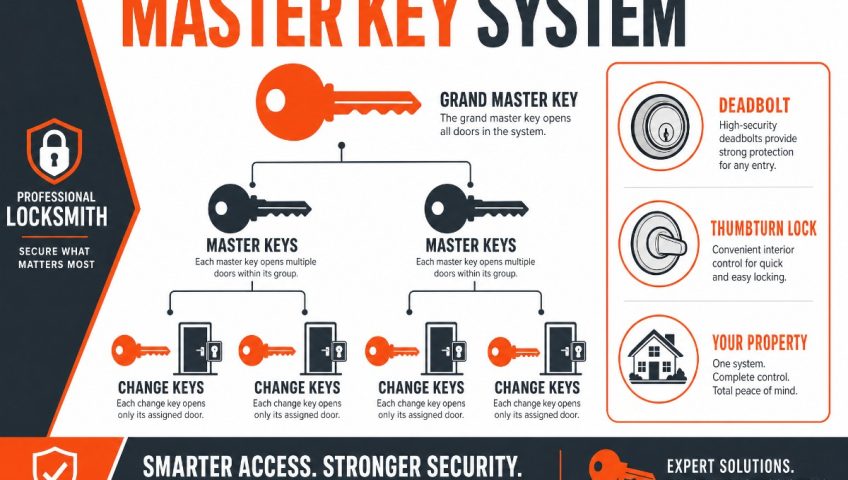
A typical hierarchy has three levels:
- Change key (CK): opens one specific lock only.
- Master key (MK): opens a defined group of locks, such as one floor or department.
- Grand master key (GMK): opens every lock in the system.
For a homeowner, even a simple version helps — one key for the front deadbolt, the back door, and the garage instead of three. Our residential locksmith services cover this kind of setup for houses across the area.
How to Create a Professional Master Key Chart
Building a chart follows a clear sequence. A professional locksmith handles the technical pinning, but the planning starts with you.
- Inventory every door and lock. Note the location, the lock brand, the keyway, and the hardware type — knob, lever, or deadbolt.
- Define access groups. Decide who should reach which areas. Group doors by role: owner, manager, staff, maintenance.
- Assign the hierarchy. Map change keys to single doors, master keys to groups, and a grand master at the top.
- Code the system. Record entries as bitting codes and symbols, never as open instructions anyone could read and duplicate.
- Pin the cylinders. The locksmith sets the pins and master wafers in each cylinder to match the chart, then tests every key against every lock.
If you are moving into a new home or office, this is also the point to consider a lock rekey so old keys from previous occupants stop working.
Master Key System Types and Security Levels
Not every property needs a full grand master setup. The comparison below ranks common keying approaches by control and security, so you can match the system to the building.
| Keying Approach | How Access Works | Best Fit | Control Level | Security Level |
|---|---|---|---|---|
| Individual keys (no master) | One unique key per lock | Single door, one user | Low | Basic |
| Keyed-alike | One key opens several locks | Home, small unit | Low | Basic |
| Master key | Change keys plus one master | Small office, rental | Medium | Moderate |
| Grand master | Master keys grouped under a grand master | Multi-area building | High | High |
| Grand master + restricted keyway | Tiered keys with duplication-controlled blanks | High-security site | High | Very high |
Best Practices for Master Key Chart Management
Strong master key chart management is mostly about discipline after installation. A few habits keep the system both usable and secure:
- Store the chart securely. Keep it in an encrypted file or a locked location, separate from the keys themselves.
- Use codes, not cuts. A chart that lists actual key cuts in the open is a liability — anyone who sees it can have keys made.
- Track issuance. Log who holds each key. When access needs change, you know exactly which keys to collect or void.
- Re-pin after a loss. If a master key goes missing, re-pin the affected cylinders rather than ignoring the gap.
- Review when access changes. Update the chart every time you add a door, change staff, or expand a group.
Pro Tip From the Field
After more than fifteen years pinning systems across homes and businesses, the lesson that saves clients the most trouble is simple: never let the working chart leave with the bitting cuts written on it. Keep a coded version for everyday use and store the actual cuts in a separate secured reference. When a master key disappears, the chart tells you precisely which cylinders that key touched — so you re-pin only those locks instead of the entire property. That one habit turns a building-wide scramble into a contained fix.
Pairing Your Chart With Strong Door Hardware
A master key chart is only as secure as the locks it controls. Deadbolt security matters most on exterior doors: a Grade 1 deadbolt with a hardened bolt resists kick-ins and prying far better than a basic knob lock. On the inside, a thumbturn lock lets people exit without a key, which supports both home safety and code compliance — but pair a thumbturn with a solid strike plate and long screws so the door holds under force.
For higher-risk doors, ask about high security locks with restricted keyways, which block unauthorized key duplication. Upgrading worn hardware through a lock change is often the missing step that makes a master key system genuinely secure. For residential standards, the Builders Hardware Manufacturers Association publishes the ANSI/BHMA grades that rank lock durability.
Set Up Your Master Key System With a Local Professional
A master key chart gives you controlled access and a single record you can actually manage — but the design and pinning are best handled by an experienced hand, ideally one affiliated with the Associated Locksmiths of America. The team at CallOrange Locksmith Tempe has built and maintained these systems for homes and businesses since 2008, serving Tempe, Mesa, Chandler, and Scottsdale.
To plan a new system or book a security audit of your current locks, call (480) 847-2635 or reach us through our contact page. You can also find us on the map at our Tempe location. Learn more about our work and let a professional help you lock down access the right way.
Frequently Asked Questions
Q What is a master key chart?
It is the written blueprint of a master key system. The chart records every lock, keyway, and key in coded form, showing which key opens which door and how the change keys, master keys, and grand master key relate to one another.
Q Can a master key system work on home deadbolts?
Yes. Most residential deadbolts and knob locks can be master keyed by a professional locksmith. A homeowner can run one master key for the front deadbolt, back door, and garage while keeping deadbolt security on each entry.
Q Is a master key less secure than individual keys?
A master-keyed cylinder adds extra pins, which slightly increases the number of keys that could turn it. Good chart management, restricted keyways, and Grade 1 hardware offset that and keep the system strong.
Q What happens if a master key is lost?
Re-pin the affected cylinders so the lost key no longer works. A well-kept chart shows exactly which locks that key touched, so you correct only those cylinders instead of the whole property.
Q Can existing locks be master keyed, or do I need new ones?
Many existing locks can be re-pinned to join a master key system, as long as the keyways match. Where hardware is worn or low-grade, a lock change is the better starting point.
Q How do restricted keyways improve master key security?
Restricted keyways use patented blanks that hardware stores cannot copy, so keys are duplicated only through an authorized locksmith. Pairing them with high security locks tightens control over who can make a key. Questions? Call (480) 847-2635.