push-to-start-key-fob-not-working-tempe

Push-to-Start Key Fob Not Working? What to Do in Tempe

A push-to-start key fob that stops responding usually traces back to a depleted coin-cell battery, corroded contact terminals inside the fob housing, or heat-damaged circuitry from Arizona’s extreme summers. A licensed locksmith tests the fob’s signal output, inspects the internal PCB, and either replaces the battery, repairs the contacts, or programs a replacement fob to your vehicle’s receiver module.

Prices shown reflect general market ranges for the Tempe and Phoenix metro area as of 2026. Actual costs depend on your vehicle’s year, make, model, and the type of key fob required. Contact us directly for a personalized quote.

You press the brake, hit the start button, and nothing happens. The dashboard stays dark or flashes a “key not detected” warning. In Tempe, this scenario plays out more often than most drivers expect — especially between May and October when surface temperatures inside parked vehicles regularly exceed 150°F. That kind of heat doesn’t just make your steering wheel untouchable. It warps the plastic housing around delicate electronic components that your fob depends on to communicate with your car.

The push-to-start system relies on a low-frequency signal exchange between your key fob and a receiver antenna built into the steering column or center console. When the fob’s internal transmitter weakens — whether from a dying battery, cracked solder joints, or UV-degraded circuitry — the vehicle can’t authenticate the signal and refuses to start. The problem isn’t always the fob itself, either. The vehicle’s antenna module, the immobilizer ECU, or even a drained car battery can mimic the same symptoms.

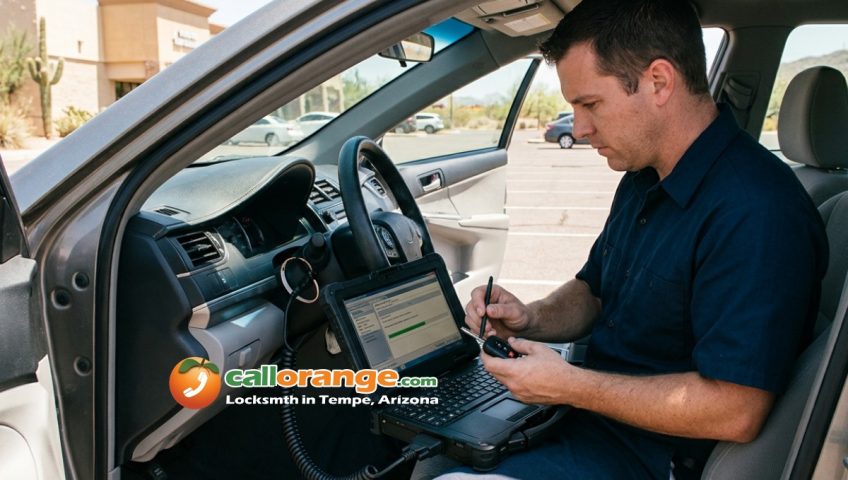
The right approach starts with professional diagnosis. A certified locksmith uses frequency-testing equipment to measure whether the fob is transmitting at all, then narrows down the cause to the fob, the vehicle’s receiver, or the programming link between them. That process avoids the common mistake of buying a new fob online only to discover the real issue was somewhere else entirely.

CallOrange.com has been diagnosing and programming push-to-start key fobs in Tempe since 2015. With 4.8 stars across 1,451 Google reviews and mobile technicians who come to your location, the diagnostic and repair process happens wherever your vehicle is parked — your driveway, an office lot in Downtown Tempe, or the ASU campus parking structure off University Drive.

Symptom Likely Cause What a Pro Checks
Fob works only at very close range Weak battery or partially cracked antenna trace on PCB Frequency analyzer measures signal strength at multiple distances
No response from any fob button Dead battery, fried transmitter chip, or broken solder joint Opens fob housing, inspects PCB for burn marks and tests battery voltage
Lock/unlock works but car won’t start Immobilizer rolling-code desynchronization Connects OBD-II diagnostic tool to check ECU-to-fob code alignment
Fob works intermittently in hot weather Thermal solder fatigue on transmitter circuit Inspects solder joints under magnification for micro-cracks
One button works, others don’t Degraded rubber membrane under specific button Removes button pad, checks conductive coating for wear or UV damage
Dashboard shows “key not detected” Vehicle receiver antenna failure or weak 12V battery Tests receiver antenna response with known-good fob; checks vehicle battery voltage
Fob works only at very close range
Likely CauseWeak battery or partially cracked antenna trace on PCB
What a Pro ChecksFrequency analyzer measures signal strength at multiple distances
No response from any fob button
Likely CauseDead battery, fried transmitter chip, or broken solder joint
What a Pro ChecksOpens fob housing, inspects PCB for burn marks and tests battery voltage
Lock/unlock works but car won’t start
Likely CauseImmobilizer rolling-code desynchronization
What a Pro ChecksConnects OBD-II diagnostic tool to check ECU-to-fob code alignment
Fob works intermittently in hot weather
Likely CauseThermal solder fatigue on transmitter circuit
What a Pro ChecksInspects solder joints under magnification for micro-cracks
One button works, others don’t
Likely CauseDegraded rubber membrane under specific button
What a Pro ChecksRemoves button pad, checks conductive coating for wear or UV damage
Dashboard shows “key not detected”
Likely CauseVehicle receiver antenna failure or weak 12V battery
What a Pro ChecksTests receiver antenna response with known-good fob; checks vehicle battery voltage

Why Push-to-Start Fobs Fail in the Phoenix Metro Area

Arizona’s Sonoran Desert climate creates conditions that accelerate electronic component failure in ways that drivers in milder states rarely experience. Understanding what actually breaks inside your fob helps you make smarter decisions about repair versus replacement.

Thermal cycling is the primary culprit. When you park your car at Tempe Marketplace or along Mill Avenue during a July afternoon, the cabin temperature can spike past 160°F within 20 minutes. The fob sitting in your cupholder or center console absorbs that heat directly. Over weeks and months, the repeated cycle of extreme heat during the day and air-conditioned cool at night causes the solder joints on the fob’s printed circuit board to expand, contract, and eventually crack. Once a solder joint fractures, the signal transmission becomes intermittent — the fob works sometimes and fails other times with no obvious pattern.

UV radiation degrades the rubber button membranes that seal the fob’s internal contacts. When those membranes harden and shrink, pressing the lock or unlock button no longer makes reliable contact with the circuit board underneath. You might notice that you have to press harder than you used to, or press multiple times before the car responds. That’s a textbook sign of membrane deterioration, and it’s far more common in Arizona than in northern climates.

The coin-cell battery inside a standard key fob — usually a CR2025 or CR2032 — has a rated shelf life of about five years under normal conditions. Arizona heat cuts that lifespan roughly in half. The chemical reaction inside lithium cells accelerates at higher temperatures, which means a fob battery that would last four years in Seattle might drain in under two years here in the Valley.

Fine desert particulate also works its way into the fob casing through button gaps and seam lines. This dust is abrasive at a microscopic level. It settles on the battery contacts and the PCB traces, creating a resistive layer that weakens the signal output even when the battery is technically still charged.

The Emergency Backup: Starting Your Car with a Dead Fob

Most drivers don’t realize that every push-to-start vehicle has a built-in backup method for when the fob battery dies. This doesn’t fix the underlying problem, but it gets you moving while you arrange professional service.

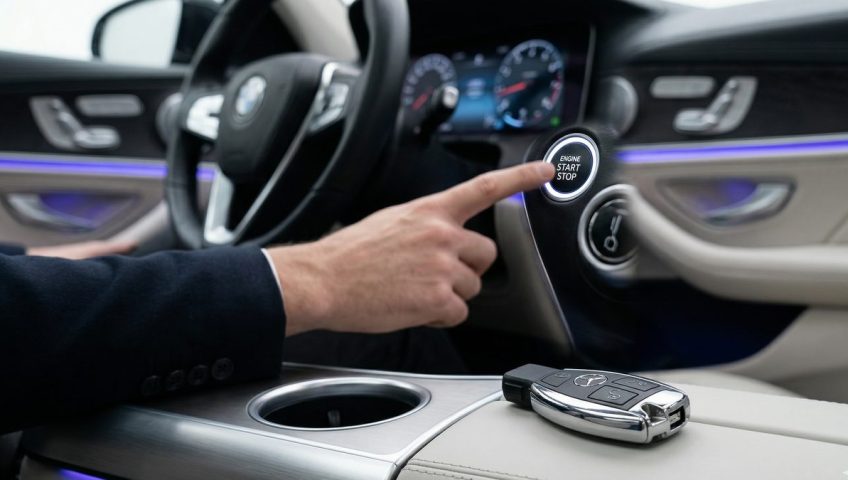
Hold the dead fob directly against the start button. On most Toyota, Honda, Nissan, Hyundai, and Kia models, the start button contains a secondary antenna coil that can read the fob’s passive RFID chip at near-zero range — even with a completely dead battery. Press the brake pedal, hold the fob flat against the button, and press start. The car should recognize the chip and fire the engine.

On some vehicles — particularly certain Ford, Mazda, and Subaru models — the backup antenna is located in the center console, the steering column, or a marked spot on the dashboard. Check your owner’s manual for the exact location. A few important things to keep in mind:

  • This backup method only works if the fob’s RFID chip is intact — heat damage to the chip itself will prevent even close-range detection
  • The method does not restore remote lock, unlock, or trunk functions — those require active battery power
  • If the vehicle’s own 12V battery is also weak, the passive read may fail because the antenna coil needs vehicle power to operate
  • Starting the car this way is a temporary solution, not a permanent fix — the fob still needs diagnosis and repair
  • Some luxury vehicles like BMW, Mercedes, and Lexus have a physical emergency key blade hidden inside the fob that unlocks the driver’s door manually

If the backup start fails entirely, the problem likely goes beyond just a dead fob battery. That’s when professional automotive locksmith diagnosis becomes necessary to identify whether the fob, the vehicle’s receiver, or the immobilizer module needs attention.

What a Locksmith Actually Tests During Fob Diagnosis

When a mobile locksmith arrives to diagnose your push-to-start issue, the process follows a structured sequence that eliminates possibilities one at a time. Understanding this sequence helps you know what to expect and why the diagnosis matters before jumping straight to a replacement.

Step one is verifying the fob’s output signal. The technician uses a frequency analyzer to check whether the fob is broadcasting on the correct frequency — typically 315 MHz for North American vehicles or 433 MHz for some European models. If there’s no signal at all, the issue is internal to the fob. If the signal is present but weak, the battery contacts or antenna trace may be corroded.

Step two isolates the vehicle’s receiver. Even if the fob is transmitting correctly, the car won’t start if the receiver antenna module isn’t picking up the signal. The technician tests the antenna by attempting communication with a known-good fob or diagnostic tool. Receiver failures are less common than fob failures, but they do happen — especially in vehicles that have been in accidents where the steering column or dashboard took impact.

Step three checks the immobilizer handshake. Modern push-to-start systems use rolling-code encryption between the fob and the vehicle’s ECU. Each time you start the car, the code changes. If the synchronization between fob and ECU falls out of alignment — which can happen after a battery replacement, a jump start, or prolonged disconnection — the system locks out the fob even though the hardware is fine. A locksmith’s diagnostic programming equipment can resynchronize the codes and restore normal operation.

The vehicle’s 12V battery also plays a role. A weak car battery reduces the power available to the receiver antenna and the immobilizer module. In Tempe’s heat, car batteries degrade faster than the national average. If the vehicle cranks slowly or the interior lights dim when you press start, the 12V battery should be tested before assuming the fob is at fault.

Common Fob Symptoms and What They Actually Mean

Not every fob problem means you need a full replacement. Some symptoms point to simple fixes, while others indicate more serious component failure. Here’s what the most common warning signs actually tell a trained technician:

Intermittent response — the fob works from three feet away but not from ten — usually means a weak battery or corroded contacts. The fob is still transmitting, just not with enough power to reach the vehicle’s antenna at normal range. Battery replacement and contact cleaning resolve this about 80% of the time.

No response at all from any button could mean a dead battery, a fried circuit board, or a broken solder joint on the transmitter chip. If pressing the fob against the start button still starts the car, the passive RFID chip is intact and the issue is limited to the active transmitter circuit. If even the backup start fails, the chip itself may be heat-damaged.

Buttons work for lock/unlock but the car won’t start points to a problem with the immobilizer authentication rather than the fob’s radio transmitter. The fob is communicating, but the rolling code exchange is failing. This often happens after a car battery replacement or when someone attempts to program a third-party fob without proper equipment.

One button works but others don’t is almost always a membrane issue. The rubber pad under that specific button has hardened, torn, or lost its conductive coating. In Arizona, UV and heat cause uneven degradation across buttons depending on which side of the fob faces upward in sun-exposed storage.

The fob works only when very close to the car suggests the fob’s internal antenna trace has a partial break. The antenna is a thin copper trace printed on the PCB. Thermal expansion can crack it partially, reducing transmission range dramatically without killing the signal completely.

Market Pricing for Fob Diagnosis and Replacement in 2026

Push-to-start fob service costs vary significantly depending on whether you need a simple battery swap, a circuit repair, or a complete fob replacement with programming. Here’s what the Tempe and Phoenix metro market looks like for the most common scenarios.

A basic fob battery replacement is straightforward and inexpensive. The battery itself costs a few dollars, and most locksmiths include the replacement as part of a diagnostic visit. If the battery is the only issue, you’re looking at the lowest end of the service range.

Fob reprogramming — resynchronizing the rolling codes between a working fob and the vehicle — typically falls in the mid-range. This service requires professional diagnostic equipment that connects to the vehicle’s OBD-II port and communicates directly with the immobilizer ECU. The equipment investment is one reason this isn’t a DIY job.

Complete fob replacement and programming is the most involved service. It includes sourcing a compatible blank fob for your specific make, model, and year, cutting the emergency key blade if applicable, programming the fob’s transponder chip to the vehicle’s immobilizer, and syncing the remote functions. Luxury and European vehicles cost more because their encryption systems require manufacturer-level software access.

A few factors that affect final pricing in this market:

  • Vehicle make and year — a 2024 Toyota Camry fob costs less than a 2024 BMW X5 fob
  • OEM versus aftermarket fob blanks — OEM parts carry higher cost but guaranteed compatibility
  • Number of fobs being programmed — programming two fobs at the same time costs less per unit than programming one
  • Time of service — evening and weekend calls may carry different rates depending on the provider
  • Mobile service — having a technician come to your location is standard for locksmith services in Tempe but some providers charge differently

Dealership pricing for fob replacement and programming typically runs two to three times higher than what a licensed mobile locksmith charges for the same service. The dealership uses the same diagnostic process, but their overhead structure — facility costs, parts markup, scheduling delays — inflates the final bill. Many Tempe drivers discover this after calling the dealer first, then searching for a local alternative.

Which Vehicles Need Special Attention in Arizona

Certain vehicle brands and their push-to-start systems are more vulnerable to heat-related fob failures than others. If you drive one of these vehicles in Tempe or anywhere in the Valley, proactive fob maintenance can save you from an unexpected no-start situation.

Nissan Intelligent Key fobs are among the most common failure cases in Arizona. The plastic housing uses a thin seam that allows fine dust infiltration, and the PCB layout places the battery contacts close to the antenna trace — meaning corrosion from a leaking battery can disable both the active transmitter and the passive chip simultaneously.

Hyundai and Kia Smart Key fobs from 2018 to 2023 use a compact design that traps heat inside the housing. The solder joints on the transmitter module in these fobs are known to fatigue faster in extreme-heat climates. If your Hyundai or Kia fob starts working intermittently during summer months, thermal solder fatigue is the most likely explanation.

Toyota and Lexus Smart Key systems are generally more heat-resilient, but the rubber button membranes degrade at the same rate as other brands. Toyota fobs also use a unique encryption protocol that requires Toyota-specific software for key programming — generic tools won’t complete the pairing process.

Ford and Lincoln push-to-start fobs use a two-piece housing design that’s easier to open for battery replacement but also more susceptible to dust and moisture entry. The positive trade-off is that battery replacement is simpler, which means routine maintenance is less of a barrier.

European brands — BMW, Mercedes-Benz, Audi, and Volkswagen — use the most complex encryption and the most expensive fob hardware. Replacement fobs for these vehicles require dealer-level or advanced aftermarket programming equipment and carry higher parts costs. Having a spare fob programmed before your primary fails is especially worthwhile for these vehicles.

When to Replace Versus When to Repair

The decision between repairing your existing fob and replacing it entirely comes down to the type of failure and the cost comparison. Not every dead fob needs to be thrown away.

Repair makes sense when the fob housing is intact, the PCB shows no visible burn marks or cracked traces, and the issue traces back to a dead battery, dirty contacts, or a worn button membrane. A technician can replace the battery, clean the contacts with electronic-grade solvent, and replace the button pad for a fraction of the cost of a new fob. This is the right call for fobs that are less than five years old with a single point of failure.

Replacement is the better path when the PCB has visible damage — scorched components, multiple cracked solder joints, or a corroded antenna trace. At that point, repairing individual connections becomes unreliable because adjacent components are likely to fail soon after. It’s also the better option when the fob housing itself is cracked open, since a compromised seal means dust and moisture will continue to degrade the internals even after repair.

Programming is required in both cases whenever the immobilizer codes need to be re-synced. Whether you’re restoring a repaired fob or pairing a brand-new one, the vehicle’s ECU needs to recognize and authorize the fob before the push-to-start system works. This is the step that requires professional equipment and training — it’s not something a YouTube tutorial and an Amazon tool can handle reliably.

CallOrange.com technicians carry both repair supplies and blank fob inventory on every mobile service call. That means the diagnosis, the decision, and the fix all happen in a single visit at your location in Tempe, Mesa, Scottsdale, Chandler, or anywhere in the Phoenix metro area.

Keep Your Fob Working Longer in Arizona Heat

Preventive care extends the life of your push-to-start fob and reduces the chance of being stranded with a no-start condition. These maintenance steps are simple but make a measurable difference in a desert climate.

Replace the fob battery every 12 to 18 months instead of waiting for it to die. In Arizona, the standard battery lifecycle is significantly shorter than the manufacturer’s estimate. A proactive swap costs very little and eliminates the most common cause of fob failure.

Store your spare fob indoors, not in the car. Many drivers keep a backup fob in the glovebox or center console. In Tempe’s summer heat, that spare is absorbing the same thermal punishment as the primary fob. Keep it inside your home or office where temperatures stay controlled.

Avoid placing your fob near magnetic sources like phone mounts, tablet cases, or magnetic purse clasps. Strong magnetic fields can interfere with the fob’s internal antenna and gradually demagnetize components that affect signal strength.

Clean the battery contacts annually. Open the fob housing — most use a small flathead slot or a release button — and gently clean the battery contact points with a dry cotton swab. If you see green or white residue, that’s corrosion from the battery. Replace the battery and clean the contacts with isopropyl alcohol before reassembling.

Use a protective silicone case if your fob rides in a pocket with keys, coins, or other metal objects. Physical impact and scratching can compromise the housing seal over time, accelerating dust infiltration.

Frequently Asked Questions

Why did my push-to-start fob suddenly stop working?

The most common cause is a depleted coin-cell battery, especially in the Phoenix metro area where summer heat drains lithium batteries faster than in cooler climates. Other causes include corroded battery contacts, cracked solder joints from thermal cycling, or a desynchronized immobilizer code. A diagnostic test identifies the exact point of failure before any parts are replaced.

Can I start my car if the key fob battery is dead?

Yes. Most push-to-start vehicles have a backup method. Hold the dead fob directly against the start button while pressing the brake. The start button contains a secondary antenna that reads the fob’s passive RFID chip at close range, even with no battery power. Check your owner’s manual for the exact location of the backup reader on your vehicle.

How often should I replace the fob battery in Arizona?

Every 12 to 18 months in the Tempe and Phoenix area. The manufacturer’s estimate of three to five years assumes moderate climates. Arizona’s sustained heat above 110°F accelerates the chemical drain inside lithium coin cells significantly, so proactive replacement before symptoms appear is the safest approach.

Can a locksmith program a new fob or only the dealership?

A licensed automotive locksmith with professional programming equipment can program fobs for virtually all major vehicle brands, including Toyota, Honda, Nissan, Hyundai, Ford, Chevrolet, BMW, and Mercedes-Benz. The process uses the same OBD-II diagnostic interface as the dealership. Mobile locksmiths bring the equipment to your location, which eliminates the need to tow the vehicle.

Do I need my vehicle registration for fob replacement?

Yes. Any reputable locksmith requires your current vehicle registration and a valid government-issued photo ID before performing key fob programming or replacement. This is a security measure that protects vehicle owners from unauthorized key duplication and is standard practice across the locksmith industry.

Is it cheaper to buy a fob online and have it programmed?

Sometimes, but it carries risk. Aftermarket fobs from Amazon or eBay may not be compatible with your specific vehicle year and trim, and some lack the correct encryption chip for programming. If the fob doesn’t match, you’ll pay for a service visit with no result. A locksmith who supplies the fob guarantees compatibility and typically includes programming in the price.

How long does fob programming take on-site?

Most standard fob programming takes 20 to 45 minutes once the technician arrives. Luxury and European vehicles with more complex encryption may take up to 60 minutes. The process includes diagnosis, pairing the fob to the vehicle’s immobilizer ECU, and testing all remote functions before the technician leaves.

Getting Your Fob Diagnosed and Fixed in Tempe

A push-to-start fob that stops working doesn’t always mean you need a new one. In many cases, a battery replacement, contact cleaning, or code resynchronization restores full function at a fraction of the cost of a replacement. The key is accurate diagnosis before spending money on parts you might not need.

CallOrange.com has served the Tempe and Phoenix metro area since 2015, with 1,451 Google reviews and a 4.8-star rating built on transparent pricing and mobile service that comes to you. Every technician carries diagnostic equipment, replacement batteries, fob blanks, and programming tools — so the entire process from diagnosis to fix happens in a single visit. Licensed, insured, and experienced with every major vehicle brand on the road today.

Call (480) 847-2635 to schedule a diagnostic visit at your location. Bring your vehicle registration and a valid photo ID — both are required before any key fob programming or replacement service. You can also reach out through the contact page to describe your fob issue and get a preliminary estimate. Learn more about the team and service history on the about us page.
car-key-replacement-cost-tempe

Car Key Replacement Cost in Tempe, AZ — What You’ll Actually Pay

Car key replacement prices in Tempe range from $45 to $350+ depending on key type, vehicle year, and programming requirements. A basic mechanical key for older models costs the least, while push-to-start proximity fobs for European vehicles sit at the top of the range. A licensed locksmith diagnoses the exact key type your vehicle needs and programs it on-site to match your car’s immobilizer system.

Prices shown reflect general market ranges for the Tempe and Phoenix metro area as of 2026. Your actual cost depends on vehicle make, model, key type, and parts availability. Call (480) 847-2635 for an exact quote before service.

You’re standing in a parking lot somewhere near Mill Avenue or off the 101, holding a key that snapped in the ignition — or maybe you lost the only copy you had. The first thing that crosses your mind is how much this is going to cost. The second is who to call. Both are valid concerns, and the answers depend on several factors most drivers don’t think about until they’re in this exact situation.

The price gap between key types has widened significantly over the past decade. A standard metal key blank and a proximity fob with rolling-code encryption are completely different products, even though both “start your car.” The technology inside each key determines the equipment needed, the time required, and ultimately the cost. In Tempe’s extreme summer heat — where dashboard temperatures regularly exceed 160°F — plastic transponder housings and fob batteries degrade significantly, making replacement more common here than in milder climates.

CallOrange.com has provided automotive locksmith services in Tempe since 2015, programming and cutting keys for virtually every make and model on the road. Our licensed and insured technicians bring the tools and key blanks directly to your location — no tow truck needed, no dealership markup.

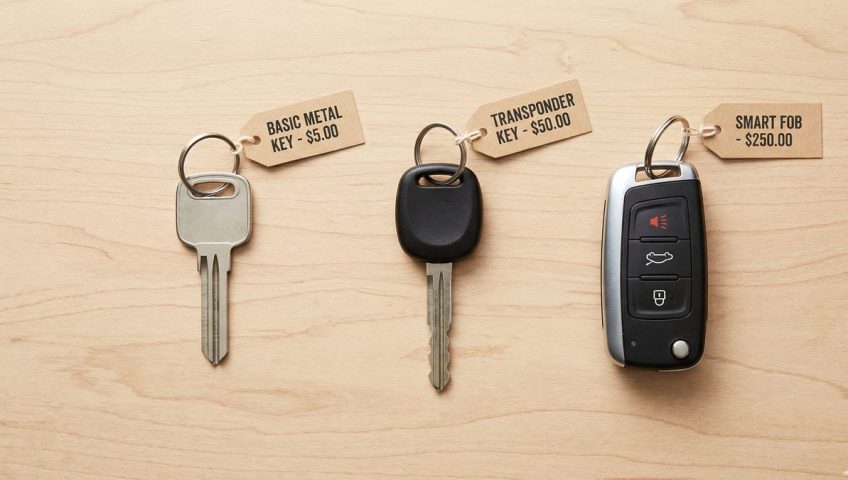
Key Type Cost Range Programming Required Common Vehicles
Basic Mechanical Key $45 – $75 No Pre-1997 models, utility vehicles
Transponder Chip Key $75 – $180 Yes — chip to immobilizer Honda Civic, Toyota Corolla, Ford F-150
Remote Head Key $120 – $225 Yes — chip + remote sync Toyota Camry, Honda Accord, Nissan Altima
Proximity / Smart Key Fob $150 – $350+ Yes — encrypted rolling code Toyota RAV4, Hyundai Tucson, Kia Sportage
European Smart Key $250 – $400+ Yes — dealer-level software BMW 3-Series, Mercedes C-Class, Audi A4
All Keys Lost (add-on) + $50 – $150 Full immobilizer reset Any vehicle — no working key available
Ignition + Key Bundle $200 – $450 Yes — ignition + key match Older Honda, GM, Chrysler models
Spare Key (with original) $75 – $120 Clone from existing key Most makes and models

Car Key Types and What Each One Costs

Not every car key is the same, and the type your vehicle uses is the single biggest factor in replacement cost. Here’s what Tempe drivers encounter most often.

Basic mechanical keys are simple metal-cut keys with no electronics. Vehicles manufactured before the mid-1990s typically use these. Replacement runs between $45 and $75, including cutting on-site. These keys don’t require programming because there’s no chip inside — the physical cut pattern is the only security layer.

Transponder chip keys contain a small radio-frequency chip embedded in the plastic head. When you insert the key and turn the ignition, the chip sends a coded signal to your vehicle’s immobilizer. If the codes don’t match, the engine won’t start. Most vehicles from 1997 onward use some form of transponder technology. Replacement typically costs $75 to $180 depending on the vehicle brand and whether the locksmith can clone from an existing key or needs to program from scratch through the OBD-II port.

Remote head keys combine a transponder chip with integrated buttons for lock, unlock, and trunk release — all in one unit. These are standard on most mid-2000s to mid-2010s vehicles. The cost ranges from $120 to $225 because the locksmith must cut the blade, program the transponder chip, and sync the remote functions separately.

Proximity fobs and smart keys are the most advanced and most expensive to replace. These push-to-start key fobs communicate with your vehicle through encrypted radio signals and never need to physically enter the ignition. Replacing one costs between $150 and $350+, depending on the brand. European vehicles like BMW, Mercedes, and Audi tend to be at the higher end because their encryption protocols require specialized software and dealer-level programming tools.

Why Location and Vehicle Brand Affect Your Price

Two drivers in Tempe can need the same service — “replace my car key” — and pay very different amounts. The vehicle brand and the specifics of the situation explain why.

Japanese brands (Toyota, Honda, Nissan, Subaru) generally fall in the moderate range. Their transponder systems use well-documented protocols, and aftermarket key blanks are widely available. A Toyota Camry transponder key might cost $90 to $140 to replace and program on-site.

American brands (Ford, Chevrolet, Dodge, Jeep) vary widely. Older Ford models with the PATS (Passive Anti-Theft System) are straightforward. Newer Dodge and Jeep vehicles with the Fobik key system cost more because the fob and transponder are integrated into a single unit that requires dealer-level access to program.

European brands (BMW, Mercedes-Benz, Volkswagen, Audi) are consistently the most expensive. Their security systems use layered encryption, and many require the locksmith to connect directly to the vehicle’s onboard computer. A Mercedes smart key replacement can run $250 to $400 depending on the model year.

The “all keys lost” scenario is always more expensive than having a spare. When you have at least one working key, a locksmith can often clone or add a new key to the system in minutes. When every key is gone, the technician must access the vehicle’s security system from scratch — resetting the immobilizer, programming a new master key, and sometimes replacing the ignition cylinder entirely. This process adds $50 to $150 to the total cost. If you’re in this situation, our car key replacement specialists handle all-keys-lost jobs daily across the Tempe metro area.

Dealership vs. Locksmith — Comparing Your Options

Most dealerships in the Phoenix metro area charge between $200 and $500 for a replacement key, and the process typically requires towing the vehicle to the dealer, waiting 3 to 7 business days for the key to be ordered, and paying separately for programming. For a car that’s already sitting in your driveway or a parking lot, that’s a significant inconvenience on top of the cost.

A mobile locksmith brings the key blanks, cutting machine, and programming equipment directly to you. The entire process — from arrival to handing you a working key — usually takes 30 to 60 minutes on-site. The cost savings compared to a dealership average 30% to 50%, and there’s no towing expense.

There’s one exception where a dealership might be necessary: some ultra-high-security vehicles (certain Volvo, Tesla, and late-model Mercedes models) use proprietary programming that only authorized dealers can access. A qualified locksmith will tell you upfront if your vehicle falls into this category rather than waste your time.

For the majority of vehicles on Tempe roads — Hondas, Toyotas, Fords, Chevys, Hyundais, Kias — a licensed mobile locksmith handles the job at a lower price and with same-day service. You can request a quote from our team before we dispatch, so there are no surprises when the technician arrives.

How Arizona Heat Damages Car Keys and Fobs

Living in the Tempe and Phoenix metro area means your car keys endure conditions that drivers in other states never deal with. Arizona’s summer heat plays a direct role in how often keys fail and need replacement.

Transponder chip delamination happens when the plastic housing around the chip expands and contracts through repeated heat cycles. Dashboard temperatures inside a parked car in Tempe can hit 170°F between June and September. Over time, this thermal stress cracks the internal antenna connection between the chip and the key housing, causing intermittent starting failures that eventually become permanent.

Key fob battery drain accelerates in extreme heat. The lithium coin-cell batteries inside fobs are rated for moderate temperatures. Consistent exposure to 110°F+ ambient air — common in Tempe from May through October — shortens battery life from the typical 2 to 3 years down to 12 to 18 months. When the battery dies in a proximity fob, many drivers assume the fob itself is broken.

Plastic housing warping affects both transponder keys and fobs. The buttons on remote head keys become soft and unresponsive. The blade on flip keys may not deploy properly because the spring mechanism housing has deformed. We see a noticeable increase in car remote and fob issues every summer at our Tempe location.

UV degradation breaks down rubber gaskets and button pads on key fobs left on dashboards or hung from rearview mirrors. The infrared signal can weaken as the fob’s plastic lens yellows and clouds, reducing the effective range from 30 feet down to 5 feet or less.

The takeaway: store your spare key indoors, not in the glove compartment or center console. If your fob’s range has been decreasing gradually, the battery or the internal antenna may be heat-damaged — not just low on charge.

What to Do When You Need a Replacement Key Right Now

If you’re locked out or stranded with a broken key, here’s the most efficient path to getting back on the road:

  • Check for a spare first. If anyone in your household has a copy, that’s the simplest solution. A locksmith can unlock your car door to get you moving while you arrange a duplicate.
  • Know your vehicle’s year, make, and model. This tells the locksmith exactly which key blank and programming protocol to bring. It also gives you an accurate price quote over the phone.
  • Have your photo ID and registration ready. Every reputable locksmith in Arizona verifies ownership before cutting or programming a key. This protects you from unauthorized key duplication.
  • Ask about the total cost upfront. A transparent locksmith gives you a price that includes the trip charge, key blank, cutting, and programming — no add-on fees after the work is done.
  • Request a warranty. Replacement keys should come with a guarantee on both the physical cut and the electronic programming. CallOrange.com includes a 30-day warranty on parts and labor for every automotive key service.

If your key snapped inside the ignition, don’t try to extract it yourself — metal fragments can damage the ignition wafer stack and turn a key replacement into a costly ignition repair. A locksmith has extraction tools designed for this exact situation.

Saving Money on Car Key Replacement

The most effective way to reduce your cost is to get a spare key made before you lose the original. Cloning an existing key is significantly less expensive than programming from scratch in an all-keys-lost scenario. Most locksmith visits for a spare transponder key cost roughly half of what you’d pay in an emergency.

Insurance coverage is another avenue worth checking. Some auto insurance policies and extended warranty plans cover key replacement, particularly for newer vehicles with expensive fob systems. AAA and similar roadside assistance programs typically cover the lockout service but not the key itself — so read the fine print.

Aftermarket vs. OEM key blanks is a real choice with real cost implications. OEM blanks from the vehicle manufacturer cost more but guarantee compatibility. Aftermarket blanks from reputable suppliers (Ilco, JMA, Keyline) work identically in most cases at 40% to 60% lower cost. A qualified locksmith knows which aftermarket blanks are reliable for your specific vehicle and which models genuinely require OEM parts.

You can also save by combining services. If your ignition has been giving you trouble and you also need a new key, handling both in one visit eliminates a second trip charge. Similarly, if you’ve just moved to Tempe and want to rekey your home locks along with getting a spare car key, bundling those services into one appointment makes financial sense.

Frequently Asked Questions

How much does a car key replacement cost?

Replacement costs range from $45 for a basic mechanical key to $350+ for a push-to-start smart key fob. The price depends on your vehicle’s year, make, model, and key type. European luxury vehicles with encrypted proximity systems sit at the higher end. We provide an exact quote over the phone once we confirm your vehicle details.

Can you make a key if I lost all copies?

Yes. Our technicians handle all-keys-lost situations daily across Tempe and the Phoenix metro area. The process involves accessing your vehicle’s immobilizer system, programming a new master key, and cutting the blade on-site. This costs $50 to $150 more than a standard replacement because of the additional programming required. Bring your photo ID and vehicle registration for ownership verification.

Is a locksmith cheaper than the dealership?

In most cases, yes — by 30% to 50%. Dealerships charge for the key, programming, and often require towing the vehicle to their location. A mobile locksmith comes to you, cuts and programs the key on-site, and completes the job in 30 to 60 minutes. The exception is a small number of ultra-high-security vehicles that require proprietary dealer software.

Do you program transponder keys on-site?

Yes. Our mobile units carry programming equipment for domestic, Japanese, Korean, and most European vehicles. We connect to your vehicle’s OBD-II port, program the transponder chip to match the immobilizer, and test the key before leaving. The entire process typically takes 20 to 45 minutes depending on the vehicle.

Does Arizona heat damage car keys?

Absolutely. Tempe’s summer temperatures cause transponder chip delamination, accelerated fob battery drain, plastic housing warping, and UV degradation of rubber buttons and signal lenses. We recommend storing spare keys indoors rather than in the glove compartment, and replacing fob batteries annually instead of waiting for failure.

What information do I need when I call?

Have your vehicle’s year, make, model, and trim level ready. Let us know if you have a working key or if all keys are lost — this affects the programming method and price. We also ask for your location so we can dispatch the nearest available technician with the correct key blank for your vehicle.

Do you offer a warranty on replacement keys?

Every car key replacement from CallOrange.com includes a 30-day warranty on both the physical key cut and the electronic programming. If the key or fob malfunctions within that period due to a defect in our work, we return and fix it at no additional charge.

Should I get a spare key made now?

Yes — getting a spare while you still have a working key costs roughly half of what you’d pay in an all-keys-lost emergency. Cloning an existing key is simpler, takes less time, and avoids the full immobilizer reset. It also means you’ll never be stranded without a backup if your primary key fails or goes missing.

Making the Right Call on Car Key Replacement in Tempe

Car key replacement costs between $45 and $350+ in Tempe, depending on key type, vehicle brand, and whether you have a spare. The gap between a basic metal key and a push-to-start proximity fob reflects the real difference in technology, equipment, and expertise required.

The smartest move is getting a spare made now while you still have a working key — it cuts your future replacement cost nearly in half and eliminates the stress of being stranded. If you’re already in a situation where you need a key today, a mobile locksmith is the most efficient and cost-effective option for the majority of vehicles.

CallOrange.com has served Tempe and the Phoenix metro area since 2015, with a 4.8-star rating across 1,451 Google reviews. Our technicians are licensed, insured, and bonded, and we carry key blanks and programming equipment for domestic, Japanese, Korean, and European vehicles. Every job includes a 30-day warranty on parts and labor.

Call (480) 847-2635 for an exact quote based on your vehicle. We verify year, make, model, and key type over the phone so you know the price before we arrive. You can also visit us at our Tempe location in Broad River Plaza or reach out through our contact page to schedule service.

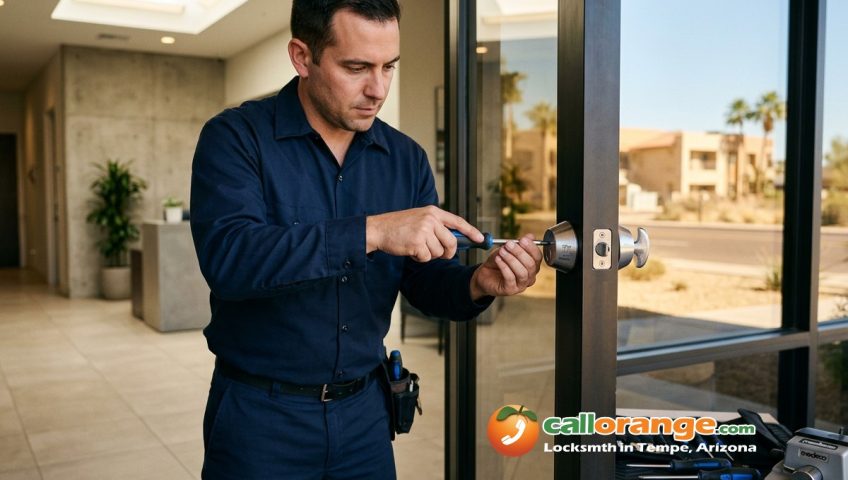
Locksmith installing a high-security deadbolt on a commercial door in Tempe AZ

High Security Locks in Tempe AZ — What Businesses and Homeowners Need to Know

A standard residential deadbolt can be bumped open in under 10 seconds with a $5 tool — high-security cylinders from Medeco, Schlage Primus, and Mul-T-Lock are specifically engineered to defeat that attack, along with picking, drilling, and unauthorized key duplication. The difference isn’t marketing language — it’s measurable engineering in the cylinder tolerances, key control systems, and hardened materials. Understanding what those differences actually are helps you decide whether a high-security upgrade is warranted for your specific property in Tempe.

Most Tempe properties run builder-grade Kwikset or standard Schlage deadbolts — hardware that meets code, operates reliably, and costs $25–$50 at a hardware store. That hardware does what it’s designed to do. What it’s designed to do is resist casual entry attempts, not targeted attacks by someone who has bought a bump key or a basic pick set. The gap between builder-grade and high-security isn’t a gap in everyday function — both turn smoothly with the right key. The gap is in what happens when someone tries to open the lock without a key.

Our locksmiths at CallOrange Locksmith in Tempe install and service high-security cylinders from Medeco, Schlage Primus, Mul-T-Lock, and ASSA Abloy on residential and commercial properties throughout Tempe and Metro Phoenix. Find our location and read reviews from Tempe property owners on Google Maps before you call. We carry high-security hardware on every truck and provide a written quote before any installation begins.

Founded in 2008, CallOrange has 17+ years of commercial and residential locksmith experience in the Tempe area. Techs Michael and Liran work high-security installations regularly — this isn’t hardware we special-order; it’s on the truck.


What Makes a Lock “High Security” — The Three Measurable Differences

The term gets used loosely in hardware store marketing. In the locksmith industry, high security has a specific meaning rooted in three engineering characteristics.

Pick resistance through tight tolerances and security pins. A standard pin tumbler cylinder uses simple driver pins and key pins. The tolerances between the pin diameter and the cylinder bore allow enough variation that a skilled pick can manipulate each stack individually — a technique called single-pin picking. High-security cylinders use spool pins, serrated pins, or mushroom pins that create false sets — the pick detects what feels like a shear line but isn’t one. Combined with tighter manufacturing tolerances that reduce the working room available to a pick, these cylinders require significantly more skill and time to pick, and many are effectively resistant to all common pick attacks.

Bump resistance through sidebar or secondary locking mechanisms. Key bumping uses a modified blank cut to maximum depth. When struck, the impact briefly separates all pin stacks simultaneously, and a fast rotation at that moment opens the cylinder. High-security cylinders defeat this with a sidebar mechanism — a secondary locking bar that must be engaged by rotating elements in the key itself, not just the pin stacks. A bump key has no sidebar profile and cannot engage that mechanism. Medeco cylinders use a combination of rotating key elements and a sidebar. Schlage Primus uses a secondary set of pins in a separate channel. Mul-T-Lock uses a telescoping pin system inside each stack. All three defeat standard bump attacks by design.

Key control through restricted keyways and patented blanks. A standard Kwikset key blank is available at every hardware store and locksmith supply house. Anyone with your key for 30 seconds can have a copy cut anywhere. High-security systems use patented keyways with restricted blanks — key duplication requires factory authorization or a licensed dealer account. Medeco keys can only be duplicated by authorized Medeco dealers with written authorization from the registered key owner. Mul-T-Lock uses a similar registered system. This means that even if a key leaves your control temporarily, an unauthorized copy cannot be made.


High-Security Cylinders We Install in Tempe — What Each One Is Best For

Medeco is the highest-recognition high-security brand in the U.S. market. Medeco cylinders combine the sidebar mechanism with key elements that rotate in the cylinder in addition to the standard vertical pin movement — the correct key must both lift all pins to the shear line and rotate each element to the correct angular position to engage the sidebar. This dual-axis requirement makes Medeco one of the most pick-resistant cylinders commercially available. Medeco is available as a deadbolt cylinder, knob cylinder, rim cylinder for commercial doors, and high-security padlock. It’s the standard choice for commercial properties in Tempe that need documented key control and maximum cylinder resistance.

Schlage Primus uses a secondary pin system in a separate keyway channel alongside the standard pin stacks. The Primus key has a standard cut profile for the primary pins plus a secondary milled track on the blade that engages the Primus pins in a separate channel. Both sets must align simultaneously. Primus keys cannot be duplicated on standard key cutting equipment — the secondary track requires Primus-specific blanks available only through authorized Schlage dealers. For Tempe homeowners and commercial operators already running Schlage hardware, the Primus upgrade integrates with existing Schlage door prep without modification.

Mul-T-Lock uses a telescoping pin system where each standard pin contains a second spring-loaded element inside it, creating a lock within a lock. To reach the shear line, both the outer pin and the inner element must be aligned simultaneously. The key has a standard external cut plus a dimple pattern on the blade face that operates the inner elements. Mul-T-Lock is widely used in Israeli government and military applications and is one of the most drill-resistant cylinders in the civilian market due to the hardened steel inserts around the pin chambers. It’s the preferred choice for high-value commercial applications in Tempe where both pick resistance and physical attack resistance are priorities.

ASSA Abloy covers a broad range of high-security hardware for commercial door systems, including mortise cylinders, exit device cylinders, and master key systems at the high-security tier. For commercial Tempe properties with mortise locks or Adams Rite-style door hardware, ASSA Abloy provides high-security options that integrate with existing commercial door prep.

Our high-security locks service covers installation, rekeying, and key duplication management for all four brands, plus compatibility assessment for your existing door hardware.


Residential vs Commercial High-Security Applications in Tempe

The hardware is the same. The installation context and key control requirements differ.

Residential applications in Tempe where high-security is worth the investment: rental properties where tenant turnover creates key control challenges, homes with previous break-in attempts, properties with high-value contents, and any home where the standard rekey cycle isn’t sufficient because the concern is targeted entry rather than unauthorized keys.

For most Tempe homeowners, the realistic upgrade path is a Schlage Primus deadbolt on the primary entry doors — it integrates with standard Schlage door prep, the key control system is straightforward to manage, and the cost is a fraction of a security system installation with meaningfully better physical deterrence than a builder-grade deadbolt. Our lock change service covers the hardware swap, and our lock rekey service handles key consolidation if you’re upgrading multiple entry points.

Commercial applications in Tempe where high-security is a standard requirement rather than an upgrade: medical offices with HIPAA-relevant access control, law offices, financial services locations, retail businesses with significant after-hours inventory exposure, and any commercial property where documented key control is part of a compliance obligation.

For commercial properties, the key control documentation aspect of high-security systems matters as much as the cylinder resistance. A registered Medeco or Mul-T-Lock key system creates an auditable record of who has been issued keys and who has authorization to duplicate them. When a key is reported lost, the restricted blank means an unauthorized copy cannot be in circulation — and rekeying under a new authorization eliminates the lost key’s validity entirely. Our commercial locksmith services cover the full scope of commercial lock installations in Tempe.


Tempe-Specific Factors — How the Climate Affects High-Security Hardware

High-security cylinders are tighter-tolerance instruments than builder-grade hardware, and Tempe’s conditions affect them in specific ways worth knowing before installation.

Thermal expansion. The precision tolerances that make Medeco and Mul-T-Lock cylinders pick-resistant also make them slightly more sensitive to thermal expansion than standard cylinders. A cylinder installed on an exterior door in direct Tempe sun can reach 160°F+ on a summer afternoon. This is within the operational range of properly installed high-security cylinders, but it means installation alignment matters more — a cylinder that’s slightly misaligned at 70°F may bind at 150°F. Our technicians verify smooth operation across the temperature range by testing after installation and before leaving.

Dust infiltration. The fine particulate in Tempe’s desert air affects all cylinders, but high-security cylinders with tighter tolerances require more consistent lubrication maintenance to prevent particulate from causing binding. We use cylinder lubricants appropriate for high-security hardware — not graphite, which works into tight tolerances and attracts particulate — and we advise on a maintenance schedule based on the cylinder brand and the door’s exposure level.

UV degradation of key head plastic. The restricted key blanks for Medeco and Mul-T-Lock use plastic key heads that hold the brand identifier and registration information. Tempe UV degrades these heads faster than in moderate climates. We recommend keeping one key stored indoors as the original and using UV-resistant key covers on daily-carry keys.


Quick Diagnosis — Which High-Security Option Fits Your Property
Situation Recommended Brand Why
Residential upgrade — currently running Schlage hardware Schlage Primus Integrates with existing Schlage door prep — no modification required, restricted key control added
Commercial property — documented key control required Medeco or Mul-T-Lock Factory-registered key system with auditable authorization — unauthorized duplication is not possible
High-value commercial — maximum drill and pick resistance Mul-T-Lock Hardened steel inserts around pin chambers — highest physical attack resistance in the civilian market
Commercial mortise or exit device cylinder replacement ASSA Abloy High-security cylinders designed for commercial door hardware formats including mortise and rim configurations
Rental property — tenant turnover key control Schlage Primus or Mul-T-Lock Restricted blanks prevent unauthorized copies — rekey under new authorization when tenant turns over
Maximum pick and bump resistance — residential or commercial Medeco Dual-axis key requirement engages sidebar — defeats standard pick and bump attacks by design

Frequently Asked Questions

How much do high-security locks cost in Tempe? +
Hardware cost varies by brand and cylinder type. Schlage Primus cylinders typically run $80–$150 per cylinder. Medeco and Mul-T-Lock cylinders range from $150–$300 depending on the format. Installation labor is separate. CallOrange provides a written quote covering hardware and labor before any work begins — call (480) 847-2635 with your property type and door count for a phone estimate.
Can high-security locks be rekeyed if a key is lost? +
Yes. High-security cylinders are rekeyed the same way standard cylinders are — the pin stacks are changed and a new key is issued. The advantage is that the restricted blank means an unauthorized copy of the lost key cannot be in circulation. Rekeying under a new authorization eliminates the lost key’s validity and updates the key control record.
Are high-security locks worth it for a Tempe home? +
For most homes, a Schlage Primus upgrade on primary entry doors is a cost-effective improvement over builder-grade hardware — the key control benefit alone justifies it for properties with tenant history or high turnover of key holders. Full Medeco or Mul-T-Lock installation makes the most sense for homes with documented security concerns or high-value contents. We assess your specific situation and give you an honest recommendation, not a default toward the highest-cost option.
Will high-security locks work in Tempe’s heat? +
Yes, with proper installation and maintenance. High-security cylinders have tighter tolerances than standard hardware, which makes correct installation alignment more important in Tempe’s extreme heat range. Our technicians verify smooth operation at installation and advise on lubrication maintenance to prevent dust-related binding over time.
Where can I get high-security keys duplicated in Tempe? +
High-security keys use restricted blanks that cannot be duplicated at hardware stores or standard key kiosks. Duplication requires authorization from the registered key owner and must be performed by a licensed dealer for that brand. CallOrange is a licensed dealer for the brands we install — key duplication is handled through us with proper authorization documentation.
Can high-security cylinders be installed in my existing door hardware? +
In most cases, yes. High-security cylinders are available in standard residential deadbolt formats, knob and lever formats, mortise formats, and rim formats. Schlage Primus cylinders install directly in existing Schlage-prep doors. Medeco and Mul-T-Lock are available in formats that fit most standard residential and commercial door prep. We confirm compatibility with your existing hardware before ordering anything.
Do high-security locks prevent all break-ins? +
No lock prevents all entry — a determined attacker with enough time and the right tools can defeat any cylinder. What high-security locks do is eliminate the fastest and most common attack methods: bumping, basic picking, and unauthorized key duplication. They force a longer, noisier, more visible forced entry if the cylinder is to be defeated — which is a meaningful deterrent in most real-world scenarios. Cylinder resistance is one layer of a complete door security assessment that also includes strike plate depth, door frame condition, and hinge security.

The Right Next Step

High-security hardware in Tempe isn’t a premium purchase for its own sake — it’s a specific answer to a specific problem. If the problem is key control over a managed property, Schlage Primus or Mul-T-Lock provides a documented system that standard hardware cannot replicate. If the problem is cylinder resistance on a commercial property with real after-hours exposure, Medeco or Mul-T-Lock addresses that directly. If the problem is a builder-grade deadbolt on a home where someone has made you uncomfortable about who might have a key, a Schlage Primus upgrade closes that gap at a cost well below what most people expect.

CallOrange Locksmith in Tempe installs Medeco, Schlage Primus, Mul-T-Lock, and ASSA Abloy hardware on residential and commercial properties throughout Tempe and Metro Phoenix. Our technicians are licensed, insured, and bonded, carry high-security hardware on every truck, and complete most installations in a single visit. Founded in 2008, with 17+ years of locksmith experience and a 5-star Google rating from Tempe property owners.

Call (480) 847-2635 to schedule your high-security assessment. We’re available every day from 6:00 AM to 10:00 PM. Visit our contact page for non-urgent scheduling, or see our commercial locksmith services and residential locksmith services for the full scope of what CallOrange covers in Tempe.

Residential locksmith rekeying a deadbolt cylinder at a home in Tempe AZ

Rekey vs Lock Change in Tempe AZ — Which One Do You Actually Need?

Rekeying and lock replacement are two different solutions to two different problems — and choosing the wrong one costs either money you didn’t need to spend or security you can’t recover. Rekeying reconfigures the pins inside the existing cylinder so the old key stops working and a new key takes its place. Lock replacement swaps the entire hardware unit. The right choice depends on the condition of the hardware, the reason you need the change, and what level of security you want going forward.

The most common reason Tempe homeowners call about rekeying is a life transition: a move into a new home, a roommate or tenant moving out, a relationship ending, or a key that was lost or stolen. In every one of those scenarios, the question isn’t whether the lock works — it’s whether the wrong person might still have a key that works. That’s a rekeying situation, not a hardware replacement situation, unless the lock itself is damaged or you want to upgrade security at the same time.

Our locksmiths at CallOrange Locksmith in Tempe handle both rekeying and lock replacement from mobile units, available every day from 6:00 AM to 10:00 PM. See our location and read reviews from Tempe homeowners on Google Maps — our track record on residential lock work is documented there. We provide a written quote before any work begins, and we carry replacement hardware for all major residential lock brands on every truck.

Founded in 2008, CallOrange has 17+ years of residential locksmith experience across Tempe, Mesa, Chandler, and the Metro Phoenix area. Techs Michael and Liran work Tempe area calls regularly and carry Schlage Primus, Medeco, Mul-T-Lock, ASSA Abloy, and Kwikset hardware for same-visit upgrades when the job calls for it.


What Rekeying Actually Does — and What It Doesn’t

Rekeying changes which key operates the lock. It does not change the lock itself.

Inside every pin tumbler cylinder is a stack of driver pins and key pins — typically five or six pin stacks depending on the keyway. The key lifts each stack to a precise height determined by its cuts. When all stacks align at the shear line, the cylinder turns. Rekeying replaces the key pins at the bottom of each stack with pins of different heights, calibrated to a new key blank. The old key’s cuts no longer align the stacks. The new key does.

The entire process takes 15–20 minutes per lock. The cylinder is removed from the door hardware, the retaining clip is released, the plug is pushed out, and the pin stacks are swapped using a plug follower and pinning tray. The cylinder goes back in, the new key is tested, and the job is done. The existing lock hardware — the deadbolt body, the latch assembly, the strike plate, the door prep — stays exactly where it is. Nothing on the door changes except which key turns it.

What rekeying doesn’t do: it doesn’t upgrade the pick resistance of the cylinder, doesn’t change the bump resistance of the lock, and doesn’t address physical damage to the hardware. If the deadbolt throw is short, the strike plate is loose, or the cylinder has wear from years of use, rekeying fixes the key control problem but leaves every other vulnerability in place. That’s the distinction that determines when a full lock change is worth the additional cost.

Our lock rekey service covers all standard residential pin tumbler cylinders, including deadbolts and knob/lever sets.


What a Lock Change Involves — and When It’s the Right Answer

A lock change replaces the entire hardware unit: deadbolt body, cylinder, latch or bolt mechanism, and exterior and interior trim. The door prep — the holes drilled for the lock and the latch — stays the same if the new hardware matches the existing bore dimensions. Most residential deadbolts use a standard 2-1/8″ bore, which covers the vast majority of replacement options at every price point.

Lock replacement is the right answer in four specific scenarios:

The hardware is physically damaged. A cylinder that’s been drilled, a deadbolt body that’s been forced, a latch that’s seized or misaligned — damaged components don’t rekey correctly and can fail under normal use. Replacement is the only reliable fix.

The lock is worn to the point of functional unreliability. Tempe’s dust and heat accelerate cylinder wear faster than in moderate climates. Fine particulate from desert conditions works into the keyway and acts as an abrasive on the pin stacks. A cylinder that’s been through a decade of Tempe summers without lubrication may have tolerances too loose for accurate rekeying. A new cylinder performs to factory specification.

You want a security upgrade at the same time. Rekeying a builder-grade Kwikset to a new key does nothing for its pick resistance or bump resistance. If you’re rekeying after a security concern — a break-in attempt, a lost key in a high-risk situation — upgrading to a high-security cylinder like a Schlage Primus, Medeco, or Mul-T-Lock at the same time addresses the key control problem and the hardware vulnerability in one visit. Our high-security locks service covers what distinguishes a high-security cylinder from a standard residential lock.

You’re replacing a deadbolt with a smart lock. Smart lock installation is a lock change by definition — the entire hardware platform changes. The cylinder is replaced with an electronic module, and the interior assembly changes entirely. Our lock change service covers standard replacement, and for smart lock conversions, we address the door prep if the new hardware requires it.


The Cost Difference — What You’re Actually Paying For

Rekeying costs less than lock replacement in almost every scenario. The cost of a rekey is labor plus a minimal parts cost — a set of key pins and a new key blank. The lock hardware itself is untouched.

Lock replacement costs more because you’re paying for new hardware in addition to labor. The hardware cost varies widely: a builder-grade Kwikset deadbolt runs $20–$40. A mid-grade Schlage B60N runs $40–$70. A high-security Schlage Primus or Medeco cylinder runs $150–$300 for the cylinder alone. The labor to install any of them is roughly the same.

The scenario where lock replacement actually saves money: If you’re moving into a Tempe home and the existing locks are worn builder-grade hardware from 2005, rekeying them gives you key control but leaves aging hardware on the door. Replacing them with mid-grade deadbolts gives you key control, new hardware tolerances, and a warranty — for a cost difference that’s modest when you’re already paying for a locksmith visit.

We give you the honest comparison on-site. A written quote covers both options when they apply, and you decide which direction matches your situation and budget. There’s no pressure toward the higher-cost option — our job is to solve your security problem, not to sell hardware you don’t need.


Tempe-Specific Factors That Affect This Decision

Arizona’s climate creates two residential lock issues that don’t come up in the same way in moderate markets.

Cylinder wear from dust. The fine particulate common in Tempe’s air — particularly during haboob season — works into keyways and pin chambers over time. A well-maintained cylinder with periodic lubrication handles this without issue. A cylinder that’s been running dry for years may have pin stack tolerances loose enough that rekeying produces an unreliable result. When we assess a cylinder before rekeying, we’re looking for this wear pattern.

UV and heat damage to rubber gaskets and plastic components. Exterior lock hardware in Tempe takes UV and thermal stress that interior hardware doesn’t. Rubber gaskets around the cylinder and interior the deadbolt body degrade and crack. On some older hardware, the plastic cam at the back of the cylinder becomes brittle. Neither of these is visible from the outside, and neither prevents rekeying — but both are signs that the hardware has more years behind it than ahead of it, which factors into the rekey-vs-replace recommendation.

When we assess your locks in Tempe, we account for both. The recommendation you get reflects the actual condition of your specific hardware, not a default preference for one service over the other.

Quick Diagnosis — Which Service Your Situation Calls For
Situation Recommended Service Why
Moved into a new home in Tempe Rekey (or replace if hardware is worn) Previous owner, agent, and contractor keys all stop working — same hardware, new key control
Lost or stolen key Rekey immediately Lost key is no longer valid — hardware condition permitting, no replacement needed
Tenant or roommate moved out Rekey Key access revoked without hardware replacement — faster and lower cost than new locks
Lock physically damaged or forced Lock replacement Damaged hardware can’t be rekeyed reliably — replacement restores full function
Hardware is worn — builder-grade 10+ years old Lock replacement Loose pin tolerances from Tempe dust wear make rekeying unreliable — new hardware performs to spec
Want pick or bump resistance upgrade Lock replacement — high-security cylinder Rekeying doesn’t change cylinder security rating — only new hardware upgrades resistance
Multiple doors — want one key for all Rekey to matching key or master key system All compatible cylinders rekeyed to same bitting — one key operates all doors


Master Keying and Key Consolidation — A Third Option Worth Knowing

If you’re a Tempe homeowner or landlord managing multiple units or entry points, rekeying also opens the option of master key consolidation — configuring multiple cylinders to operate on a single master key while each lock still has its own individual key. This is accomplished through a bitting hierarchy in the pin stacks that creates two shear lines: one for the individual key, one for the master.

Master keying is more complex than standard rekeying and requires planning the key hierarchy before any pins are cut — you can’t add master keying to an existing standard rekey after the fact without redoing the job. If key consolidation is relevant to your situation, tell us when you call and we’ll plan the pinning accordingly.

For rental properties where tenants need individual key control and the owner needs master access, this is a standard approach that eliminates the need to replace hardware every time a tenant turns over. Our lock rekey service and lock change service both support master key configurations.

Frequently Asked Questions

How much does rekeying cost in Tempe compared to lock replacement? +
Rekeying costs significantly less than lock replacement because the hardware stays in place — you’re paying for labor and a minimal parts cost for new key pins. Lock replacement adds the cost of the new hardware on top of labor. We provide a written quote for both options when they apply so you can make an informed decision. Call (480) 847-2635 for a phone estimate based on your specific locks and situation.
Should I rekey when I move into a new home in Tempe? +
Yes — it’s the first thing most security-conscious homeowners do after closing. The previous owner, real estate agents, contractors, and anyone they gave keys to all still have working keys to your home until you rekey. The lock hardware is perfectly functional; the only thing that changes is which key turns it. A standard three-door residential rekey takes under an hour.
Can any lock be rekeyed? +
Any standard pin tumbler lock can be rekeyed — which covers nearly all residential deadbolts and knob or lever sets. Wafer tumbler locks (common on older interior doors and some padlocks) use a different mechanism and cannot be rekeyed the same way. Smart locks with electronic cylinders are replaced rather than rekeyed. If you’re unsure what type of lock you have, describe it when you call and we’ll tell you which applies.
How long does a residential rekey take in Tempe? +
Each individual lock takes 15–20 minutes. A standard Tempe home with a front door deadbolt, front door knob, and back door deadbolt is typically rekeyed in under an hour. We test the new key in each cylinder before moving to the next lock, and we test it in all locks at the end to confirm they all work on the same key.
Does Tempe heat affect residential lock hardware? +
Yes, in two specific ways. Desert dust and fine particulate work into keyways and act as an abrasive on pin stacks over years of use, loosening tolerances. UV and heat degrade rubber gaskets and plastic cylinder components on exterior-facing hardware. These factors accelerate hardware wear compared to moderate climates, which is why we assess cylinder condition before recommending a rekey vs replacement on older Tempe hardware.
Can you rekey my locks so they all use the same key? +
Yes — key consolidation is one of the most common rekey requests we get in Tempe. As long as all the cylinders use the same keyway profile, we rekey them all to a single key blank. If they use different keyways, cylinder replacement with matching hardware is required. We assess compatibility on-site before quoting.
Is rekeying as secure as replacing the locks? +
For key control purposes, yes — a rekeyed lock is just as effective as a new lock at preventing entry with the old key. For overall security level, the answer depends on the hardware. Rekeying a builder-grade deadbolt gives you key control but the same pick and bump resistance as before. If security level matters, upgrading to a high-security cylinder during the same visit is the way to address both issues at once.


Making the Right Call

Most Tempe homeowners who need to change who has access to their home need a rekey — not new hardware. The lock works fine; the problem is that someone else has a key that also works fine. Rekeying solves that in 15–20 minutes per lock at a fraction of the cost of new hardware.

Lock replacement is the right call when the hardware itself is the issue: physical damage, excessive wear, a security upgrade, or a smart lock conversion. We assess your existing hardware on-site and tell you which situation you’re actually in before quoting either option.

CallOrange Locksmith in Tempe has served Tempe homeowners since 2008. Our technicians are licensed, insured, and bonded, carry Schlage, Medeco, Mul-T-Lock, and Kwikset hardware on every truck, and complete most residential rekey and lock change jobs in a single visit. Every job comes with a written quote before work begins and a warranty on parts and labor.

Call (480) 847-2635 to schedule your rekey or lock assessment. We’re available every day from 6:00 AM to 10:00 PM. Visit our contact page for non-urgent scheduling, or see our residential locksmith services for everything we cover in Tempe.

Mobile locksmith programming a transponder car key via OBD-II connection in a Tempe AZ parking lot

Transponder Key Programming in Tempe AZ — Locksmith vs Dealer

Transponder key failures in Tempe are frequently misdiagnosed as dead batteries — the real cause is chip delamination from Arizona’s 115°F+ heat, which breaks the internal antenna connection inside the key head. A new battery changes nothing. The fix is chip diagnosis, cloning or transponder replacement, and ECU re-authorization — work a mobile locksmith performs on-site in under an hour without a tow to the dealer.

Every vehicle manufactured after 1995 in the U.S. uses a transponder system. The chip embedded in the key head transmits a rolling code to the immobilizer module near the ignition. If the code doesn’t match, the engine cranks but won’t start — the immobilizer cuts fuel injection regardless of whether the mechanical key blade is the correct cut. In Tempe’s climate, the most common failure point isn’t the chip itself but the antenna wire coiled inside the plastic key head. Thermal expansion and contraction cycles crack the solder points over time, breaking the signal path before the chip shows any visible damage.

Our automotive locksmiths at CallOrange Locksmith in Tempe program transponder keys on-site daily from 6:00 AM to 10:00 PM — no tow required, no dealership appointment. See our location and customer reviews on Google Maps before you call. We carry key blanks and programming equipment for all major platforms on every truck, and we provide a written quote before any work begins.

Founded in 2008, CallOrange has 17+ years of automotive locksmith experience across Tempe, Mesa, Chandler, Scottsdale, and the Metro Phoenix area. Our technicians work with Mul-T-Lock, Schlage Primus, Medeco, ASSA Abloy, Kwikset, and all major OEM transponder systems — the full platform range, not just common domestic vehicles.


How Transponder Keys Work — and Why Arizona Heat Breaks Them

Understanding the failure mode helps you make the right call faster.

A transponder key has three functional components: the mechanical blade that operates the lock cylinder, the chip (typically a Philips, Texas Instruments, or Megamos crystal), and the antenna coil that lets the immobilizer reader energize and interrogate the chip. The antenna is a tight coil of wire inside the plastic key head — not in the chip itself. The immobilizer ring around the ignition cylinder sends a low-frequency RF field, the antenna coil picks it up and powers the chip, and the chip responds with its authorization code.

Tempe’s thermal environment attacks the antenna coil specifically. A key left in a car on a summer day reaches 180°F+. A key pulled from a pocket into a 115°F exterior temperature expands and contracts through the same range every day. The wire coil and the solder joints that connect it to the chip board undergo hundreds of micro-stress cycles per year. Eventually a joint cracks, the coil loses continuity, and the chip goes silent — even though the chip itself is undamaged.

The secondary failure mode is key head delamination. Tempe UV exposure causes the plastic key head to become brittle, and the key head splits where it meets the blade collar. When that happens, the antenna shifts position inside the head and loses reliable contact with the ignition reader — the vehicle starts intermittently, then stops starting entirely.

Neither failure shows any visible damage. A diagnostic tool that reads the chip directly can confirm which component has failed before any replacement is ordered.


Locksmith vs Dealer — The Real Comparison in Tempe

This is the question most Tempe drivers search before calling anyone. The honest answer depends on what you need.

Dealership programming is brand-specific, appointment-based, and requires the vehicle to be on-site. Most Tempe dealerships schedule transponder programming as a service department job — typical wait times run 1–3 days for an appointment, and the vehicle must be driven or towed in. Dealer cost for a transponder key with programming typically runs $150–$400 depending on make and model. For proximity keys and smart fobs, the range is $200–$600. The dealer uses OEM programming software, which is the definitive tool for newer vehicles with rolling-code systems that require factory authorization.

Mobile locksmith programming eliminates the tow and the appointment. A CallOrange technician comes to your location with aftermarket key blanks and professional programming equipment — including tools compatible with EEPROM-based systems, OBD-II pin-detect programming, and proximity key frequency matching. For most vehicles, the programming is completed on-site in 30–60 minutes. Cost is typically lower than dealer pricing, and there’s no tow bill. The written quote you receive before work begins covers both the key and the programming — no separate line items added after.

The scenario where a dealer is the better choice: Vehicles with manufacturer-encrypted systems that require a live connection to the OEM server for authorization — primarily newer BMW, Mercedes-Benz, and select GM platforms with VATS encryption. Our technicians identify these during the initial consultation and tell you directly if a dealer connection is required. We don’t attempt programming we can’t complete.

For the majority of Tempe drivers — domestic trucks and SUVs, Japanese platforms, Korean vehicles, and most European models from 2010–2020 — a mobile locksmith is the faster, lower-cost option with no difference in programming quality. Our replacement car keys service covers the full key-cutting and programming scope, and our push-to-start and keyless ignition service specifically covers proximity keys and smart fobs.


Transponder Key Types — What You Have and What Programming Involves

Fixed-code transponders use a single stored code that never changes. These are found on domestic vehicles from the mid-1990s through the early 2000s and some Japanese platforms. Programming involves writing a new code to the chip and adding it to the immobilizer’s authorized list. These are the most straightforward to program and the most compatible with aftermarket equipment.

Rolling-code transponders generate a new code on each start cycle using a synchronized algorithm between the key and the ECU. Most vehicles from 2005 onward use rolling codes. Programming requires synchronizing the new key’s algorithm with the ECU’s current state — this is a two-step process involving both the key and the vehicle’s OBD-II port.

Proximity keys and smart fobs operate on a different frequency entirely — typically 315 MHz or 433 MHz RF — and contain a transponder backup chip for the mechanical emergency start function. Programming requires pairing the RF frequency to the body control module in addition to the transponder authorization. Our make car key service covers new key origination for vehicles with no working key present — a scenario that requires reading the immobilizer’s stored data directly rather than cloning an existing key.

Cloning vs new programming: If you have a working original key, the fastest approach is cloning — reading the chip data from the original and writing it to a new key blank. Cloning doesn’t require access to the vehicle’s OBD-II port. If the original key is lost, damaged, or non-functional, new programming from the vehicle’s immobilizer data is required. Both approaches are available on our truck.


Quick Diagnosis — What Your Vehicle Is Telling You
Symptom Likely Cause What a Pro Checks
Engine cranks but won’t start Transponder not communicating — immobilizer blocking fuel OBD-II immobilizer read, chip diagnostic, antenna coil continuity
Vehicle starts sometimes, not others Cracked antenna coil or delaminating key head Chip read at multiple positions, key head integrity, solder joint check
Security light stays on after inserting key Immobilizer not receiving valid code from chip Immobilizer module status, chip family verification, ECU authorization count
New battery didn’t fix the no-start Chip failure, not battery — misdiagnosis is common Transponder chip read, antenna signal test, immobilizer log
Key fob buttons work but car won’t start RF and transponder are separate — fob RF works, transponder chip failed Separate chip and RF diagnostics, fob PCB inspection
Only one key left — original lost Need new key programmed from immobilizer data EEPROM read or OBD-II new key origination, VIN-matched blade cut

The Programming Process — What Happens On-Site

When a CallOrange technician arrives at your Tempe location, the job starts with a diagnostic read — not a replacement order.

We connect to the vehicle’s OBD-II port and read the current immobilizer status. This confirms how many keys are currently authorized, whether the ECU is locked from too many failed programming attempts, and which chip family is required for replacement. On vehicles with a working original key, we read the chip data directly using a transponder analyzer.

From that diagnostic read we provide your written quote — key blank cost, programming fee, total. You approve it before we cut or program anything.

Key cutting happens on-site using our mobile cutting equipment calibrated to your vehicle’s VIN data or a direct trace from the original blade. The cut key is tested mechanically in the lock cylinder before programming begins — a key that doesn’t turn the cylinder cleanly won’t start the vehicle even with a valid transponder signal.

Programming is performed via OBD-II connection or emergency bypass procedure depending on the platform. After programming, we verify the new key starts the engine and test the original key (if present) to confirm it still functions. We don’t leave until both tests pass.

See our automotive locksmith services overview for the full scope of what we carry and program, and our ignition repair service if the ignition cylinder itself has wear that’s affecting key turn and start.


Frequently Asked Questions

How much does transponder key programming cost in Tempe? +
Cost depends on vehicle make, model, year, and key type. Standard chip key programming runs significantly less than dealer pricing in most cases. CallOrange provides a written quote after the diagnostic read — you know the full cost before any key is cut or programmed. Call (480) 847-2635 with your year, make, and model for a phone estimate.
Can you program a transponder key without the original? +
Yes. If no working key is present, we perform new key origination from the vehicle’s immobilizer data via OBD-II connection or EEPROM read depending on the platform. The blade is cut to your VIN and the chip is programmed from scratch to the ECU. This takes longer than cloning an existing key but is completed on-site in most cases.
Is a mobile locksmith as good as the dealer for key programming? +
For most vehicles — domestic, Japanese, Korean, and most European platforms — yes. Professional aftermarket programming equipment covers the full key-authorization process for the majority of vehicles on the road. The exception is certain newer European and GM platforms with manufacturer-encrypted OEM-server authorization. We identify those during the initial consultation and tell you directly if a dealer connection is required.
Why did Arizona heat cause my transponder key to fail? +
Tempe’s summer heat cycles — from 115°F ambient to 180°F+ inside a parked car — cause the antenna coil wire inside the key head to expand and contract repeatedly. Over time this cracks the solder joints connecting the coil to the chip board, breaking the signal path. The chip itself is usually undamaged, but without a functioning antenna coil the immobilizer can’t read it. This failure is specific to the Phoenix metro climate and happens faster than in moderate climates.
How long does on-site transponder key programming take? +
Most transponder key jobs — diagnostic read, key cutting, and programming — are completed in 30 to 60 minutes on-site. Proximity key and smart fob programming takes slightly longer due to the RF pairing step in addition to transponder authorization. We don’t leave until the new key has started the engine and all existing keys have been tested.
Do you carry key blanks for all vehicle makes in Tempe? +
We carry blanks for all major domestic, Japanese, European, and Korean platforms on every truck. When you call, give us your year, make, and model and we confirm blank availability before dispatch — we won’t send a technician who doesn’t have the right blank for your vehicle. Specialty or rare platforms may require a blank order, which we communicate upfront.
Can you program a second key so I have a spare? +
Yes, and we recommend it. Programming a second key during the same visit costs less than a separate service call later — the vehicle is already in programming mode and the diagnostic work is already done. A spare transponder key stored somewhere other than your main keychain is the most effective way to avoid a future lockout or no-start in Tempe’s climate.

Getting Back on the Road

A transponder key problem in Tempe doesn’t require a tow or a multi-day wait. The diagnostic, key cutting, and programming happen at your location — most jobs are done in under an hour. The written quote you get before we start covers everything; there are no separate charges added after the engine starts.

CallOrange Locksmith in Tempe has been serving drivers across the Metro Phoenix area since 2008. Our technicians are licensed, insured, and bonded, and they carry blanks and programming equipment for domestic, Japanese, European, and Korean platforms on every truck. Our 5-star Google reviews from Tempe drivers reflect the same standard on every automotive call.

Call (480) 847-2635 to schedule your transponder key service. We’re available every day from 6:00 AM to 10:00 PM. Visit our contact page for non-urgent scheduling, or see our about page to learn more about how our team operates. Our full automotive locksmith services page covers every key type and ignition service we handle in Tempe.

Mobile locksmith unlocking a car door during a car lockout service call in Tempe AZ

Car Lockout Service in Tempe AZ

A car lockout in Tempe isn’t just an inconvenience — standing outside on asphalt that reaches 170°F in summer while your vehicle’s interior climbs past 150°F is a genuine health risk. Getting a trained mobile locksmith to your location fast is the right call. Forcing entry with improvised tools bends door linkage rods and damages weather seals, turning a simple unlock into a repair bill.

Car lockouts happen the same predictable ways: keys left on the seat when the door auto-locks, a fob battery that dies without warning, a broken key blade stuck in the door cylinder, or a spare that never made it off the counter at home. Modern vehicles have multiple layers of door linkage inside the panel — the mechanisms that connect the exterior handle to the latch. The wrong tool in the wrong position bends one of those rods and the door stops responding entirely.

Our mobile locksmiths at CallOrange Locksmith in Tempe are positioned across the Tempe and Metro Phoenix area, available every day from 6:00 AM to 10:00 PM. Find us on Google Maps and read reviews from Tempe drivers before you call — our location, our hours, and our track record are all there. We carry professional entry tools for every vehicle platform on every truck.

Founded in 2008, CallOrange has 17+ years serving Tempe area drivers. Our TechTracker GPS dispatch system routes the nearest available technician to your location the moment you call — no relay, no wait time added by a call center routing you elsewhere.


What Happens on a Car Lockout Call

The process from your call to your door opening is consistent on every job.

When you call (480) 847-2635, we confirm your location, vehicle make and model, and the nature of the lockout. That information goes directly to the nearest technician via TechTracker dispatch. We give you an honest estimated arrival time based on where that technician actually is — not an optimistic number.

On arrival, the technician assesses which entry method applies to your specific vehicle. Entry technique is platform-specific. A door unlock on a late-model Ford F-150 uses different tools and angles than a Honda Civic or a BMW 3 Series with flush door handles. Our technicians — including longtime techs Michael and Liran — work across all makes, including domestic, Japanese, European, and Korean platforms.

After entry, we inspect the door to confirm the linkage is intact and the handle is responding normally. If the lockout happened because of a broken key in the cylinder, we can extract the fragment and cut a new key on-site. If the fob battery died and the vehicle has no mechanical key backup, we diagnose the correct bypass path for your specific push-to-start system. See our unlock car door service for a full breakdown of entry methods by vehicle type, and our push-to-start and keyless ignition service for dead-fob scenarios.


Car Lockout Scenarios in Tempe — What Each One Involves

Keys locked inside, door auto-locked. The most common call. The lock is intact, the key is visible. Professional entry tools — either a long-reach tool through the window seal or an air wedge and rod through the door frame — reach the interior unlock mechanism without touching the door linkage. Properly executed, zero damage.

Broken key in the door cylinder. A key blade that snaps in the cylinder blocks entry and prevents using a spare. Extraction requires broken key extractors sized to the key blank profile. Depending on how far the fragment has traveled and whether it’s rotated in the lock, the cylinder may need to be removed and inspected. We carry replacement cylinders for major vehicle platforms if the lock is damaged beyond rekey. Our ignition repair service covers the same broken-key scenario when the fragment is in the ignition rather than the door.

Key fob battery dead — push-to-start vehicle. Most push-to-start vehicles have a mechanical key blade embedded in the fob. If yours does, the door has a mechanical cylinder behind a cover that accepts that blade. If the fob has no blade, most platforms have an emergency entry point under the door handle cover or a proximity bypass using the fob body held against the start button. Our locksmiths diagnose the correct entry path for your vehicle before touching anything.

Key lost or left at home. A lockout caused by a lost key warrants a different response than one caused by keys locked inside. If the key is lost, we recommend a car key replacement to ensure no one else can use that key. If your key is just at home, a door unlock is the complete solution.


Quick Diagnosis — What Your Situation Calls For
Situation Likely Solution What the Tech Does
Keys locked inside, door closed Professional door entry Long-reach tool or wedge entry — zero damage to linkage or seals
Key fob dead — push-to-start vehicle Emergency mechanical bypass or proximity entry Platform-specific fob bypass, hidden cylinder access if equipped
Key broken inside door cylinder Broken key extraction + new key cut Extractor tools, cylinder inspection, on-site replacement if damaged
Key lost — not inside vehicle Door unlock + replacement key cut Entry via professional tools, new key cut to VIN same visit
Transponder key won’t communicate Transponder diagnosis + programming Chip read, clone or replacement key cut and programmed to ECU
Door handle not responding after DIY attempt Linkage rod inspection + repair Door panel removal, bent rod identification, replacement if needed

Why Not to Use DIY Entry Methods in Tempe

A wire hanger or credit card works in movies. In a modern vehicle, the door panel contains multiple plastic linkage rods connecting the exterior handle, interior handle, latch, and lock cylinder. A wire slipped between the door and the frame with no knowledge of where those rods sit bends the closest one. That bent rod means the exterior handle no longer opens the door, the interior handle may not either, and the door has to be disassembled to replace the rod — typically $150–$300 at a body shop.

Tempe’s heat adds a second problem. Rubber weather stripping gets brittle in sustained UV and heat exposure. Forcing a tool between the glass and the seal when the rubber is hot and dry tears the seal, letting water in during monsoon season and wind noise year-round. Replacement seals for a modern vehicle door run $80–$200 plus labor.

Professional entry tools are designed to avoid both of these outcomes. The time from our arrival to your door opening is typically under 10 minutes. That’s the actual cost comparison.

Our automotive locksmith services page has the full scope of what we handle — lockouts, key cutting, transponder programming, ignition repair — all from mobile units that come to you.


Frequently Asked Questions

How long does it take for a locksmith to arrive in Tempe? +
CallOrange uses TechTracker GPS dispatch to route the nearest available technician to your location. Actual arrival time depends on current technician positions and traffic — we give you an honest estimate when you call, not an optimistic number. Call (480) 847-2635 and we’ll tell you exactly where the nearest tech is.
Will a locksmith damage my car door? +
A trained locksmith using professional entry tools causes zero damage to the door panel, weather seals, or linkage rods. The risk of damage comes from improvised tools — wires, hangers, or credit cards — which have no way to avoid the linkage rods inside the door. Professional long-reach tools and wedges are designed specifically to access the interior mechanism without contacting the panel components.
How much does a car lockout service cost in Tempe? +
CallOrange provides a written quote before any work begins — you know the full cost before the technician touches the door. Cost varies based on vehicle type, lock configuration, and whether additional services like broken key extraction or replacement key cutting are needed. Call (480) 847-2635 for a phone estimate based on your vehicle and situation.
What should I do while waiting for the locksmith? +
Stay in a shaded area or a nearby air-conditioned space if possible. Tempe summer heat causes heat exhaustion within 30 minutes of standing in direct sun — don’t underestimate it. If you’re in a parking lot with shade available, use it. Don’t attempt to enter the vehicle with improvised tools while you wait — that’s the most common way a straightforward lockout becomes a door repair.
Can you unlock any car make or model? +
Yes. CallOrange technicians work across all makes and models — domestic, Japanese, European, Korean, and luxury platforms. Some vehicles with flush door handles or double-locked security require specific entry techniques. When you call, give us the year, make, and model and we confirm the correct approach before dispatch.
Is CallOrange available for car lockouts on weekends in Tempe? +
Yes. CallOrange Locksmith in Tempe is available every day of the week from 6:00 AM to 10:00 PM, including weekends and holidays. Call (480) 847-2635 and we’ll dispatch the closest available technician to your Tempe location.

What to Do Right Now

A car lockout in Tempe has one correct response: call a mobile locksmith and stay in a shaded area while you wait. The door opens without damage, you’re back on the road, and nothing about your vehicle has changed. That’s the only outcome worth pursuing.

If your lockout happened because of a lost key rather than keys locked inside, the right follow-up is a replacement key cut to your VIN to restore full security. We handle that in the same visit. If the lockout revealed a damaged lock cylinder or a fob that’s failing beyond battery, our automotive service team can diagnose and resolve both in one stop.

CallOrange Locksmith in Tempe has served drivers across Tempe, Mesa, Chandler, and the Metro Phoenix area since 2008. Our technicians are licensed, insured, and bonded, and every job comes with a written quote before any work begins — no surprise charges after the door is open. Our 5-star reviews reflect the same standard on every call.

Call (480) 847-2635 right now. We’re available daily from 6:00 AM to 10:00 PM. Visit our contact page for non-emergency scheduling, or see our full services menu for everything CallOrange covers in Tempe.

Car lockout service by auto locksmith in Tempe Arizona opening vehicle door

Auto Locksmith Tempe: Why “Key Not Detected” and Remote Failures Spike in Dust + Heat

“Key Not Detected” is usually a signal-quality or power-quality problem—not a mysterious immobilizer failure. In Tempe heat and dust, fob batteries sag, contacts oxidize, antennas see weaker reception, and interference sources pile up, so the vehicle intermittently loses clean authorization.

If your car starts one minute and refuses the next, the pattern matters: temperature, time of day, parking location, and whether the remote buttons still work. Those clues tell a technician whether you’re dealing with fob power, receiver/antenna sensitivity, RF interference, or mechanical wear in the ignition/door hardware.

For more automotive topics, start with our blog hub: automotive locksmith resources or browse the full library on our blog. When you’re ready to schedule, use our Contact Us page or learn who we are on About Us.

Directions and reviews: Google Maps


Why Tempe and Phoenix conditions make keyless issues more common

A modern key fob system depends on stable voltage, clean electrical contact, and a strong RF “handshake” between the fob and the vehicle. In Tempe, Phoenix, Mesa, Chandler, Scottsdale, and Gilbert, the environment pushes on all three:

  • Heat accelerates battery voltage drop (especially older coin cells) and increases resistance at marginal connections.
  • Dust + fine grit work into button membranes and contact surfaces, causing intermittent button response and signal inconsistency.
  • Daily high-temperature cabin cycles (parked in sun → cooled at night → reheated) stress solder joints and connectors over time.
  • Parking-lot RF noise (dense Wi-Fi, Bluetooth, retail security systems, EV chargers, some LED drivers) can reduce effective reception in “hot spots.”

Bold takeaway: Intermittent failures are usually tolerance failures—barely enough voltage, barely enough signal, barely enough contact.

If the issue is specifically with a push-to-start vehicle, our service page is here: push-to-start keyless ignition support.


The “Key Not Detected” chain: what has to work for a start to happen

Keyless systems vary by make/model, but the logic is similar:

  1. The fob must broadcast a readable signal (powered and transmitting cleanly).
  2. The vehicle must receive that signal (antenna/receiver sensitivity, low interference).
  3. The system must confirm authorization (immobilizer logic—conceptually, not bypassable).
  4. The vehicle must see valid brake/gear/door-state inputs and adequate system voltage to complete the start sequence.

When any step is marginal, you get intermittent messages like:

  • “Key Not Detected”
  • “Key Not In Vehicle”
  • “No Key”
  • Or the car unlocks but won’t start

For key and remote related problems, you can also reference: car remote overview.


Most common root causes we see in Tempe (and why they happen)

1) Weak fob battery under heat load

Coin cells can test “okay” at rest, then sag under actual transmit load—especially in heat. The symptom is classic: the system works in the morning, struggles in the afternoon, then “magically” works again later.

Bold takeaway: Voltage under load matters more than a quick resting test.

2) Dirty or oxidized contact surfaces in the fob

Dust and skin oils can build up on contact points; over time, button presses become inconsistent and transmit strength can drop intermittently.

3) RF interference in specific parking locations

If the failure clusters at one place (apartment garage, a certain retail lot, a campus zone), think interference. The fob is fine—the environment isn’t.

4) Vehicle-side antenna/receiver sensitivity drift

Receiver performance can degrade slowly. A marginal receiver still works when the fob is very close, then fails at normal distance.

5) Low vehicle system voltage or borderline charging health

A weak 12V system can cause modules to behave inconsistently—even if the engine runs fine once started. You’ll often see more warnings and “odd” electronics behavior alongside keyless issues.

6) Mechanical wear that masquerades as an electronic problem

Not every “no start” complaint is purely electronic. If there’s an ignition/lock component with wear (depending on vehicle type), binding and timing issues can create confusing symptoms.

If ignition hardware is part of the complaint set, start here: ignition repair service and the deeper explainer: ignition lock repair.


Quick Diagnosis: symptom → likely cause → what a pro checks

This is a safe, non-bypass diagnostic map. It helps separate fob issues, environment issues, and vehicle-side reception issues.

Symptom Likely cause What a pro checks
Works close-up only Weak transmit or receiver sensitivity Fob power under load, range consistency
Fails in one parking lot RF interference hot spot Location pattern, signal environment
Buttons work, start fails Vehicle-side receive/auth path Receiver behavior, system voltage, inputs
Starts AM, fails PM Heat-driven voltage/contact issue Battery sag pattern, fob contact condition
Random warnings + key issue Low 12V stability Voltage behavior, module stability signs
Unlock works, start doesn’t Different antenna paths Start/immobilizer receive path patterns

Bold takeaway: Pattern beats guesswork. Time + place + distance are diagnostic data.


What a real auto locksmith inspection looks like (no risky shortcuts)

A good auto locksmith workflow focuses on verification and repeatability:

  • Confirm the complaint pattern (distance, location, heat, frequency)
  • Check remote function consistency (buttons vs proximity behavior)
  • Evaluate likely fob power/contact issues (without “hoping”)
  • Identify whether the issue tracks the vehicle environment (interference) or vehicle-side reception
  • If ignition hardware is implicated, evaluate wear/tolerance behavior (no bypass)
  • Document what changed so the next failure is predictable—not surprising

If you need new keys made or replaced as part of the solution path, these pages are helpful:


Heat, dust, and wear: the underappreciated failure multipliers

Heat expansion and tolerance stacking

Components don’t have to “break” to fail—they just have to drift out of tolerance. Heat increases resistance in marginal contacts and reduces headroom in weak batteries.

Dust contamination and button membrane behavior

Dust intrusion can make button presses inconsistent, which can look like “the remote is dead” when it’s actually intermittent contact.

Fleet usage and repeated handling

If a fob is used many times per day (delivery, rideshare, service fleets), mechanical wear and contamination accelerate.

Bold takeaway: High-cycle usage creates intermittent behavior long before total failure.


Table: common Tempe driver scenarios and what they usually mean

Scenario What it often points to Best next step
Only fails after sun exposure Battery sag / contact issues Verify fob power + contact health
Fails at a specific garage/lot RF interference environment Confirm location pattern
Works for unlock, not start Separate receive paths Check start-side reception pattern
Needs the fob “just right” Range/antenna sensitivity Evaluate receiver sensitivity behavior
Multiple electronics warnings Low 12V stability Confirm vehicle voltage stability

When a key/remote problem becomes a business risk

For Tempe businesses with staff vehicles, service vans, or customer-facing operations, intermittent keyless issues become downtime. A technical fix is only half the solution—repeat prevention matters:

  • Standardize key handling (avoid contamination)
  • Replace borderline fobs before they become “random”
  • Don’t ignore early signs (range shrinking, intermittent buttons)

If you’re dealing with broader commercial entry hardware issues at your business location (separate from vehicles), this reference may help: commercial door hardware.


Related security note: if a lost key ring includes home keys

Sometimes a vehicle issue starts with a lost key ring—and that includes house keys. If that’s your situation, it’s smart to reset access at home as well:


FAQs

1) Why does my car say “Key Not Detected” only sometimes?

Intermittent messages usually mean marginal voltage, marginal contact, or marginal reception. Heat and dust push weak batteries and worn contacts over the edge, especially in Tempe summers.

2) The remote buttons work, but the car won’t start—how is that possible?

Many vehicles use different receive paths for button-based commands versus proximity authorization. A locksmith looks for pattern differences (distance sensitivity, location sensitivity) to narrow the cause.

3) Why does it fail in one parking lot but not another?

That’s a classic sign of RF interference. Dense electronics environments can reduce effective reception even when the fob is healthy.

4) Can a weak vehicle battery cause keyless problems?

Yes. A borderline 12V system can make control modules behave inconsistently, causing keyless authorization to fail intermittently or throw confusing warnings.

5) Is this the immobilizer “locking me out”?

Immobilizer logic exists to prevent unauthorized starts, but most “Key Not Detected” complaints are signal or power quality issues—not a sudden security lockout. Diagnosis focuses on what’s missing in the authorization chain.

6) Do push-to-start systems fail more in Arizona heat?

They can. Heat accelerates battery sag and increases resistance in marginal contacts. If the pattern tracks temperature, a technician treats it as a tolerance problem first.

7) Should I replace my key fob right away?

Not always. The best approach is verify the failure pattern, confirm whether it’s fob power/contact, interference, or vehicle-side reception—then choose the correct fix to prevent repeat downtime.

8) What information should I share when I call?

Tell us the exact message, when it happens (morning vs afternoon), where it happens (specific lot/garage), and whether the remote buttons work consistently. That saves time and avoids guesswork.


Wrap-up: keep your start system dependable in Tempe

When you see “Key Not Detected,” the problem is usually signal and voltage stability—a weak fob battery under heat, worn contact surfaces, interference in specific locations, or a vehicle-side reception issue that has drifted out of tolerance.

The correct path forward is to diagnose the pattern, confirm whether the failure is fob-driven, environment-driven, or vehicle-driven, and then apply the fix that prevents repeat incidents—without risky shortcuts or guesswork.

CallOrange has been serving Tempe and the Phoenix metro area since 2008, with a focus on clean diagnostics and verification so your vehicle is consistent again—not just “working for now.”

For push-to-start and remote problems, call (480) 847-2635 or reach out through our Contact Us page. We’ll verify authorization and prioritize damage prevention and legal compliance—because security systems and high-risk openings should be handled carefully.

Residential door lock replacement service by locksmith in Tempe Arizona

Locksmith Tempe AZ: Business Door Hardware Issues That Cause Lockouts (Panic Bars, Closers, Strikes)

Most commercial “lockouts” in Tempe aren’t a bad key—they’re a door hardware timing problem. Heat expansion, door sag, and worn components throw off latch timing, panic bar retraction, or closer control, so the door looks unlocked but won’t open (or won’t secure).

Tempe businesses see this more than they expect—especially on high-traffic entries, back doors, and office suites that cycle hundreds of times a day. If you’re dealing with a door that suddenly binds, a panic bar that feels “mushy,” or a latch that won’t catch unless you pull the door hard, the hardware stack is telling you something is out of tolerance.

For broader commercial topics we publish, start in our commercial locksmith article hub on the blog category page: commercial locksmith resources. You can also browse the full library on our blog.

If you need help on a live site, CallOrange is a local team established in 2008, focused on correct diagnosis—door geometry first, then lock hardware, then authorization (keys/access) in the right order. See our About Us and contact us from the Contact page when you’re ready.

Directions and reviews: Google Maps


Why commercial doors fail differently in Tempe

Commercial openings are systems—hinges, door leaf, frame, closer, latch/lock, strike, sometimes a panic device, and sometimes an electronic or smart lock layer. When one part drifts, everything downstream suffers.

Phoenix-area conditions amplify common failure modes:

  • Heat expansion: Metal frames, strikes, and latch components expand. Small clearance issues become big friction issues.
  • Dust + grit: Fine dust works into latch and strike interfaces, accelerating wear and binding.
  • High cycle counts: Retail and office doors see constant use; springs, linkages, and latch components fatigue.
  • Door sag over time: Hinge wear changes latch alignment by millimeters—enough to cause a “won’t latch” or “won’t open” complaint.

Bold takeaway: If the door doesn’t close cleanly, the lock can’t “behave.” Lock hardware is not designed to compensate for poor closing geometry.

If you want a technical reference point for commercial components we commonly evaluate, see: commercial door hardware overview.


The hardware stack that causes most business lockouts

Below are the components that most often create “lockout-like” symptoms in Tempe businesses:

1) Strike plate and latch alignment

When the latch hits the strike wrong, you get:

  • “Door only locks if I lift/pull it”
  • “Key turns but door won’t open”
  • “Latch won’t catch unless slammed”

We check:

  • Strike height and lateral alignment
  • Latch-to-strike clearance
  • Frame condition (warped, shifted, paint buildup, loose screws)

Related reading: commercial lockout service.

2) Door closer control and latch timing

A closer that’s mis-set or failing changes the closing speed and “latching energy.” Too slow and the latch never seats. Too fast and components slam/wear.

We evaluate:

  • Sweep and latch speeds
  • Backcheck behavior
  • Arm geometry and mounting points
  • Door seals/weatherstripping drag

Bold takeaway: A closer problem often looks like a lock problem.

3) Panic bars (exit devices) on retail / public doors

A panic device can create lockouts even when it “moves”:

  • Worn linkage doesn’t retract latch fully
  • Binding latchbolt from misalignment
  • Loose mounting causes inconsistent retraction

If your building has panic hardware, this is a must-read: panic push bar installation insights.

4) Cylinder tolerances and keyway wear (pin-tumbler behavior)

Commercial cylinders live hard lives. Keys get copied on worn blanks, pins and springs fatigue, and tolerances stack up. In desert heat and dust, lubrication dries out and friction climbs.

We look for:

  • Key blank wear and poor cuts
  • Cylinder plug drag
  • Pin wear / spring fatigue
  • Keyway contamination (dust + dried lubricant)

If you’re deciding whether to rekey after turnover or staffing changes, see: office rekey guidance.

5) High-security cylinders and restricted key systems

High-security hardware improves control, but it’s less forgiving of poor door geometry. If the door is sagging or the strike is off, the system feels “tight” and can fail early.

Our commercial service page: high-security locks.


Quick Diagnosis: symptom → likely cause → what a pro checks

No bypass steps here—just safe, legal diagnostic direction. This is how we separate “door” problems from “lock” problems quickly.

Symptom Likely cause What a pro checks
Key turns, door won’t open Latch not retracting fully Latch travel, strike interference
Door won’t latch unless pulled Door sag / strike misaligned Hinge wear, latch-to-strike height
Panic bar feels soft/mushy Linkage wear / loose mounts Device mounting, latch retraction
Door closes but won’t stay closed Closer mis-set / latch speed Latch speed, sweep, seal drag
Key sticks on hot afternoons Expansion + friction in cylinder Plug drag, key wear, lubrication state
Smart lock works but door won’t lock Alignment/timing issue Bolt path, strike pocket clearance

Bold takeaway: When the symptom changes with temperature or time of day, think clearance and friction—not “bad luck.”


Rekey vs lock change for businesses: what actually drives the decision

Tempe businesses often ask whether they should rekey after employee changes, tenant transitions, or lost keys.

Important commercial nuance: If the door geometry is the true failure point, rekeying alone won’t stop future “lockouts.” Fix alignment first, then address key control.


Smart locks on commercial doors: why alignment matters more than features

Commercial smart locks often fail in predictable ways:

  • Bolt path is tight due to strike pocket misalignment
  • Door closer is slamming, loosening mounting and drifting alignment
  • Door seals create drag, stopping full closure before bolt engagement

If your business is considering smart hardware, reference: commercial smart lock installation discussion.

Bold takeaway: Smart locks still need “dumb” fundamentals—square doors, correct strikes, stable closers.


How we approach commercial hardware calls (what you should expect)

When you call a locksmith for commercial door hardware in Tempe, you want a process that prevents repeat failures:

  1. Door geometry first: hinges, sag, closer behavior, latch timing
  2. Strike and latch interface: alignment, clearance, fasteners, frame condition
  3. Lock cylinder health: key quality, tolerances, friction, wear pattern
  4. Key control and access policy: rekey plan, restricted keys (if needed)
  5. Document what changed: so your facilities team has a baseline

You can start from our Services page and reach us through Contact Us. If you’re new to CallOrange, begin at the homepage for the full service breakdown.


Technical notes: components that quietly cause repeated failures

Key blank wear and poor duplication

Worn keys and off-spec blanks cause intermittent cylinder binding. A key might “work” but feel gritty or require jiggle. That’s a tolerance clue—not something you want escalating at a critical entry.

Related automotive reading (for key/remote wear patterns): car remote behavior and car keys replacement.

Wafer vs pin-tumbler behavior (high level)

  • Pin-tumbler cylinders are common in commercial doors; friction and contamination show up as sticking/drag.
  • Wafer systems are more common in certain automotive and cabinet contexts; wear shows up differently.

We keep this at a conceptual level to avoid misuse, but it’s helpful for understanding why some locks “age” badly in dust-heavy environments.

Authorization concepts (no bypass)

For restricted systems, the “lockout” is sometimes organizational—keys issued, keys lost, access policy unclear. We can help you reset key control the right way (rekeying, restricted keyways where appropriate), without risky shortcuts.


FAQs

1) Why does my business door only lock if I pull it hard?

That usually indicates door sag or strike misalignment. A locksmith will check hinge wear, latch height, and the strike pocket clearance before touching the cylinder.

2) The key turns, but the door still won’t open—what’s happening?

Often the latch isn’t retracting fully due to strike interference, latch drag, or linkage issues (especially with panic devices). The right fix starts with measuring latch travel and contact points.

3) Can a door closer cause lockouts?

Yes. If the closer doesn’t provide proper latch speed, the door may never seat enough for the latch to engage. It looks like a lock issue, but it’s a timing and closing-energy issue.

4) Are panic bars supposed to feel “soft” when they’re worn?

A change in feel can signal loose mounts, internal wear, or binding at the latch. A pro checks retraction consistency and alignment—because partial retraction can trap you outside even when the device moves.

5) Should we rekey or replace locks after employee turnover?

Rekeying is often enough when the hardware is in good condition and you’re restoring key control. If the lock is worn, binding, or mismatched across doors, a lock change or upgrade may be smarter.

6) Do smart locks fix door alignment problems?

No—smart locks still require correct alignment. If the bolt path is tight or the door doesn’t fully close, the lock may fail or drain power faster due to repeated attempts.

7) Why do these issues seem worse in Tempe summers?

Heat expansion reduces clearances, dust increases friction, and high door usage accelerates wear. The combination makes small tolerance issues become operational failures.

8) What should I prepare before calling a locksmith for a commercial door issue?

Have the door location, a description of the symptom pattern (time of day, temperature, frequency), and whether it’s a panic bar, closer, or standard lever/deadbolt setup. That helps prioritize the right diagnostic checks.


Wrap-up: keep your entry doors dependable

Commercial lockouts in Tempe are frequently door hardware timing failures—strike alignment, door sag, closer behavior, or panic device retraction issues that make a door act “locked” even when it isn’t.

The correct path forward is to diagnose the opening as a system: confirm geometry and closing behavior first, restore latch/strike alignment, then address cylinder health and key control (rekeying or upgrades) based on what the hardware is actually doing.

CallOrange is a local Tempe team established in 2008, and our work is built around repeatable diagnostics, durable fixes, and clear verification—so your staff isn’t fighting the same door next week.

If your business door is binding, won’t latch, or keeps creating lockout situations, call (480) 847-2635. We’ll confirm authorization and keep changes compliant—because high-security openings require legal verification and careful handling to prevent damage and reduce security risk.