A push-to-start key fob that stops responding usually traces back to a depleted coin-cell battery, corroded contact terminals inside the fob housing, or heat-damaged circuitry from Arizona’s extreme summers. A certified locksmith tests the fob’s signal output, inspects the internal PCB, and either replaces the battery, repairs the contacts, or programs a replacement fob to your vehicle’s receiver module.
Prices shown reflect general market ranges for the Tempe and Phoenix metro area as of 2026. Actual costs depend on your vehicle’s year, make, model, and the type of key fob required. Contact us directly for a personalized quote.
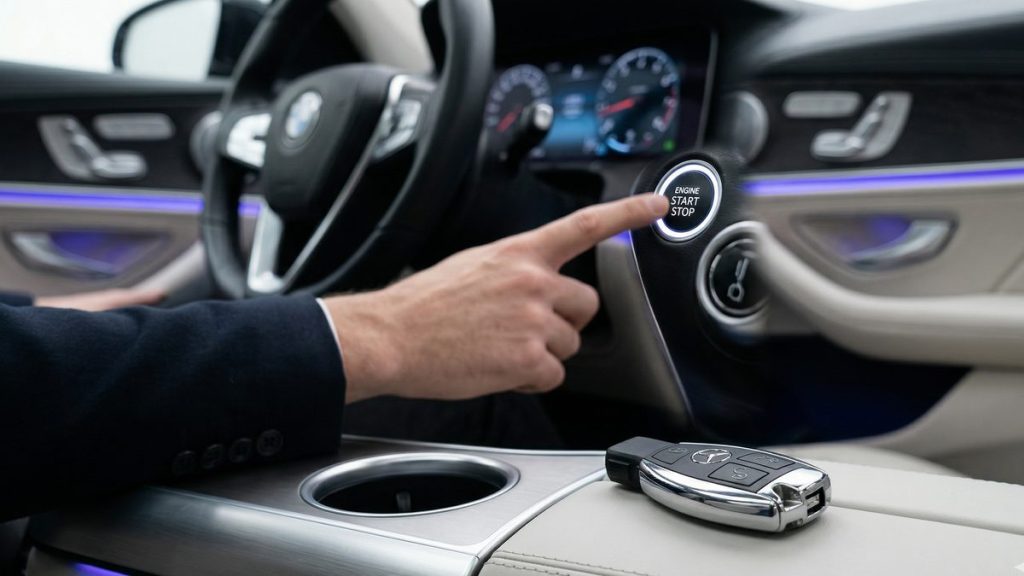
You press the brake, hit the start button, and nothing happens. The dashboard stays dark or flashes a “key not detected” warning. In Tempe, this scenario plays out more often than most drivers expect — especially between May and October when surface temperatures inside parked vehicles regularly exceed 150°F. That kind of heat doesn’t just make your steering wheel untouchable. It warps the plastic housing around delicate electronic components that your fob depends on to communicate with your car.
The push-to-start system relies on a low-frequency signal exchange between your key fob and a receiver antenna built into the steering column or center console. When the fob’s internal transmitter weakens — whether from a dying battery, cracked solder joints, or UV-degraded circuitry — the vehicle can’t authenticate the signal and refuses to start. The problem isn’t always the fob itself, either. The vehicle’s antenna module, the immobilizer ECU, or even a drained car battery can mimic the same symptoms.
The right approach starts with professional diagnosis. A certified locksmith uses frequency-testing equipment to measure whether the fob is transmitting at all, then narrows down the cause to the fob, the vehicle’s receiver, or the programming link between them. That process avoids the common mistake of buying a new fob online only to discover the real issue was somewhere else entirely.
CallOrange.com has been diagnosing and programming push-to-start key fobs in Tempe since 2015. With 4.8 stars across 1,451 Google reviews and mobile technicians who come to your location, the diagnostic and repair process happens wherever your vehicle is parked — your driveway, an office lot in Downtown Tempe, or the ASU campus parking structure off University Drive.
| Symptom | Likely Cause | What a Pro Checks |
|---|---|---|
| Fob works only at very close range | Weak battery or partially cracked antenna trace on PCB | Frequency analyzer measures signal strength at multiple distances |
| No response from any fob button | Dead battery, fried transmitter chip, or broken solder joint | Opens fob housing, inspects PCB for burn marks and tests battery voltage |
| Lock/unlock works but car won’t start | Immobilizer rolling-code desynchronization | Connects OBD-II diagnostic tool to check ECU-to-fob code alignment |
| Fob works intermittently in hot weather | Thermal solder fatigue on transmitter circuit | Inspects solder joints under magnification for micro-cracks |
| One button works, others don’t | Degraded rubber membrane under specific button | Removes button pad, checks conductive coating for wear or UV damage |
| Dashboard shows “key not detected” | Vehicle receiver antenna failure or weak 12V battery | Tests receiver antenna response with known-good fob; checks vehicle battery voltage |
Why Push-to-Start Fobs Fail in the Phoenix Metro Area
Arizona’s Sonoran Desert climate creates conditions that accelerate electronic component failure in ways that drivers in milder states rarely experience. Understanding what actually breaks inside your fob helps you make smarter decisions about repair versus replacement.
Thermal cycling is the primary culprit. When you park your car at Tempe Marketplace or along Mill Avenue during a July afternoon, the cabin temperature can spike past 160°F within 20 minutes. The fob sitting in your cupholder or center console absorbs that heat directly. Over weeks and months, the repeated cycle of extreme heat during the day and air-conditioned cool at night causes the solder joints on the fob’s printed circuit board to expand, contract, and eventually crack. Once a solder joint fractures, the signal transmission becomes intermittent — the fob works sometimes and fails other times with no obvious pattern.
UV radiation degrades the rubber button membranes that seal the fob’s internal contacts. When those membranes harden and shrink, pressing the lock or unlock button no longer makes reliable contact with the circuit board underneath. You might notice that you have to press harder than you used to, or press multiple times before the car responds. That’s a textbook sign of membrane deterioration, and it’s far more common in Arizona than in northern climates.
The coin-cell battery inside a standard key fob — usually a CR2025 or CR2032 — has a rated shelf life of about five years under normal conditions. Arizona heat cuts that lifespan roughly in half. The chemical reaction inside lithium cells accelerates at higher temperatures, which means a fob battery that would last four years in Seattle might drain in under two years here in the Valley.
Fine desert particulate also works its way into the fob casing through button gaps and seam lines. This dust is abrasive at a microscopic level. It settles on the battery contacts and the PCB traces, creating a resistive layer that weakens the signal output even when the battery is technically still charged.
The Emergency Backup: Starting Your Car with a Dead Fob
Most drivers don’t realize that every push-to-start vehicle has a built-in backup method for when the fob battery dies. This doesn’t fix the underlying problem, but it gets you moving while you arrange professional service.
Hold the dead fob directly against the start button. On most Toyota, Honda, Nissan, Hyundai, and Kia models, the start button contains a secondary antenna coil that can read the fob’s passive RFID chip at near-zero range — even with a completely dead battery. Press the brake pedal, hold the fob flat against the button, and press start. The car should recognize the chip and fire the engine.
On some vehicles — particularly certain Ford, Mazda, and Subaru models — the backup antenna is located in the center console, the steering column, or a marked spot on the dashboard. Check your owner’s manual for the exact location. A few important things to keep in mind:
- This backup method only works if the fob’s RFID chip is intact — heat damage to the chip itself will prevent even close-range detection
- The method does not restore remote lock, unlock, or trunk functions — those require active battery power
- If the vehicle’s own 12V battery is also weak, the passive read may fail because the antenna coil needs vehicle power to operate
- Starting the car this way is a temporary solution, not a permanent fix — the fob still needs diagnosis and repair
- Some luxury vehicles like BMW, Mercedes, and Lexus have a physical emergency key blade hidden inside the fob that unlocks the driver’s door manually
If the backup start fails entirely, the problem likely goes beyond just a dead fob battery. That’s when professional automotive locksmith diagnosis becomes necessary to identify whether the fob, the vehicle’s receiver, or the immobilizer module needs attention.
What a Locksmith Actually Tests During Fob Diagnosis
When a mobile locksmith arrives to diagnose your push-to-start issue, the process follows a structured sequence that eliminates possibilities one at a time. Understanding this sequence helps you know what to expect and why the diagnosis matters before jumping straight to a replacement.
Step one is verifying the fob’s output signal. The technician uses a frequency analyzer to check whether the fob is broadcasting on the correct frequency — typically 315 MHz for North American vehicles or 433 MHz for some European models. If there’s no signal at all, the issue is internal to the fob. If the signal is present but weak, the battery contacts or antenna trace may be corroded.
Step two isolates the vehicle’s receiver. Even if the fob is transmitting correctly, the car won’t start if the receiver antenna module isn’t picking up the signal. The technician tests the antenna by attempting communication with a known-good fob or diagnostic tool. Receiver failures are less common than fob failures, but they do happen — especially in vehicles that have been in accidents where the steering column or dashboard took impact.
Step three checks the immobilizer handshake. Modern push-to-start systems use rolling-code encryption between the fob and the vehicle’s ECU. Each time you start the car, the code changes. If the synchronization between fob and ECU falls out of alignment — which can happen after a battery replacement, a jump start, or prolonged disconnection — the system locks out the fob even though the hardware is fine. A locksmith’s diagnostic programming equipment can resynchronize the codes and restore normal operation.
The vehicle’s 12V battery also plays a role. A weak car battery reduces the power available to the receiver antenna and the immobilizer module. In Tempe’s heat, car batteries degrade faster than the national average. If the vehicle cranks slowly or the interior lights dim when you press start, the 12V battery should be tested before assuming the fob is at fault.
Common Fob Symptoms and What They Actually Mean
Not every fob problem means you need a full replacement. Some symptoms point to simple fixes, while others indicate more serious component failure. Here’s what the most common warning signs actually tell a trained technician:
Intermittent response — the fob works from three feet away but not from ten — usually means a weak battery or corroded contacts. The fob is still transmitting, just not with enough power to reach the vehicle’s antenna at normal range. Battery replacement and contact cleaning resolve this about 80% of the time.
No response at all from any button could mean a dead battery, a fried circuit board, or a broken solder joint on the transmitter chip. If pressing the fob against the start button still starts the car, the passive RFID chip is intact and the issue is limited to the active transmitter circuit. If even the backup start fails, the chip itself may be heat-damaged.
Buttons work for lock/unlock but the car won’t start points to a problem with the immobilizer authentication rather than the fob’s radio transmitter. The fob is communicating, but the rolling code exchange is failing. This often happens after a car battery replacement or when someone attempts to program a third-party fob without proper equipment.
One button works but others don’t is almost always a membrane issue. The rubber pad under that specific button has hardened, torn, or lost its conductive coating. In Arizona, UV and heat cause uneven degradation across buttons depending on which side of the fob faces upward in sun-exposed storage.
The fob works only when very close to the car suggests the fob’s internal antenna trace has a partial break. The antenna is a thin copper trace printed on the PCB. Thermal expansion can crack it partially, reducing transmission range dramatically without killing the signal completely.
Market Pricing for Fob Diagnosis and Replacement in 2026
Push-to-start fob service costs vary significantly depending on whether you need a simple battery swap, a circuit repair, or a complete fob replacement with programming. Here’s what the Tempe and Phoenix metro market looks like for the most common scenarios.
A basic fob battery replacement is straightforward and inexpensive. The battery itself costs a few dollars, and most locksmiths include the replacement as part of a diagnostic visit. If the battery is the only issue, you’re looking at the lowest end of the service range.
Fob reprogramming — resynchronizing the rolling codes between a working fob and the vehicle — typically falls in the mid-range. This service requires professional diagnostic equipment that connects to the vehicle’s OBD-II port and communicates directly with the immobilizer ECU. The equipment investment is one reason this isn’t a DIY job.
Complete fob replacement and programming is the most involved service. It includes sourcing a compatible blank fob for your specific make, model, and year, cutting the emergency key blade if applicable, programming the fob’s transponder chip to the vehicle’s immobilizer, and syncing the remote functions. Luxury and European vehicles cost more because their encryption systems require manufacturer-level software access.
A few factors that affect final pricing in this market:
- Vehicle make and year — a 2024 Toyota Camry fob costs less than a 2024 BMW X5 fob
- OEM versus aftermarket fob blanks — OEM parts carry higher cost but guaranteed compatibility
- Number of fobs being programmed — programming two fobs at the same time costs less per unit than programming one
- Time of service — evening and weekend calls may carry different rates depending on the provider
- Mobile service — having a technician come to your location is standard for locksmith services in Tempe but some providers charge differently
Dealership pricing for fob replacement and programming typically runs two to three times higher than what a certified mobile locksmith charges for the same service. The dealership uses the same diagnostic process, but their overhead structure — facility costs, parts markup, scheduling delays — inflates the final bill. Many Tempe drivers discover this after calling the dealer first, then searching for a local alternative.
Which Vehicles Need Special Attention in Arizona
Certain vehicle brands and their push-to-start systems are more vulnerable to heat-related fob failures than others. If you drive one of these vehicles in Tempe or anywhere in the Valley, proactive fob maintenance can save you from an unexpected no-start situation.
Nissan Intelligent Key fobs are among the most common failure cases in Arizona. The plastic housing uses a thin seam that allows fine dust infiltration, and the PCB layout places the battery contacts close to the antenna trace — meaning corrosion from a leaking battery can disable both the active transmitter and the passive chip simultaneously.
Hyundai and Kia Smart Key fobs from 2018 to 2023 use a compact design that traps heat inside the housing. The solder joints on the transmitter module in these fobs are known to fatigue faster in extreme-heat climates. If your Hyundai or Kia fob starts working intermittently during summer months, thermal solder fatigue is the most likely explanation.
Toyota and Lexus Smart Key systems are generally more heat-resilient, but the rubber button membranes degrade at the same rate as other brands. Toyota fobs also use a unique encryption protocol that requires Toyota-specific software for key programming — generic tools won’t complete the pairing process.
Ford and Lincoln push-to-start fobs use a two-piece housing design that’s easier to open for battery replacement but also more susceptible to dust and moisture entry. The positive trade-off is that battery replacement is simpler, which means routine maintenance is less of a barrier.
European brands — BMW, Mercedes-Benz, Audi, and Volkswagen — use the most complex encryption and the most expensive fob hardware. Replacement fobs for these vehicles require dealer-level or advanced aftermarket programming equipment and carry higher parts costs. Having a spare fob programmed before your primary fails is especially worthwhile for these vehicles.
When to Replace Versus When to Repair
The decision between repairing your existing fob and replacing it entirely comes down to the type of failure and the cost comparison. Not every dead fob needs to be thrown away.
Repair makes sense when the fob housing is intact, the PCB shows no visible burn marks or cracked traces, and the issue traces back to a dead battery, dirty contacts, or a worn button membrane. A technician can replace the battery, clean the contacts with electronic-grade solvent, and replace the button pad for a fraction of the cost of a new fob. This is the right call for fobs that are less than five years old with a single point of failure.
Replacement is the better path when the PCB has visible damage — scorched components, multiple cracked solder joints, or a corroded antenna trace. At that point, repairing individual connections becomes unreliable because adjacent components are likely to fail soon after. It’s also the better option when the fob housing itself is cracked open, since a compromised seal means dust and moisture will continue to degrade the internals even after repair.
Programming is required in both cases whenever the immobilizer codes need to be re-synced. Whether you’re restoring a repaired fob or pairing a brand-new one, the vehicle’s ECU needs to recognize and authorize the fob before the push-to-start system works. This is the step that requires professional equipment and training — it’s not something a YouTube tutorial and an Amazon tool can handle reliably.
CallOrange.com technicians carry both repair supplies and blank fob inventory on every mobile service call. That means the diagnosis, the decision, and the fix all happen in a single visit at your location in Tempe, Mesa, Scottsdale, Chandler, or anywhere in the Phoenix metro area.
Keep Your Fob Working Longer in Arizona Heat
Preventive care extends the life of your push-to-start fob and reduces the chance of being stranded with a no-start condition. These maintenance steps are simple but make a measurable difference in a desert climate.
Replace the fob battery every 12 to 18 months instead of waiting for it to die. In Arizona, the standard battery lifecycle is significantly shorter than the manufacturer’s estimate. A proactive swap costs very little and eliminates the most common cause of fob failure.
Store your spare fob indoors, not in the car. Many drivers keep a backup fob in the glovebox or center console. In Tempe’s summer heat, that spare is absorbing the same thermal punishment as the primary fob. Keep it inside your home or office where temperatures stay controlled.
Avoid placing your fob near magnetic sources like phone mounts, tablet cases, or magnetic purse clasps. Strong magnetic fields can interfere with the fob’s internal antenna and gradually demagnetize components that affect signal strength.
Clean the battery contacts annually. Open the fob housing — most use a small flathead slot or a release button — and gently clean the battery contact points with a dry cotton swab. If you see green or white residue, that’s corrosion from the battery. Replace the battery and clean the contacts with isopropyl alcohol before reassembling.
Use a protective silicone case if your fob rides in a pocket with keys, coins, or other metal objects. Physical impact and scratching can compromise the housing seal over time, accelerating dust infiltration.
Frequently Asked Questions
Why did my push-to-start fob suddenly stop working?
The most common cause is a depleted coin-cell battery, especially in the Phoenix metro area where summer heat drains lithium batteries faster than in cooler climates. Other causes include corroded battery contacts, cracked solder joints from thermal cycling, or a desynchronized immobilizer code. A diagnostic test identifies the exact point of failure before any parts are replaced.
Can I start my car if the key fob battery is dead?
Yes. Most push-to-start vehicles have a backup method. Hold the dead fob directly against the start button while pressing the brake. The start button contains a secondary antenna that reads the fob’s passive RFID chip at close range, even with no battery power. Check your owner’s manual for the exact location of the backup reader on your vehicle.
How often should I replace the fob battery in Arizona?
Every 12 to 18 months in the Tempe and Phoenix area. The manufacturer’s estimate of three to five years assumes moderate climates. Arizona’s sustained heat above 110°F accelerates the chemical drain inside lithium coin cells significantly, so proactive replacement before symptoms appear is the safest approach.
Can a locksmith program a new fob or only the dealership?
A certified automotive locksmith with professional programming equipment can program fobs for virtually all major vehicle brands, including Toyota, Honda, Nissan, Hyundai, Ford, Chevrolet, BMW, and Mercedes-Benz. The process uses the same OBD-II diagnostic interface as the dealership. Mobile locksmiths bring the equipment to your location, which eliminates the need to tow the vehicle.
Do I need my vehicle registration for fob replacement?
Yes. Any reputable locksmith requires your current vehicle registration and a valid government-issued photo ID before performing key fob programming or replacement. This is a security measure that protects vehicle owners from unauthorized key duplication and is standard practice across the locksmith industry.
Is it cheaper to buy a fob online and have it programmed?
Sometimes, but it carries risk. Aftermarket fobs from Amazon or eBay may not be compatible with your specific vehicle year and trim, and some lack the correct encryption chip for programming. If the fob doesn’t match, you’ll pay for a service visit with no result. A locksmith who supplies the fob guarantees compatibility and typically includes programming in the price.
How long does fob programming take on-site?
Most standard fob programming takes 20 to 45 minutes once the technician arrives. Luxury and European vehicles with more complex encryption may take up to 60 minutes. The process includes diagnosis, pairing the fob to the vehicle’s immobilizer ECU, and testing all remote functions before the technician leaves.
Getting Your Fob Diagnosed and Fixed in Tempe
A push-to-start fob that stops working doesn’t always mean you need a new one. In many cases, a battery replacement, contact cleaning, or code resynchronization restores full function at a fraction of the cost of a replacement. The key is accurate diagnosis before spending money on parts you might not need.
CallOrange.com has served the Tempe and Phoenix metro area since 2015, with 1,451 Google reviews and a 4.8-star rating built on transparent pricing and mobile service that comes to you. Every technician carries diagnostic equipment, replacement batteries, fob blanks, and programming tools — so the entire process from diagnosis to fix happens in a single visit. Insured, certified, and experienced with every major vehicle brand on the road today.
Call (480) 847-2635 to schedule a diagnostic visit at your location. Bring your vehicle registration and a valid photo ID — both are required before any key fob programming or replacement service. You can also reach out through the contact page to describe your fob issue and get a preliminary estimate. Learn more about the team and service history on the about us page.