Broken Key in Ignition or Lock? Step-by-Step Extraction Guide
When a key snaps inside a lock or ignition, the break point is almost never random — metal fatigue builds along the blade’s worn cuts until a single turn causes failure. Extraction requires removing the broken piece without displacing the lock pins or damaging the cylinder housing. In Tempe’s extreme summer heat, metal expands and door frames shift, making an already stressed key blade even more vulnerable. A certified locksmith extracts the fragment, diagnoses whether the lock or ignition cylinder sustained damage, and gets you back in your vehicle or home without replacing the entire hardware unit.
A broken key inside a lock is one of the more disorienting situations a property owner or driver can face. You can see part of the key, but you cannot grab it. Pulling at the exposed fragment usually makes things worse — it drives the piece deeper into the keyway or causes the cylinder pins to drop on top of the fragment, locking it in place.
In Tempe and the East Valley, this problem is more common than it sounds. Arizona’s 110°F+ summers accelerate metal fatigue on key blades, particularly on older keys that have been copied multiple times. Each generation of duplication introduces minor bitting tolerance errors. Over hundreds of uses, those tiny errors create stress points along the cuts. When the blade finally gives, the break almost always happens inside the cylinder — exactly where you cannot reach it.
Broken key extraction is a service CallOrange Locksmith Tempe has handled since 2008. You can find us on Google Maps — we serve Tempe and the surrounding East Valley. The process differs depending on whether the key broke in a residential door lock, a commercial deadbolt, or a car ignition — and the approach a technician takes depends on the cylinder type, the break location, and whether the lock sustained additional damage from the break. Understanding the process helps you avoid the DIY attempts that most commonly cause expensive secondary damage.
Why Keys Break Inside Locks and Ignitions
Key breakage is a mechanical failure, not bad luck. Several compounding factors lead to it.
Metal fatigue from repeated stress cycles is the primary cause. Every time a key is turned, the blade flexes slightly under torque. Over time — and the timeline shortens significantly with cheap key blanks or rough cuts — micro-fractures develop along the highest-stress points in the blade. In a pin tumbler lock, that stress concentrates at the deepest cuts in the bitting pattern, where metal is thinnest.
Heat-related expansion plays a significant role in Arizona. When lock cylinders heat up in direct sun — in Tempe, a car door lock or a deadbolt on a south-facing door can reach 150°F+ in summer — the internal components expand. The clearances between the key blade and the pin stack tighten. Inserting a worn key into a heat-expanded cylinder requires slightly more torque, which is often the final straw for a fatigued blade.
Duplicate-of-duplicate cutting errors are an underappreciated cause. Each time a key is re-cut from a copy rather than from the original, the bitting tolerances drift slightly. By the third or fourth generation, some cuts may be off by 0.003–0.006 inches — enough to bind on specific pins in the cylinder and require extra turning force. If you’ve been experiencing ignition problems — stiffness, wobble, or a key that sticks on the way out — those are warning signs that your key or cylinder is near failure.
Ignition cylinders present a specific problem because the blade must be fully inserted and turned to engage the ignition wafer stack. If the key was already worn at the tip or shoulder, the extra resistance from ignition wafers creates a break point well inside the cylinder housing — sometimes past the depth a standard extraction tool can reach without disassembly.
What Happens During Professional Broken Key Extraction
The extraction process varies by lock type, but the professional approach follows the same core sequence: release the cylinder tension, position the extraction tool alongside the fragment, hook the key’s shoulder or blade notch, and draw it out parallel to the keyway.
For door locks (residential and commercial), a locksmith uses a set of key extractor picks — thin, hook-tipped tools sized to fit alongside a broken blade in a standard keyway. The goal is zero additional torque on the cylinder. The technician positions the hook behind a cut or along the blade edge and draws the fragment out in a smooth, controlled motion. In most cases this takes two to four minutes for an accessible lock in good condition.
For automotive ignitions, the process is more technical. Car ignition cylinders have a narrower keyway and a deeper barrel than most door locks, and the ignition wafer stack creates additional resistance. If the key broke past the first set of wafers, a direct extraction approach may not reach the fragment. In those cases, the technician may need to remove the ignition cylinder — a process that requires knowledge of the steering column assembly specific to your vehicle’s make and model — extract the fragment under controlled conditions, and reinstall the cylinder. This is a more involved service than a door lock extraction, and it is worth having your ignition inspected for additional wear at the same appointment.
Commercial deadbolts and high-security cylinders add another layer of complexity. Mul-T-Lock, Medeco, and ASSA Abloy cylinders have tighter internal tolerances. The extraction tools must be sized correctly for the specific keyway profile — a tool sized for a Kwikset keyway will not fit cleanly in a Medeco keyway. A locksmith with commercial hardware experience carries the correct extraction tools for the lock brands they service, rather than forcing a generic tool into a precision cylinder and risking pin damage. You can learn more about our commercial locksmith services and the hardware we work with.
Quick Diagnosis: Broken Key Symptoms and What They Mean
Before a technician begins extraction, they assess the fragment’s position, the cylinder’s condition, and whether any secondary damage occurred during the break. The table below covers the most common symptoms our locksmiths evaluate on arrival.
| Symptom | Likely Cause | What a Pro Checks |
|---|---|---|
| Key snapped, fragment fully inside | Metal fatigue at blade cut under torque | Keyway depth, fragment position, cylinder pin condition |
| Small piece visible at keyway opening | Shallow break near key shoulder | Extractability without cylinder removal; hook positioning |
| Key broke and lock won’t turn at all | Fragment lodged under cylinder pins | Pin stack alignment, whether pins dropped on fragment |
| Ignition key broke at tip during start | Tip wear + ignition wafer resistance | Wafer stack condition, fragment depth in barrel, cylinder removal need |
| Fragment removed but lock still feels stiff | Cylinder wear or bent cam tail piece | Full cylinder inspection — rekey or replacement assessment |
| Multiple broken keys on the same lock | Cylinder wear, door frame misalignment, or chronic key duplication errors | Door frame alignment, cylinder condition, original key code verification |
| Key broke after battery change on fob | Emergency key blade was worn — went unnoticed because fob was used | Emergency key blade condition, lock cylinder wear, transponder chip status |
If the cylinder shows signs of wear beyond the broken key — loose plug, damaged pin chambers, or a keyway that feels rough — the technician will advise whether a rekey or a full lock change is the right next step after extraction.
After Extraction: What Your Lock or Ignition Actually Needs
Extraction solves the immediate problem, but it does not fix what caused the break. Skipping the follow-up assessment is the most common reason a lock sees a second broken key within weeks.
Cylinder wear check. A cylinder that has been wearing unevenly — loose plug, worn keyway wiper, damaged pin chambers — will continue to stress new keys the same way. A locksmith rotates and probes the cylinder to identify wear before it causes another failure.
Rekeying vs. replacement. If the cylinder itself is in acceptable condition, rekeying your lock changes the pin configuration so you’re operating on a fresh, properly cut key. If the cylinder housing is damaged — cracked plug, deformed keyway, bent cam — a full lock change is the correct next step.
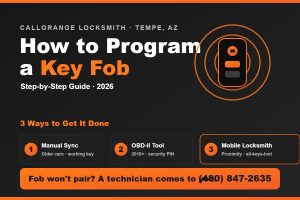
Key replacement for automotive. After a broken key is extracted from an ignition, most vehicles need a new key cut and programmed. If the original key had a transponder chip, the replacement must be programmed to match your vehicle’s immobilizer. Replacement car key services from a locksmith are significantly less expensive than the same service through a dealership, and our mobile technicians complete key programming at your location — no tow required.
If you were also locked out of the vehicle during the incident, our car unlocking service and key extraction can be handled in a single dispatch. Our automotive locksmith services in Tempe cover the full range of vehicle lock and key situations.
Broken Key Extraction in Tempe: What to Expect
Extraction pricing in the Tempe and East Valley market depends on the lock type, the fragment’s position, and the level of access work required. A door lock extraction on a standard residential deadbolt costs less than a car ignition extraction where cylinder removal is involved — and both are significantly less expensive than replacing the lock or ignition outright.
Before any work begins, the CallOrange technician assesses the fragment’s position and gives you an upfront quote. There are no teardown fees charged separately from the quoted service. We operate Monday through Sunday, 6 AM to 10 PM, serving Tempe, Mesa, Chandler, Scottsdale, Phoenix, Gilbert, and Guadalupe. The technician comes to your location — you do not need to transport a vehicle with a broken key in the ignition to a shop.
Learn more about how we work and the team behind the service on our About Us page, or go directly to our full services list.
Get Your Broken Key Out — Call CallOrange Locksmith Tempe
A broken key inside a lock or ignition does not get easier to remove the longer it sits. Continued attempts to turn or extract it without the right tools can drive the fragment deeper, damage the cylinder pins, or score the keyway walls — turning a straightforward extraction into a cylinder replacement.
CallOrange Locksmith Tempe has handled broken key extraction across the East Valley since 2008. Our certified technicians carry extraction tools for the full range of lock types common in Arizona — standard residential keyways, automotive ignition cylinders, commercial deadbolts, and high-security hardware.
Call (480) 847-2635 — tell us where you are and what type of lock is involved, and we will give you a direct quote before dispatch. You can also reach us through our contact page.
Frequently Asked Questions
How much does broken key extraction cost in Tempe?
Pricing depends on the lock type and fragment position. A residential door lock extraction is a straightforward service, while an automotive ignition extraction requiring cylinder removal involves additional labor. CallOrange provides an upfront quote before any work begins — call (480) 847-2635 for a direct estimate.
Can I remove a broken key from my ignition or lock myself?
Most DIY attempts cause additional damage — pushing the fragment deeper, scoring the keyway, or dropping pins on top of the piece. Lock cylinders are precision components with tolerances measured in thousandths of an inch. A locksmith uses sized extraction tools that fit alongside the fragment without disturbing the pin stack.
How long does broken key extraction take?
A residential door lock extraction typically takes 5–10 minutes. An automotive ignition extraction where the fragment is accessible without disassembly runs 10–20 minutes. If the ignition cylinder requires removal, expect 30–45 minutes depending on the vehicle’s make and steering column access.
Will extraction damage my lock or ignition?
Done correctly with the right tools, extraction leaves the cylinder in the same condition as before the break. If the cylinder was already worn — loose plug, damaged pins, cracked housing — the technician will identify that during the assessment and advise whether rekeying or a full lock change is the right next step.
Do I need a new key after the broken piece is removed?
Yes, in all cases. The broken key cannot be rejoined, and operating a lock or ignition with the original broken piece is not safe. For door locks, a new key cut from the existing cylinder code is the most economical solution. For automotive ignitions, a replacement transponder key must be cut and programmed to your vehicle.
What if my car key broke in the ignition and the car won’t start?
Do not attempt to start the vehicle. Torque on a partially lodged fragment can drive it past the wafer stack, making extraction significantly more complex. Call a locksmith before operating the vehicle. CallOrange dispatches to your location across the East Valley — call (480) 847-2635.
The Bottom Line on Broken Key Extraction in Tempe
A key that breaks inside a lock or ignition is a mechanical failure with a mechanical solution — but only when approached with the right tools and technique. Every DIY attempt without a proper extractor risks driving the fragment deeper, collapsing the pin stack on top of it, or scoring the keyway walls. What starts as a simple extraction can turn into a full cylinder replacement if handled incorrectly.
The moment a key breaks inside your lock or ignition, stop turning. Don’t insert another key, don’t use pliers on the exposed piece, and don’t try to start the vehicle. Call a locksmith who carries the correct sized extraction tools for your specific lock type — whether that’s a standard residential deadbolt, an automotive ignition cylinder, or a high-security commercial lock.
CallOrange Locksmith Tempe has handled this exact situation across Tempe, Mesa, Chandler, Scottsdale, Phoenix, Gilbert, and Guadalupe since 2008. Our mobile technicians come to you with the equipment to extract the fragment, assess the cylinder, and get you a replacement key on the spot when needed. Call (480) 847-2635 or visit our contact page — we give you a direct quote before any work begins.